
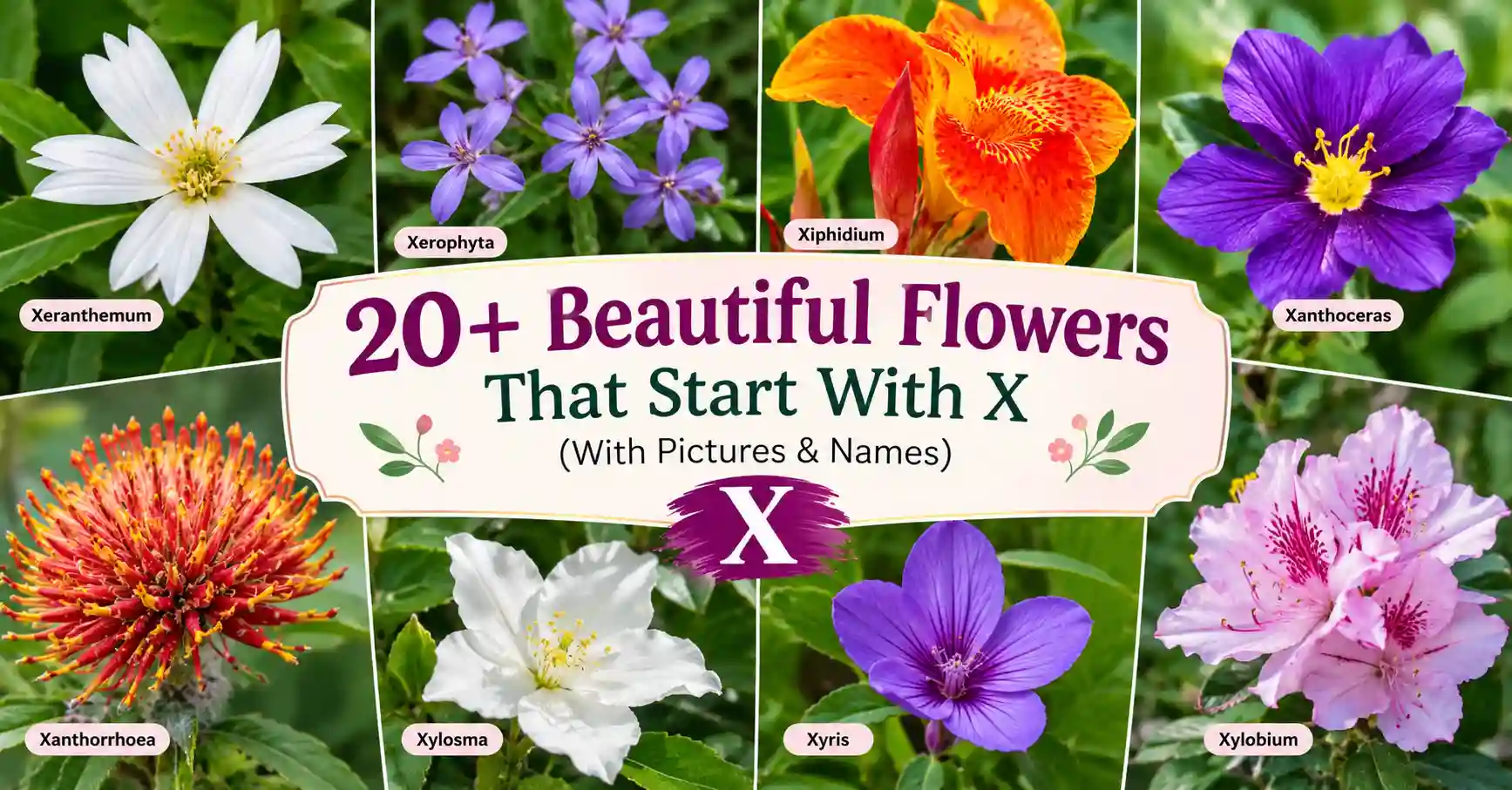
Flowers that start with X are rare, and almost every one of them is known by a Greek-based botanical name. Xerochrysum, xeranthemum, xanthorrhoea, and xerophyllum are the names you will meet most often. But this short list holds real treasures, like a grass tree that blooms after fire, a papery daisy that lasts for years, and a plant that comes back to life after drought. This guide gathers 25 of them in one place.
Why so few? In English, very few common names start with X. The letter shows up almost only in Greek-rooted Latin names. Xero means dry, and xantho means yellow. That is why many of these plants love dry soil or bloom in gold. Every plant below is real and has a verified botanical name. Two entries are grown mainly for leaves or ground cover, and each one is clearly marked as an exception.
A short list still needs to be useful. So this guide sorts the plants by color, life cycle, and use. A bloom’s beauty means little if it dies in your climate. It means even less if it harms a child or a pet. Each table is explained in plain words first, so you never face a bare spreadsheet.
Many of these plants come from Australia, South Africa, and the dry American West, so they suit hot, sunny gardens. Read straight through or jump to what you need. Want a quick pick? Try the decision table near the end.
Quick Answer: Ten Standout X Flowers
Strawflower (Xerochrysum bracteatum) is the easy star, a sunny annual with papery blooms that keep their color when dried. Xeranthemum, called immortelle, is its Mediterranean cousin, with pink and purple papery daisies. Xanthorrhoea, the grass tree, is the dramatic Australian icon, with a tall cream spike that rises from a slow-growing trunk.
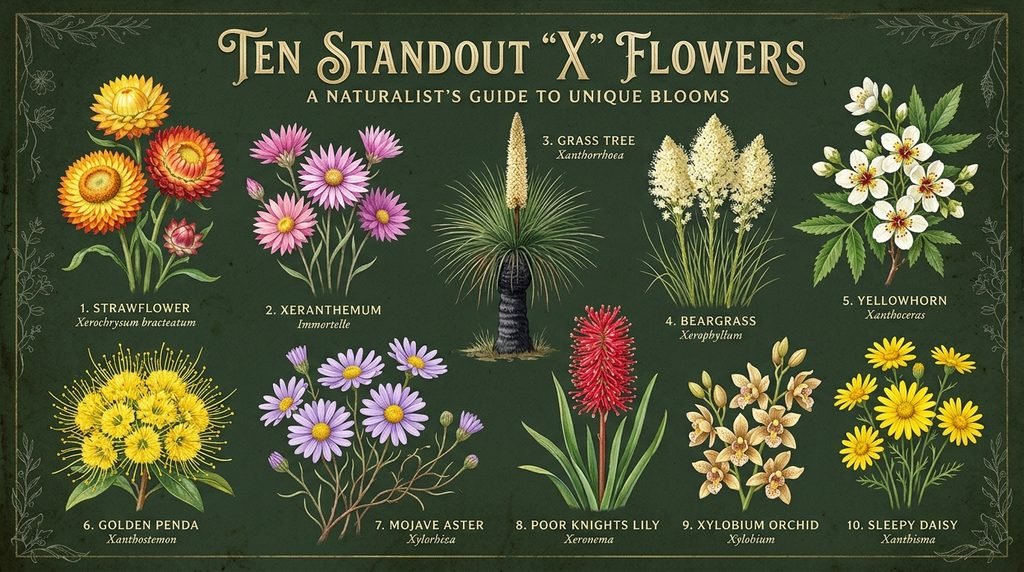
Xerophyllum, or beargrass, sends up creamy plumes in mountain meadows. Xanthoceras, or yellowhorn, is the small tree with white spring flowers. Xanthostemon, the golden penda, covers a tropical tree in golden pom-poms. Xylorhiza, the Mojave aster, brings lavender daisies to desert gardens, and Xeronema, the Poor Knights lily, is the rare red bottlebrush of New Zealand.
Read More: Flowers That Start With W: 90+ Names, Meanings & Beautiful Photos
Master Alphabetical List of Flowers That Start With X
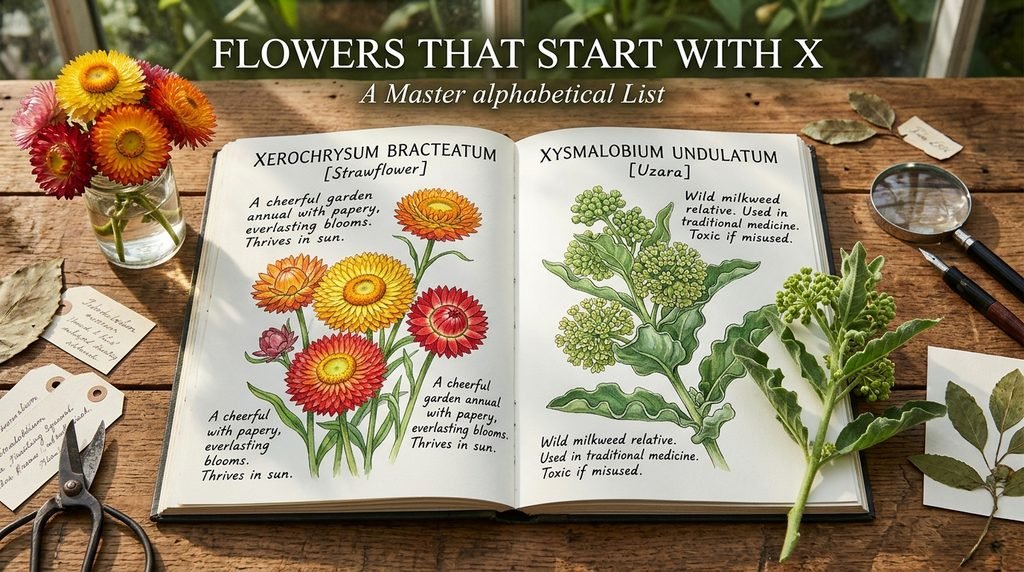
This list names 25 flowers. Unlike most letters, almost every entry here is listed by its botanical genus first, because few X plants have a settled English name. The common name appears in brackets where one exists. Each row has a short note, so you can see at a glance what the plant looks like and where it grows best. Two entries are marked as exceptions because the flower is not the main reason people grow them.
| Flower | Botanical Name | Note |
| Xanthisma (Lacy Tansyaster) | Xanthisma spinulosum | Yellow daisies on a western North American native |
| Xanthisma (Slender Goldenweed) | Xanthisma gracile | Small yellow daisies for dry, open ground |
| Xanthisma (Texas Sleepy Daisy) | Xanthisma texanum | Yellow daisies that close in afternoon heat |
| Xanthoceras (Yellowhorn) | Xanthoceras sorbifolium | White spring blooms with red-yellow centers on a small tree |
| Xanthorhiza (Yellowroot) (exception) | Xanthorhiza simplicissima | Grown as groundcover, tiny purple spring flowers |
| Xanthorrhoea (Austral Grass Tree) | Xanthorrhoea australis | Tall cream flower spike on a slow-growing trunk |
| Xanthorrhoea (Balga) | Xanthorrhoea preissii | Western Australian grass tree with a long white spike |
| Xanthorrhoea (Grass Tree) | Xanthorrhoea glauca | Dense creamy spikes, often flowering after fire |
| Xanthosoma (Elephant Ear) (exception) | Xanthosoma sagittifolium | Grown for leaves and tubers, pale spathes |
| Xanthostemon (Golden Penda) | Xanthostemon chrysanthus | Golden pompom flowers on a tropical tree |
| Xeranthemum (Immortelle) | Xeranthemum annuum | Papery pink and purple daisies, popular for drying |
| Xeranthemum (Paper Daisy) | Xeranthemum cylindraceum | Papery daisies in pink and white |
| Xerochrysum (Alpine Everlasting) | Xerochrysum subundulatum | Golden papery bracts on an alpine plant |
| Xerochrysum (Sticky Everlasting) | Xerochrysum viscosum | Bright yellow papery daisies on sticky stems |
| Xerochrysum (Strawflower) | Xerochrysum bracteatum | Papery blooms in gold, orange, pink, and white |
| Xeronema (Poor Knights Lily) | Xeronema callistemon | Red bottlebrush spikes on a rare New Zealand plant |
| Xerophyllum (Beargrass) | Xerophyllum tenax | Tall white flower plumes on a mountain plant |
| Xerophyllum (Eastern Turkeybeard) | Xerophyllum asphodeloides | White flower spike on a grassy eastern native |
| Xerophyta (Resurrection Plant) | Xerophyta viscosa | Purple blooms on a plant that revives after drought |
| Xylomelum (Woody Pear) | Xylomelum pyriforme | Cream flower spikes, then woody pear-shaped fruit |
| Xylorhiza (Mojave Aster) | Xylorhiza tortifolia | Lavender daisies in the American desert |
| Xylorhiza (Smooth Woody Aster) | Xylorhiza glabriuscula | Pale lavender daisies for dry badlands |
| Xyris (Twisted Yellow-Eyed Grass) | Xyris torta | Small yellow flowers on a grassy wetland plant |
| Xyris (Yellow-Eyed Grass) | Xyris ambigua | Yellow blooms that open briefly on wet soil |
| Xysmalobium (Uzara) | Xysmalobium undulatum | Greenish milkweed-like flowers, toxic if misused |
That table names 25 distinct flowers that start with X. Strawflower and Xysmalobium sit at opposite ends of the story. One is a cheerful garden annual. The other is a milkweed relative used in traditional medicine that can be toxic. Both show how much range this rare letter holds.
Explore More: 60+ Beautiful Flowers That Start With Y (With Pictures & Names)
Full Comparison Table: Sun, Water, and Bloom Time
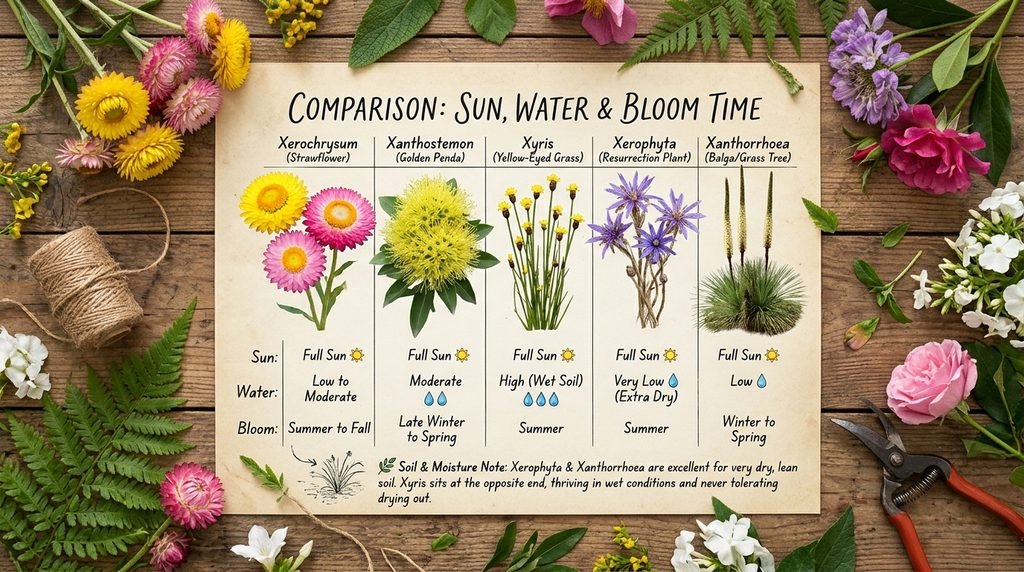
When two plants seem equally good, sun and water needs usually pick the winner. The table below compares the main X flowers from this guide. Read the sun column first. Then check the water column and the bloom season to see if the plant fits your space and your calendar. Cultivation data for some of these plants is limited, so the columns reflect typical needs in their home habitats.
| Flower | Sun Needs | Water Needs | Bloom Season |
| Xerochrysum (Strawflower) | Full sun | Low to moderate | Summer to fall |
| Xeranthemum (Immortelle) | Full sun | Low | Summer |
| Xanthoceras (Yellowhorn) | Full sun | Low to moderate | Spring |
| Xerophyllum (Beargrass) | Full sun to part shade | Moderate | Early summer, not every year |
| Xerophyllum (Eastern Turkeybeard) | Full sun to part shade | Low to moderate | Late spring to early summer |
| Xanthorrhoea (Balga) | Full sun | Low | Winter to spring, often after fire |
| Xeronema (Poor Knights Lily) | Full sun to part shade | Moderate | Late spring to summer |
| Xanthostemon (Golden Penda) | Full sun | Moderate | Late winter to spring |
| Xylorhiza (Mojave Aster) | Full sun | Low | Spring |
| Xanthisma (Texas Sleepy Daisy) | Full sun | Low | Spring to fall |
| Xanthorrhiza (Yellowroot) | Part shade | Moderate | Early spring |
| Xyris (Yellow-Eyed Grass) | Full sun | High (wet soil) | Summer |
| Xerophyta (Resurrection Plant) | Full sun | Very low | Summer |
| Xylomelum (Woody Pear) | Full sun | Low | Spring |
| Xerochrysum (Sticky Everlasting) | Full sun | Low | Spring to summer |
| Xerochrysum (Alpine Everlasting) | Full sun | Moderate | Summer |
| Xanthisma (Lacy Tansyaster) | Full sun | Low | Summer to fall |
| Xysmalobium (Uzara) | Full sun | Low | Summer |
Xerophyta and Xanthorrhoea are the best picks for very dry, lean soil. Both come from regions that go many months without rain. Xyris sits at the other end. It grows in wet soil and does not tolerate drying out.
Garden Favorites Among X Flowers
Only a few X plants are easy to find, but they are worth growing. Strawflower is the star of dry-flower gardens, since it blooms for months and keeps its color for years after drying. Xeranthemum gives the same papery charm in softer pink and purple. Xanthoceras gives a spring show on a small, tough tree. Xanthisma texanum fills dry beds with yellow daisies that close in the heat of the afternoon.
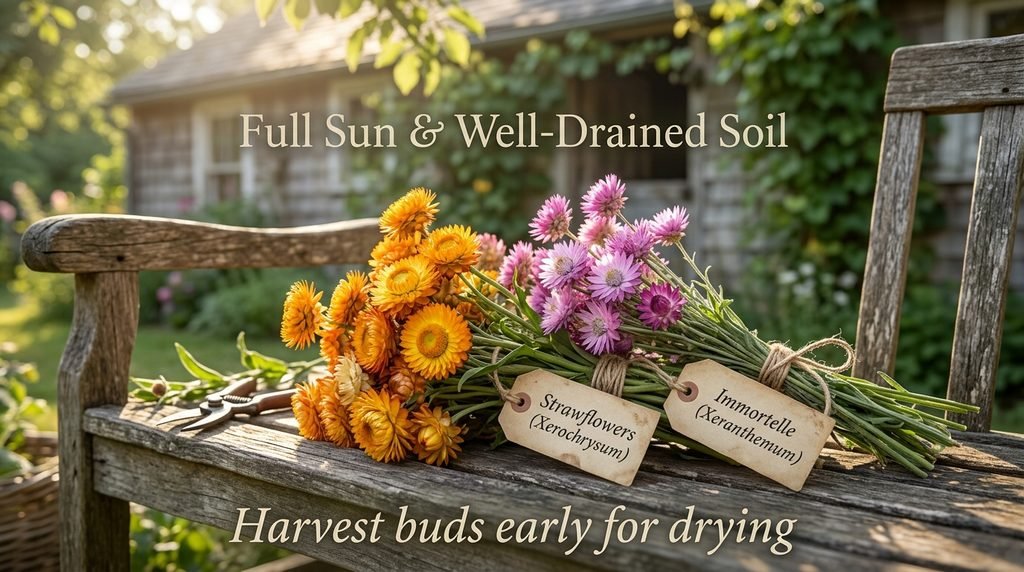
- Strawflower thrives in full sun and blooms until frost.
- Xeranthemum grows easily from seed and is perfect for drying.
- Xanthoceras (Yellowhorn) tolerates drought and cold once settled.
- Xanthisma (Texas Sleepy Daisy) blooms in poor soil and heat.
- Xerochrysum (Sticky Everlasting) gives gold papery blooms with almost no care.
Strawflower and xeranthemum make a strong pair. One brings warm golds and oranges, and the other brings cool pinks and purples. Together they make a dry-flower garden that looks good fresh and dried.
A few care habits keep these plants happy. Do not overwater strawflower, or the roots will rot. Cut strawflower and xeranthemum for drying just as the buds open, since the centers keep opening in the vase. Give xanthoceras full sun and good drainage. Sow xeranthemum and strawflower seed outdoors after the last frost.
Learn Plant Care: 50+ Beautiful Flowers That Start With V (With Pictures & Names)
Indoor and Container Picks Among X Flowers
Very few X plants grow well indoors, but a couple do well in pots. Strawflower thrives in large sunny containers on a balcony or patio. Xerophyta, the resurrection plant, can be grown in a pot by serious collectors who enjoy watching it dry out and revive. Xanthosoma, called elephant ear, is a houseplant grown for its giant leaves, and it rarely flowers indoors.
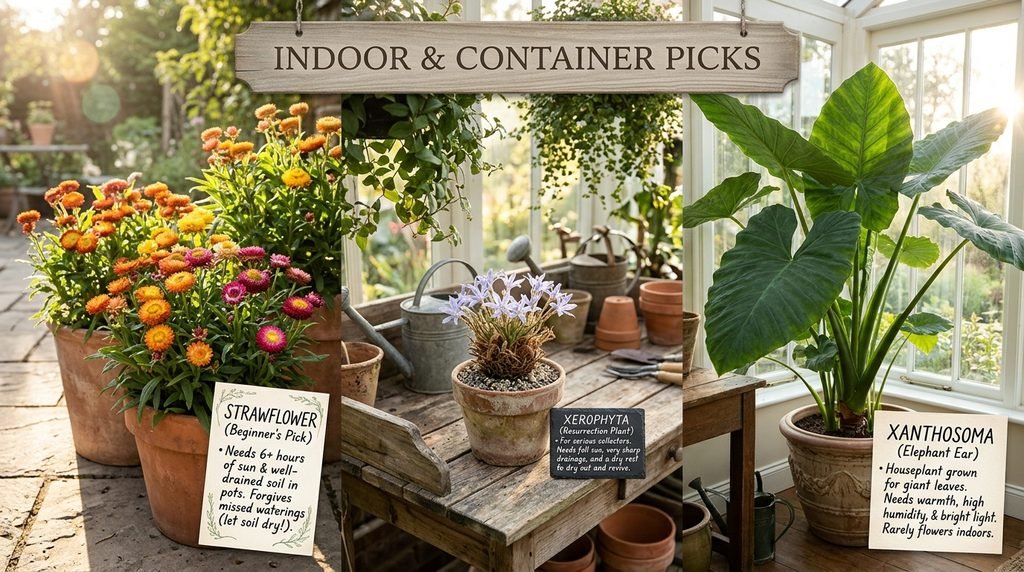
- Strawflower needs six hours of sun and well-drained soil in pots.
- Xerophyta needs full sun, very sharp drainage, and a dry rest.
- Xanthosoma (exception) wants warmth, humidity, and bright light, and is grown for its leaves.
Strawflower is the pick for beginners. It forgives missed waterings. Just make sure the pot has drain holes, and let the soil dry before you water again.
Light matters more than anything else for X plants in containers. A sunny south-facing spot suits strawflower and xerophytes. Avoid cold drafts and soggy saucers. Most of these plants fail from too much water, not too little.
Florist Favorites Among X Flowers
Florists love X flowers for one reason above all, which is that they dry beautifully. Strawflower and xeranthemum are two of the best everlasting flowers in the world. Their papery bracts keep their shape and color for years after cutting. Xerochrysum viscosum and xerochrysum subundulatum are Australian everlastings that add gold to dried wreaths. Xerophyllum and Xanthorrhoea spikes add height and drama to big modern displays.
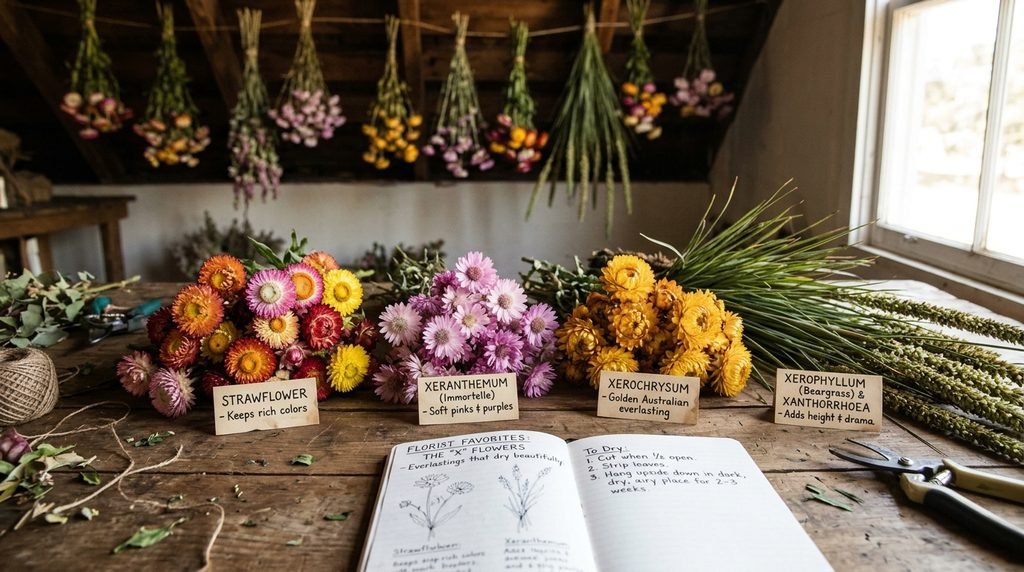
- Strawflower is the most popular dried flower, in many colors.
- Xeranthemum (Immortelle) gives soft pink and purple everlasting blooms.
- Xerochrysum (Sticky Everlasting) adds gold papery accents.
- Xerophyllum (Beargrass) has long, strong leaves used in floral design.
Strawflower and xeranthemum are the quiet workhorses. Many dried bouquets would fall flat without them. A florist’s dried-flower wall would feel empty without them.
For drying, cut the stems when the flowers are about half open. Strip the leaves. Hang small bunches upside down in a dark, dry, airy place for two to three weeks. Wire the stems if they are brittle.
Find More Ideas: Flowers That Start With Z: Names, Meanings & Beautiful Photos
Rare and Unusual X Flowers
Some X plants are hard to find or hard to grow. Xeronema callistemon, the Poor Knights lily, comes from a small group of islands off New Zealand and is rare in the wild. Xanthorrhoea, the grass tree, grows only a few centimeters a year and can live for centuries, and its tall flower spike often appears after a bushfire. Xerophyta viscosa is a resurrection plant that dries to a crisp in drought and turns green again within hours to days of rain. Xylomelum pyriforme, the woody pear, is an Australian tree with cream flower spikes and a fruit that looks like a small pear carved from wood.
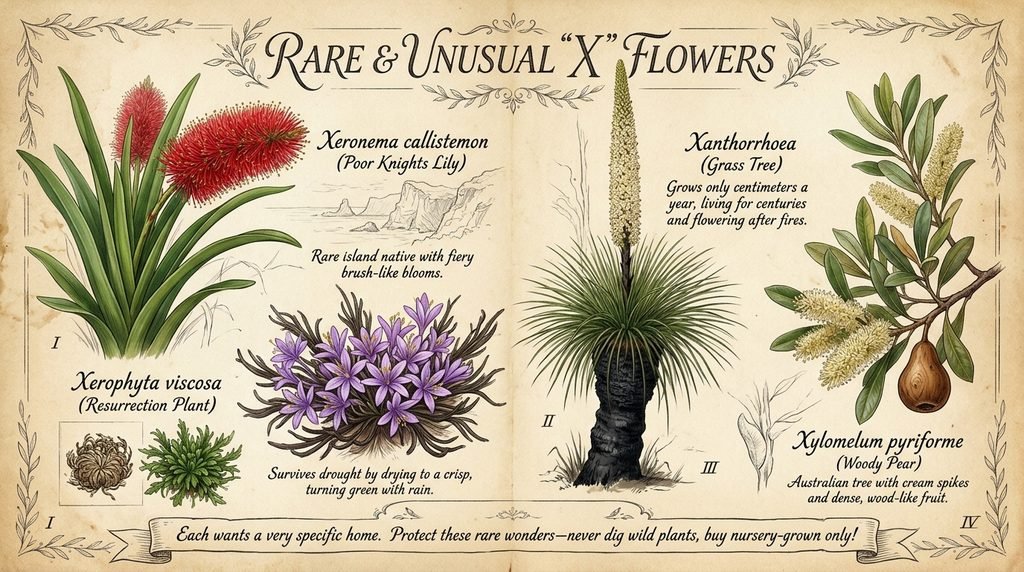
These four plants share one trait. Each wants a very specific home. That is why they stay special. If you want to grow one, buy nursery-grown plants only. Never dig wild plants, since many rare X species are protected by law.
Caution: Toxic and Unknown-Risk X Flowers
Only a few X plants have clear toxicity data, and many are poorly studied. That means you should be careful. Xysmalobium undulatum, called uzara, is a southern African milkweed relative that contains heart-affecting compounds and is used in controlled traditional medicine. It should never be eaten without expert guidance. Xanthosoma, or elephant ear, contains crystals that burn the mouth. Xanthorhiza, or yellowroot, contains berberine and has a long history of folk medicine, so it is best kept away from pets and livestock.
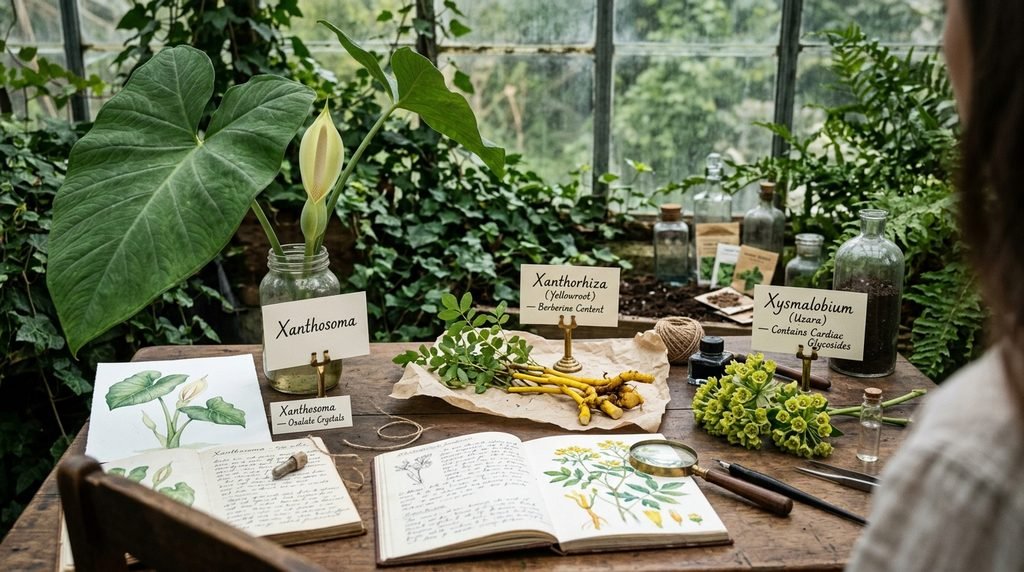
| Flower | Toxic To | Severity |
| Xysmalobium (Uzara) | Humans, dogs, cats, livestock | Moderate to severe — cardiac glycosides in all parts |
| Xanthosoma (Elephant Ear) | Dogs, cats, humans | Mild to moderate — oxalate crystals burn the mouth and throat |
| Xanthorrhiza (Yellowroot) | Livestock, pets (limited data) | Unknown to moderate — contains berberine, treat with caution |
For the other X plants in this guide, there is little published safety data for pets. Strawflower and xeranthemum are not known as dangerous, but you should still keep any plant out of reach of animals that chew. Ask your vet before planting anything new in a pet-friendly yard. If a pet or child eats any plant on this list, call a vet or poison control right away.
X Flowers Grouped by Color
Yellow and gold lead the X list, which makes sense, since xantho means yellow. Xerochrysum, xanthostemon, xanthisma, xyris, and xanthorhiza all bring gold. Xerochrysum bracteatum comes in many shades, including gold, orange, and red. Xanthostemon, or golden penda, covers a tropical tree in bright pom-poms. Xanthisma and xyris bring small yellow flowers to dry and wet soils.
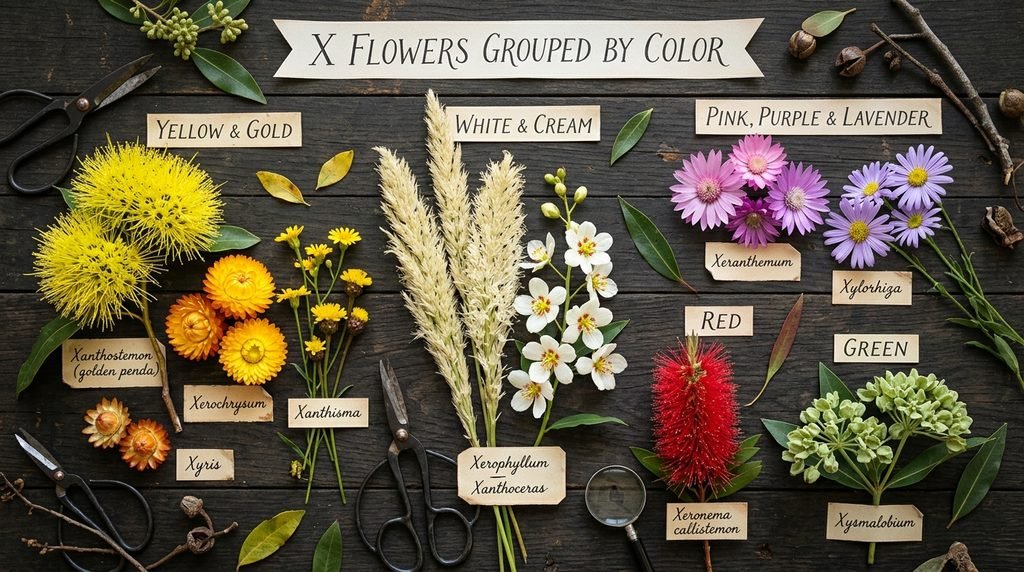
White and cream flowers include xerophyllum, xanthorrhoea, xylomelum, and xanthoceras. White and cream spikes glow in dry meadows and open landscapes. Xerophyllum tenax and xerophyllum asphodeloides send up tall creamy plumes. Xanthorrhoea and Xylomelum bring tall cream spikes to the Australian bush. Xanthoceras gives white spring blooms with red-yellow centers.
Pink, purple, and lavender come from xeranthemum, xylorhiza, and xerophyta. Xeranthemum gives papery pinks and purples. Xylorhiza gives lavender daisies on desert slopes. Xerophyta gives purple blooms on a plant that revives after drought.
Red is rare in this letter, but it is striking. Xeronema callistemon, the Poor Knights lily, sends up a bright red bottlebrush spike. It is the one true red bloom in this guide. Pair it with white or cream plants for strong contrast.
Green and subtle tones show up in Xysmalobium. Its greenish, milkweed-like flowers are quiet and unusual. They suit collectors more than flower borders.
Life-Cycle Groupings for X Flowers
A plant’s life cycle tells you how much work to expect. Annuals live one season, so you replant each year. Perennials return on their own. Shrubs, trees, and grass trees take longer to bloom but can last for decades or even centuries. Zones below are approximate, since many of these plants are not widely grown, so check any local advice before you buy.
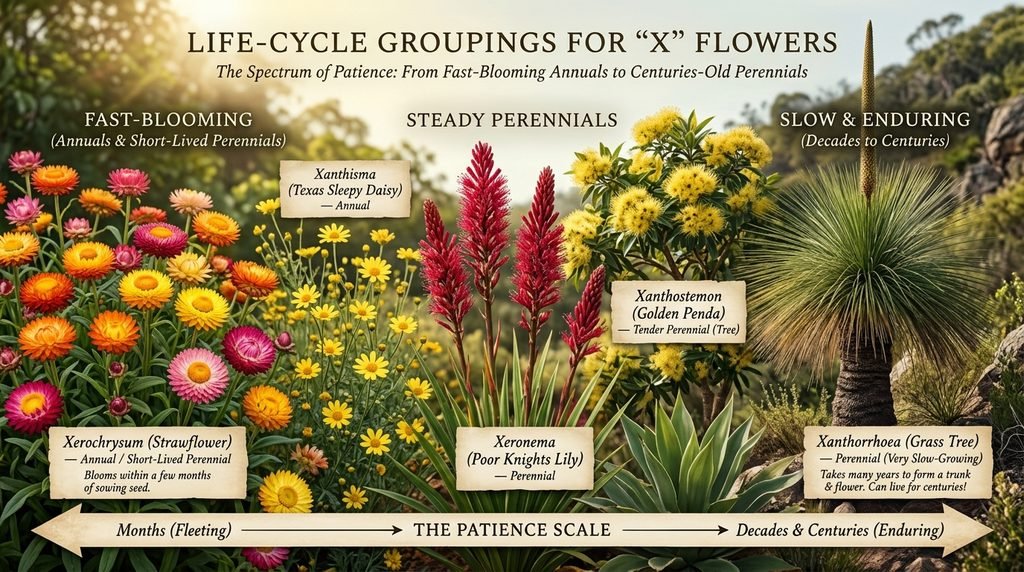
| Flower | Life Cycle | Typical Zones |
| Xerochrysum (Strawflower) | Annual or short-lived perennial | All zones (seasonal), perennial in 9–11 |
| Xeranthemum (Immortelle) | Annual | All zones (seasonal) |
| Xanthisma (Texas Sleepy Daisy) | Annual or short-lived perennial | All zones (seasonal) |
| Xerochrysum (Sticky Everlasting) | Short-lived perennial | 8–10 |
| Xerochrysum (Alpine Everlasting) | Perennial | 7–9 |
| Xylorhiza (Mojave Aster) | Perennial | 5–9 |
| Xerophyllum (Beargrass) | Perennial | 4–8 |
| Xerophyllum (Eastern Turkeybeard) | Perennial | 5–8 |
| Xanthorhiza (Yellowroot) | Perennial (shrub) | 4–9 |
| Xanthoceras (Yellowhorn) | Perennial (small tree) | 4–8 |
| Xanthorrhoea (Grass Tree) | Perennial (very slow-growing) | 9–11 |
| Xeronema (Poor Knights Lily) | Perennial | 9–11 |
| Xanthostemon (Golden Penda) | Tender perennial (tree) | 10–12 |
| Xerophyta (Resurrection Plant) | Perennial | 9–11 |
| Xyris (Yellow-Eyed Grass) | Perennial (wetland) | 5–10 |
Strawflower and xanthorrhoea sit at opposite ends of the patience scale. Strawflower blooms within a few months of sowing seed. Xanthorrhoea may take many years to form a trunk and flower, but it can live for centuries.
Botanical Name Crosswalk
For this letter, botanical names are more important than for any other. Most X plants have no common name at all, so nursery tags, seed packets, and search engines all rely on Latin. Knowing the genus lets you search with confidence. It also protects you from buying the wrong plant, since two plants can share an English nickname.

| Common Name | Botanical Name |
| Strawflower | Xerochrysum bracteatum |
| Immortelle | Xeranthemum annuum |
| Grass Tree (Balga) | Xanthorrhoea preissii |
| Beargrass | Xerophyllum tenax |
| Yellowhorn | Xanthoceras sorbifolium |
| Golden Penda | Xanthostemon chrysanthus |
| Poor Knights Lily | Xeronema callistemon |
| Mojave Aster | Xylorhiza tortifolia |
| Texas Sleepy Daisy | Xanthisma texanum |
| Yellowroot | Xanthorhiza simplicissima |
| Resurrection Plant | Xerophyta viscosa |
| Woody Pear | Xylomelum pyriforme |
| Uzara | Xysmalobium undulatum |
| Yellow-Eyed Grass | Xyris ambigua |
| Eastern Turkeybeard | Xerophyllum asphodeloides |
Strawflower shows why this matters. It was once sold as Helichrysum bracteatum, and many seed packets still use that older name. Today it is classified as Xerochrysum bracteatum. Both names point to the same plant, so check both when you shop.
What X Flowers Mean
Flower meanings are thinner for this letter, because few X plants entered old flower-language traditions. Still, a few have clear symbolism. Strawflower and xeranthemum stand for everlasting memory and lasting love. Their papery petals keep their color for years, so they have been used in remembrance wreaths and keepsakes.
Xerophyta, the resurrection plant, stands for renewal and resilience. A plant that dries out and revives with rain is a natural symbol of hope. Xanthorrhoea, the grass tree, stands for endurance. It survives fire and drought and can live for centuries. In Australia, Aboriginal peoples have long used its resin as a glue and its flower spikes as a source of nectar.
Xerophyllum tenax, beargrass, is tied to the mountains of the American Northwest. Native peoples wove its long leaves into baskets and hats, so it stands for craft and community. Xeronema callistemon, the Poor Knights lily, stands for rarity, since it grows wild on just a few small islands. Match the flower to your message, and remember that the same bloom can mean something different in another culture.
Decision Table: Which X Flower Fits Your Situation
You do not have to read the whole list to choose well. Start with your goal in the left column. The right column names the best X flower for it. Because pet-safety data is limited for most of this list, check with your vet before planting if you have animals.

| If You Want… | Choose This X Flower |
| Easy color from seed | Xerochrysum (Strawflower) or Xeranthemum (Immortelle) |
| Dried flowers that last for years | Xerochrysum, Xeranthemum, or Xerochrysum (Sticky Everlasting) |
| Dry-garden or xeriscape color | Xanthisma, Xylorhiza, or Xerochrysum |
| A dramatic native Australian plant | Xanthorrhoea or Xylomelum |
| A small flowering tree | Xanthoceras (Yellowhorn) or Xanthostemon (Golden Penda) |
| A mountain-meadow look | Xerophyllum (Beargrass) |
| A rare plant for collectors | Xeronema or Xerophyta |
| A wet-soil flower | Xyris (Yellow-Eyed Grass) |
| A plant for pots and balconies | Xerochrysum (Strawflower) |
Strawflower appears several times because it is the easiest, most versatile X flower. Xeranthemum is a good partner for it, especially in dried-flower gardens. Always double-check any plant with your vet if a pet is likely to chew it.
Conclusion
Flowers that start with X are few, but they are full of surprises, from the papery strawflower to the fire-loving grass tree. This guide sorted 25 of them by color, life cycle, and use, so you can pick with confidence. Whether you want a dried-flower garden, a dry xeriscape, or a rare collector’s plant, there is an X flower that fits. Use the tables above, read the toxicity notes, and start planting.
Frequently Asked Questions
How many flowers start with X?
More than 20 flowers start with X, and nearly all have Latin names. This guide lists 25, from easy annuals to rare Australian and African plants.
What is the most popular flower that starts with X?
Strawflower, Xerochrysum bracteatum, is the most popular. Xeranthemum, or immortelle, is also loved for dried arrangements.
Why do so few flowers start with X?
In English, very few words begin with X. Plant names with X come almost only from Greek-based Latin, such as xero for dry and xantho for yellow.
What does xero mean in plant names?
Xero means dry. Plants with xero in their names often grow in dry places or have dry, papery parts, like xerochrysum and xeranthemum.
Which X flowers are good for drying?
Strawflower, xeranthemum, and sticky everlasting are the best. Cut them when the blooms are about half open, then hang them upside down.
Are strawflowers easy to grow?
Yes. Strawflower grows well from seed in full sun and well-drained soil. It blooms for months and needs little water once settled.
What is a grass tree?
A grass tree, Xanthorrhoea, is a slow-growing Australian plant with a thick trunk, a grassy crown, and a tall flower spike. It can live for centuries and often flowers after a fire.
Is xanthosoma poisonous?
Yes, mildly. Xanthosoma, or elephant ear, contains crystals that burn the mouth and throat. Keep it away from pets and children.
Which X flowers grow in dry gardens?
Strawflower, xeranthemum, xanthisma, xylorhiza, and xerophyta all handle dry sun. Grass trees also thrive in dry, poor soil.
Can I grow xeranthemum in a pot?
Yes. Xeranthemum grows well in sunny pots with sharp drainage. Sow seed after the last frost, and do not overwater.
What is the rarest flower that starts with X?
Xeronema callistemon, the Poor Knights lily, and xerophyta, the resurrection plant, are among the rarest. Both are hard to grow outside their home climates.
What does xerophyta do in drought?
Xerophyta dries to a crisp in drought and revives within hours to days of rain. This makes it a famous resurrection plant.

1 thought on “20+ Beautiful Flowers That Start With X (With Pictures & Names)”