
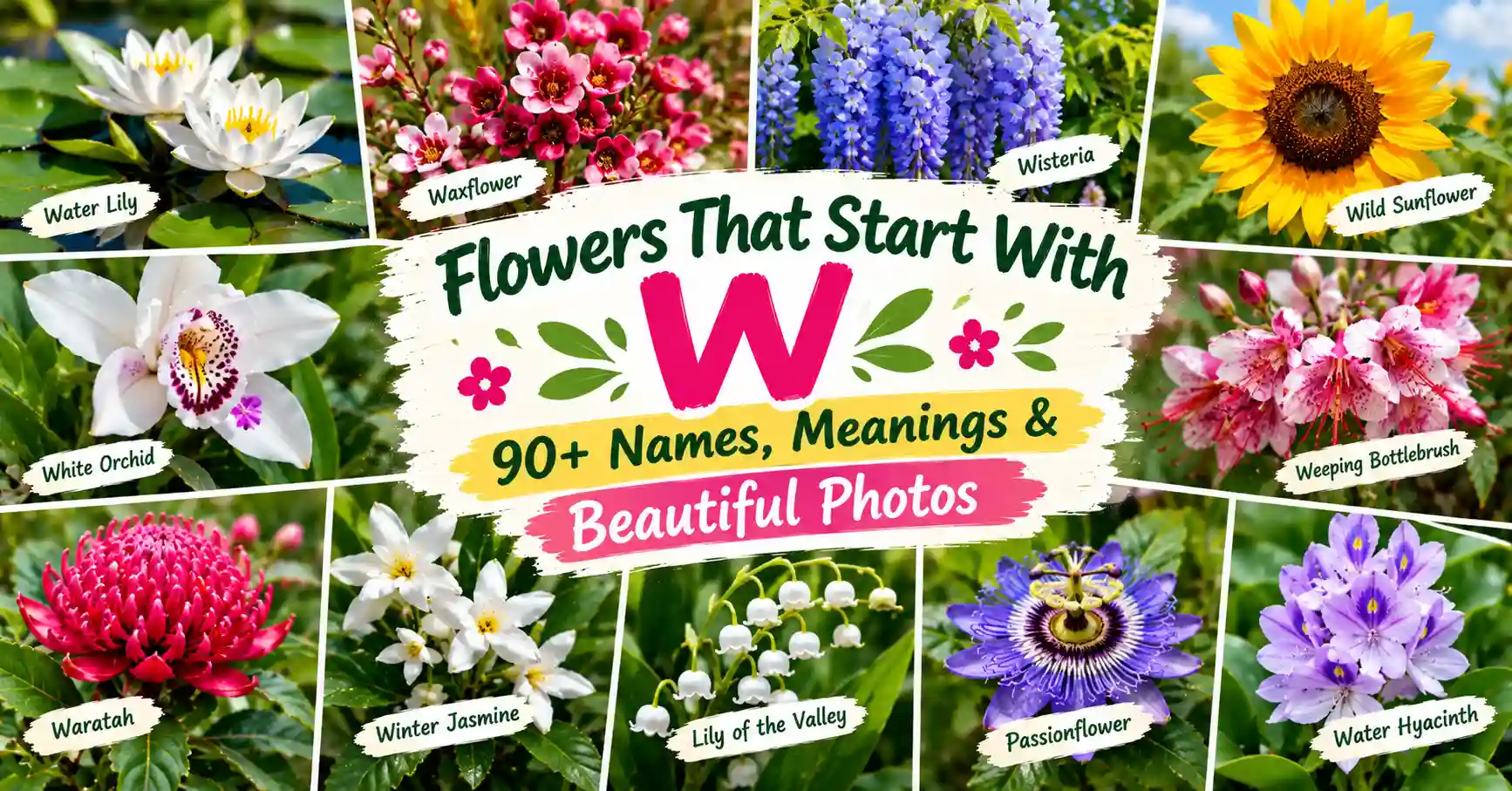
Flowers that start with W run from the dreamy wisteria to the humble white clover. Wisteria, water lily, wallflower, and weigela are the names most gardeners know. But the letter W also hides a winter-blooming shrub that perfumes bare branches, a pond plant with floating fragrant flowers, and the national flower of Trinidad and Tobago. This guide gathers 122 of them in one place.
Every plant below is real and has a verified botanical name. You will find vines, shrubs, pond plants, woodland wildflowers, houseplants, and florist picks. Only one entry is grown mainly for its leaves, and it is clearly marked as an exception.
A long list only helps if you can use it. So this guide sorts the plants by color, life cycle, and use. A bloom’s beauty means little if it dies in your climate. It means even less if it harms a child or a pet. Each table is explained in plain words first, so you never face a bare spreadsheet.
W is rich in names that start with Water, Wild, Winter, Wood, and White. Those words hint at where each plant grows or when it blooms. Read straight through or jump to what you need. Have a pet? Check the toxicity section first. Want a quick pick? Try the decision table near the end.
Quick Answer: Ten Standout W Flowers
Wisteria is the dramatic climber, with long violet clusters that scent a whole pergola in spring. Water lily is the classic pond bloom, floating on still water through summer. Wallflower and weigela bring color and scent to spring beds and shrub borders.
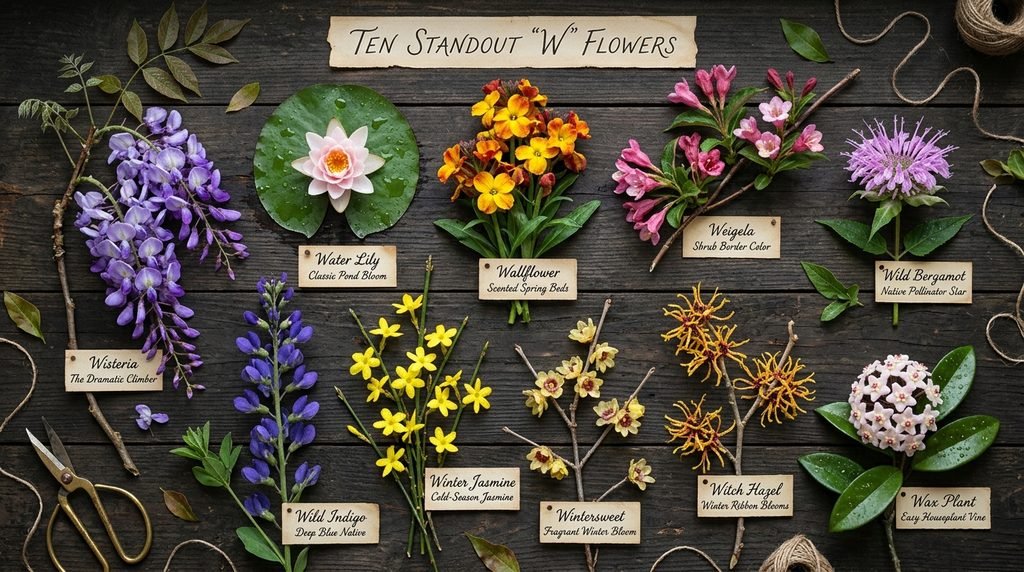
Wild bergamot and wild indigo are the native pollinator stars, drawing bees, butterflies, and hummingbirds. Winter jasmine, wintersweet, and witch hazel solve the cold-season problem with blooms on bare branches. Wax plant, or hoya, is the easy houseplant vine, and woman’s tongue tree lines streets across South Asia with fragrant cream blooms.
Master Alphabetical List of Flowers That Start With W
This list names 122 flowers. Most entries use a common name that gardeners already know. A few are better known by their botanical name, so they appear under the name nurseries print on plant tags. Each row has a short note, so you can see at a glance what the plant looks like and where it grows best. One entry is marked as an exception because the flower is not the main reason people grow it.
Read More: 50+ Beautiful Flowers That Start With V (With Pictures & Names)
| Flower | Botanical Name | Note |
| Wahlenbergia | Wahlenbergia stricta | Blue bell-shaped flowers on slender stems |
| Wake Robin | Trillium sessile | Maroon woodland bloom that appears with the robins |
| Waldsteinia (Barren Strawberry) | Waldsteinia fragarioides | Yellow strawberry-like flowers for groundcover |
| Walking Iris | Neomarica gracilis | Blue-white blooms, plantlets form on stems |
| Wallflower | Erysimum cheiri | Fragrant yellow-orange bloom, thrives in rocky soil |
| Wallflower (Siberian) | Erysimum × allionii | Bright orange spring clusters |
| Wallich’s Anemone | Anemone wallichii | Large white Himalayan wildflower |
| Wandering Jew Flower | Tradescantia zebrina | Small purple bloom on striped trailing foliage |
| Wandflower | Dierama pulcherrimum | Arching stems with bell-shaped pink blooms |
| Wapato | Sagittaria latifolia | White three-petaled flowers on a pond edge plant |
| Washington Lily | Lilium washingtonianum | Fragrant white trumpets, deadly to cats |
| Water Avens | Geum rivale | Nodding apricot-pink bells for damp soil |
| Water Betony | Scrophularia auriculata | Small red-brown flowers beside streams |
| Water Canna | Thalia dealbata | Purple flower sprays on tall aquatic stems |
| Water Crowfoot | Ranunculus aquatilis | White buttercup-like blooms floating on water |
| Water Forget-Me-Not | Myosotis scorpioides | Sky-blue blooms for pond margins |
| Water Hawthorn | Aponogeton distachyos | Fragrant white floating flowers |
| Water Hyacinth | Eichhornia crassipes | Floating aquatic plant, lavender bloom spike |
| Water Iris | Iris pseudacorus | Yellow iris for pond edges |
| Water Lily | Nymphaea spp. | Classic floating pond bloom in many colors |
| Water Plantain | Alisma plantago-aquatica | Pale pink airy sprays for shallow water |
| Water Poppy | Hydrocleys nymphoides | Small yellow floating pond bloom |
| Water Violet | Hottonia palustris | Pale lilac whorls rising above water |
| Waterlily Tulip | Tulipa kaufmanniana | Early spring bulb with open star-shaped blooms |
| Watsonia | Watsonia spp. | Tall spiked bloom from South Africa |
| Wattle (Golden) | Acacia pycnantha | Golden puffs, national floral emblem of Australia |
| Wax Begonia | Begonia semperflorens | Continuous small pink, red, or white blooms |
| Wax Flower | Chamelaucium uncinatum | Small star-shaped bloom, long vase life |
| Wax Mallow | Malvaviscus arboreus | Red hibiscus-like buds that stay half-closed |
| Wax Plant (Hoya) | Hoya carnosa | Waxy star-shaped cluster, long-lived vine |
| Weeping Cherry Blossom | Prunus subhirtella ‘Pendula’ | Cascading pink spring blossom on a tree |
| Weeping Forsythia | Forsythia suspensa | Arching branches covered in yellow |
| Weigela | Weigela florida | Trumpet-shaped pink-red spring bloom |
| Welsh Poppy | Papaver cambricum | Lemon-yellow poppies for shady corners |
| Western Azalea | Rhododendron occidentale | Fragrant white-pink blooms, toxic |
| Western Bleeding Heart | Dicentra formosa | Pink hearts over lacy leaves |
| Western Columbine | Aquilegia formosa | Red and yellow spurred wildflower |
| Western Flowering Dogwood | Cornus nuttallii | Huge white bracts in spring |
| Western Redbud | Cercis occidentalis | Magenta blooms on bare branches |
| Western Trillium | Trillium ovatum | White blooms that age to pink |
| Western Wallflower | Erysimum capitatum | Orange clusters on a western native |
| Westringia (Coastal Rosemary) | Westringia fruticosa | Small white blooms on a hardy coastal shrub |
| Whirling Butterflies (Gaura) | Oenothera lindheimeri | Airy white-pink fluttering summer bloom |
| White Baneberry | Actaea pachypoda | White woodland spikes, toxic doll’s-eye berries |
| White Clover | Trifolium repens | White pom-poms that feed bees |
| White Fringetree | Chionanthus virginicus | Fragrant white ribbon-like spring blooms |
| White Ginger Lily | Hedychium coronarium | Fragrant white butterfly-shaped tropical blooms |
| White Prairie Clover | Dalea candida | White bottlebrush spikes for native bees |
| White Sage (exception) | Salvia apiana | Grown for silver leaves, pale flower spikes |
| White Snakeroot | Ageratina altissima | Clustered small white late-summer bloom |
| White Trillium | Trillium grandiflorum | Large white three-petaled woodland bloom |
| White Turtlehead | Chelone glabra | Snapdragon-like white fall blooms |
| White Wood Aster | Eurybia divaricata | White fall asters for shade |
| Whitlavia | Phacelia viscida | Deep blue bells with white centers |
| Whitlow Grass | Draba aizoides | Tiny yellow flowers for rock gardens |
| Whorled Milkweed | Asclepias verticillata | Small white bloom, narrow whorled leaves |
| Widow’s Tears | Commelina erecta | Small blue three-petaled bloom |
| Wild Bergamot | Monarda fistulosa | Shaggy lavender bloom, pollinator favorite |
| Wild Four O’Clock | Mirabilis nyctaginea | Pink-magenta trumpets for tough prairie soil |
| Wild Garlic | Allium ursinum | White star flowers in damp woods, toxic to pets |
| Wild Geranium | Geranium maculatum | Soft pink-purple native woodland bloom |
| Wild Hyacinth | Camassia scilloides | Pale blue-white spring spikes |
| Wild Indigo | Baptisia australis | Tall blue-purple spiked native bloom |
| Wild Lupine | Lupinus perennis | Blue-purple spiked native wildflower |
| Wild Onion | Allium canadense | Pink-white clusters on a native bulb |
| Wild Pansy | Viola tricolor | Small purple, yellow, and white faces |
| Wild Petunia | Ruellia humilis | Small lavender trumpet-shaped native bloom |
| Wild Pink | Silene caroliniana | Pink fringed flowers for dry slopes |
| Wild Poinsettia | Warszewiczia coccinea | Crimson bracts, national flower of Trinidad and Tobago |
| Wild Quinine | Parthenium integrifolium | White button-like clusters on a prairie plant |
| Wild Rose | Rosa acicularis | Simple pink five-petaled wild bloom |
| Wild Senna | Senna hebecarpa | Yellow pea-flower clusters on a tall native |
| Wild Sweet William | Phlox maculata | Fragrant pink-purple clustered native bloom |
| Wild Violet | Viola sororia | Purple spring violets, edible |
| Willow Gentian | Gentiana asclepiadea | Deep blue trumpets along arching stems |
| Willow-Leaved Sunflower | Helianthus salicifolius | Tall golden fall sunflower |
| Willowherb (Fireweed) | Epilobium angustifolium | Tall pink-purple spiked wildflower |
| Wind Poppy | Stylomecon heterophylla | Orange poppy with a dark center |
| Windflower (Anemone) | Anemone spp. | Delicate cup-shaped bloom in many colors |
| Windmill Palm Bloom | Trachycarpus fortunei | Small cream flower clusters on a hardy palm |
| Winecup (Poppy Mallow) | Callirhoe involucrata | Deep magenta cup-shaped native bloom |
| Winged Everlasting | Ammobium alatum | Papery white bloom, popular dried flower |
| Winter Aconite | Eranthis hyemalis | Bright yellow bloom, one of the earliest of the year |
| Winter Cherry (Chinese Lantern) | Physalis alkekengi | Orange papery husk around a small bloom and berry |
| Winter Cyclamen | Cyclamen coum | Small pink-purple bloom over patterned leaves |
| Winter Daphne | Daphne odora | Pink-white fragrant winter blooms, toxic |
| Winter Hazel | Corylopsis spicata | Soft yellow hanging catkin-like flowers |
| Winter Heath | Erica carnea | Pink bell clusters in winter |
| Winter Honeysuckle | Lonicera fragrantissima | Very fragrant cream blooms on bare stems |
| Winter Iris | Iris unguicularis | Lavender-blue blooms in the coldest months |
| Winter Jasmine | Jasminum nudiflorum | Bright yellow bloom on bare winter branches |
| Winter Rose (Hellebore) | Helleborus niger | White-pink nodding bloom in late winter |
| Wintersweet | Chimonanthus praecox | Fragrant pale yellow bloom on bare winter branches |
| Wishbone Flower | Torenia fournieri | Shade-tolerant purple and yellow bloom |
| Wisteria | Wisteria sinensis | Long cascading purple flower clusters |
| Wisteria (Japanese) | Wisteria floribunda | Very long violet clusters, late spring |
| Witch Alder | Fothergilla gardenii | White bottlebrush blooms, fiery fall color |
| Witch Hazel | Hamamelis virginiana | Spidery yellow bloom on bare fall or winter branches |
| Wolfsbane (Aconite) | Aconitum lycoctonum | Highly toxic; hooded purple-yellow spiked bloom |
| Woman’s Tongue Tree | Albizia lebbeck | Fragrant cream puffs on a South Asian avenue tree |
| Wonga Wonga Vine | Pandorea pandorana | Cream and maroon trumpet-shaped tropical bloom |
| Wood Anemone | Anemone nemorosa | Small white woodland spring bloom |
| Wood Betony | Betonica officinalis | Purple-pink whorled spikes for meadows |
| Wood Cranesbill | Geranium sylvaticum | Violet-blue open blooms for cool meadows |
| Wood Forget-Me-Not | Myosotis sylvatica | Tiny sky-blue blooms for shade |
| Wood Lily | Lilium philadelphicum | Upward-facing orange-red native lily bloom |
| Wood Poppy | Stylophorum diphyllum | Yellow poppies for woodland shade |
| Wood Sage | Teucrium scorodonia | Pale green-yellow spikes in dry woods |
| Wood Sorrel | Oxalis acetosella | Small white-pink bloom above clover-like leaves |
| Wood Spurge | Euphorbia amygdaloides | Chartreuse bracts, irritating sap |
| Woodbine (Honeysuckle) | Lonicera periclymenum | Fragrant tubular pink-yellow climbing bloom |
| Woodland Phlox | Phlox divaricata | Fragrant lavender-blue woodland spring bloom |
| Woodland Sage | Salvia nemorosa | Violet-blue spikes for sunny borders |
| Woodland Tobacco | Nicotiana sylvestris | White tubular blooms scented at night, toxic |
| Woodruff (Sweet Woodruff) | Galium odoratum | Tiny white star-shaped groundcover bloom |
| Woody Nightshade | Solanum dulcamara | Purple star-shaped bloom, toxic berries follow |
| Woolflower (Celosia) | Celosia argentea var. cristata | Dense, textured plume or crest-shaped bloom |
| Woolly Blue Curls | Trichostema lanatum | Fuzzy blue-purple spikes on a western shrub |
| Woolly Sunflower | Eriophyllum lanatum | Golden daisies over silvery wool |
| Woundwort | Stachys sylvatica | Maroon-purple whorled flowers for shade |
| Wreath Goldenrod | Solidago caesia | Yellow clusters along arching stems |
| Wyethia (Mule’s Ears) | Wyethia amplexicaulis | Large yellow sunflower-like blooms |
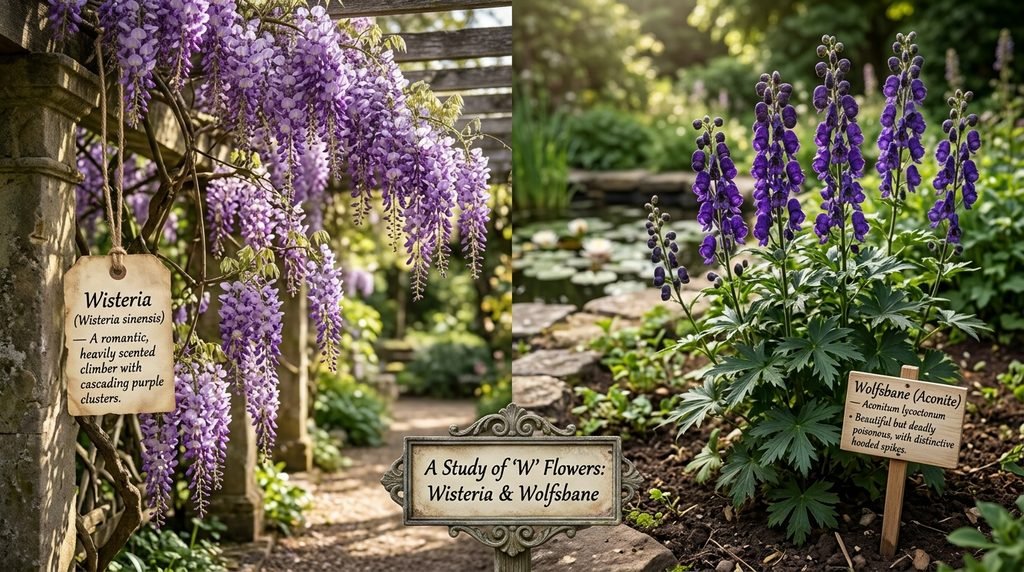
That table names 122 distinct flowers that start with W. Wisteria and wolfsbane sit far apart in character. One is a romantic, scented climber. The other is a lovely plant that is deadly poisonous. Both show how wide this single letter reaches.
Full Comparison Table: Sun, Water, and Bloom Time
When two plants seem equally good, sun and water needs usually pick the winner. The table below compares the main W flowers from this guide. Read the sun column first. Then check the water column and the bloom season to see if the plant fits your space and your calendar.
| Flower | Sun Needs | Water Needs | Bloom Season |
| Wallflower | Full sun to part shade | Low to moderate | Spring |
| Wisteria | Full sun | Moderate | Mid to late spring |
| Weigela | Full sun to part shade | Moderate | Late spring |
| Water Lily | Full sun | Aquatic | Summer |
| Windflower (Anemone) | Part shade | Moderate | Spring |
| Wild Bergamot | Full sun | Low to moderate | Mid to late summer |
| Wild Indigo | Full sun | Low once established | Late spring to early summer |
| Winter Jasmine | Full sun to part shade | Low to moderate | Late winter |
| Witch Hazel | Full sun to part shade | Moderate | Late fall to winter |
| Wintersweet | Full sun | Moderate | Midwinter |
| Wild Geranium | Part shade | Moderate | Spring |
| Wood Anemone | Part to full shade | Moderate | Early to mid-spring |
| Woodland Phlox | Part shade | Moderate | Spring |
| Woolflower (Celosia) | Full sun | Moderate | Summer to fall |
| Wax Plant (Hoya) | Bright indirect light | Low to moderate | Spring to summer |
| Winter Aconite | Full sun to part shade | Moderate | Late winter |
| White Turtlehead | Full sun to part shade | Moderate to high | Late summer to fall |
| Wax Begonia | Part shade to full sun | Moderate | Spring to frost |
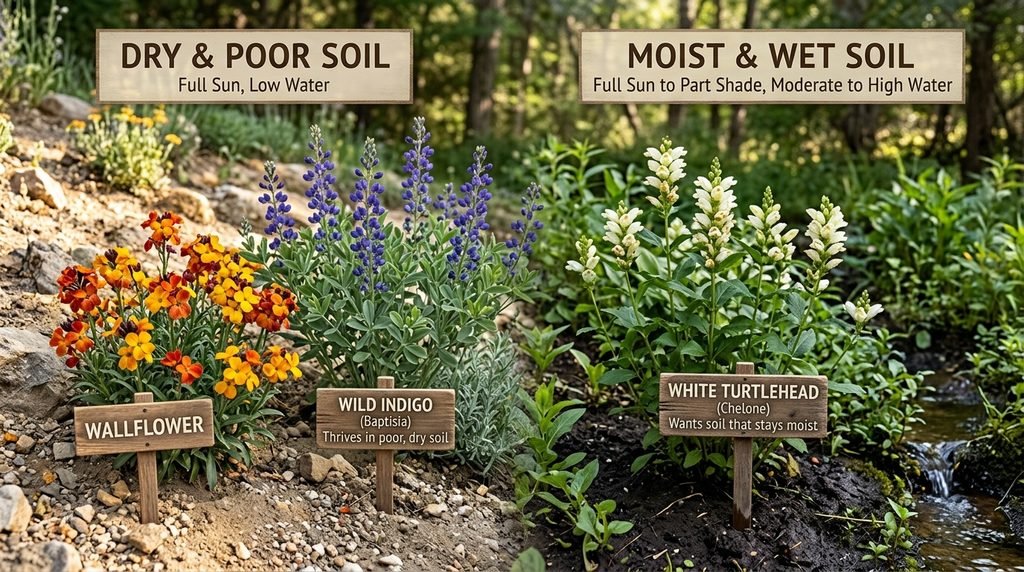
Wild indigo and wallflower are the best picks for dry, poor soil. Both bloom better without rich feeding. White turtlehead sits at the other end. It wants soil that stays moist.
Garden Favorites Among W Flowers
A handful of W flowers earn a place in almost every garden. Wisteria gives a dramatic spring show on a strong support. Weigela blooms heavily on a tough shrub with almost no care. Wild bergamot and wild indigo bring native color and pollinators. Windflower and woodland phlox carpet shaded beds in spring.
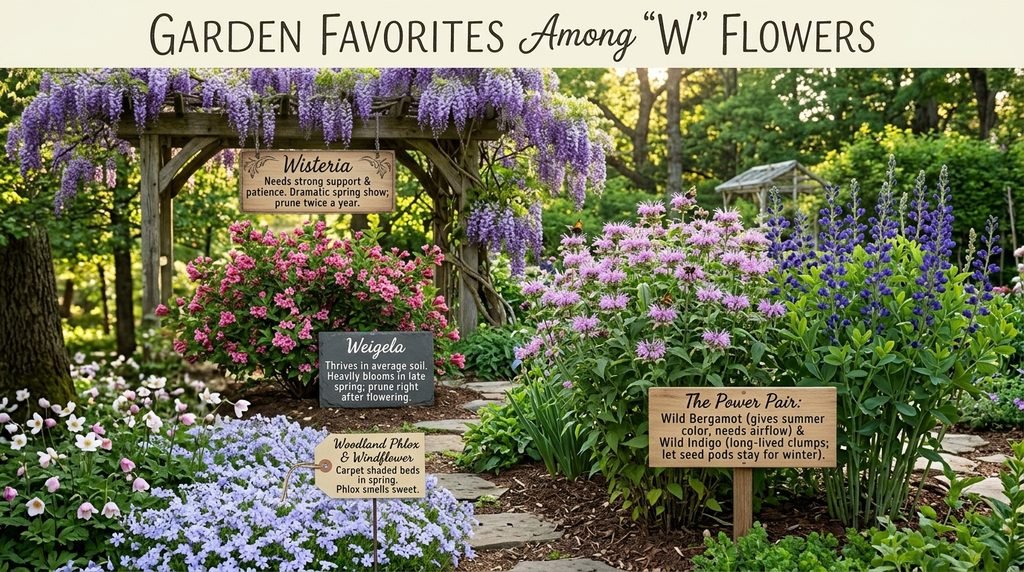
- Wisteria needs strong support and a few years before it blooms well.
- Weigela thrives in average soil and blooms for weeks in late spring.
- Wild Bergamot draws bees, butterflies, and hummingbirds all summer.
- Wild Indigo forms a long-lived shrubby clump with blue spikes.
- Woodland Phlox spreads gently in shade and smells sweet.
Wild bergamot and wild indigo make a strong pair. One carries early summer, and the other carries midsummer. Together they feed pollinators for months.
A few care habits keep these plants happy. Prune wisteria twice a year to control growth and encourage blooms. Cut weigela right after it flowers. Give wild bergamot good airflow to avoid mildew. Let wild indigo seed pods stay on the plant, since they rattle and look interesting in winter.
See More Flowers: 20+ Beautiful Flowers That Start With X (With Pictures & Names)
Indoor and Container Picks Among W Flowers
Only a few W plants thrive indoors, but they are worth knowing. Wax plant, or hoya, is the easiest, producing waxy star-shaped clusters on a long-lived vine. Wax begonia flowers nonstop in a bright window. Wandering Jew flower grows tiny blooms on a colorful trailing plant. Winter cyclamen and wishbone flower thrive in cool, bright rooms and shady patio pots.
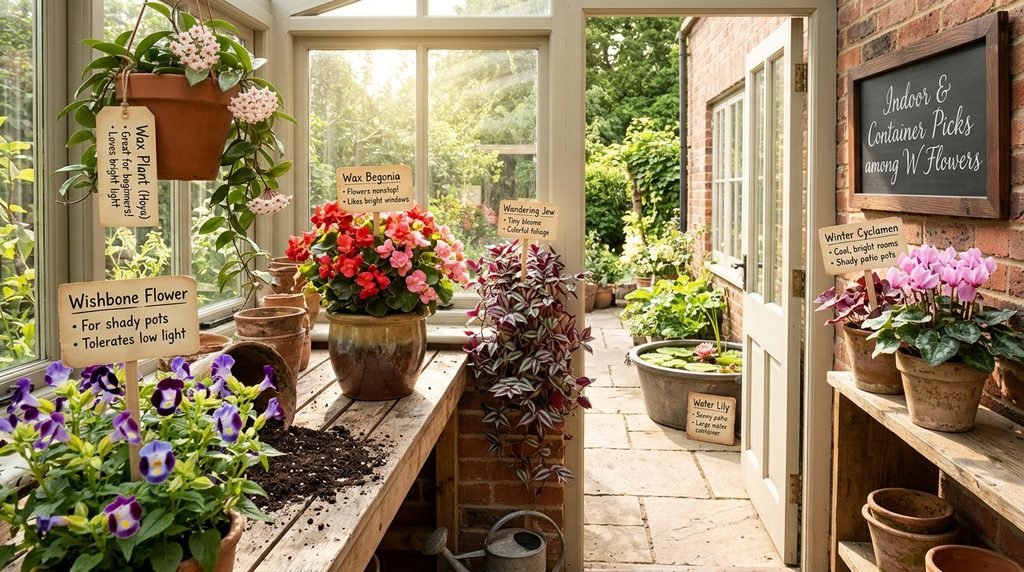
- Wax Plant (Hoya) blooms best when slightly root-bound and given bright light.
- Wax Begonia flowers continuously with regular watering.
- Wishbone Flower suits shady pots and tolerates low light.
- Water Lily can grow in a large, sunny patio container with water.
Wax plant is the pick for beginners. It forgives missed waterings. Just do not cut off the old flower spurs, since new blooms appear from the same spot each year.
Light matters more than anything else for indoor W plants. A bright east window suits hoya and wax begonia. Avoid cold drafts and soggy saucers. Most of these plants fail from too much water, not too little.
Florist Favorites Among W Flowers
Florists use W flowers for scent, texture, and a wild look. Wax flower, or Geraldton wax, adds tiny star blooms that last two weeks. Whirling butterflies, or gaura, add airy, fluttering movement. Winged everlasting and woolflower dry well for long-lasting arrangements. Weeping cherry and witch hazel branches bring spring and winter color indoors.
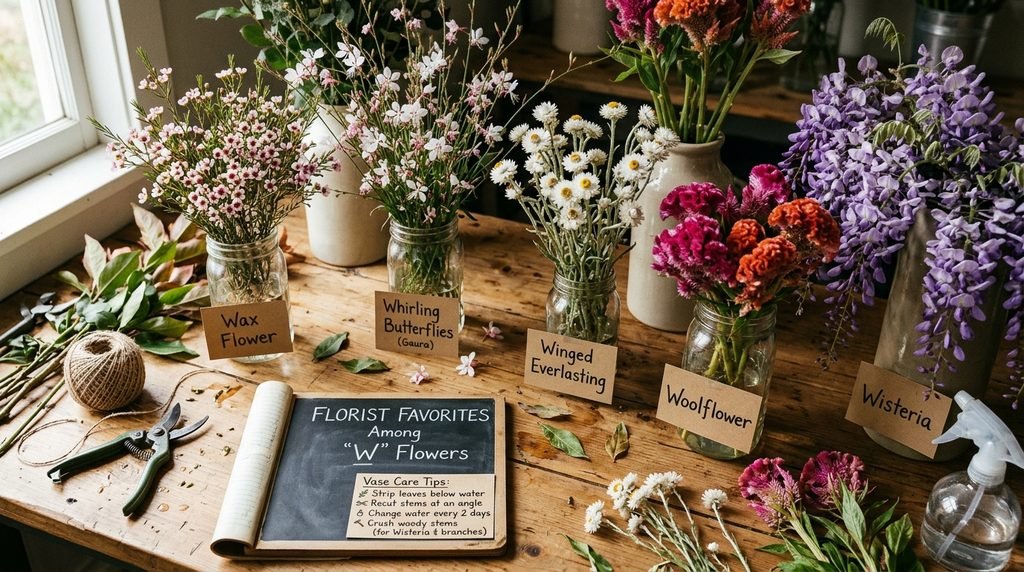
- Wax Flower holds its shape and color for two weeks or more.
- Whirling Butterflies adds light, airy movement to mixed bouquets.
- Winged Everlasting dries well and keeps its papery texture.
- Woolflower gives fluffy, textured crests for fresh or dried use.
- Wisteria vines can be cut for dramatic seasonal displays, but they wilt fast.
Wax flower and whirling butterflies are the quiet workhorses. They add lightness that heavier flowers lack. A florist’s bouquet in summer would feel stiff without them.
Good vase care doubles the life of any cut flower. Strip the leaves below the water line. Recut the stems at an angle. Change the water every two days. For wisteria and woody branches, crush the stem ends so they can drink.
Rare and Unusual W Flowers
Some W plants are hard to find or hard to grow. Wonga wonga vine is an Australian native with cream and maroon trumpets that needs a mild, frost-free climate. Wallich’s anemone is a Himalayan wildflower with large white blooms that is seldom sold. Water hawthorn is a pond plant with fragrant white floating flowers that bloom in cool weather. Wild poinsettia, or chaconia, is the national flower of Trinidad and Tobago and needs warm, humid air to thrive.
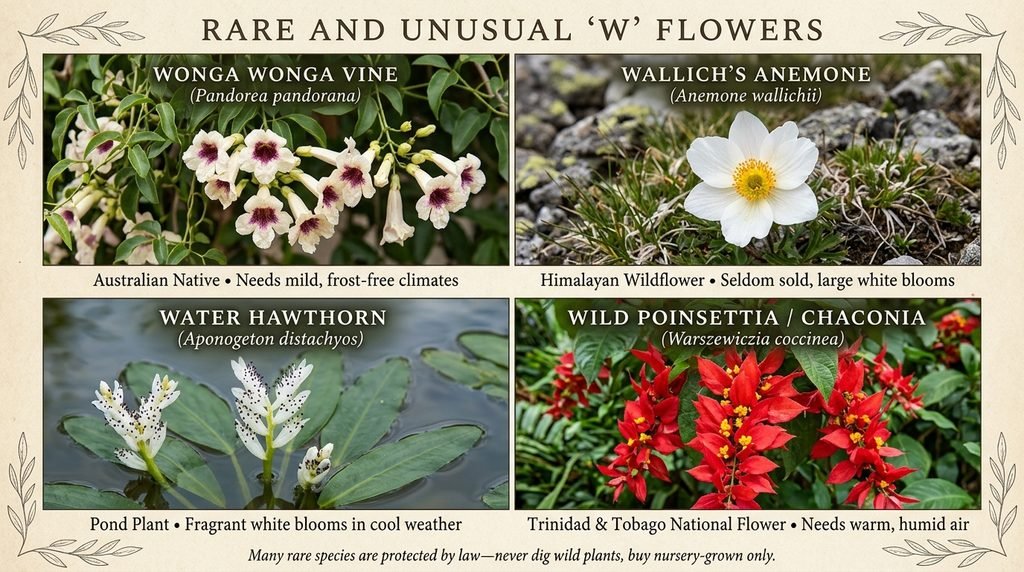
These four plants share one trait. Each wants a very specific home. That is why they stay special. If you want to grow one, buy nursery-grown plants only. Never dig wild plants, since many rare W species are protected by law.
Learn Plant Care: 30+ Beautiful Flowers That Start With Q (With Pictures & Names)
Caution: Toxic W Flowers
Several W plants can harm pets, livestock, or people. Wolfsbane, white baneberry, and western azalea are the most dangerous. Every part of each plant is poisonous. Winter Daphne is also very toxic. Cat owners need to know about Washington lily. Even a small nibble or a lick of pollen can cause kidney failure in cats.
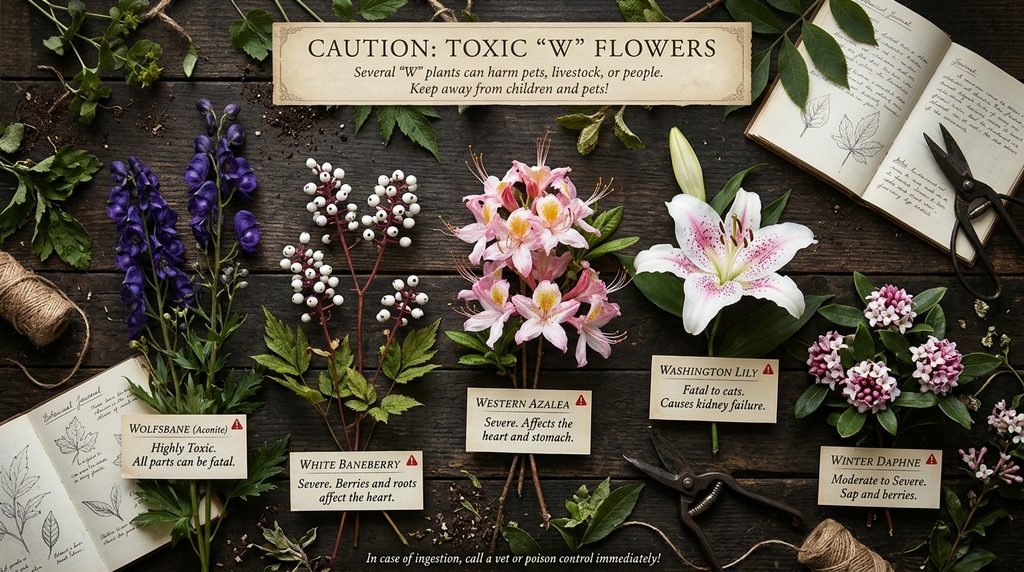
| Flower | Toxic To | Severity |
| Wolfsbane (Aconite) | Humans, dogs, cats, horses, livestock | Severe — all parts, can be fatal |
| White Baneberry | Humans, dogs, cats | Severe — berries and roots affect the heart |
| Western Azalea | Dogs, cats, horses, livestock | Severe — all parts affect the heart and stomach |
| Winter Daphne | Humans, dogs, cats, horses | Moderate to severe — berries and sap |
| Washington Lily | Cats (extremely), dogs (mild) | Severe for cats — can cause kidney failure |
| Woody Nightshade | Humans, dogs, cats, livestock | Moderate to severe — unripe berries and leaves |
| Woodland Tobacco | Humans, dogs, cats, livestock | Moderate to severe — nicotine-type alkaloids |
| Winter Aconite | Dogs, cats, horses | Moderate — heart-affecting compounds |
| Wisteria | Dogs, cats, horses | Moderate — seeds and pods upset the stomach |
| Wild Garlic | Dogs, cats | Moderate — can damage red blood cells |
| Winter Cherry (Chinese Lantern) | Dogs, cats | Mild to moderate — unripe berries and foliage |
| Wood Spurge | Dogs, cats, humans | Mild to moderate — milky sap irritates skin and eyes |
Wolfsbane, white baneberry, western azalea, and Washington lily deserve the loudest warning. Keep them away from children and pets. Wisteria and wood spurge are milder, but a chewing dog can still get sick. Wax plant and wild violet, by contrast, are not on this list. If a pet or child eats any plant on this list, call a vet or poison control right away.
W Flowers Grouped by Color
Yellow and gold are the winter and woodland colors of W. Winter jasmine, wintersweet, witch hazel, winter aconite, wood poppy, golden wattle, and wallflower glow in cold or shade. Golden wattle covers whole trees in gold in an Australian winter. Winter jasmine and winter aconite bloom in late winter. Witch hazel blooms in late fall, with spidery petals. Wood poppy brightens shady beds in spring.
Purple, blue, and lilac are the cool side of W. Wisteria, wild indigo, wild bergamot, woodland phlox, and wood forget-me-not bring these tones. Wisteria gives drama on a pergola. Wild indigo and wild bergamot suit native borders. Woodland phlox and wood forget-me-not carpet shady beds.
Pink and rose tones show up in weigela, wild geranium, weeping cherry blossom, wild rose, and willowherb. Weeping cherry gives a whole tree of pink. Weigela covers a shrub. Wild geranium and wild rose suit natural, relaxed gardens. Willowherb, also called fireweed, colonizes open ground.
White and cream flowers include water lily, white trillium, wood anemone, white clover, and woman’s tongue tree. White glows at dusk and brightens shade. Water lily suits still ponds. Woman’s tongue tree, called siris in South Asia, adds fragrance to avenues and large gardens. White trillium and wood anemone suit woodland shade.
Red and orange accents come from wood lily, wild poinsettia, woolflower, and wax mallow. Wood lily and woolflower bring bright orange and red to sunny beds. Wild poinsettia gives crimson in tropical gardens. Wax mallow draws hummingbirds with red buds that never fully open.
Life-Cycle Groupings for W Flowers
A plant’s life cycle tells you how much work to expect. Annuals live one season, so you replant each year. Biennials flower in their second year. Perennials return on their own. Bulbs need the right winter, cold or warm, to come back. Trees, shrubs, and vines take longer to bloom but last for decades. Zones below are approximate and vary by variety, so check your own plant tag.
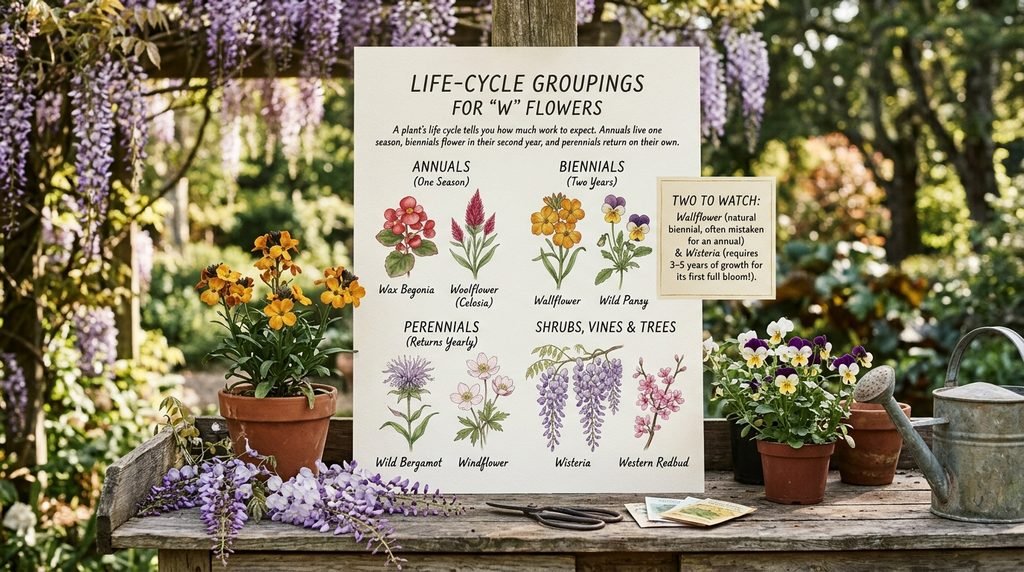
| Flower | Life Cycle | Typical Zones |
| Wax Begonia | Annual | All zones (seasonal) |
| Woolflower (Celosia) | Annual | All zones (seasonal) |
| Winged Everlasting | Annual | All zones (seasonal) |
| Wallflower | Biennial or short-lived perennial | 6–10 |
| Wild Pansy | Annual or biennial | All zones (seasonal) |
| Welsh Poppy | Short-lived perennial | 6–8 |
| Wild Bergamot | Perennial | 3–9 |
| Wild Indigo | Perennial | 3–9 |
| Wild Geranium | Perennial | 3–8 |
| Windflower (Anemone) | Perennial | 3–8 |
| Wood Anemone | Perennial | 4–8 |
| Woodland Phlox | Perennial | 3–8 |
| White Turtlehead | Perennial | 3–8 |
| White Clover | Perennial | 3–10 |
| Water Lily | Perennial (aquatic) | 3–11 |
| Winter Aconite | Perennial (tuber) | 3–7 |
| White Trillium | Perennial | 4–8 |
| Weigela | Perennial (shrub) | 4–8 |
| Winter Jasmine | Perennial (shrub) | 6–9 |
| Wintersweet | Perennial (shrub) | 7–9 |
| Witch Hazel | Perennial (shrub) | 5–8 |
| Wisteria | Perennial (vine) | 5–9 |
| Western Redbud | Perennial (small tree) | 6–9 |
| White Fringetree | Perennial (small tree) | 3–9 |
| Woman’s Tongue Tree | Tender perennial (tree) | 9–11 |
| Wax Plant (Hoya) | Tender perennial (houseplant) | 10–12 (indoors elsewhere) |
Wallflower and wisteria are the two to watch. Many gardeners treat wallflower as a one-season plant, but it is naturally biennial. Wisteria sits at the opposite end of the patience scale, often needing three to five years of growth before its first full bloom.
Botanical Name Crosswalk
Common names change from place to place. Botanical names do not. Nursery tags and seed packets use Latin for this reason. It also helps you search online with confidence. Two different plants can share one common name, so the Latin name protects you from a wrong purchase.
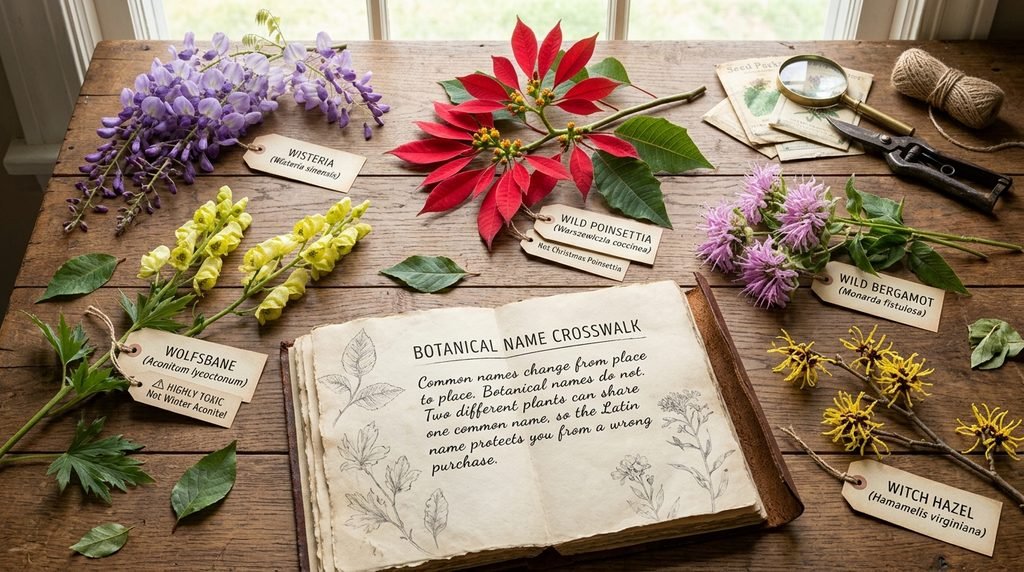
| Common Name | Botanical Name |
| Wisteria | Wisteria sinensis |
| Wisteria (Japanese) | Wisteria floribunda |
| Water Lily | Nymphaea spp. |
| Wallflower | Erysimum cheiri |
| Weigela | Weigela florida |
| Wild Bergamot | Monarda fistulosa |
| Wild Indigo | Baptisia australis |
| Winter Jasmine | Jasminum nudiflorum |
| Wintersweet | Chimonanthus praecox |
| Witch Hazel | Hamamelis virginiana |
| Wax Plant | Hoya carnosa |
| Wolfsbane | Aconitum lycoctonum |
| Woman’s Tongue Tree | Albizia lebbeck |
| Wild Poinsettia | Warszewiczia coccinea |
| Woodland Tobacco | Nicotiana sylvestris |
Wolfsbane is worth flagging. It is sometimes confused with the unrelated winter aconite, and mixing the two matters given how dangerous true Aconitum is. Also, do not confuse wild poinsettia with the Christmas poinsettia. They are different plants in different families.
What W Flowers Mean
Flower meanings vary by culture, but a good number of W flowers carry steady symbolism. Wisteria stands for devotion, long life, and romance. In Japan, where it is called fuji, it is tied to nobility and gentle beauty. The water lily stands for purity and rebirth, since it rises clean from muddy water.
Wallflower has picked up a double meaning. In Victorian flower language, it stood for faithfulness in adversity, a nod to its habit of growing from old stone walls. The word “wallflower” is also used for a shy person at a party. Windflower, or anemone, takes its name from the wind, and in Greek myth it stood for fleeting love.
Winter sweet pea is loved in China as a symbol of resilience, since it blooms in the coldest weeks. White clover stands for a promise, and in Victorian times it carried the message think of me. Golden wattle is the national floral emblem of Australia, and Wattle Day is held each September. Wild poinsettia, called chaconia, is the national flower of Trinidad and Tobago.
Wolfsbane carries a dark folk meaning. Old stories tied it to werewolves and witches, and it stood for danger. In South Asia, the woman’s tongue tree, or siris, is known for its rattling seed pods, which gave it its odd name. Match the flower to your message, and remember that the same bloom can mean something different in another culture.
Decision Table: Which W Flower Fits Your Situation
You do not have to read the whole list to choose well. Start with your goal in the left column. The right column names the best W flower for it. Then check the toxicity section if you have pets or children.
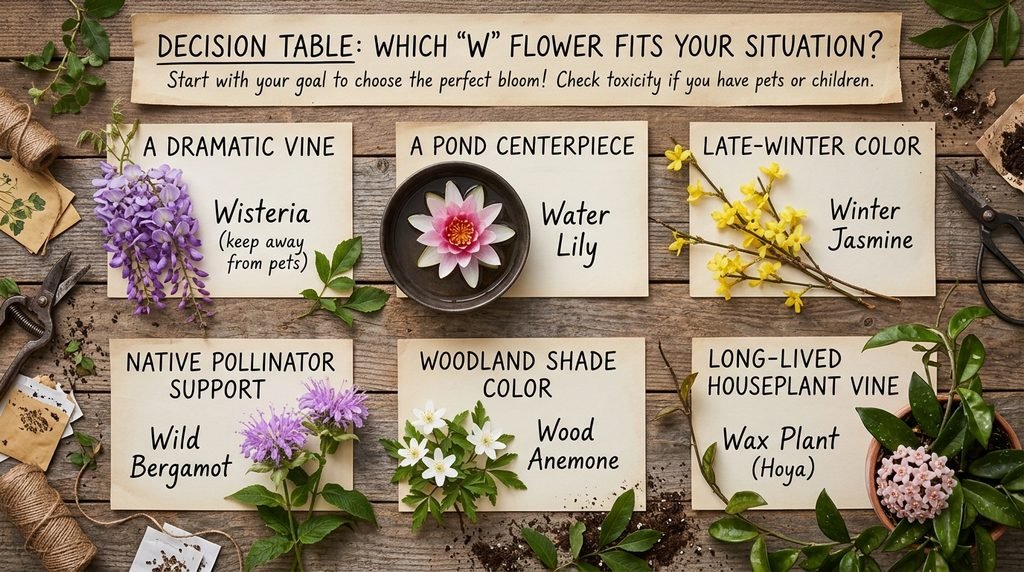
| If You Want… | Choose This W Flower |
| A dramatic flowering vine | Wisteria (keep away from pets) |
| A pond centerpiece | Water Lily or Water Hawthorn |
| Late-winter color | Winter Jasmine, Winter Aconite, or Wintersweet |
| Native pollinator support | Wild Bergamot, Wild Indigo, or White Prairie Clover |
| Woodland shade color | Wood Anemone, Woodland Phlox, or Wild Geranium |
| A long-lived houseplant vine | Wax Plant (Hoya) |
| Dried flower arrangements | Winged Everlasting or Woolflower |
| Strong fragrance | Wintersweet, Winter Honeysuckle, or White Fringetree |
| A shady spring carpet | Wood Forget-Me-Not or Woodruff |
| A pet-friendlier garden | Wax Plant, Wild Violet, or Wild Pansy (absent from this guide’s toxic list) |
Water lily and wax plant cover two very different spaces, one for ponds and the other for windowsills. Winter jasmine and wintersweet remain the clear picks for color in the coldest weeks. Always double-check any plant with your vet if a pet is likely to chew it.
Conclusion
Flowers that start with W offer a very wide choice, from the climbing wisteria to the tiny wood forget-me-not. This guide sorted 122 of them by color, life cycle, and use, so you can pick with confidence. Whether you want a dramatic spring vine, a pond centerpiece, or a shrub that blooms in winter, there is a W flower that fits. Use the tables above, read the toxicity notes, and start planting.
Frequently Asked Questions
How many flowers start with W?
More than 90 well-known flowers start with W. This guide lists 122, from common vines and shrubs to rare wildflowers and pond plants.
What is the most popular flower that starts with W?
Wisteria is among the most popular, with water lily, weigela, and wallflower close behind. Wild bergamot and wild indigo are favorites for native gardens.
What are the easiest flowers that start with W to grow?
Weigela, wild indigo, wild bergamot, white clover, and wild violet are very easy. Wax plant is the easiest W houseplant.
Which W flowers attract butterflies and hummingbirds?
Wild bergamot, white prairie clover, and willow-leaved sunflower draw butterflies and bees. Wild bergamot, weigela, and wax mallow also draw hummingbirds.
Is wisteria toxic to pets?
The flowers pose little risk, but wisteria seeds and pods can cause serious stomach upset. Keep pods out of reach of pets and children.
Which W flower is the most dangerous?
Wolfsbane, white baneberry, and western azalea are the most dangerous for people and pets. Washington lily is the most dangerous for cats.
What W flower blooms in winter?
Winter jasmine, wintersweet, witch hazel, winter aconite, and winter heath bloom in the cold months. Winter iris and winter hazel also flower early.
Does winter jasmine smell?
No. Winter jasmine has bright yellow blooms but is generally unscented. For fragrance, choose wintersweet or winter honeysuckle.
What does wisteria symbolize?
Wisteria stands for devotion, long life, and romance. In Japan, it is tied to noble beauty.
What is the woman’s tongue tree?
It is Albizia lebbeck, a fast-growing tree with fragrant cream flowers. In South Asia, it is called siris, and its seed pods rattle in the wind.
2 thoughts on “Flowers That Start With W: 90+ Names, Meanings & Beautiful Photos”