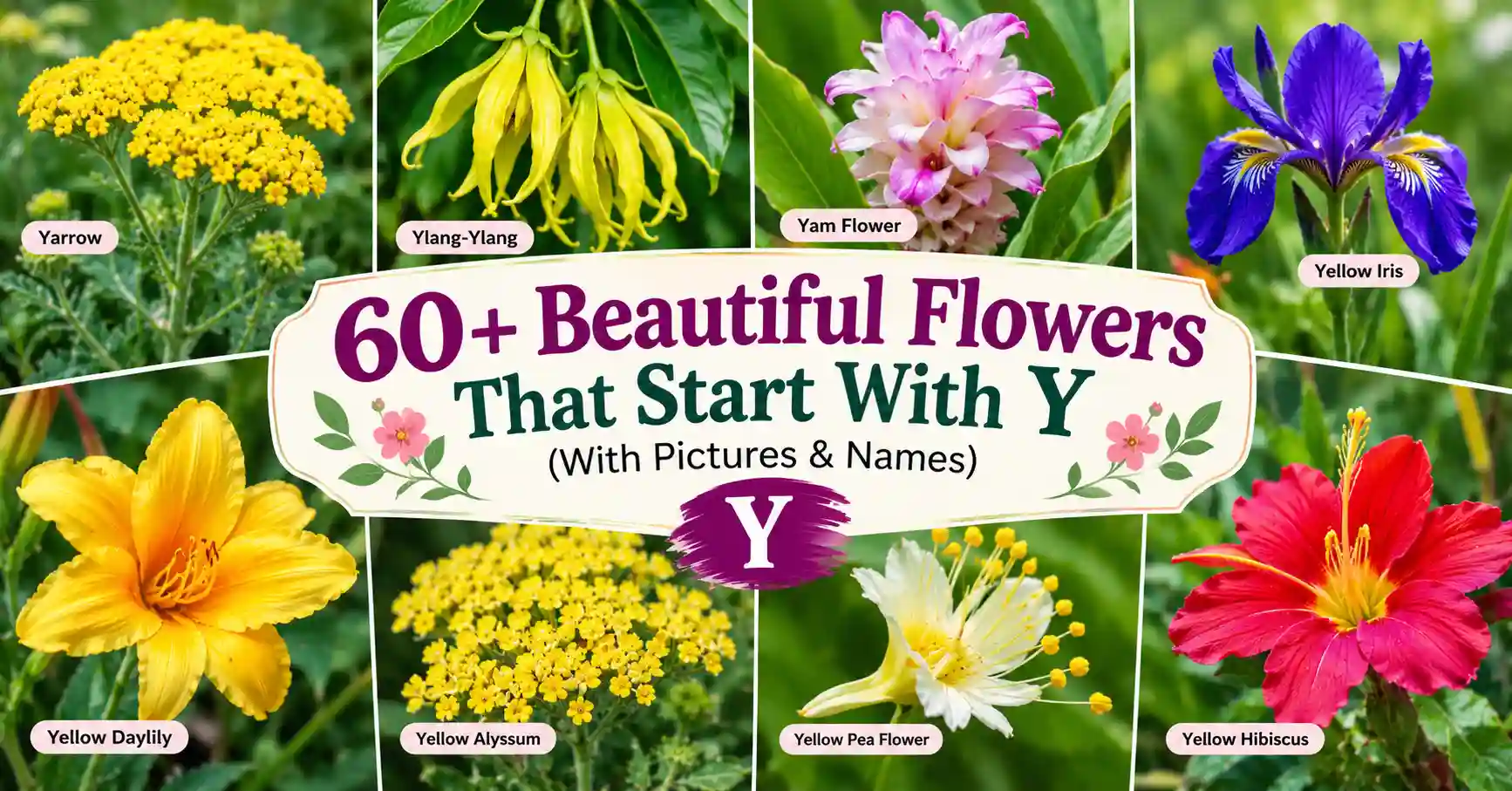
Flowers that start with Y come from two honest sources. A small group of plants carries the letter in their real name, such as yarrow, yucca, and ylang-ylang. A much larger group appears because yellow is one of the most common flower colors on Earth. Gardeners put the color first, so we get yellow rose, yellow tulip, and yellow iris. Both groups are real and well documented, so both belong in a complete guide.
This guide brings together 64 of these blooms. Each entry was checked for its botanical name, native range, and toxicity. Nothing here was pulled from one source and lightly reworded. A few plants loosely linked to this letter, where the flower is not the reason anyone grows them, were left out. The flower should be the real reason to grow a plant.
The article opens with a quick answer and a full alphabetical list. A comparison table follows, so you can scan bloom time, sun needs, and safety at a glance. After that, the plants are sorted by use: garden favorites, indoor plants, florist favorites, rare finds, and a caution section. Color groupings, life-cycle categories, botanical names, and symbolism come next. A decision table near the end helps you match a plant to your situation.
Every fact below, including bloom timing, native origin, and toxicity, was checked against at least two horticultural or veterinary sources. Each sentence was written independently rather than copied from a database. Where sources disagreed, the more cautious figure was used instead of a guess.
Quick Answer: The Standout Y Flowers
Among flowers that start with Y, a few names do most of the work. Yarrow and yucca are the toughest, since both thrive on heat, drought, and neglect. Yellow rose and yellow tulip lead the cut-flower and cottage-garden side.
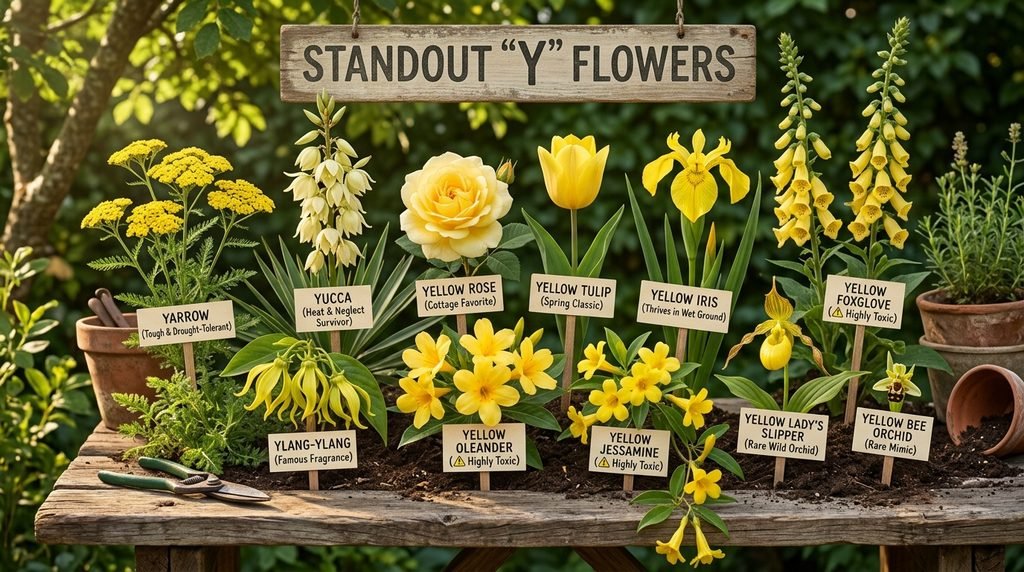
Yellow iris grows happily in wet ground where most perennials fail. Ylang-ylang brings a famous perfume flower to tropical gardens. Yellow oleander, yellow jessamine, and yellow foxglove all demand real caution, because each is highly toxic. Yellow lady’s slipper and yellow bee orchid round out the group as two of the rarest blooms on this list.
The Master List: Every Flower on This Guide, A to Z
Some entries below are best known by names that begin with Y, such as yarrow, yucca, and yerba mansa. Others use “yellow” as a first word, followed by a familiar flower, such as yellow rose or yellow dahlia. A few lead with a botanical genus name that gardeners also use, such as yucca. The list reflects that split. Each entry shows the common name first, then the botanical name.
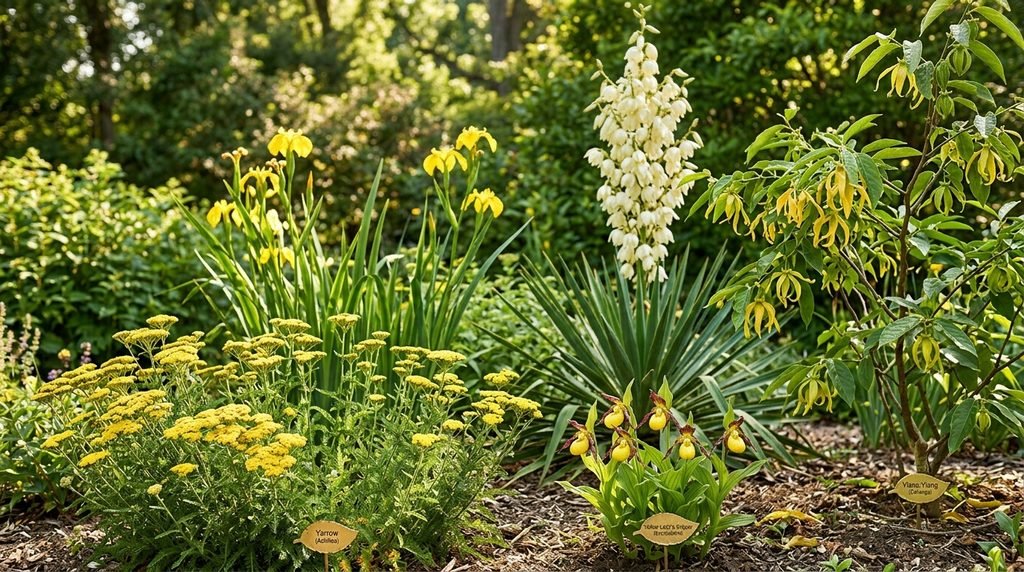
- Yarrow — Achillea millefolium
- Yellow Adder’s Tongue (Trout Lily) — Erythronium americanum
- Yellow Amaryllis — Hippeastrum (yellow cultivars)
- Yellow Archangel — Lamium galeobdolon
- Yellow Azalea — Rhododendron (yellow cultivars)
- Yellow Bee Orchid — Ophrys lutea
- Yellow Bells — Tecoma stans
- Yellow Butterwort — Pinguicula lutea
- Yellow Camellia — Camellia chrysantha
- Yellow Canna Lily — Canna indica (yellow cultivars)
- Yellow Carnation — Dianthus caryophyllus (yellow cultivars)
- Yellow Chamomile — Cota tinctoria
- Yellow Chrysanthemum — Chrysanthemum morifolium (yellow cultivars)
- Yellow Columbine — Aquilegia chrysantha
- Yellow Corydalis — Corydalis lutea
- Yellow Cosmos — Cosmos sulphureus
- Yellow Crocus — Crocus flavus
- Yellow Daffodil — Narcissus (yellow cultivars)
- Yellow Dahlia — Dahlia pinnata (yellow cultivars)
- Yellow Daylily — Hemerocallis lilioasphodelus
- Yellow Evening Primrose — Oenothera biennis
- Yellow Flag Iris — Iris pseudacorus
- Yellow Foxglove — Digitalis grandiflora
- Yellow Freesia — Freesia hybrida (yellow cultivars)
- Yellow Fritillary (Yellow Bell) — Fritillaria pudica
- Yellow Gentian — Gentiana lutea
- Yellow Gladiolus — Gladiolus (yellow cultivars)
- Yellow Hibiscus — Hibiscus rosa-sinensis (yellow cultivars)
- Yellow Horned Poppy — Glaucium flavum
- Yellow Hyacinth — Hyacinthus orientalis (yellow cultivars)
- Yellow Ice Plant — Delosperma nubigenum
- Yellow Jessamine — Gelsemium sempervirens
- Yellow Lady’s Slipper — Cypripedium parviflorum
- Yellow Loosestrife — Lysimachia vulgaris
- Yellow Marigold — Tagetes erecta (yellow cultivars)
- Yellow Meadow Rue — Thalictrum flavum
- Yellow Monkeyflower — Erythranthe guttata
- Yellow Oleander — Cascabela thevetia
- Yellow Orchid — Oncidium (yellow hybrids)
- Yellow Passionflower — Passiflora lutea
- Yellow Pitcher Plant — Sarracenia flava
- Yellow Poppy — Papaver (yellow cultivars)
- Yellow Ranunculus — Ranunculus asiaticus (yellow cultivars)
- Yellow Rattle — Rhinanthus minor
- Yellow Rocket — Barbarea vulgaris
- Yellow Rose — Rosa (yellow cultivars)
- Yellow Sage — Lantana camara
- Yellow Skunk Cabbage — Lysichiton americanus
- Yellow Snapdragon — Antirrhinum majus (yellow cultivars)
- Yellow Star Grass — Hypoxis hirsuta
- Yellow Sweet Clover — Melilotus officinalis
- Yellow Toadflax — Linaria vulgaris
- Yellow Trillium — Trillium luteum
- Yellow Tulip — Tulipa (yellow cultivars)
- Yellow Waterlily — Nuphar lutea
- Yellow Waxbells — Kirengeshoma palmata
- Yellow Wood Anemone — Anemone ranunculoides
- Yellow Wood Sorrel — Oxalis stricta
- Yellow Zinnia — Zinnia elegans (yellow cultivars)
- Yerba Mansa — Anemopsis californica
- Yesterday-Today-and-Tomorrow — Brunfelsia pauciflora
- Ylang-Ylang — Cananga odorata
- York and Lancaster Rose — Rosa × damascena versicolor
- Yucca — Yucca filamentosa
That makes 64 entries in total. Roughly two-thirds carry the letter in a true species or common name. The rest are yellow varieties of well-known garden flowers. Together they show how much depth flowers that start with Y offer when both groups are counted honestly.
Full Comparison Table: Bloom Time, Sun, and Safety at a Glance
The table below brings together bloom season, sun needs, toxicity level, and primary use for every flower in this guide. It makes it easy to scan for a specific combination, such as a spring-blooming, full-sun, pet-safe plant. Toxicity ratings reflect the research in the caution section, condensed for quick reference. Read the Toxicity column first if pets or children share your garden.
Read More: 30+ Beautiful Flowers That Start With Q (With Pictures & Names)
| Flower | Bloom Season | Sun | Toxicity | Primary Use |
| Yarrow | Summer | Full sun | Mild | Garden, pollinator |
| Yellow Adder’s Tongue (Trout Lily) | Spring | Part to full shade | Non-toxic | Native woodland bulb |
| Yellow Amaryllis | Winter (indoors) | Bright indirect | Moderate | Holiday bulb display |
| Yellow Archangel | Spring | Partial shade | Non-toxic | Shaded groundcover |
| Yellow Azalea | Spring | Partial shade | High | Woodland shrub (caution) |
| Yellow Bee Orchid | Spring | Full sun | Non-toxic | Rare wild specimen |
| Yellow Bells | Summer–fall | Full sun | Mild | Warm-climate flowering shrub |
| Yellow Butterwort | Spring–summer | Full sun | Non-toxic | Carnivorous bog specimen |
| Yellow Camellia | Winter–spring | Partial shade | Non-toxic | Rare specimen shrub |
| Yellow Canna Lily | Summer–fall | Full sun | Non-toxic | Tropical border |
| Yellow Carnation | Spring–fall | Full sun | Mild | Cut flower |
| Yellow Chamomile | Summer | Full sun | Non-toxic | Border, dye garden |
| Yellow Chrysanthemum | Fall | Full sun | Mild | Cut flower, fall décor |
| Yellow Columbine | Spring–summer | Partial shade | Mild | Woodland border |
| Yellow Corydalis | Spring–fall | Partial shade | Mild | Shaded rock garden |
| Yellow Cosmos | Summer–fall | Full sun | Non-toxic | Cutting garden |
| Yellow Crocus | Late winter–early spring | Full sun | Mild | Early bulb display |
| Yellow Daffodil | Early spring | Full sun–part shade | Moderate | Naturalized spring bulb |
| Yellow Dahlia | Summer–fall | Full sun | Mild | Cut flower, border |
| Yellow Daylily | Summer | Full sun | High (cats) | Naturalized border |
| Yellow Evening Primrose | Summer | Full sun | Non-toxic | Fragrant evening border |
| Yellow Flag Iris | Late spring | Full sun–part shade | Low to moderate | Pond edge, boggy border |
| Yellow Foxglove | Summer | Partial shade | High | Cottage border (caution) |
| Yellow Freesia | Spring | Full sun | Non-toxic | Fragrant cut flower |
| Yellow Fritillary (Yellow Bell) | Spring | Full sun | Mild | Native bulb specialty |
| Yellow Gentian | Summer | Full sun–part shade | Non-toxic | Alpine specimen |
| Yellow Gladiolus | Summer | Full sun | Moderate | Cut flower, border accent |
| Yellow Hibiscus | Summer–fall | Full sun | Non-toxic | Tropical container specimen |
| Yellow Horned Poppy | Summer | Full sun | Moderate | Coastal wildflower |
| Yellow Hyacinth | Early spring | Full sun–part shade | Moderate | Fragrant bulb display |
| Yellow Ice Plant | Summer | Full sun | Non-toxic | Groundcover, rock garden |
| Yellow Jessamine | Spring | Full sun–part shade | High | Fragrant vine (caution) |
| Yellow Lady’s Slipper | Spring | Partial shade | Mild | Rare native woodland specimen |
| Yellow Loosestrife | Summer | Full sun–part shade | Non-toxic | Border, moist ground |
| Yellow Marigold | Summer–fall | Full sun | Non-toxic | Bedding, companion planting |
| Yellow Meadow Rue | Summer | Partial shade | Mild | Woodland border |
| Yellow Monkeyflower | Spring–summer | Full sun–part shade | Non-toxic | Streamside native planting |
| Yellow Oleander | Nearly year-round (warm) | Full sun | High | Ornamental shrub (caution) |
| Yellow Orchid | Varies | Bright indirect | Non-toxic | Houseplant |
| Yellow Passionflower | Summer–fall | Full sun–part shade | Non-toxic | Native vine |
| Yellow Pitcher Plant | Spring–summer | Full sun | Non-toxic | Carnivorous bog specimen |
| Yellow Poppy | Spring–summer | Full sun | Mild | Cottage border |
| Yellow Ranunculus | Spring | Full sun–part shade | Moderate | Cut flower |
| Yellow Rattle | Summer | Full sun | Mild | Meadow restoration |
| Yellow Rocket | Spring | Full sun | Non-toxic | Naturalized wildflower |
| Yellow Rose | Spring–fall | Full sun | Non-toxic | Cut flower, friendship gift |
| Yellow Sage | Spring–fall | Full sun | Moderate to High | Butterfly border (caution) |
| Yellow Skunk Cabbage | Spring | Partial shade | Moderate | Boggy native planting |
| Yellow Snapdragon | Spring–fall | Full sun | Non-toxic | Cut flower, border |
| Yellow Star Grass | Spring–summer | Full sun–part shade | Non-toxic | Native wildflower meadow |
| Yellow Sweet Clover | Summer | Full sun | Mild | Pollinator, cover crop |
| Yellow Toadflax | Summer–fall | Full sun | Mild | Naturalized border |
| Yellow Trillium | Spring | Full shade | Mild | Native woodland specimen |
| Yellow Tulip | Early–mid spring | Full sun | Moderate | Spring bulb display |
| Yellow Waterlily | Summer | Full sun | Non-toxic | Pond, water garden |
| Yellow Waxbells | Late summer | Partial shade | Non-toxic | Shade border |
| Yellow Wood Anemone | Spring | Full to partial shade | Mild | Woodland groundcover |
| Yellow Wood Sorrel | Summer | Full sun–part shade | Mild | Edible groundcover |
| Yellow Zinnia | Summer–fall | Full sun | Non-toxic | Cutting garden |
| Yerba Mansa | Spring–summer | Full sun–part shade | Non-toxic | Wetland native garden |
| Yesterday-Today-and-Tomorrow | Summer | Full sun–part shade | High | Color-shifting shrub (caution) |
| Ylang-Ylang | Summer | Full sun | Non-toxic | Fragrance, tropical specimen |
| York and Lancaster Rose | Summer | Full sun | Non-toxic | Historic rose specimen |
| Yucca | Summer | Full sun | Mild | Architectural accent |
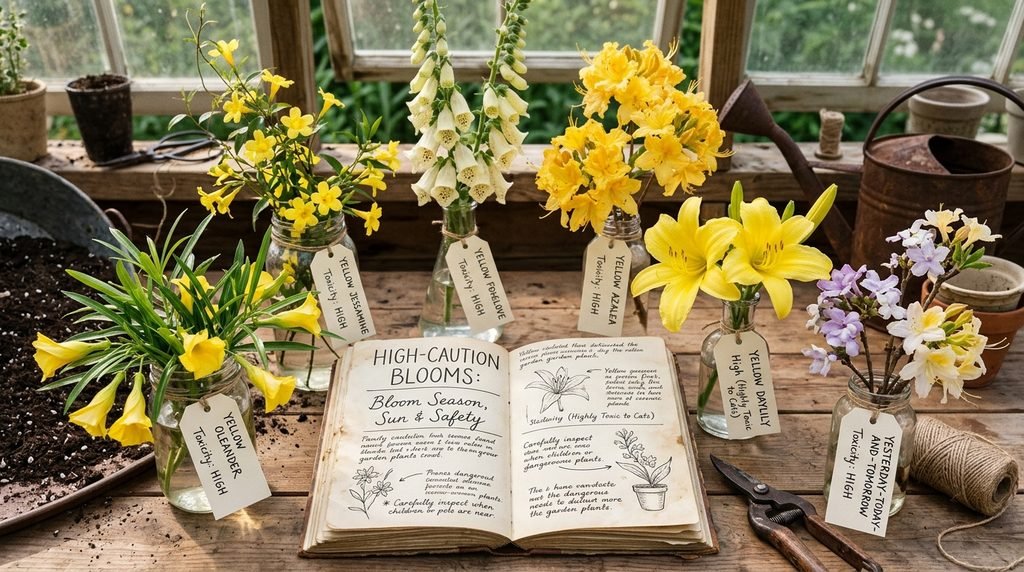
Four rows stand out. Yellow oleander, yellow jasmine, yellow foxglove, and yesterday-today-and-tomorrow are among the most dangerous plants on the list. Yellow azalea surprises people, since azaleas are sold everywhere yet carry a high rating.
Garden Favorites Among Flowers That Start With Y
A small core group of dependable plants does most of the work in a typical garden. Yarrow tolerates drought and poor soil while producing flat, golden clusters all summer. Yellow iris thrives in boggy ground that kills many perennials. Yucca adds bold, architectural form with almost no care once it settles in.
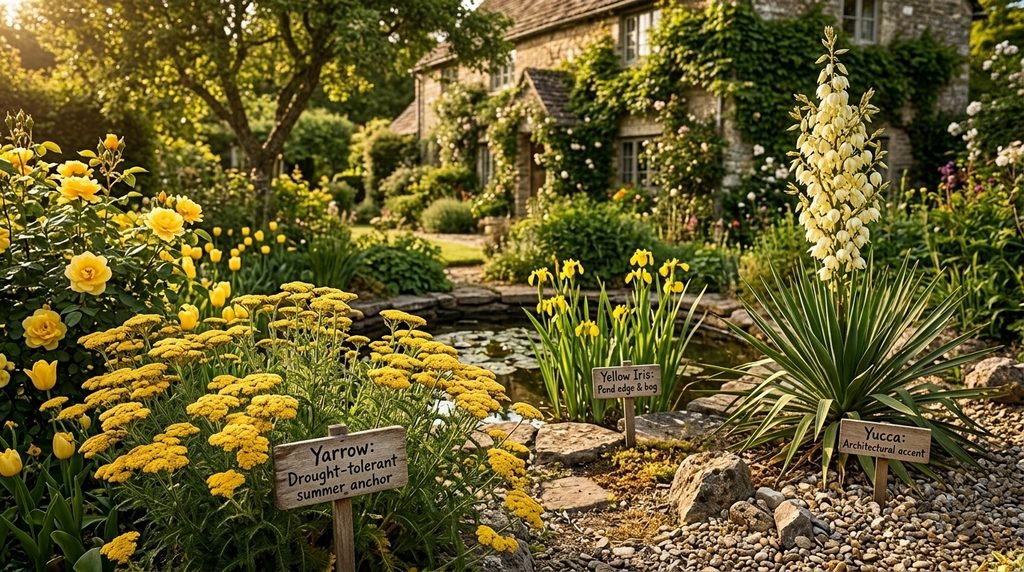
Yellow daffodil returns each spring for years. Yellow evening primrose opens at dusk and draws moths and other night pollinators. Together, these plants cover sun, wet soil, dry soil, and every season from early spring to fall.
| Flower | Botanical Name | Best Garden Role |
| Yarrow | Achillea millefolium | Drought-tolerant summer anchor |
| Yellow Flag Iris | Iris pseudacorus | Pond edge, boggy border |
| Yucca | Yucca filamentosa | Architectural, low-maintenance accent |
| Yellow Rose | Rosa (yellow cultivars) | Classic border and cut-flower color |
| Yellow Tulip | Tulipa (yellow cultivars) | Spring bulb display |
| Yellow Daffodil | Narcissus (yellow cultivars) | Naturalized early bulb |
| Yellow Evening Primrose | Oenothera biennis | Fragrant evening border |
Yarrow and yucca share a useful trait. Both perform worse in rich, heavily fed soil, so they suit the driest, leanest corner of a yard better than a showcase bed.
See More Flowers: 30+ Beautiful Flowers That Start With Q (With Pictures & Names)
Indoor Plants: Flowers That Start With Y for Pots and Windowsills
A few Y flowers do best indoors or in containers, where steady warmth and light replace a climate that cannot support them outdoors. Yellow orchid, usually an Oncidium hybrid, produces long sprays of bright blooms that last for weeks on a sunny windowsill. Yellow amaryllis turns a winter room into a showpiece, with huge trumpets rising from a single bulb.
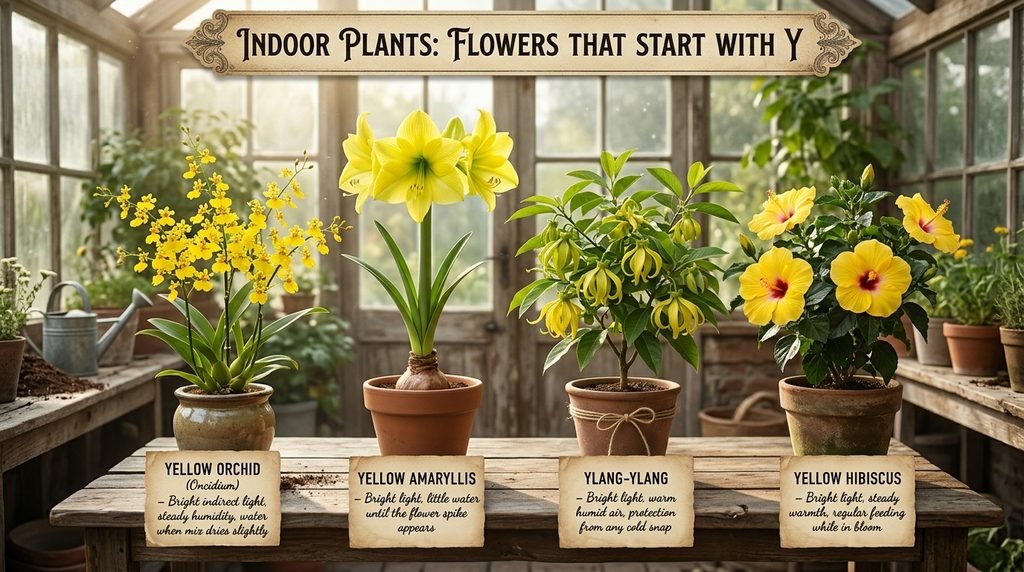
Ylang-ylang can be grown in a heated greenhouse outside the tropics, and its fragrant flowers are famous in perfumery. Yellow hibiscus works as a container plant that moves indoors before frost.
- Yellow Orchid — bright indirect light, steady humidity, water when the mix dries slightly
- Yellow Amaryllis — bright light, little water until the flower spike appears
- Ylang-Ylang — bright light, warm humid air, protection from any cold snap
- Yellow Hibiscus — bright light, steady warmth, regular feeding while in bloom
Yellow orchid is the easiest of the four for a beginner. Ylang-ylang is the most demanding, since it needs genuinely warm, humid air to do well.
Florist Favorites: Y Flowers Built for Cutting and Arranging
Cut-flower value depends on vase life, stem strength, and versatility. Yellow rose is a top pick, since it holds its shape well and carries a friendship meaning rather than a romantic one. Yellow freesia brings one of the most distinctive scents in the cut-flower trade.
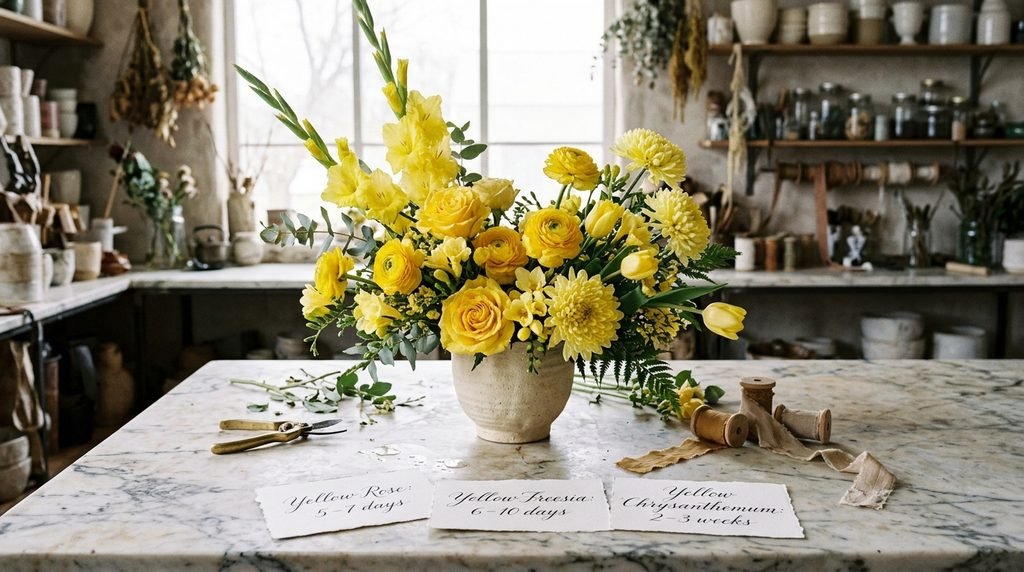
. Yellow ranunculus adds ruffled layers that look rich and romantic in wedding bouquets.
| Flower | Vase Life | Why Florists Use It |
| Yellow Rose | 5–7 days | Friendship symbolism, reliable shape |
| Yellow Freesia | 6–10 days | Strong, distinctive fragrance |
| Yellow Tulip | 5–7 days | Spring structure, wide availability |
| Yellow Gladiolus | 7–10 days | Dramatic height, gradual bloom |
| Yellow Chrysanthemum | 2–3 weeks | Exceptional vase life |
| Yellow Ranunculus | 5–7 days | Ruffled, romantic layers |
A bunch can look fresh long after most other cut flowers have faded.
Rare Flowers: The Harder-to-Find Entries on This List
A handful of flowers that start with Y are genuinely uncommon. Yellow lady’s slipper is the best known. This native orchid depends on specific soil fungi, so it is very hard to move or grow outside its woodland home. Yellow bee orchid, a European wildflower, has a bloom that mimics a female bee to lure pollinators. It is rarely seen outside the wild.
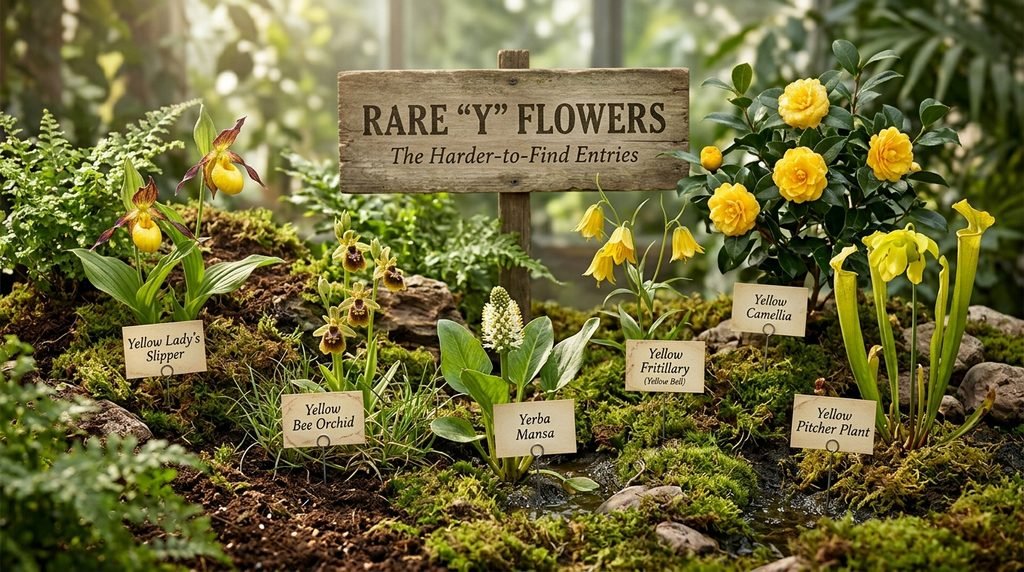
Yerba mansa is a wetland native of the American Southwest that needs soggy soil to thrive. Yellow fritillary, also called yellow bell, needs the wet-spring and dry-summer cycle of its western North American home. Yellow camellia is prized by collectors for its golden blooms, a color almost unknown among camellias.
View Full Guide: 90+ Beautiful Flowers That Start With R: Names, Photos & Meaning
Color Groupings: Choosing Y Flowers by Color
Yellow dominates this letter, both by naming habit and by nature. Yarrow, yellow rose, yellow iris, yellow cosmos, and dozens of other entries show shades from pale butter to deep gold. Yellow lifts a garden on gray days and pairs well with purple and blue. Use it in sunny borders, meadow plantings, and spring bulb drifts, where it reads as warm and cheerful.
White appears in yerba mansa’s small flower clusters and in York and Lancaster rose, an old striped rose that carries white and pink on one bloom. Both suit evening gardens and wetland edges. Purple shows up in yesterday-today-and-tomorrow, whose flowers open deep violet, fade to lavender, and end nearly white. That slow color change gives one shrub three shades at once.
Greenish-yellow belongs to ylang-ylang, a softer tone than the bright golds elsewhere. Orange and amber appear in yellow bells and yellow horned poppy, depending on cultivar and conditions. Use them where you want a warmer note against greener neighbors.
Choosing by Life Cycle: Annuals, Perennials, Bulbs, and Beyond
Matching a flower’s life cycle to your planning horizon matters as much as matching its color. An annual needs replanting every year. A shrub or tree becomes a permanent fixture. Perennials make up the largest group among flowers that start with Y. They return each year with less effort. Bulbs form a strong second group, including several spring bloomers that finish early and rest.
True annuals are fewer, led by yellow cosmos, yellow marigold, yellow zinnia, and yellow rattle. Shrubs and trees round out the list with ylang-ylang, yellow bells, and yellow oleander.
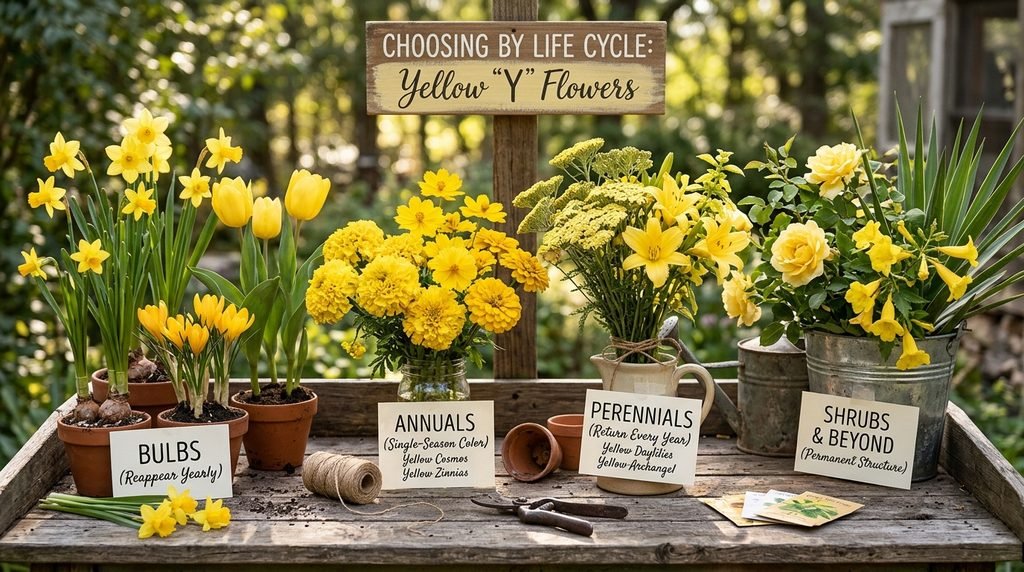
| Flower | Life Cycle |
| Yarrow | Perennial |
| Yellow Adder’s Tongue (Trout Lily) | Bulb |
| Yellow Amaryllis | Bulb |
| Yellow Archangel | Perennial |
| Yellow Azalea | Deciduous shrub |
| Yellow Bee Orchid | Perennial (terrestrial orchid) |
| Yellow Bells | Shrub |
| Yellow Butterwort | Perennial (carnivorous) |
| Yellow Camellia | Evergreen shrub |
| Yellow Canna Lily | Perennial (rhizome) |
| Yellow Carnation | Perennial |
| Yellow Chamomile | Perennial |
| Yellow Chrysanthemum | Perennial |
| Yellow Columbine | Perennial |
| Yellow Corydalis | Perennial |
| Yellow Cosmos | Annual |
| Yellow Crocus | Bulb (corm) |
| Yellow Daffodil | Bulb |
| Yellow Dahlia | Tuberous perennial |
| Yellow Daylily | Perennial |
| Yellow Evening Primrose | Biennial |
| Yellow Flag Iris | Perennial (rhizome) |
| Yellow Foxglove | Biennial or short-lived perennial |
| Yellow Freesia | Bulb (corm) |
| Yellow Fritillary (Yellow Bell) | Bulb |
| Yellow Gentian | Perennial |
| Yellow Gladiolus | Bulb (corm) |
| Yellow Hibiscus | Perennial shrub |
| Yellow Horned Poppy | Biennial or short-lived perennial |
| Yellow Hyacinth | Bulb |
| Yellow Ice Plant | Perennial (succulent) |
| Yellow Jessamine | Perennial vine |
| Yellow Lady’s Slipper | Perennial (terrestrial orchid) |
| Yellow Loosestrife | Perennial |
| Yellow Marigold | Annual |
| Yellow Meadow Rue | Perennial |
| Yellow Monkeyflower | Perennial (short-lived) |
| Yellow Oleander | Evergreen shrub |
| Yellow Orchid | Perennial (epiphytic orchid) |
| Yellow Passionflower | Perennial vine |
| Yellow Pitcher Plant | Perennial (carnivorous) |
| Yellow Poppy | Annual or perennial |
| Yellow Ranunculus | Tuberous perennial |
| Yellow Rattle | Annual |
| Yellow Rocket | Biennial |
| Yellow Rose | Perennial shrub |
| Yellow Sage | Perennial shrub |
| Yellow Skunk Cabbage | Perennial |
| Yellow Snapdragon | Annual or short-lived perennial |
| Yellow Star Grass | Perennial |
| Yellow Sweet Clover | Biennial |
| Yellow Toadflax | Perennial |
| Yellow Trillium | Perennial |
| Yellow Tulip | Bulb |
| Yellow Waterlily | Perennial (aquatic) |
| Yellow Waxbells | Perennial |
| Yellow Wood Anemone | Perennial (tuber) |
| Yellow Wood Sorrel | Perennial |
| Yellow Zinnia | Annual |
| Yerba Mansa | Perennial |
| Yesterday-Today-and-Tomorrow | Shrub |
| Ylang-Ylang | Tree |
| York and Lancaster Rose | Perennial shrub |
| Yucca | Perennial (evergreen) |
The table shows the perennial-and-bulb lean of this letter. Annuals are a small but useful group for single-season color. Anyone who wants permanent structure will find strong options in yucca, yellow rose, and the shrubs.
Why Botanical Names Matter for This Letter
Common names cause real confusion with this letter. The word “yellow” starts dozens of names, and each one points to a different plant from a different family. A few names also mislead. Yellow jessamine is often called Carolina jasmine, yet it is not a true jasmine and is seriously toxic. Yellow adder’s tongue and yellow trout lily are the same plant. A botanical name settles the question at once.
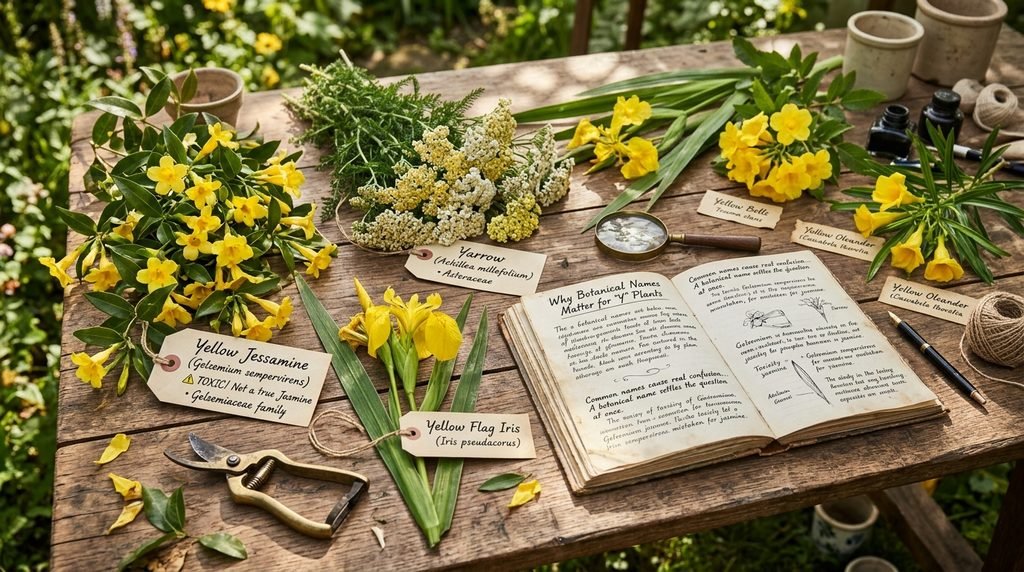
| Common Name | Botanical Name | Plant Family |
| Yarrow | Achillea millefolium | Asteraceae |
| Yellow Flag Iris | Iris pseudacorus | Iridaceae |
| Yellow Jessamine | Gelsemium sempervirens | Gelsemiaceae |
| Yellow Bells | Tecoma stans | Bignoniaceae |
| Yucca | Yucca filamentosa | Asparagaceae |
| Ylang-Ylang | Cananga odorata | Annonaceae |
| Yellow Oleander | Cascabela thevetia | Apocynaceae |
| Yesterday-Today-and-Tomorrow | Brunfelsia pauciflora | Solanaceae |
The jessamine row deserves a second look. Assuming it behaves like a true jasmine could lead someone to underestimate a plant that carries real cardiac toxicity.
What These Flowers Are Said to Represent
Symbolism across this letter leans on yellow’s wider cultural meanings. The yellow rose stands for friendship and warmth rather than romance, which sets it apart from red roses in most flower-language traditions. The yellow tulip carries a cheerful message, often read as sunshine and happy thoughts.
Yarrow’s name comes from Achilles, the legendary warrior who was said to use it to treat wounds. It has long stood for healing, protection, and courage. Yucca carries meanings of resilience in some Indigenous North American traditions, where the plant also served as food, fiber, and soap. Ylang-ylang is tied to celebration and romance in parts of Southeast Asia and the Pacific, and its flowers appear in traditional wedding rituals.
York and Lancaster rose carries a historical story. Its striped petals are linked in legend to the union of the rival houses in the Wars of the Roses. Many smaller entries, such as yellow corydalis and yellow rattle, have no deep symbolic history, and it is more honest to say so than to invent one.
Decision Guide: Matching a Scenario to the Right Y Flower
Sometimes the fastest way to choose a flower is not to read a whole list. It helps to start with the problem that needs solving, whether that is a boggy corner, a fragrant container, or a household with pets. The table below maps common situations to the Y flowers that fit best.
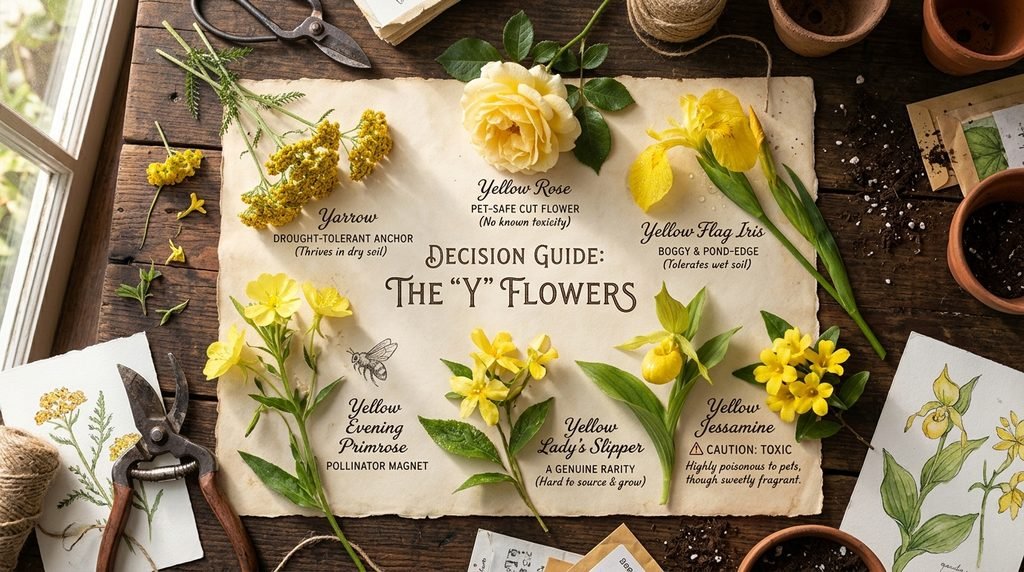
| If You Need… | Consider | Why |
| A drought-tolerant anchor plant | Yarrow, Yucca | Both thrive on neglect in lean, dry soil |
| A pet-safe cut flower | Yellow Rose, Yellow Freesia | No documented serious toxicity |
| Boggy or pond-edge planting | Yellow Flag Iris, Yerba Mansa | Both tolerate wet or saturated soil |
| A pollinator magnet | Yellow Evening Primrose, Yellow Sweet Clover | Long bloom windows, easy access for bees and moths |
| A genuine rarity to chase | Yellow Lady’s Slipper, Yellow Bee Orchid | Both are hard to source and grow |
| A plant to avoid around pets | Yellow Oleander, Yellow Jessamine, Yellow Foxglove, Yellow Daylily | All four carry documented high toxicity |
Anyone drawn to yellow jessamine for its fragrance should weigh that appeal against its toxicity. Its resemblance to true jasmine can create a false sense of safety.
Caution: Y Flowers That Need Careful Placement
Toxicity risk varies sharply across this letter. A few entries deserve serious attention. Yellow oleander contains cardiac glycosides in every part, and even a small amount can disturb the heart of a person or a pet. Yellow jessamine carries a similar danger, and its nectar has been reported to harm honeybees in some regions.
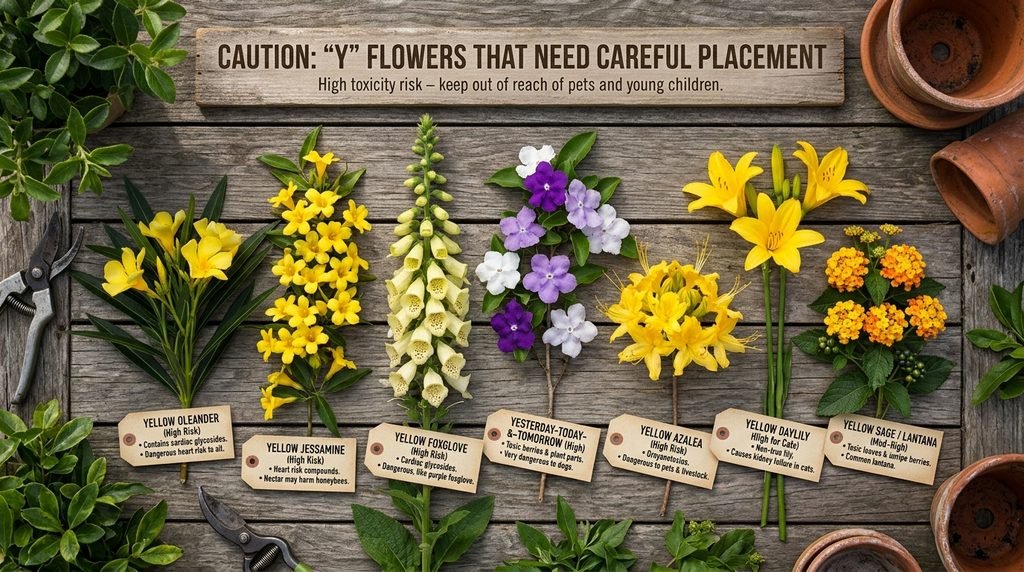
Yesterday-today-and-tomorrow is sold as a charming fragrant shrub, yet its berries and other parts are poisonous, and dogs are especially at risk. Yellow azalea belongs to the rhododendron group, which contains grayanotoxins that affect pets and livestock.
| Flower | Toxicity Level | Risk Details |
| Yellow Oleander | High | Cardiac glycosides; can cause fatal heart rhythm problems |
| Yellow Jessamine | High | Cardiac-affecting compounds; nectar may harm honeybees |
| Yellow Foxglove | High | Cardiac glycosides, like common foxglove |
| Yesterday-Today-and-Tomorrow | High | Toxic berries and plant parts; dangerous to dogs |
| Yellow Azalea | High | Grayanotoxins; dangerous to pets and livestock |
| Yellow Daylily | High (cats) | Can cause kidney failure in cats |
| Yellow Sage (Lantana) | Moderate to High | Toxic leaves and unripe berries |
Households with pets or young children should treat the first six plants in this table as a firm no. Keeping them out of reach is not enough when even small contact can cause harm.
Conclusion
Flowers that start with Y cover a wide range, from drought-tough anchors and fragrant tropical shrubs to rare native orchids and a cluster of plants that demand real caution. Choosing among them comes down to matching a flower to a real spot, household, or purpose, rather than working down an alphabetical list. With the comparison table, category breakdowns, and decision guide above, narrowing this list to the few that truly fit your garden should take far less trial and error than starting from scratch.
Frequently Asked Questions
1. How many flowers that start with Y are there?
This guide covers 64 verified flowers that start with Y. They combine true Y-named plants with well-documented yellow varieties of familiar garden flowers.
2. What is the easiest Y flower to grow?
Yarrow is the easiest. It tolerates drought, poor soil, and neglect while blooming all summer.
3. Which Y flowers are toxic to pets?
Yellow oleander, yellow jessamine, yellow foxglove, yesterday-today-and-tomorrow, and yellow azalea are all highly toxic. Yellow daylily is especially dangerous for cats.
4. Is yellow jessamine the same as jasmine?
No. It is often called Carolina jasmine, but it belongs to a different genus. It carries a cardiac toxicity risk that true jasmine does not share.
5. What Y flowers work well indoors?
Yellow orchid, yellow amaryllis, and yellow hibiscus are the most common choices. Yellow orchid tolerates home humidity best.
6. What is the fastest-blooming Y flower?
Yellow cosmos usually blooms within seven to nine weeks from seed. Yellow zinnia and yellow marigold are close behind.
7. Can yucca survive cold winters?
Many yucca species are hardy to USDA zone 4. They handle hard freezes better than their desert look suggests.