
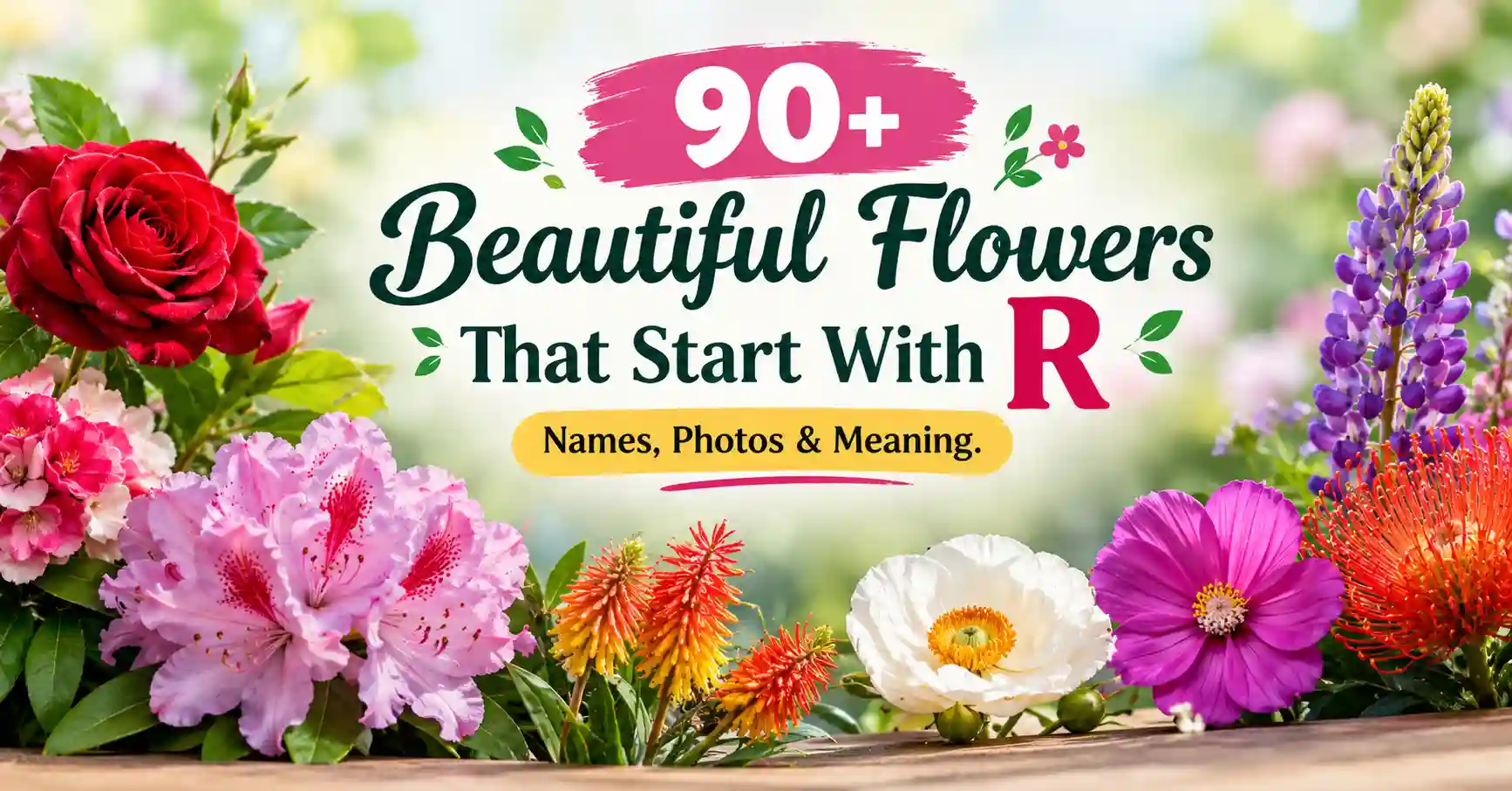
Flowers that start with R begin with the most famous flower of all. Rose, ranunculus, rhododendron, and rudbeckia are the names most people know. But the letter R also hides lovely surprises, like a fragrant night-blooming shrub, a lily that blooms on bare stems after rain, and a vine that changes color as it ages. This guide gathers 92 of them in one place.
Every plant below is real and has a verified botanical name. You will find border favorites, roses, houseplants, florist picks, trees, wildflowers, and a few rarities. Only one entry is grown mainly as a herb, and it is clearly marked as an exception.
A long list only helps if you can use it. So this guide sorts the plants by color, life cycle, and use. A bloom’s beauty means little if it dies in your climate. It means even less if it harms a child or a pet. Each table is explained in plain words first, so you never face a bare spreadsheet.
You will see many names that start with Red, Rock, Rose, and Royal. Those words hint at color, habitat, or look. Read straight through or jump to what you need. Have a cat? Check the toxicity section first, because regal and rubrum lilies are deadly to cats. Want a quick pick? Try the decision table near the end.
Quick Answer: Ten Standout R Flowers
Rose is the obvious star, with endless colors, scents, and shapes for gardens and vases. Ranunculus is its ruffled cousin, loved by florists for layered, rose-like blooms. Rudbeckia and Russian sage are the tough, long-blooming pair for hot, sunny borders.
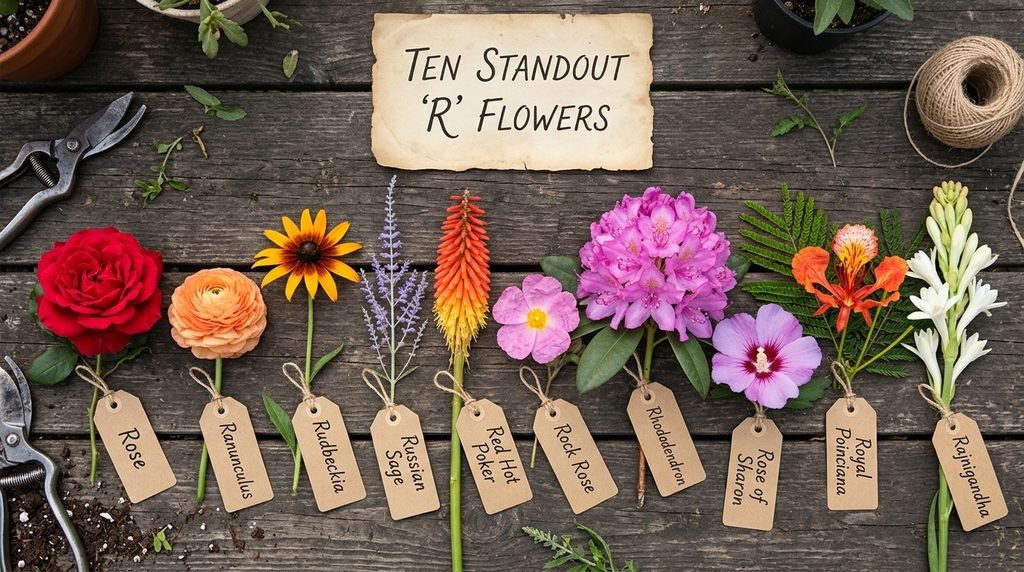
Red hot poker draws hummingbirds with fiery spikes, and rock rose thrives on dry slopes with papery pink blooms. Rhododendron lights up shady spring gardens, though every part is toxic. Rose of Sharon gives late-summer color to a hardy shrub, and royal poinciana, known as gulmohar, covers whole trees in fire-red flowers. Rajnigandha rounds out the list as the night-scented spikes loved across South Asia.
Master Alphabetical List of Flowers That Start With R
This list names 92 flowers. Most entries use a common name that gardeners already know. A few are better known by their botanical name, so they appear under the name nurseries print on plant tags. Each row has a short note, so you can see at a glance what the plant looks like and where it grows best. One entry is marked as an exception because the flower is not the main reason people grow it.
| Flower | Botanical Name | Note |
| Raat Ki Rani | Cestrum nocturnum | Night-scented greenish blooms, not a true jasmine, toxic berries |
| Ragged Robin | Silene flos-cuculi | Pink shredded petals for damp meadows |
| Rain Daisy | Dimorphotheca pluvialis | White daisies with purple-blue centers that close in clouds |
| Rain Lily | Zephyranthes grandiflora | Pink crocus-like blooms after rain |
| Rajnigandha | Agave amica | Intensely fragrant white evening spikes (tuberose) |
| Rampion | Campanula rapunculus | Pale blue spires, old kitchen-garden plant |
| Rangoon Creeper | Combretum indicum | Blooms that change from white to pink to red |
| Ranunculus | Ranunculus asiaticus | Layered rose-like blooms in bright colors |
| Rat’s Tail Cactus | Aporocactus flagelliformis | Trailing stems with pink-red tubular blooms |
| Rattail Statice | Limonium suworowii | Pink tapering spikes, good for drying |
| Rattlebox | Crotalaria retusa | Yellow pea flowers, toxic to livestock |
| Rattlesnake Master | Eryngium yuccifolium | White globes on spiky native stems |
| Rebutia | Rebutia minuscula | Tiny cactus covered in red-orange flowers |
| Red Baneberry | Actaea rubra | White woodland spikes, toxic red berries |
| Red Buckeye | Aesculus pavia | Red tubular spikes, hummingbird favorite, toxic seeds |
| Red Campion | Silene dioica | Bright pink-red woodland edge flower |
| Red Cestrum | Cestrum elegans | Rosy-red tubular clusters on a tropical shrub |
| Red Clover | Trifolium pratense | Pink pom-poms that feed bees |
| Red Columbine | Aquilegia canadensis | Red and yellow nodding lanterns |
| Red Flowering Currant | Ribes sanguineum | Pink tassels that draw early bees |
| Red Ginger | Alpinia purpurata | Scarlet bracts on tall tropical stems |
| Red Hot Cat’s Tail | Acalypha hispida | Long red fuzzy tails, tropical shrub |
| Red Hot Poker | Kniphofia uvaria | Orange and yellow torch spikes |
| Red Sage | Salvia splendens | Scarlet bedding spikes for hot sun |
| Red Spider Lily | Lycoris radiata | Crimson curling blooms on bare stems in fall |
| Red Trillium | Trillium erectum | Maroon three-petaled woodland bloom |
| Red Turk’s Cap | Malvaviscus arboreus | Red hibiscus-like buds that never fully open |
| Red Valerian | Centranthus ruber | Red-pink clusters that grow in walls |
| Red-Flowering Gum | Corymbia ficifolia | Crimson blossom clusters on a tree |
| Redbud | Cercis canadensis | Magenta-pink blooms on bare branches |
| Redwood Sorrel | Oxalis oregana | Pale pink blooms under clover-like leaves |
| Reed Orchid | Epidendrum ibaguense | Orange-red orchid clusters on tall stems |
| Regal Lily | Lilium regale | White trumpets with a golden throat, deadly to cats |
| Regal Pelargonium | Pelargonium × domesticum | Large ruffled blooms in spring |
| Reinwardtia (Yellow Flax) | Reinwardtia indica | Bright yellow winter blooms in warm gardens |
| Reticulated Iris | Iris reticulata | Tiny deep-blue iris of late winter |
| Rhodanthe | Rhodanthe chlorocephala | Papery pink-white everlasting daisies |
| Rhodochiton | Rhodochiton atrosanguineus | Pink bells with dark purple tubes on a vine |
| Rhododendron | Rhododendron spp. | Big spring clusters, highly toxic |
| Rhodohypoxis | Rhodohypoxis baurii | Tiny pink star flowers for rock gardens |
| Rhodora | Rhododendron canadense | Pink-purple early blooms on a bog shrub |
| Rice Flower | Ozothamnus diosmifolius | White rice-like clusters, popular in bouquets |
| River Lily | Hesperantha coccinea | Red satin cups in fall |
| Robin’s Plantain | Erigeron pulchellus | Pale lilac daisies in spring woods |
| Rock Cress | Arabis caucasica | White spring carpet for walls |
| Rock Harlequin | Corydalis sempervirens | Pink and yellow tubes on lacy leaves |
| Rock Jasmine | Androsace spp. | Tiny pink or white alpine cushions |
| Rock Purslane | Calandrinia spectabilis | Magenta silky cups on gray leaves |
| Rock Rose | Cistus × purpureus | Papery pink blooms with dark spots |
| Rock Soapwort | Saponaria ocymoides | Pink spring carpet for sun |
| Rocket Larkspur | Consolida ajacis | Tall spikes in blue, pink, and white, toxic |
| Rocky Mountain Columbine | Aquilegia caerulea | Blue and white spurred flowers |
| Rocky Mountain Iris | Iris missouriensis | Pale violet wild iris |
| Rocky Mountain Penstemon | Penstemon strictus | Blue-purple tubular spikes |
| Rodgersia | Rodgersia podophylla | Creamy plumes over bold leaves |
| Roman Chamomile | Chamaemelum nobile | Small white daisies, apple-scented |
| Roman Hyacinth | Hyacinthus orientalis | Fragrant spring spikes in many colors |
| Romulea | Romulea rosea | Pink crocus-like blooms from South Africa |
| Rose (Damask) | Rosa damascena | Intensely fragrant pink rose used for rose water |
| Rose (Hybrid Tea) | Rosa × hybrida | Classic long-stemmed florist rose |
| Rose Acacia | Robinia hispida | Rosy pea flowers on a suckering shrub |
| Rose Campion | Lychnis coronaria | Magenta blooms over silver leaves |
| Rose Mallow | Hibiscus moscheutos | Dinner-plate blooms for wet soil |
| Rose Moss | Portulaca grandiflora | Drought-proof, sun-loving carpet |
| Rose of Sharon | Hibiscus syriacus | Late-summer blooms on a hardy shrub |
| Rose of Venezuela | Brownea grandiceps | Giant red globes on a tropical tree |
| Rose Pink | Sabatia angularis | Fragrant pink wildflower of meadows |
| Rose Turtlehead | Chelone obliqua | Pink snapdragon-like fall blooms |
| Rose Verbena | Glandularia canadensis | Spreading rosy-purple clusters |
| Rosebay Rhododendron | Rhododendron maximum | Pink-white summer clusters, toxic |
| Rosebay Willowherb | Chamaenerion angustifolium | Tall pink-purple spikes, fast colonizer |
| Roselle | Hibiscus sabdariffa | Pale blooms, red calyces used for tea |
| Rosemary (exception) | Salvia rosmarinus | Small blue flowers on a culinary herb |
| Rosemary Grevillea | Grevillea rosmarinifolia | Red spidery blooms on a hardy shrub |
| Rosinweed | Silphium integrifolium | Yellow sunflower-like native |
| Rosy Garlic | Allium roseum | Pink ornamental onion flowers |
| Rosy Periwinkle | Catharanthus roseus | Heat-tolerant pink or white pinwheels |
| Rough Blazing Star | Liatris aspera | Purple button spikes, butterfly favorite |
| Round-Headed Leek | Allium sphaerocephalon | Burgundy egg-shaped flower heads |
| Round-Leaved Sundew | Drosera rotundifolia | Tiny white flowers on a carnivorous plant |
| Royal Azalea | Rhododendron schlippenbachii | Pale pink spring blooms, toxic |
| Royal Catchfly | Silene regia | Scarlet star-shaped prairie flowers |
| Royal Poinciana | Delonix regia | Fiery red blooms on a spreading shade tree |
| Rubrum Lily | Lilium speciosum var. rubrum | Pink-spotted late-season lily, deadly to cats |
| Rudbeckia | Rudbeckia hirta | Golden daisies with dark centers |
| Rue Anemone | Thalictrum thalictroides | Delicate white woodland stars |
| Ruellia | Ruellia brittoniana | Purple trumpets, tough in heat |
| Rugosa Rose | Rosa rugosa | Hardy, fragrant, coastal-tolerant rose |
| Russelia | Russelia equisetiformis | Red tubular sprays, hummingbird plant |
| Russian Sage | Salvia yangii | Lavender-blue haze from midsummer |
| Russian Statice | Goniolimon tataricum | Papery clouds for dried flowers |
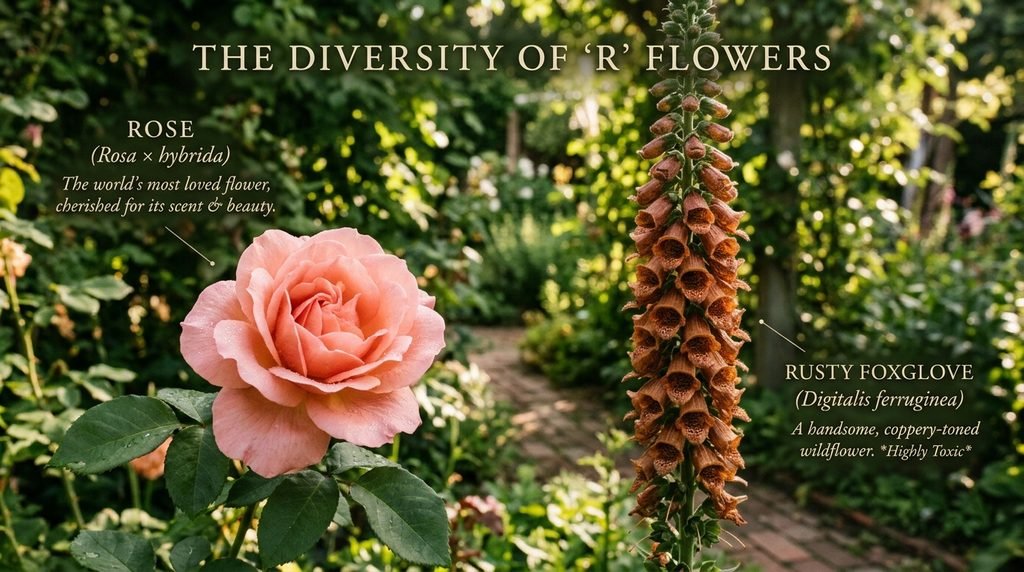
| Rusty Foxglove | Digitalis ferruginea | Tall coppery spikes, highly toxic |
That table names 92 distinct flowers that start with R. Rose and rusty foxglove sit far apart in character. One is the most loved flower in the world. The other is a handsome plant that is highly poisonous. Both show how wide this single letter reaches.
Full Comparison Table: Sun, Water, and Bloom Time
When two plants seem equally good, sun and water needs usually pick the winner. The table below compares the main R flowers from this guide. Read the sun column first. Then check the water column and the bloom season to see if the plant fits your space and your calendar.
| Flower | Sun Needs | Water Needs | Bloom Season |
| Ranunculus | Full sun | Moderate | Spring |
| Rain Lily | Full sun to part shade | Moderate | Summer, after rain |
| Rose (Hybrid Tea) | Full sun | Moderate to high | Late spring to fall |
| Rugosa Rose | Full sun | Low to moderate | Early summer to fall |
| Rhododendron | Part shade | Moderate | Spring |
| Rudbeckia | Full sun | Low to moderate | Summer to fall |
| Russian Sage | Full sun | Low | Midsummer to fall |
| Red Hot Poker | Full sun | Moderate | Summer to fall |
| Red Valerian | Full sun | Low | Late spring to summer |
| Redbud | Full sun to part shade | Moderate | Early spring |
| Rose of Sharon | Full sun | Moderate | Late summer to fall |
| Rock Rose | Full sun | Low | Late spring to summer |
| Regal Lily | Full sun to part shade | Moderate | Midsummer |
| Reticulated Iris | Full sun | Low to moderate | Late winter |
| Rodgersia | Part shade | High | Midsummer |
| Rangoon Creeper | Full sun | Moderate | Summer to fall |
| Royal Poinciana | Full sun | Low to moderate | Late spring to summer |
| Rosemary | Full sun | Low | Late winter to spring |
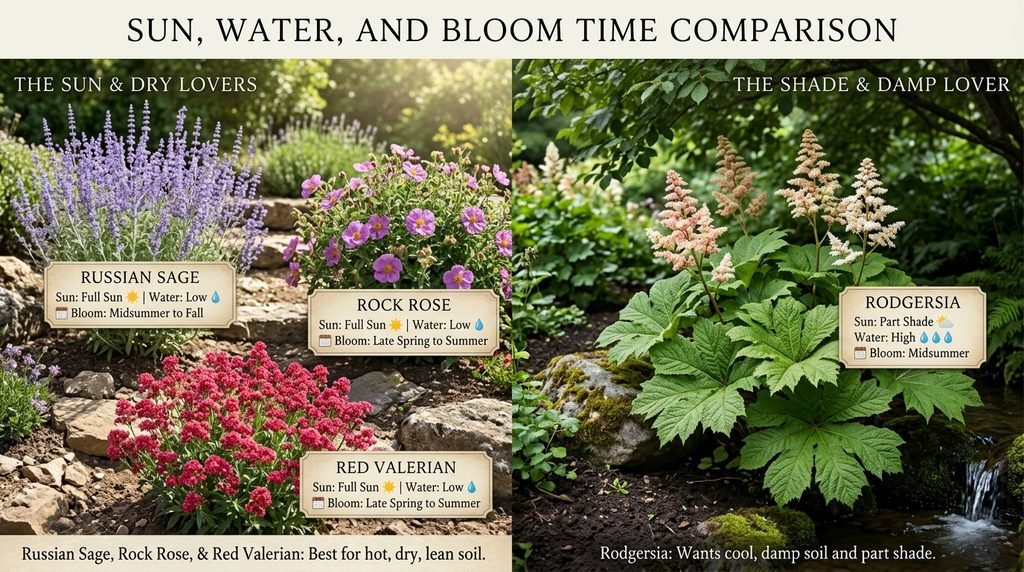
Russian sage, rock rose, and red valerian are the best picks for hot, dry, lean soil. All three bloom better when they are not overfed or overwatered. Rodgersia sits at the other end. It wants cool, damp soil and part shade.
Read More: 150+ Beautiful Flowers That Start With S: Names & Meanings
Garden Favorites Among R Flowers
A handful of R flowers earn a place in almost every garden. Roses give scent and color from late spring to fall. Rudbeckia keeps gold in the border all summer. Russian sage adds a lavender-blue haze when other plants tire. Red hot poker brings tall, glowing spikes that hummingbirds love.
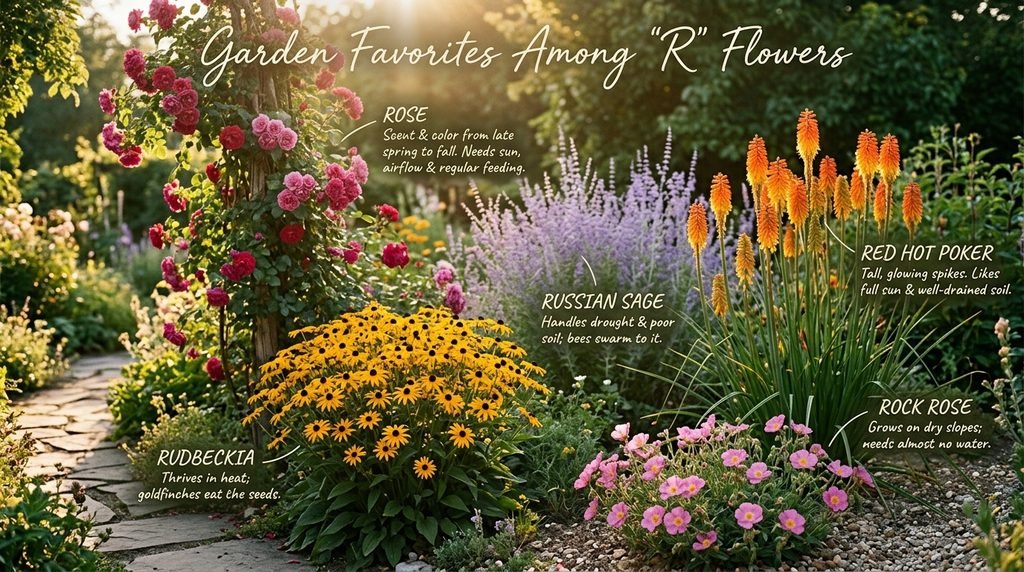
- Rose needs sun, airflow, and regular feeding to bloom well.
- Rudbeckia thrives in heat, and goldfinches eat its seeds.
- Russian Sage handles drought and poor soil, and bees swarm to it.
- Red Hot Poker likes full sun and well-drained soil.
- Rock Rose grows on dry slopes and needs almost no water.
Rudbeckia and Russian sage make a strong pair. One gives bold gold, and the other gives soft blue. Together they carry a sunny border from midsummer into fall.
A few care habits keep these plants happy. Prune roses in late winter, and remove spent blooms for more flowers. Cut Russian sage back hard in spring. Leave rudbeckia seed heads standing for the birds. Plant red hot poker where winter water drains away.
Indoor and Container Picks Among R Flowers
Only a few R plants thrive indoors, but they are worth knowing. Rat’s tail cactus trails pink-red blooms from a hanging pot. Rebutia is a tiny cactus that covers itself in flowers each spring. Rosemary and regal pelargonium grow well in sunny windows. Rhodochiton and rose moss do well in containers on sunny balconies.
- Rat’s Tail Cactus needs bright light and very little water in winter.
- Rebutia wants full sun and a cool, dry rest to set buds.
- Regal Pelargonium blooms heavily in spring and likes cool nights.
- Rose Moss loves hot, sunny pots and tolerates missed waterings.
Rebutia is the pick for beginners. It forgives missed waterings. Just give it plenty of light, and it will flower each spring.
Light matters more than anything else for indoor R plants. A bright south or east window suits rebutia and rat’s tail cactus. Avoid cold drafts and soggy saucers. Most of these plants fail from too much water, not too little.
Explore More Flower Guides: Flowers That Start With N: 60+ Beautiful Names, Meanings & Photos
Florist Favorites Among R Flowers
Florists use R flowers for fragrance, ruffles, and romance. Roses are the number one cut flower, in every color and size. Ranunculus gives layered, rose-like blooms that last about a week. Rice flower adds tiny white clusters, and rattail statice and Russian statice add dry, papery texture. Rajnigandha, or tuberose, fills a room with scent and is loved at weddings in South Asia.
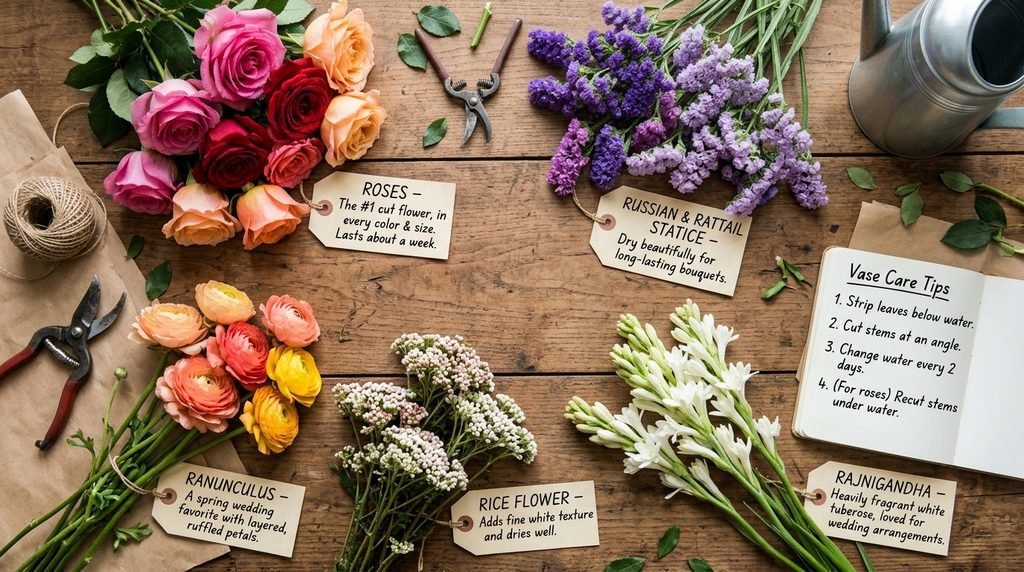
- Rose comes in countless colors and lasts about a week with good care.
- Ranunculus is a spring wedding favorite with layered, ruffled petals.
- Rice Flower adds fine white texture and dries well.
- Russian Statice and Rattail Statice dry beautifully for long-lasting bouquets.
- Rajnigandha brings strong night fragrance to formal arrangements.
Rice flower and Russian statice are the quiet workhorses. They add shape and texture, and many bouquets would feel flat without them. A florist’s cooler in summer would feel empty without roses and ranunculus.
Good vase care doubles the life of any cut flower. Strip the leaves below the water line. Recut the stems at an angle. Change the water every two days. For roses, recut the stems under water to keep air out of the stem.
Rare and Unusual R Flowers
Some R plants are hard to find or hard to grow. Rose of Venezuela is a tropical tree whose huge red flower globes appear on the trunk and branches, and it needs warm, humid air to thrive. Rhodora is a bog shrub with pink-purple spring flowers that vanishes where wetlands are drained. Royal catchfly is a scarlet prairie wildflower that has become rare as prairies shrank. Rodgersia is a Chinese woodland plant with huge leaves and creamy plumes that needs cool, damp shade.
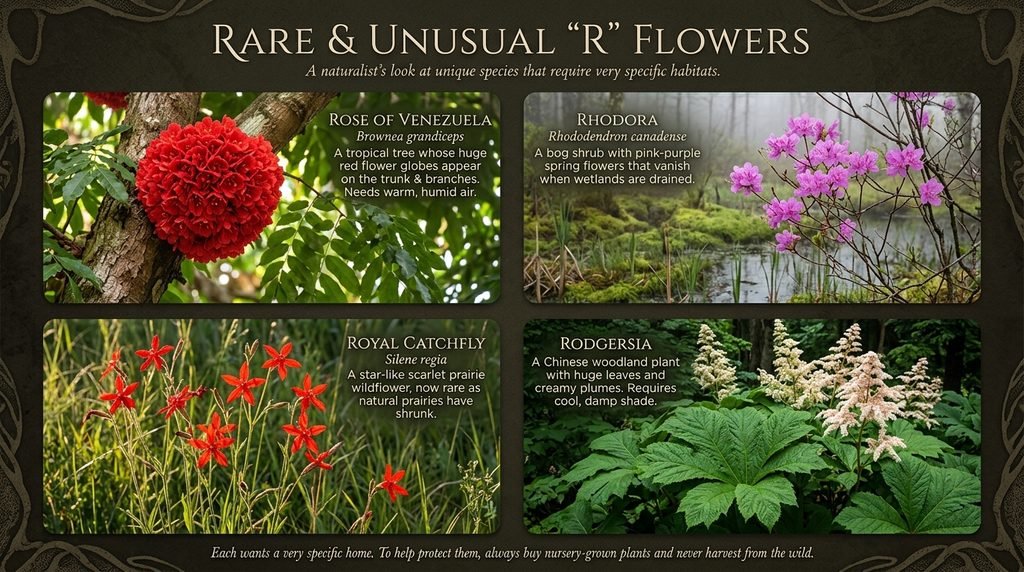
These four plants share one trait. Each wants a very specific home. That is why they stay special. If you want to grow one, buy nursery-grown plants only. Never dig wild plants, since many rare R species are protected by law.
Caution: Toxic R Flowers
Several R plants can harm pets, livestock, or people. Rhododendron and rosebay rhododendron are among the most dangerous. Every part of each shrub is poisonous, and they affect the heart. Rusty foxglove and red baneberry are also deadly. Cat owners need to know about regal lily and rubrum lily. Even a small nibble or a lick of pollen can cause kidney failure in cats.
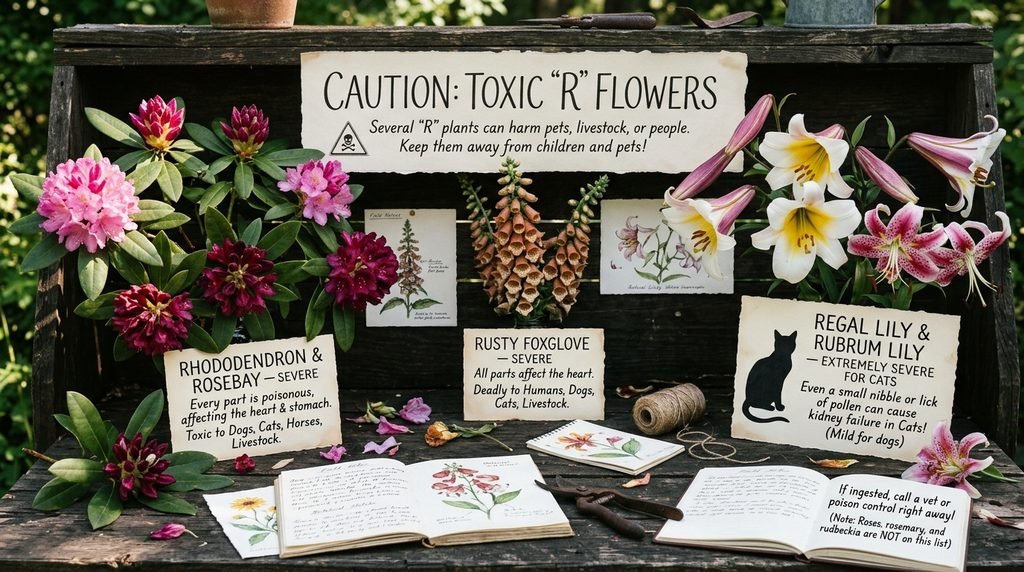
| Flower | Toxic To | Severity |
| Rhododendron | Dogs, cats, horses, livestock | Severe — all parts affect the heart and stomach |
| Rosebay Rhododendron | Dogs, cats, horses, livestock | Severe — all parts affect the heart and stomach |
| Rusty Foxglove | Humans, dogs, cats, livestock | Severe — all parts affect the heart |
| Red Baneberry | Humans, dogs, cats | Severe — berries and roots affect the heart |
| Rocket Larkspur | Horses, cattle, dogs, cats, humans | Severe — all parts, especially seeds |
| Regal Lily | Cats (extremely), dogs (mild) | Severe for cats — can cause kidney failure |
| Rubrum Lily | Cats (extremely), dogs (mild) | Severe for cats — can cause kidney failure |
| Red Buckeye | Humans, dogs, cats, livestock | Moderate to severe — seeds and sprouts |
| Rattlebox | Livestock, horses, dogs | Moderate to severe — seeds damage the liver |
| Red Spider Lily | Dogs, cats, horses | Moderate — bulbs cause vomiting and drooling |
| Rose Acacia | Dogs, cats, horses | Moderate — bark, seeds, and leaves |
| Redwood Sorrel | Dogs, cats | Mild to moderate — oxalate crystals upset the stomach |
Rhododendron, rusty foxglove, and the two lilies for cats deserve the loudest warning. Keep them away from children and pets. Redwood sorrel is milder, but a chewing dog can still get sick. Roses, rosemary, and rudbeckia, by contrast, are not on this list. If a pet or child eats any plant on this list, call a vet or poison control right away.
You May Also Like: 30+ Beautiful Flowers That Start With Q (With Pictures & Names)
R Flowers Grouped by Color
Pink and rose tones lead the R list, starting with the rose itself. Rose, rosy periwinkle, redbud, rose mallow, and rock rose deliver shades from blush to deep magenta. Redbud and rose of Sharon give the biggest show on small trees and shrubs. Damask rose brings the classic scent of rose water. Rose campion and rock purslane add bright magenta.
Red and orange bring heat. Red hot poker, red columbine, red ginger, red spider lily, and royal poinciana all glow in the sun. Royal poinciana, known as gulmohar, lights up South Asian streets in early summer.
Purple, blue, and lilac are the cool side of R. Russian sage, reticulated iris, Rocky Mountain columbine, Roman hyacinth, and rampion all bring these tones. Russian sage gives a long, hazy summer cloud. Reticulated iris blooms first, in late winter. Roman hyacinth adds scent in spring.
White and cream flowers include rain lily, rajnigandha, rice flower, rue anemone, and Roman chamomile. White glows at dusk and brightens shade. Rajnigandha and raat ki rani add strong scent in the evening. Rue anemone suits cool woodland gardens. Roman chamomile suits herb beds and lawns.
Yellow and gold come from rudbeckia, rosinweed, reinwardtia, and rock harlequin. Rudbeckia and rosinweed fill prairie-style beds. Reinwardtia, or yellow flax, brightens warm winter gardens. Rock harlequin mixes yellow with pink on lacy leaves.
Life-Cycle Groupings for R Flowers
A plant’s life cycle tells you how much work to expect. Annuals live one season, so you replant each year. Biennials flower in their second year. Perennials return on their own. Bulbs and tubers need the right winter, cold or warm, to come back. Trees and shrubs take longer to bloom but last for decades. Zones below are approximate and vary by variety, so check your own plant tag.
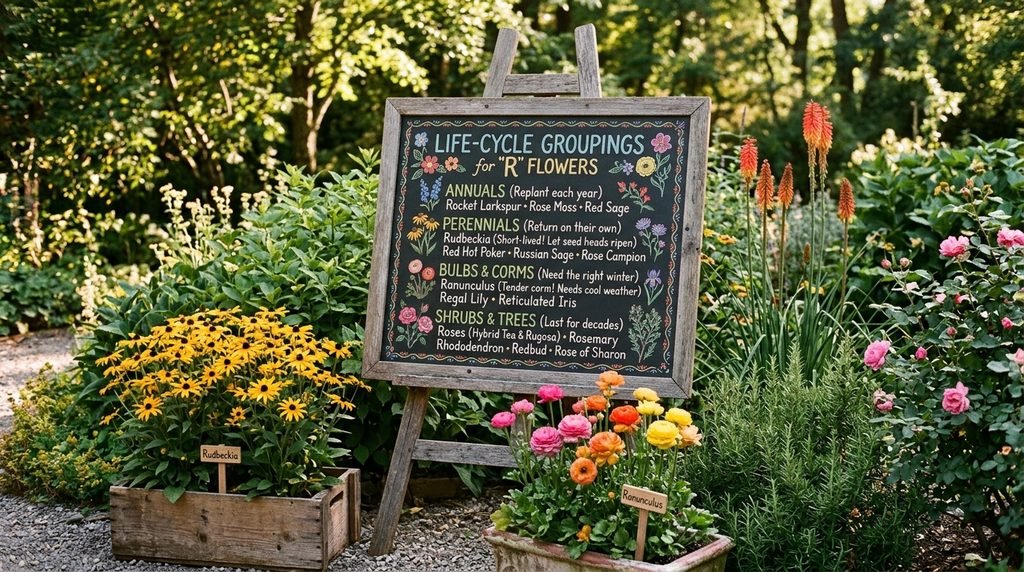
| Flower | Life Cycle | Typical Zones |
| Rain Daisy | Annual | All zones (seasonal) |
| Rhodanthe | Annual | All zones (seasonal) |
| Rocket Larkspur | Annual | All zones (seasonal) |
| Red Sage | Tender perennial, grown as annual | All zones (seasonal) |
| Rose Moss | Annual | All zones (seasonal) |
| Rudbeckia | Short-lived perennial | 3–9 |
| Russian Sage | Perennial | 4–9 |
| Red Hot Poker | Perennial | 5–9 |
| Red Valerian | Perennial | 5–9 |
| Rock Cress | Perennial | 4–8 |
| Rose Campion | Short-lived perennial | 4–8 |
| Rose Mallow | Perennial | 4–9 |
| Rodgersia | Perennial | 5–8 |
| Rue Anemone | Perennial | 4–8 |
| Red Trillium | Perennial | 4–8 |
| Regal Lily | Perennial (bulb) | 4–8 |
| Reticulated Iris | Perennial (bulb) | 5–9 |
| Roman Hyacinth | Perennial (bulb) | 4–8 |
| Ranunculus | Tender perennial (corm) | 8–10 |
| Rain Lily | Tender perennial (bulb) | 8–11 |
| Rose (Hybrid Tea) | Perennial (shrub) | 5–9 |
| Rugosa Rose | Perennial (shrub) | 2–7 |
| Rhododendron | Perennial (shrub) | 4–8 |
| Rose of Sharon | Perennial (shrub) | 5–9 |
| Rock Rose | Perennial (shrub) | 8–10 |
| Rosemary | Perennial (shrub) | 7–10 |
| Redbud | Perennial (small tree) | 4–9 |
| Royal Poinciana | Tender perennial (tree) | 10–12 |
| Rangoon Creeper | Tender perennial (vine) | 10–12 |
Rudbeckia and ranunculus are the two to watch. Rudbeckia often fades after two or three years, so let a few seed heads ripen. Ranunculus is the opposite. It needs cool weather to bloom, and in warm regions it is grown from corms planted in fall and treated as an annual.
Botanical Name Crosswalk
Common names change from place to place. Botanical names do not. Nursery tags and seed packets use Latin for this reason. It also helps you search online with confidence. Two different plants can share one common name, so the Latin name protects you from a wrong purchase.
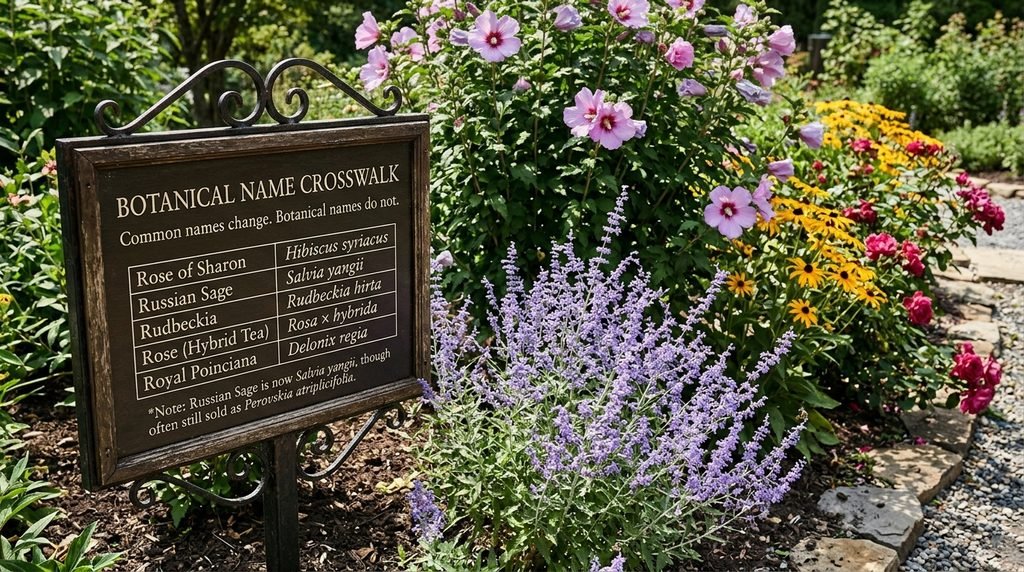
| Common Name | Botanical Name |
| Rose (Hybrid Tea) | Rosa × hybrida |
| Rose (Damask) | Rosa damascena |
| Rugosa Rose | Rosa rugosa |
| Ranunculus | Ranunculus asiaticus |
| Rhododendron | Rhododendron spp. |
| Rudbeckia | Rudbeckia hirta |
| Russian Sage | Salvia yangii |
| Red Hot Poker | Kniphofia uvaria |
| Rose of Sharon | Hibiscus syriacus |
| Redbud | Cercis canadensis |
| Rock Rose | Cistus × purpureus |
| Royal Poinciana | Delonix regia |
| Rangoon Creeper | Combretum indicum |
| Rajnigandha | Agave amica |
| Regal Lily | Lilium regale |
Russian sage shows why this matters. It was long sold as Perovskia atriplicifolia, and nurseries still use that older name. Today it is classified as Salvia yangii. Both names point to the same plant, so check both when you shop. Also, rose of Sharon is a hibiscus, not a rose, and the rose of Sharon named in the Bible was probably a different plant.
What R Flowers Mean
Flower meanings vary by culture, but a good number of R flowers carry steady symbolism. The rose is the great flower of love. Red stands for passion, white for purity, yellow for friendship, and pink for grace. In South Asia, the rose is called gulab, and rose water and rose petals appear in sweets, drinks, weddings, and prayers.
Ranunculus stands for charm and radiant beauty, since its layered petals glow. Rosemary stands for remembrance, and it is used at both weddings and funerals. Rhododendron carries a warning in Victorian flower language, and it also stands for caution. It is the national flower of Nepal. Rose of Sharon is the national flower of South Korea and stands for endless blooming.
Rajnigandha, called tuberose in English, stands for sweetness and night-time romance, and it is a favorite at South Asian weddings. Raat ki rani, the night-blooming shrub, is loved for its sweet scent after dark. Royal poinciana, or gulmohar, marks the start of summer in South Asia with red blooms.
Rudbeckia stands for encouragement and justice. The red spider lily, called higanbana in Japan, is linked with autumn and the afterlife. The rain lily stands for renewal, since it bursts into bloom just after rain. Match the flower to your message, and remember that the same bloom can mean something different in another culture.
Decision Table: Which R Flower Fits Your Situation
You do not have to read the whole list to choose well. Start with your goal in the left column. The right column names the best R flower for it. Then check the toxicity section if you have pets or children.
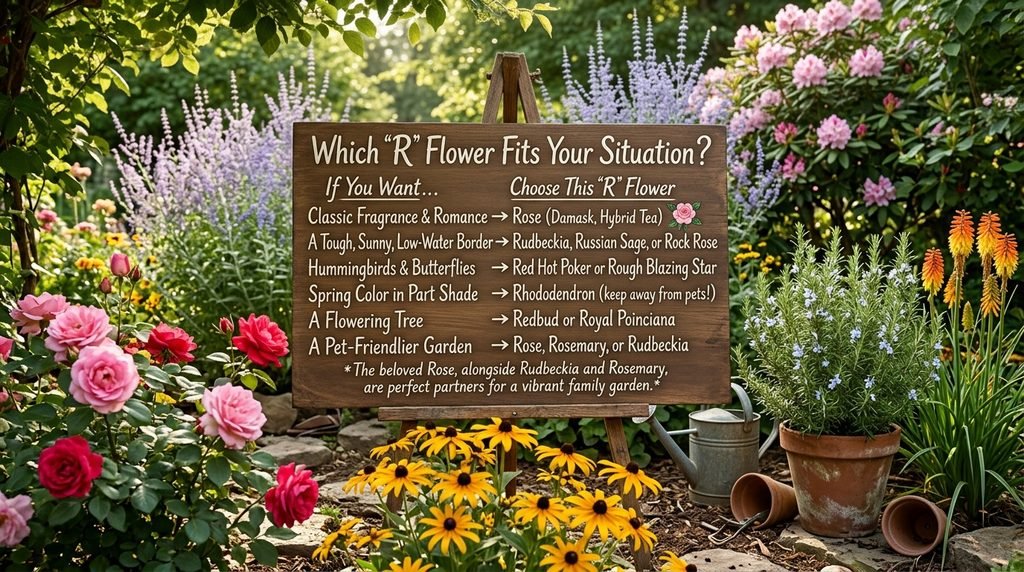
| If You Want… | Choose This R Flower |
| Classic fragrance and romance | Rose (Damask), Rose (Hybrid Tea), or Rugosa Rose |
| A tough, sunny, low-water border | Russian Sage, Rudbeckia, or Rock Rose |
| Hummingbirds and butterflies | Red Hot Poker, Rough Blazing Star, or Red Buckeye |
| Spring color in part shade | Rhododendron (keep away from pets) or Rue Anemone |
| Evening and night fragrance | Rajnigandha, Raat Ki Rani, or Rangoon Creeper |
| A flowering tree | Redbud, Royal Poinciana, or Rose of Venezuela |
| An easy-blooming cactus | Rebutia or Rat’s Tail Cactus |
| Dried flower arrangements | Russian Statice, Rattail Statice, or Rhodanthe |
| A pond or wet-soil flower | Rose Mallow or Rodgersia |
| A pet-friendlier garden | Rose (Hybrid Tea), Rosemary, or Rudbeckia (absent from this guide’s toxic list) |
Rose appears first because it is the most loved and the most versatile. Rudbeckia and rosemary are good partners for it in a family garden. Always double-check any plant with your vet if a pet is likely to chew it.
Conclusion
Flowers that start with R offer a very wide choice, from the classic rose to the rare rose of Venezuela. This guide sorted 92 of them by color, life cycle, and use, so you can pick with confidence. Whether you want a perfumed rose border, a pollinator garden, or a night-scented patio, there is an R flower that fits. Use the tables above, read the toxicity notes, and start planting.
Frequently Asked Questions
How many flowers start with R?
More than 90 well-known flowers start with R. This guide lists 92, from common roses to rare tropical trees and wildflowers.
What is the most popular flower that starts with R?
Rose is by far the most popular. Ranunculus, rhododendron, and rudbeckia are also widely grown.
What are the easiest flowers that start with R to grow?
Rudbeckia, Russian sage, red valerian, rock rose, and rose moss are very easy. Rebutia is the easiest R houseplant.
Which R flowers attract butterflies and hummingbirds?
Rudbeckia, rough blazing star, and red clover draw butterflies and bees. Red hot poker, red buckeye, and russelia draw hummingbirds.
Is rhododendron poisonous?
Yes. Every part of rhododendron is poisonous to people, pets, and livestock. It can affect the heart, so keep it away from children and animals.
Which R flower is the most dangerous?
Rhododendron, rusty foxglove, and red baneberry are the most dangerous for people and pets. Regal lily and rubrum lily are the most dangerous for cats.
Are roses safe for pets?
Roses are generally listed as non-toxic to dogs and cats. The thorns can still scratch curious pets, and fertilizers or sprays can be harmful.
What does a red rose symbolize?
A red rose stands for passion and deep love. Other colors carry other meanings, like white for purity and yellow for friendship.
What is gulmohar?
Gulmohar is the South Asian name for royal poinciana, Delonix regia. It is a spreading tree that covers itself in fiery red flowers in early summer.
What is rajnigandha?
Rajnigandha is the Hindi and Urdu name for tuberose. It has strongly scented white spikes that are loved at weddings and in perfumes.
2 thoughts on “90+ Beautiful Flowers That Start With R: Names, Photos & Meaning”