
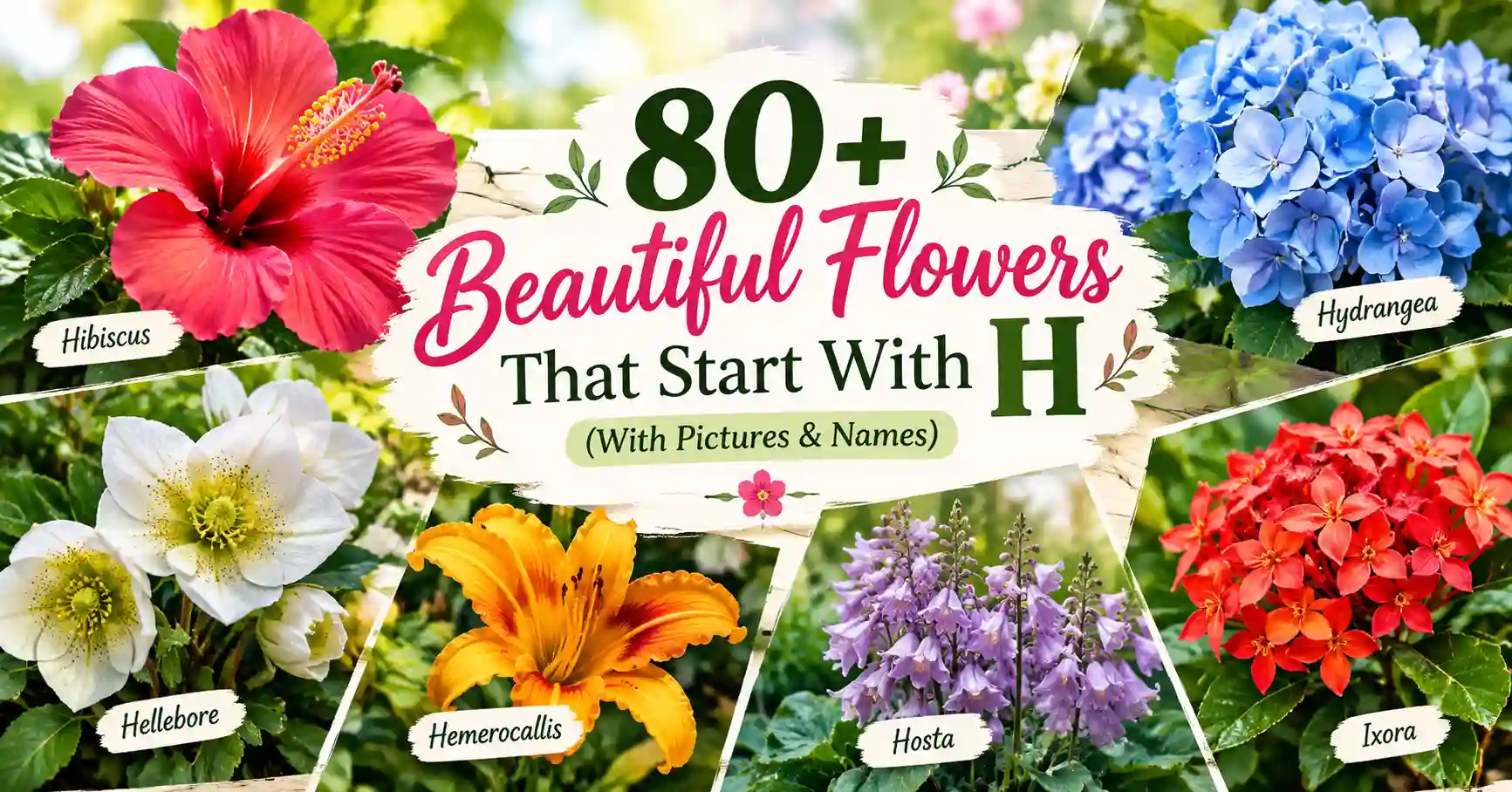
Flowers that start with H include some of the most loved plants in any yard. Hydrangea fills summer borders with huge blooms. Hellebore flowers bloom in the dead of winter. Hyacinth perfumes a room in early spring. This guide gathers more than 80 of them in one place, from easy garden staples to rare finds.
Every plant here is real, and the flower is the main reason people grow it. Botanical names, native regions, bloom seasons, and toxicity notes were checked against more than one source. Safety facts matter most. A few H plants can harm cats, dogs, livestock, or people, so those get clear warnings.
The guide starts with a quick answer and a full alphabetical list. A comparison table follows. Then come sections on garden plants, houseplants, cut flowers, rare finds, and toxic plants. Color groups, life cycles, botanical names, and meanings come next. A short decision table ends the guide.
Quick Answer: Top Flowers That Start With H
Hydrangea, Hellebore, Hollyhock, Hardy Geranium, and Daylily give gardeners the strongest mix of color and reliability. Hydrangea brings big summer blooms, while Hellebore flowers in late winter when little else is awake.
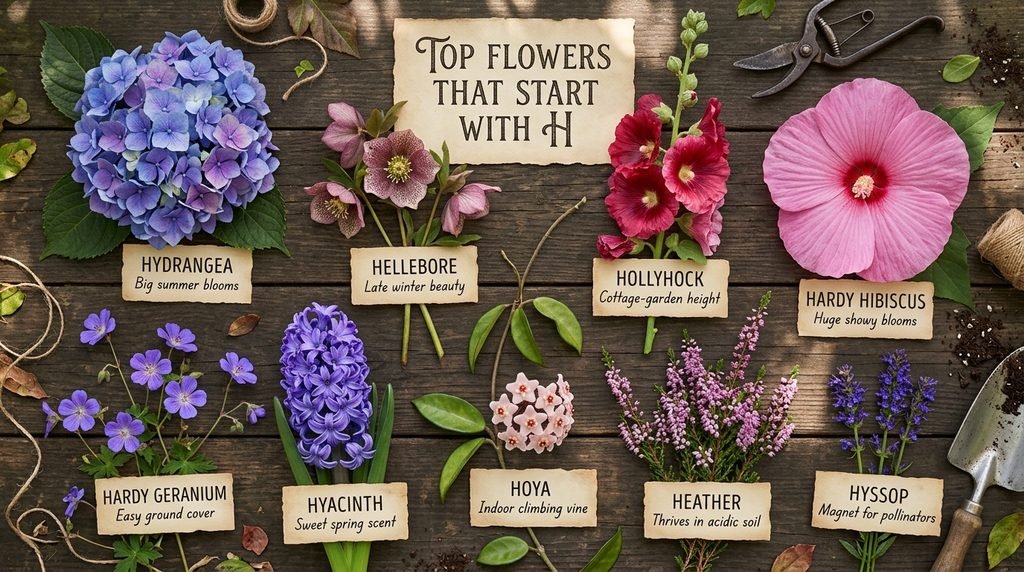
Hollyhock adds cottage-garden height, and Hardy Geranium covers the ground with easy charm. Hyacinth, Hoya, and Hardy Hibiscus suit specific needs, from spring scent to indoor vines to dinner-plate blooms. Heather and Hyssop round out the group for acidic soil and pollinators, which shows how many jobs flowers that start with H can do.
Master List of Flowers That Start With H
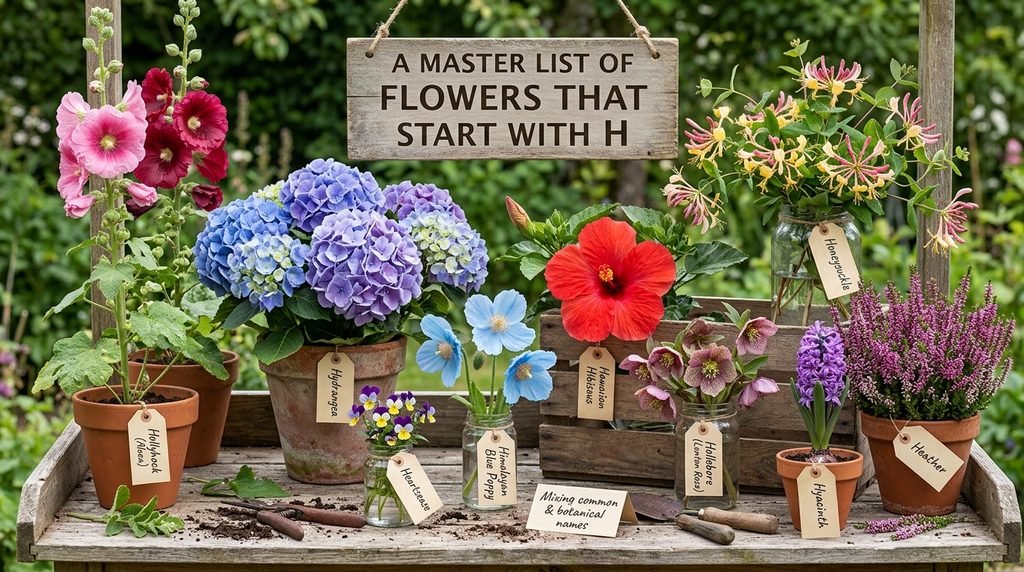
The list below mixes common names and botanical names. Where people usually search by common name, that name comes first, such as Hollyhock or Honeysuckle. Where the botanical name is better known, it leads instead, such as Hesperis or Hypericum.
- Habranthus (Copper Lily)
- Hacquetia
- Haemanthus (Blood Lily)
- Hairy Vetch
- Hakea
- Halesia (Silverbell)
- Halimium
- Hamamelis (Witch Hazel)
- Hamelia (Firebush)
- Hanging Lobster Claw
- Hardenbergia (Happy Wanderer)
- Hardhack
- Hardy Begonia
- Hardy Chrysanthemum
- Hardy Cyclamen
- Hardy Fuchsia
- Hardy Geranium
- Hardy Hibiscus
- Hardy Ice Plant
- Hardy Plumbago
- Harebell
- Harlequin Flower (Sparaxis)
- Harlequin Glorybower
- Hawaiian Hibiscus
- Hawthorn
- Heartsease
- Heath Spotted Orchid
- Heather
- Hebe
- Hedychium (Ginger Lily)
- Helenium (Sneezeweed)
- Helianthemum (Sun Rose)
- Helianthus (Perennial Sunflower)
- Helichrysum (Strawflower)
- Heliconia (Lobster Claw)
- Heliophila (Cape Stock)
- Heliopsis (False Sunflower)
- Heliotrope
- Hellebore (Lenten Rose)
- Helleborine
- Helonias (Swamp Pink)
- Hemerocallis (Daylily)
- Hemp Agrimony
- Henbane
- Hepatica
- Herb Robert
- Hesperaloe (Red Yucca)
- Hesperantha (Crimson Flag Lily)
- Hesperis (Dame’s Rocket)
- Hesperoyucca (Our Lord’s Candle)
- Heterocentron (Spanish Shawl)
- Hibbertia (Guinea Flower)
- Hibiscus
- Himalayan Blue Poppy
- Himalayan Honeysuckle
- Hippeastrum
- Hogweed (Giant Hogweed)
- Hoheria (Lacebark)
- Hollyhock
- Holodiscus (Ocean Spray)
- Honesty
- Honeysuckle
- Honeywort
- Horned Violet
- Horse Chestnut
- Hottentot Fig
- Hottonia (Water Violet)
- Hound’s Tongue
- Houstonia (Bluets)
- Hovea
- Hoya (Wax Flower)
- Hummingbird Sage
- Hummingbird Trumpet
- Hunnemannia (Mexican Tulip Poppy)
- Hyacinth
- Hyacinth Bean
- Hyacinth Orchid
- Hyacinthoides (Bluebell)
- Hydrangea
- Hydrocleys (Water Poppy)
- Hylomecon (Wood Poppy)
- Hylotelephium (Stonecrop)
- Hymenocallis (Spider Lily)
- Hymenoxys
- Hypericum (St John’s Wort)
- Hypoxis (Star Grass)
- Hyssop
A few names cause mix-ups. Hardy Geranium, or Cranesbill, is a different plant from the potted Pelargonium sold as geranium. Hardy Hibiscus and Hawaiian Hibiscus share a genus, but only the first survives cold winters. Helichrysum Strawflower is now sorted under Xerochrysum, so older plant tags may use either name.
Read More: 80+ Beautiful Flowers That Start With A (With Pictures, Names & Meanings)
Comparison Table: Region, Bloom Time, Zones, and Safety
The table below compares 14 popular flowers side by side. Columns cover native region, bloom season, hardiness zones, and toxicity. Hardiness zones show where a plant survives winter outdoors, so check your own zone before buying.
| Flower | Native Region | Bloom Season | Hardiness Zones | Toxicity |
| Hydrangea | East Asia and the Americas | Summer | 3–9, varies by type | Mild to moderate |
| Hardy Hibiscus | Eastern North America | Midsummer to fall | 4–9 | Minimal to mild |
| Hellebore | Europe and western Asia | Late winter to early spring | 4–9 | Moderate to severe |
| Daylily | East Asia | Summer | 3–9 | Severe for cats |
| Hyacinth | Eastern Mediterranean | Early spring | 4–8 | Mild to moderate; bulb |
| Heather | Europe and western Asia | Late summer to fall | 4–7 | Minimal |
| Hollyhock | Asia | Summer | 3–8 | Minimal |
| Heliotrope | Peru | Summer | 10–11; annual elsewhere | Moderate |
| Hoya | Asia and Australia | Spring to fall, indoors | 10–12; houseplant elsewhere | Non-toxic |
| Hardy Geranium | Temperate regions worldwide | Late spring to summer | 3–9 | Minimal |
| Hardy Fuchsia | Chile and Argentina | Summer to fall | 6–9 | Non-toxic |
| Harebell | Northern Hemisphere | Summer to fall | 3–8 | Minimal |
| English Bluebell | Western Europe | Spring | 4–8 | Mild to moderate; bulb |
| Henbane | Europe and western Asia | Early summer | Annual or biennial | Severe |
Three rows deserve a second look. Daylily looks harmless, yet it can cause kidney failure in cats. Henbane carries severe toxicity and grows wild in many places. Hoya and Hardy Fuchsia sit at the safe end, which makes them good picks for homes with curious pets.
Garden Favorites for Sun, Shade, and Pollinators
Gardeners who want easy wins among flowers that start with H should begin with Hydrangea, Hellebore, and Hardy Geranium. Hydrangea gives summer color in part shade. Hellebore blooms in late winter and resists deer and rabbits.
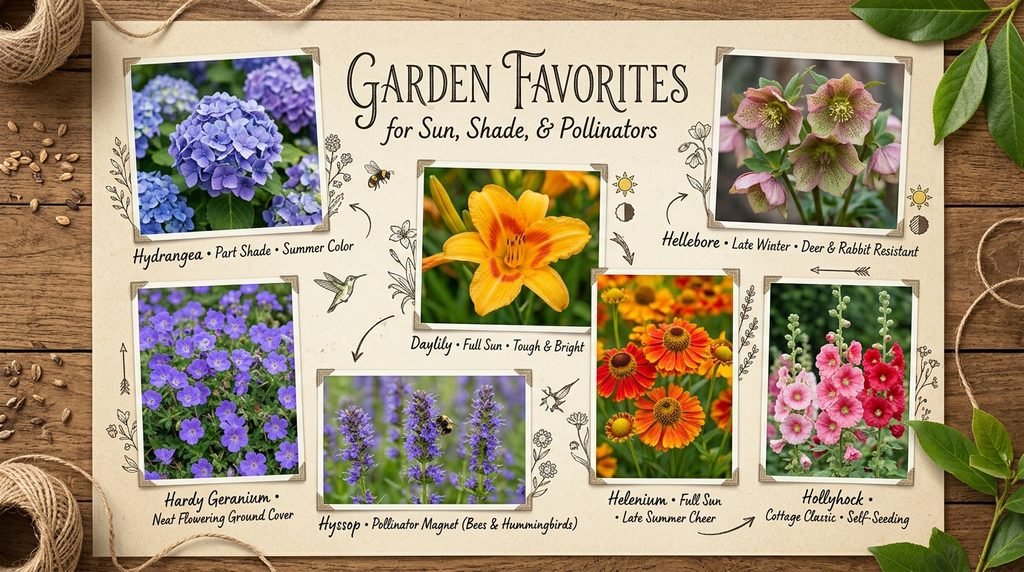
Hardy Geranium spreads into a neat, flowering carpet. Daylily and Helenium handle full sun, and Hyssop draws bees and hummingbirds. Hollyhock suits cottage gardens, since it self-seeds and returns each year.
Best Indoor Plants and Houseplants
Hoya is the top indoor pick. Its waxy, star-shaped flowers come in fragrant clusters and last for weeks. Leave the old flower stalks in place, since Hoya blooms again in the same spot.
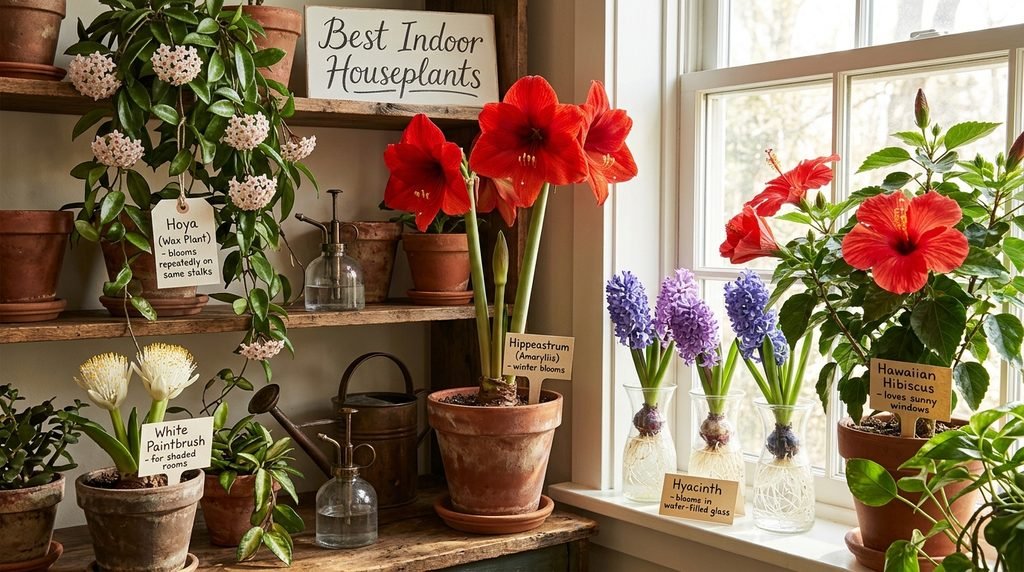
Hippeastrum, the bulb sold as Amaryllis, flowers indoors in winter with almost no effort. Hyacinth bulbs bloom in water-filled glass vases after a stretch of cold storage. Hawaiian Hibiscus enjoys a bright, sunny window and rewards good light with large flowers. White Paintbrush, or Haemanthus albiflos, adds fuzzy blooms to a shaded room.
Explore More Flower Guides: 100+ Flowers That Start With B: Names, Meanings & Beautiful Photos
Cut Flowers That Florists Love
Hydrangea is a florist staple because its big heads fill a vase fast. It wilts easily, but a quick soak in water often revives it. Hyacinth adds spring scent, though its cut stems leak sap that can irritate skin. Hellebore works best in short vases and needs careful stem treatment. Hypericum berries add a bold pop of color as filler. Heliconia brings a tropical look to large arrangements, while Hippeastrum offers tall stems with giant blooms. Honesty and Helichrysum dry well, which gives them a second life in wreaths and dried bouquets.
Rare and Unusual Finds
Some H flowers are hard to find, and each has its own story. The Himalayan Blue Poppy, a Meconopsis, grows in cool, damp mountain regions. Many gardeners struggle to keep it alive in warm climates. Swamp Pink, or Helonias bullata, lives in wet woods of the eastern United States and is protected as a threatened species.
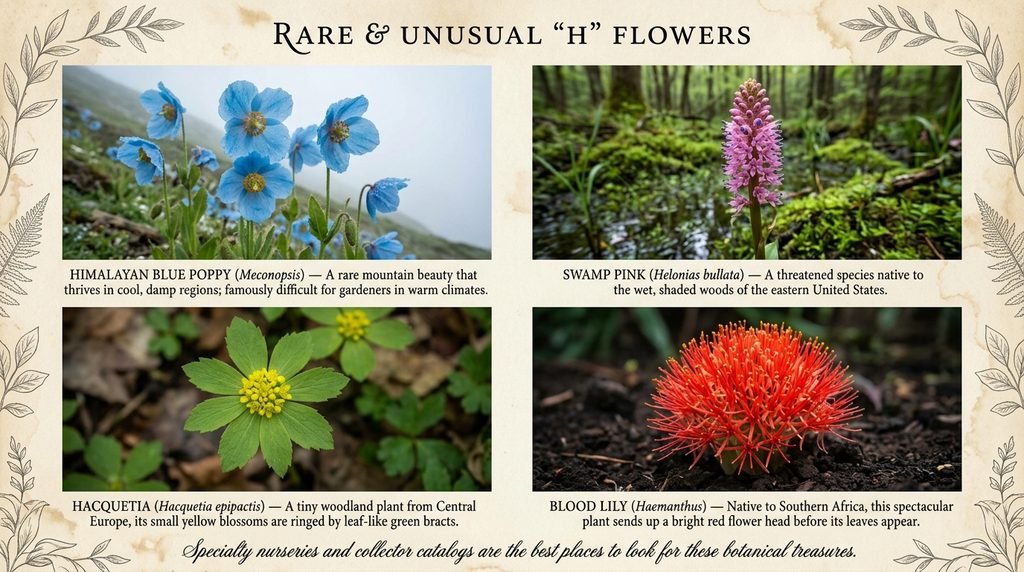
Hacquetia is a tiny woodland plant from central Europe. Its small yellow flowers sit inside a ring of green bracts. Blood Lily, or Haemanthus, from southern Africa, sends up a bright red flower head before its leaves appear. Specialty nurseries and collector catalogs are the best places to look for these plants.
Toxic Flowers and Safety Notes
Several H plants can cause real harm. Henbane contains tropane alkaloids that cause hallucinations and delirium. Giant Hogweed produces a sap that burns skin when sunlight hits it, and the blisters can scar for years. Hellebore holds compounds that irritate the mouth and affect the heart. Daylily is especially dangerous for cats, since even small amounts can lead to kidney failure.
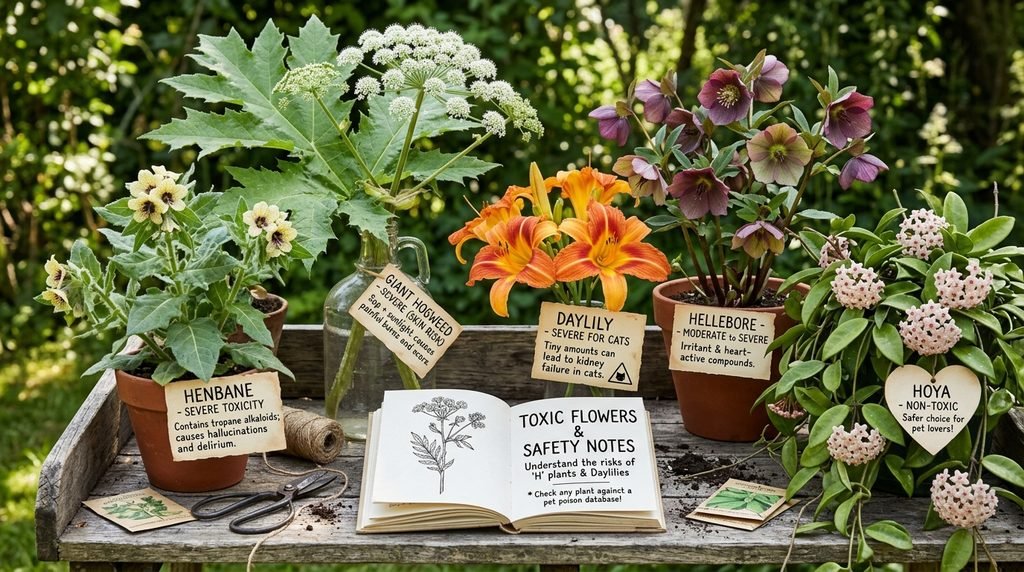
The table below ranks the main risks on this list. Levels reflect the effect of eating a meaningful amount, except where skin contact is noted. Check any plant against a pet poison database before planting it near animals.
| Flower | Toxicity Level | Main Concern |
| Henbane | Severe | Tropane alkaloids; hallucinations and delirium |
| Giant Hogweed | Severe (skin) | Sap plus sunlight causes painful burns and scars |
| Daylily | Severe for cats | Can cause kidney failure in cats |
| Hellebore | Moderate to severe | Irritant and heart-active compounds |
| Horse Chestnut | Moderate | Seeds contain aesculin; harmful to dogs |
| Heliotrope | Moderate | Pyrrolizidine alkaloids harm the liver |
| Hyacinth Bean | Moderate | Raw seeds contain cyanogenic compounds |
| St John’s Wort | Moderate for livestock | Can cause sun sensitivity in grazing animals |
| Hydrangea | Mild to moderate | Cyanogenic compounds; stomach upset |
| Hyacinth | Mild to moderate | Bulbs irritate mouth and skin |
| Honeysuckle | Mild to moderate | Berries cause stomach upset |
| Hoya | Non-toxic | Considered safe for pets |
Henbane, Giant Hogweed, and Daylily deserve the most care. Daylily is the sneakiest, since it is sold everywhere and looks harmless. Cat owners should skip it, and also skip true lilies. Hoya sits at the opposite end and is a safer choice for animal lovers.
You May Also Like: Flowers That Start With E: 85 Beautiful Blooms With Names & Pictures
Color Groups: Blue, Pink, White, Yellow, and Green
Color often drives the choice of flowers that start with H. This section groups the plants by shade and shows where each group works best.

Blue and purple shades have plenty of options. Hyacinth, Hydrangea, Hyssop, Harebell, Heliotrope, and Bluebell all carry rich tones. Pair them with yellow blooms for strong contrast, or with silver foliage for a calm look. Pink and red shades come from Hibiscus, Heather, Hollyhock, Hippeastrum, and Heliconia. They suit warm, bold borders and showy containers.
White flowers glow in low light. Hellebore, Hoya, Hawthorn, Silverbell, and white Hydrangea all fit here. They work well in shaded corners and wedding designs. Yellow and orange flowers bring sunny energy. Daylily, Helenium, Heliopsis, Hypericum, and Hibbertia thrive in full sun and keep borders bright into fall. Green and unusual shades add surprise. Green Hellebores, Honeywort, and Hacquetia offer soft, lime tones that pair with almost any color.
Life Cycle Guide: Annuals, Perennials, Bulbs, and Shrubs
Life cycle tells a gardener how much work a plant needs. Annuals bloom for one season and end. Perennials return year after year. Bulbs store energy underground, while shrubs form a lasting frame. Matching the life cycle to your plan saves money, time, and replanting.
| Flower | Life Cycle | What to Expect |
| Honeywort | Annual | One season; often self-seeds |
| Cape Stock (Heliophila) | Annual | One season; best in cool weather |
| Heliotrope | Tender perennial | Annual in cold zones; scented blooms |
| Heartsease | Short-lived perennial | Self-seeds freely |
| Hollyhock | Biennial | Blooms in year two, then self-seeds |
| Honesty | Biennial | Blooms in year two; silver seed pods |
| Hardy Geranium | Perennial | Long-lived; spreads slowly |
| Hellebore | Evergreen perennial | Long-lived; slow to establish |
| Daylily | Perennial | Long-lived; divide every few years |
| Helenium | Perennial | Divide every few years for vigor |
| Hyssop | Perennial herb | Woody base; trim each spring |
| Hyacinth | Bulb | Strongest first year; fades slowly |
| English Bluebell | Bulb | Naturalizes in shady woods |
| Hydrangea | Shrub | Lives for decades |
| Heather | Evergreen shrub | Needs acidic soil |
Annuals give the fastest color but need replanting. Perennials and shrubs cost more at first and pay off over time. Hollyhock and Honesty offer a middle path, since each plant lives two years but reseeds so the bed keeps blooming.
Botanical Name Crosswalk
Botanical names matter when you buy plants or search online. Common names change by region and can point to several plants. Geranium, for example, can mean a hardy Cranesbill or a tender Pelargonium. A botanical name gives one clear answer, which prevents costly mix-ups at the nursery.
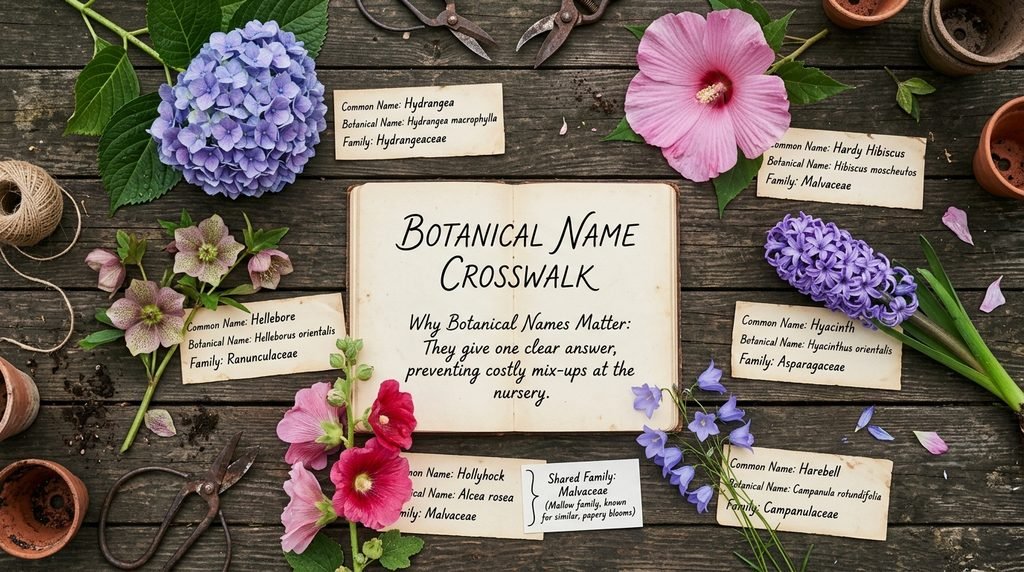
| Common Name | Botanical Name | Family |
| Hydrangea | Hydrangea macrophylla | Hydrangeaceae |
| Hardy Hibiscus | Hibiscus moscheutos | Malvaceae |
| Hellebore | Helleborus orientalis | Ranunculaceae |
| Daylily | Hemerocallis spp. | Asphodelaceae |
| Hyacinth | Hyacinthus orientalis | Asparagaceae |
| Heather | Calluna vulgaris | Ericaceae |
| Hollyhock | Alcea rosea | Malvaceae |
| Heliotrope | Heliotropium arborescens | Heliotropiaceae |
| Wax Flower | Hoya carnosa | Apocynaceae |
| Hardy Geranium | Geranium spp. | Geraniaceae |
| Hardy Fuchsia | Fuchsia magellanica | Onagraceae |
| Harebell | Campanula rotundifolia | Campanulaceae |
| English Bluebell | Hyacinthoides non-scripta | Asparagaceae |
| Henbane | Hyoscyamus niger | Solanaceae |
| Witch Hazel | Hamamelis virginiana | Hamamelidaceae |
| Giant Hogweed | Heracleum mantegazzianum | Apiaceae |
Hibiscus and Hollyhock share the mallow family, which explains their similar, papery blooms. Henbane belongs to the nightshade family, a group known for strong alkaloids. Giant Hogweed sits in the carrot family, alongside many harmless garden herbs, which shows that family ties never tell the whole safety story.
Meanings and Symbolism
Flowers that start with H carry deep stories, and many have shaped how people give and read flowers for centuries. Hyacinth comes from a Greek myth. Hyacinthus was a young man killed by a discus, and a flower rose from his blood. Victorian flower language later tied purple Hyacinth to sorrow and a plea for forgiveness.
Hydrangea carries mixed meanings. In Japan, it is linked to gratitude and heartfelt apology. In Victorian England, it sometimes hinted at boasting or coldness, since the plant gives many blooms but few seeds. Hibiscus stands for delicate beauty, and in Hawaii it is the state flower. Folk custom says that wearing one behind the ear can signal a person’s relationship status.
Heather means luck and protection in Scottish tradition, especially the white kind. Hellebore carries a gentle legend. In the story, a Christmas Rose bloomed in the snow to give a poor shepherd girl a gift for the newborn Jesus. It now stands for hope and comfort. Honeysuckle signals devoted affection, and Hollyhock suggests ambition and fertility. English Bluebell stands for humility and constancy, and folklore says bluebell woods belong to fairies.
Decision Guide: Match the Flower to Your Space
Use the table below to narrow your choices fast. Start with the row that matches your main need, such as shade, pet safety, or winter color. Then compare the suggested plants and pick the one that suits your climate. Anyone sorting flowers that start with H will find this the quickest route from a long list to a final choice.
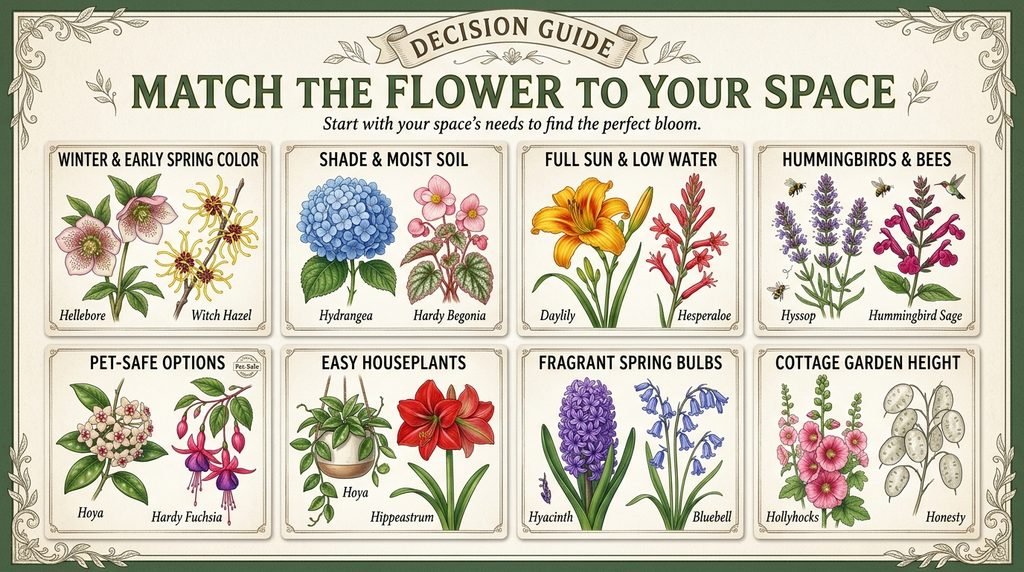
| If You Need | Try These |
| Winter or early spring color | Hellebore, Witch Hazel |
| Shade and moist soil | Hydrangea, Hardy Begonia |
| Full sun and low water | Daylily, Hesperaloe |
| Hummingbirds and bees | Hyssop, Hummingbird Sage |
| Pet-safe options | Hoya, Hardy Fuchsia, Hollyhock |
| Easy houseplant | Hoya, Hippeastrum |
| Fragrant spring bulbs | Hyacinth, Bluebell |
| Cottage garden height | Hollyhock, Honesty |
| Acidic soil | Heather, Hydrangea, Hebe |
| Fall color | Helenium, Hardy Chrysanthemum |
No single plant fits every need. Hoya and Hardy Fuchsia work for homes with curious pets, while Hellebore and Witch Hazel brighten the coldest months. If safety is a concern, skip the severely toxic plants from the earlier table and choose from the pet-safe row first.
Conclusion
Flowers that start with H offer something for nearly every garden, windowsill, and vase. They range from easy beginners such as Hardy Geranium and Hollyhock to rare treasures such as the Himalayan Blue Poppy. A few, like Henbane and Daylily, call for real caution around pets and children. Use the tables and guides above to match each plant to your light, space, and household. With so many choices, there is room to experiment.
Frequently Asked Questions
Hardy Geranium, Hollyhock, Daylily, and Hyssop are all beginner-friendly. They tolerate average soil and need little fuss. Most return each year with minimal care.
Henbane, Giant Hogweed, and Hellebore are the most dangerous. Daylily is toxic to cats, and Horse Chestnut seeds can harm dogs. Keep all of them away from children and pets.
Yes. Daylily can cause kidney failure in cats, even from small amounts of leaves or pollen. Cat owners should avoid planting it and should call a vet right away after any exposure.
Hellebore blooms from late winter into early spring. Witch Hazel also flowers in the cold months, with spidery yellow or orange blooms. Both are a welcome sight in a bare garden.
Hydrangea, Hellebore, and Hardy Begonia all handle shade well. Hydrangea prefers moist soil and part shade. Hellebore does best under deciduous trees.
Bigleaf Hydrangea changes color with soil acidity. Acidic soil tends to give blue flowers, and alkaline soil tends to give pink. White varieties usually stay white.
Hoya is considered non-toxic to cats and dogs. This makes it a popular houseplant for pet owners. It still needs bright, indirect light to bloom well.
Forced indoor bulbs often fade after one season. Plant them outdoors after the flowers finish, and they may bloom again in a year or two. The blooms will be smaller than the first year.
4 thoughts on “80+ Beautiful Flowers That Start With H (With Pictures & Names)”