
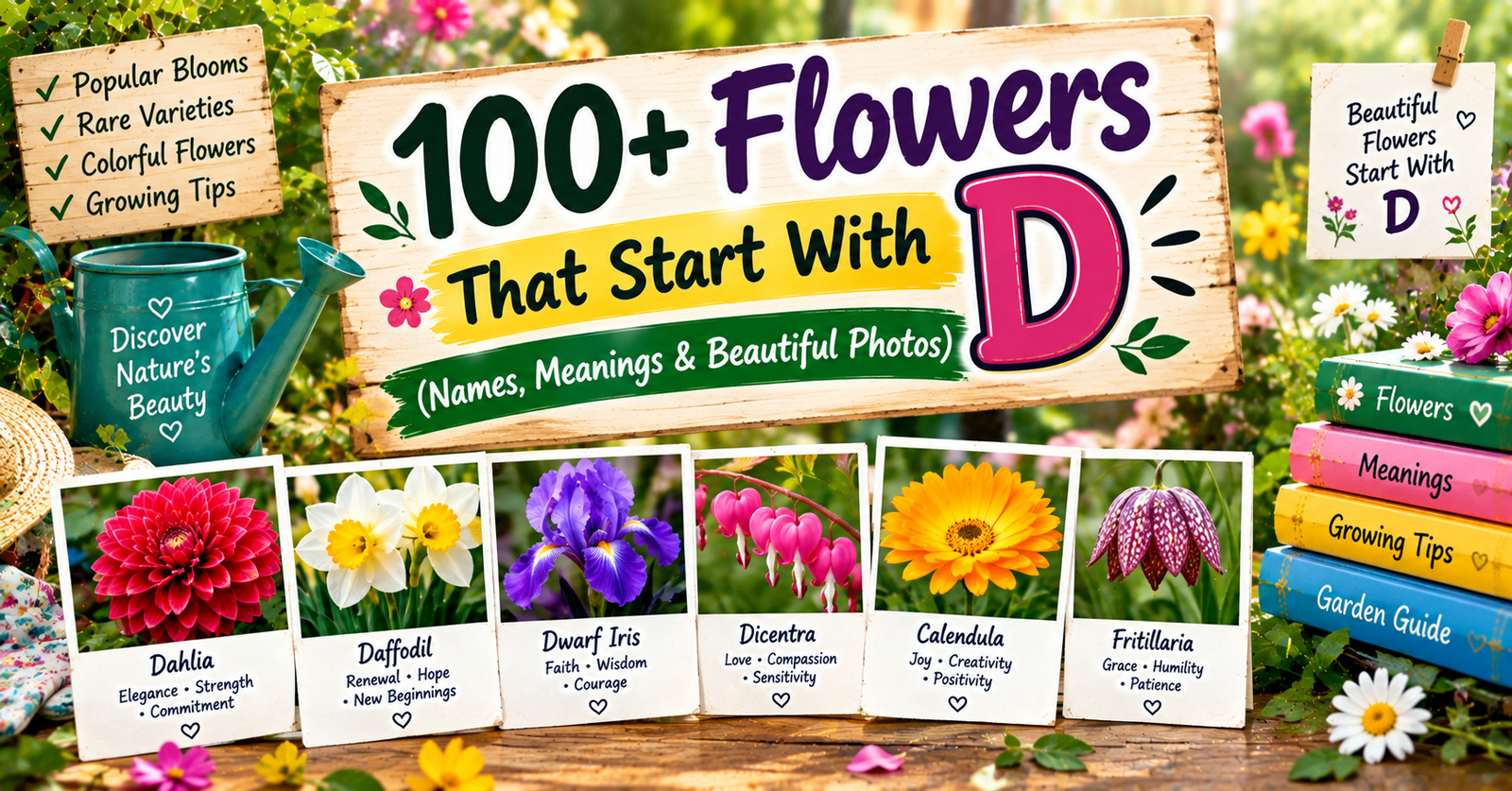
Flowers that start with D cover a huge stretch of the garden world. Daffodil brings the first real color of spring. Dahlia fills late summer with bold, dinner-plate blooms. Delphinium sends up tall spires of blue that anchor a cottage border. Digitalis, better known as foxglove, adds beauty and danger in equal measure. This letter holds some of the most loved plants anywhere, along with several that deserve real respect.
This guide brings together more than one hundred of these blooms. Each entry was checked individually for its botanical name, native range, and toxicity. Nothing here was pulled from a single source and lightly reworded. A few D-named plants grown mainly for foliage, such as dusty miller and dracaena, were left off the list. The flower itself should be the real reason to grow a plant.
The guide opens with a quick answer and a full alphabetical list. A complete comparison table follows, so you can scan bloom time, sun needs, and safety at a glance. After that, the plants are sorted by use: garden favorites, indoor plants, florist favorites, rare finds, and a caution section. Color groupings, life-cycle categories, botanical names, and symbolism come next. A decision table near the end helps you match a plant to your exact situation.
Every fact below, including bloom timing, native origin, hardiness, and toxicity, was checked against at least two horticultural or veterinary sources. Each sentence was written independently rather than copied from a database. Where sources disagreed, the more conservative figure was used instead of a guess.
Quick Answer: The Standout D Flowers
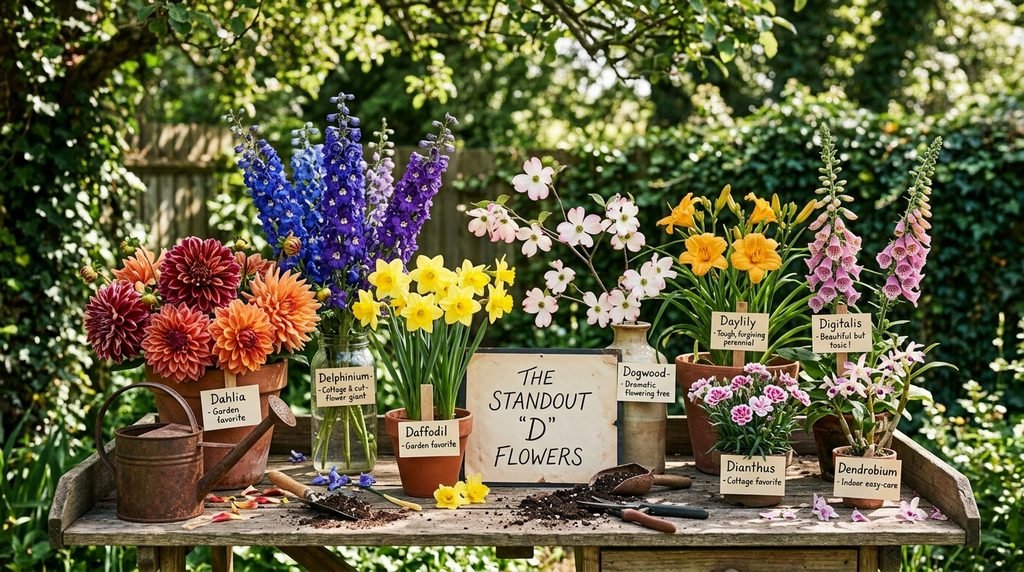
A short list of names does most of the heavy lifting here. Daffodil and dahlia anchor the garden-favorite role, while delphinium and dianthus dominate the cottage and cut-flower side of this letter. Daylily is the toughest, most forgiving perennial of the group. Dogwood brings the most dramatic spring display of any flowering tree here. Dendrobium covers the indoor orchid niche with very little fuss. Datura, daphne, and digitalis all demand real caution, since each carries serious, well-documented toxicity. Disa and Dracula orchids round out the group as two of the rarest blooms this letter has to offer.
The Master List: Every Flower on This Guide, A to Z
Some of the flowers below are best known by common English names, such as daffodil, daisy, and dandelion. Others are almost always sold under their botanical genus name, such as dicentra, diascia, and dierama, because no separate common name ever became standard. The list reflects that natural split. Common names appear first where they exist, followed by the botanical name.
- Daffodil — Narcissus pseudonarcissus
- Dahlia — Dahlia pinnata
- Dahurian Rhododendron — Rhododendron dauricum
- Daisy — Bellis perennis
- Daisy Bush — Olearia × haastii
- Daisy Fleabane — Erigeron annuus
- Dalea (Prairie Clover) — Dalea purpurea
- Dalmatian Bellflower — Campanula portenschlagiana
- Dalmatian Iris — Iris pallida
- Dame’s Rocket — Hesperis matronalis
- Damask Rose — Rosa × damascena
- Dandelion — Taraxacum officinale
- Daphne — Daphne odora
- Darling Pea — Swainsona galegifolia
- Darwin Tulip — Tulipa ‘Darwin Hybrid’
- Darwin’s Barberry — Berberis darwinii
- Datura — Datura stramonium
- Day Jessamine — Cestrum diurnum
- Dayflower — Commelina communis
- Daylily — Hemerocallis fulva
- Dead Nettle — Lamium maculatum
- Deerbrush — Ceanothus integerrimus
- Delosperma (Ice Plant) — Delosperma cooperi
- Delphinium — Delphinium elatum
- Dendrobium — Dendrobium nobile
- Dendromecon (Bush Poppy) — Dendromecon rigida
- Deptford Pink — Dianthus armeria
- Desert Chicory — Rafinesquia neomexicana
- Desert Evening Primrose — Oenothera deltoides
- Desert Four O’Clock — Mirabilis multiflora
- Desert Lily — Hesperocallis undulata
- Desert Marigold — Baileya multiradiata
- Desert Rose — Adenium obesum
- Desert Sand Verbena — Abronia villosa
- Desert Sunflower — Geraea canescens
- Desert Willow — Chilopsis linearis
- Desmodium (Tick Trefoil) — Desmodium canadense
- Deutzia — Deutzia gracilis
- Devil’s Bit Scabious — Succisa pratensis
- Devil’s Claw — Proboscidea louisianica
- Devil’s Paintbrush — Hieracium aurantiacum
- Devil’s Walking Stick — Aralia spinosa
- Dew Flower — Drosanthemum hispidum
- Diascia (Twinspur) — Diascia barberae
- Dianthus — Dianthus chinensis
- Dicentra (Bleeding Heart) — Dicentra spectabilis
- Dichelostemma (Blue Dicks) — Dichelostemma capitatum
- Dichorisandra (Blue Ginger) — Dichorisandra thyrsiflora
- Dicliptera — Dicliptera suberecta
- Dictamnus (Gas Plant) — Dictamnus albus
- Dierama (Fairy Wand) — Dierama pulcherrimum
- Dietes (Fortnight Lily) — Dietes iridioides
- Digiplexis — Digiplexis ‘Illumination’
- Digitalis (Foxglove) — Digitalis purpurea
- Dillenia — Dillenia indica
- Dimorphotheca (Cape Marigold) — Dimorphotheca sinuata
- Dinner Plate Hibiscus — Hibiscus moscheutos
- Dionysia — Dionysia aretioides
- Diplacus (Sticky Monkeyflower) — Diplacus aurantiacus
- Dipladenia — Mandevilla sanderi
- Disa — Disa uniflora
- Disphyma (Rounded Noon Flower) — Disphyma crassifolium
- Disporum (Fairy Bells) — Disporum sessile
- Dissotis — Dissotis rotundifolia
- Dodecatheon (Shooting Star) — Dodecatheon meadia
- Dogbane — Apocynum cannabinum
- Dog Rose — Rosa canina
- Dogtooth Violet — Erythronium dens-canis
- Dogwood — Cornus florida
- Dombeya — Dombeya wallichii
- Doronicum (Leopard’s Bane) — Doronicum orientale
- Dorotheanthus (Livingstone Daisy) — Dorotheanthus bellidiformis
- Doryanthes (Gymea Lily) — Doryanthes excelsa
- Dove Orchid — Peristeria elata
- Dracula Orchid — Dracula simia
- Dragon Arum — Dracunculus vulgaris
- Dragon’s Mouth Orchid — Arethusa bulbosa
- Dragonhead — Dracocephalum ruyschiana
- Dropwort — Filipendula vulgaris
- Drumstick Allium — Allium sphaerocephalon
- Drumstick Flower — Craspedia globosa
- Drumstick Primula — Primula denticulata
- Dryandra — Banksia formosa
- Dryas (Mountain Avens) — Dryas octopetala
- Duranta — Duranta erecta
- Dusky Cranesbill — Geranium phaeum
- Dutch Crocus — Crocus vernus
- Dutch Hyacinth — Hyacinthus orientalis
- Dutch Iris — Iris × hollandica
- Dutch Lavender — Lavandula × intermedia
- Dutchman’s Breeches — Dicentra cucullaria
- Dutchman’s Pipe — Aristolochia macrophylla
- Dwarf Bearded Iris — Iris pumila
- Dwarf Cornel — Cornus canadensis
- Dwarf Crested Iris — Iris cristata
- Dwarf Fireweed — Chamaenerion latifolium
- Dwarf Iris — Iris reticulata
- Dwarf Morning Glory — Convolvulus tricolor
- Dwarf Plumbago — Ceratostigma plumbaginoides
- Dyer’s Chamomile — Anthemis tinctoria
- Dyer’s Greenweed — Genista tinctoria
- Dyer’s Woad — Isatis tinctoria
That makes one hundred and two entries in total. The list spans garden perennials, spring bulbs, desert wildflowers, tropical shrubs, rare orchids, and several genuinely dangerous plants. It shows how much depth flowers that start with D offer once foliage-only plants are set aside.
Full Comparison Table: Bloom Time, Sun, and Safety at a Glance
The table below brings together bloom season, sun needs, toxicity level, and primary use for every flower covered in this guide. It makes it easy to scan for a specific combination of traits, such as a spring-blooming, full-sun, pet-safe option. Toxicity ratings reflect the research covered in the caution section, condensed for quick reference. Read the Toxicity column first if pets or children share your garden.
Read More: Flowers That Start With E: 85 Beautiful Blooms With Names & Pictures
| Flower | Bloom Season | Sun | Toxicity | Primary Use |
| Daffodil | Early spring | Full sun–part shade | Moderate | Naturalized bulb |
| Dahlia | Summer–frost | Full sun | Mild | Cut flower, border |
| Dahurian Rhododendron | Late winter–spring | Partial shade | High | Early shrub (caution) |
| Daisy | Spring–fall | Full sun–part shade | Non-toxic | Lawn alternative, edging |
| Daisy Bush | Spring–summer | Full sun | Non-toxic | Coastal shrub |
| Daisy Fleabane | Spring–fall | Full sun | Non-toxic | Wildflower |
| Dalea | Summer | Full sun | Non-toxic | Prairie pollinator |
| Dalmatian Bellflower | Summer | Full sun–part shade | Non-toxic | Rock wall |
| Dalmatian Iris | Late spring | Full sun | Mild | Border |
| Dame’s Rocket | Late spring | Full sun–part shade | Non-toxic | Fragrant meadow |
| Damask Rose | Early summer | Full sun | Non-toxic | Fragrant rose, perfumery |
| Dandelion | Spring–fall | Full sun | Non-toxic | Wild, edible |
| Daphne | Late winter–spring | Partial shade | High | Fragrant shrub (caution) |
| Darling Pea | Spring | Full sun | Moderate (livestock) | Native wildflower |
| Darwin Tulip | Mid-spring | Full sun | Moderate | Bulb display, cut flower |
| Darwin’s Barberry | Spring | Full sun–part shade | Mild | Flowering hedge |
| Datura | Summer–fall | Full sun | High | Night bloomer (caution) |
| Day Jessamine | Spring–summer | Full sun | Moderate to High | Fragrant shrub (caution) |
| Dayflower | Summer | Partial shade | Non-toxic | Wildflower groundcover |
| Daylily | Summer | Full sun | High (cats) | Border, naturalized |
| Dead Nettle | Spring–summer | Partial shade | Non-toxic | Groundcover |
| Deerbrush | Spring | Full sun | Non-toxic | Native shrub |
| Delosperma | Summer | Full sun | Non-toxic | Groundcover, rock garden |
| Delphinium | Early summer | Full sun | High | Back border (caution) |
| Dendrobium | Varies | Bright indirect | Non-toxic | Orchid houseplant |
| Dendromecon | Spring–summer | Full sun | Non-toxic | Native shrub |
| Deptford Pink | Summer | Full sun | Mild | Wildflower |
| Desert Chicory | Spring | Full sun | Non-toxic | Desert annual |
| Desert Evening Primrose | Spring | Full sun | Non-toxic | Desert annual |
| Desert Four O’Clock | Spring–fall | Full sun | Mild | Xeric perennial |
| Desert Lily | Spring (after rain) | Full sun | Mild | Desert bulb |
| Desert Marigold | Spring–fall | Full sun | Moderate (livestock) | Desert wildflower |
| Desert Rose | Spring–summer | Full sun | High | Succulent specimen (caution) |
| Desert Sand Verbena | Spring | Full sun | Non-toxic | Desert annual |
| Desert Sunflower | Spring | Full sun | Non-toxic | Desert annual |
| Desert Willow | Spring–summer | Full sun | Non-toxic | Flowering tree |
| Desmodium | Summer | Partial shade | Non-toxic | Native woodland |
| Deutzia | Late spring | Full sun–part shade | Non-toxic | Flowering shrub |
| Devil’s Bit Scabious | Late summer | Full sun–part shade | Non-toxic | Meadow pollinator |
| Devil’s Claw | Summer | Full sun | Mild | Novelty annual |
| Devil’s Paintbrush | Summer | Full sun | Non-toxic | Naturalized meadow |
| Devil’s Walking Stick | Summer | Full sun–part shade | Mild to Moderate | Specimen shrub |
| Dew Flower | Summer | Full sun | Non-toxic | Groundcover |
| Diascia | Spring–fall | Full sun | Non-toxic | Container, edging |
| Dianthus | Spring–summer | Full sun | Mild | Border, cut flower |
| Dicentra | Spring | Partial shade | Moderate | Woodland border |
| Dichelostemma | Late spring | Full sun | Non-toxic | Native bulb |
| Dichorisandra | Winter | Partial shade | Non-toxic | Tropical groundcover |
| Dicliptera | Summer–fall | Full sun–part shade | Non-toxic | Hummingbird plant |
| Dictamnus | Early summer | Full sun | Moderate to High (skin) | Border (skin caution) |
| Dierama | Summer | Full sun | Non-toxic | Border accent |
| Dietes | Spring–fall | Full sun | Non-toxic | Evergreen border |
| Digiplexis | Summer | Full sun–part shade | Moderate to High | Border (caution) |
| Digitalis | Early summer | Partial shade | High | Cottage border (caution) |
| Dillenia | Summer | Full sun | Non-toxic | Tropical tree |
| Dimorphotheca | Spring–summer | Full sun | Non-toxic | Bedding |
| Dinner Plate Hibiscus | Summer | Full sun | Non-toxic | Border, pond edge |
| Dionysia | Spring | Full sun | Non-toxic | Alpine collector plant |
| Diplacus | Spring–summer | Full sun | Non-toxic | Native shrub |
| Dipladenia | Summer–fall | Full sun | Mild to Moderate | Container vine |
| Disa | Summer | Partial shade | Non-toxic | Rare orchid |
| Disphyma | Summer | Full sun | Non-toxic | Coastal groundcover |
| Disporum | Spring | Partial shade | Non-toxic | Woodland |
| Dissotis | Summer–fall | Full sun–part shade | Non-toxic | Tropical shrub |
| Dodecatheon | Spring | Partial shade | Non-toxic | Native woodland |
| Dogbane | Summer | Full sun | Moderate to High | Native wildflower (caution) |
| Dog Rose | Early summer | Full sun | Non-toxic | Hedgerow rose |
| Dogtooth Violet | Spring | Partial shade | Non-toxic | Woodland bulb |
| Dogwood | Spring | Full sun–part shade | Non-toxic | Specimen tree |
| Dombeya | Winter | Full sun | Non-toxic | Tropical tree or shrub |
| Doronicum | Spring | Partial shade | Mild | Early daisy border |
| Dorotheanthus | Spring–summer | Full sun | Non-toxic | Bedding |
| Doryanthes | Spring–summer | Full sun | Non-toxic | Dramatic Australian accent |
| Dove Orchid | Summer | Partial shade | Non-toxic | Rare tropical orchid |
| Dracula Orchid | Year-round (cool) | Bright indirect | Non-toxic | Collector orchid |
| Dragon Arum | Late spring | Full sun | Moderate | Dramatic specimen |
| Dragon’s Mouth Orchid | Spring | Partial shade | Non-toxic | Rare native orchid |
| Dragonhead | Summer | Full sun | Non-toxic | Border |
| Dropwort | Early summer | Full sun | Non-toxic | Border, meadow |
| Drumstick Allium | Early summer | Full sun | Mild | Accent bulb |
| Drumstick Flower | Summer | Full sun | Non-toxic | Cut and dried |
| Drumstick Primula | Early spring | Partial shade | Mild | Moist border |
| Dryandra | Winter–spring | Full sun | Non-toxic | Cut flower, native |
| Dryas | Summer | Full sun | Non-toxic | Alpine groundcover |
| Duranta | Summer–fall | Full sun | Moderate | Butterfly hedge (caution) |
| Dusky Cranesbill | Late spring | Partial shade | Non-toxic | Woodland border |
| Dutch Crocus | Late winter | Full sun | Mild | Naturalized bulb |
| Dutch Hyacinth | Early spring | Full sun–part shade | Moderate | Fragrant bulb |
| Dutch Iris | Late spring | Full sun | Mild | Cut flower |
| Dutch Lavender | Summer | Full sun | Mild | Fragrant hedge |
| Dutchman’s Breeches | Early spring | Partial shade | Moderate | Woodland native |
| Dutchman’s Pipe | Spring–summer | Full sun–part shade | Moderate to High | Climbing vine |
| Dwarf Bearded Iris | Spring | Full sun | Mild | Edging |
| Dwarf Cornel | Late spring | Partial shade | Non-toxic | Woodland groundcover |
| Dwarf Crested Iris | Spring | Partial shade | Mild | Woodland groundcover |
| Dwarf Fireweed | Summer | Full sun | Non-toxic | Arctic wildflower |
| Dwarf Iris | Late winter | Full sun | Mild | Early bulb |
| Dwarf Morning Glory | Summer | Full sun | Mild | Bedding, container |
| Dwarf Plumbago | Late summer–fall | Full sun–part shade | Mild | Groundcover |
| Dyer’s Chamomile | Summer | Full sun | Mild | Border, dye garden |
| Dyer’s Greenweed | Early summer | Full sun | Moderate | Dry border shrub |
| Dyer’s Woad | Spring–summer | Full sun | Mild | Dye garden |
Three rows stand out. Digitalis, delphinium, and datura are among the most dangerous plants on the list, yet two of them are sold at ordinary garden centers. Daylily is the surprise, since it is a popular border perennial that can seriously harm cats. Dictamnus matters for a different reason, because its sap can cause painful skin blisters in sunlight.
Garden Favorites Among Flowers That Start With D
A small core group of dependable plants does most of the work in a typical garden. Daffodil heralds spring and returns for years with almost no care. Dahlia fills late summer with huge, colorful blooms until the first frost. Delphinium adds towering blue spires to the back of a cottage border. Daylily thrives on neglect and spreads into generous clumps.
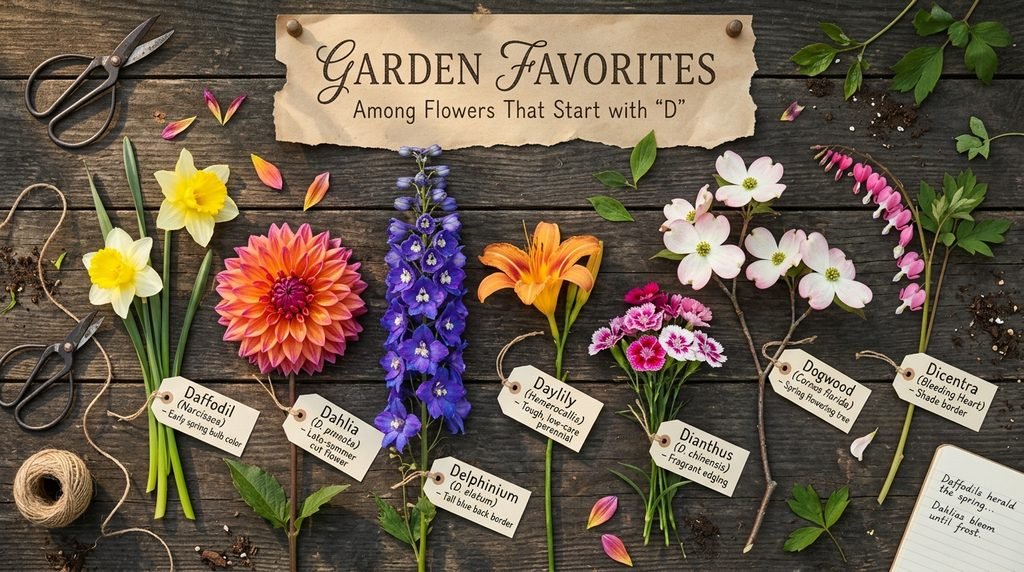
Dianthus brings spicy fragrance and cheerful color to sunny edges. Dogwood offers the grandest spring display of any tree on the list. Dicentra, the classic bleeding heart, lights up shady corners with arching rows of heart-shaped blooms. Together, these plants cover sun, shade, tall borders, and low edging.
| Flower | Botanical Name | Best Border Role |
| Daffodil | Narcissus pseudonarcissus | Early spring bulb color |
| Dahlia | Dahlia pinnata | Late-summer cut flower |
| Delphinium | Delphinium elatum | Tall blue back border |
| Daylily | Hemerocallis fulva | Tough, low-care perennial |
| Dianthus | Dianthus chinensis | Fragrant edging |
| Dogwood | Cornus florida | Spring flowering tree |
| Dicentra | Dicentra spectabilis | Shade border, woodland garden |
Daffodil and dahlia sit at opposite ends of the season. Daffodil is planted in fall and flowers in early spring, while dahlia is planted in spring and flowers until frost.
Indoor Plants: Flowers That Start With D for Pots and Windowsills
A smaller group of D flowers performs best indoors, where steady warmth and humidity make up for conditions that are hard to sustain outdoors. Dendrobium is the clear leader, producing long canes of fragrant, long-lasting blooms on a bright windowsill. Dipladenia, a compact form of mandevilla, flowers all summer in a container and can come indoors before frost.
Dracula orchid suits growers who love the unusual. Its small, monkey-faced blooms appear throughout the year, though it needs cool, humid air to thrive. Dombeya, sometimes called tropical hydrangea, can bloom indoors in a bright conservatory or greenhouse during winter.
- Dendrobium — bright indirect light, let the mix dry slightly between waterings
- Dipladenia — bright light, warm temperatures, move indoors before frost
- Dracula Orchid — bright indirect light, cool nights, high humidity
- Dombeya — bright light, warm greenhouse or conservatory
Dendrobium is the easiest of the group for a beginner. Dracula orchid is the fussiest, since warm, dry indoor air will quickly stress it.
Explore More Ideas: 80+ Beautiful Flowers That Start With C (With Pictures, Names & Meanings)
Florist Favorites: D Flowers Built for Cutting and Arranging
Cut-flower value depends on vase life, stem strength, and versatility. Dahlia is a favorite for its sheer variety of shapes, from tiny pompons to giant dinner plates. Delphinium gives arrangements dramatic height and some of the truest blues in the floral trade. Dianthus, especially the carnation forms, lasts well and carries a spicy scent.
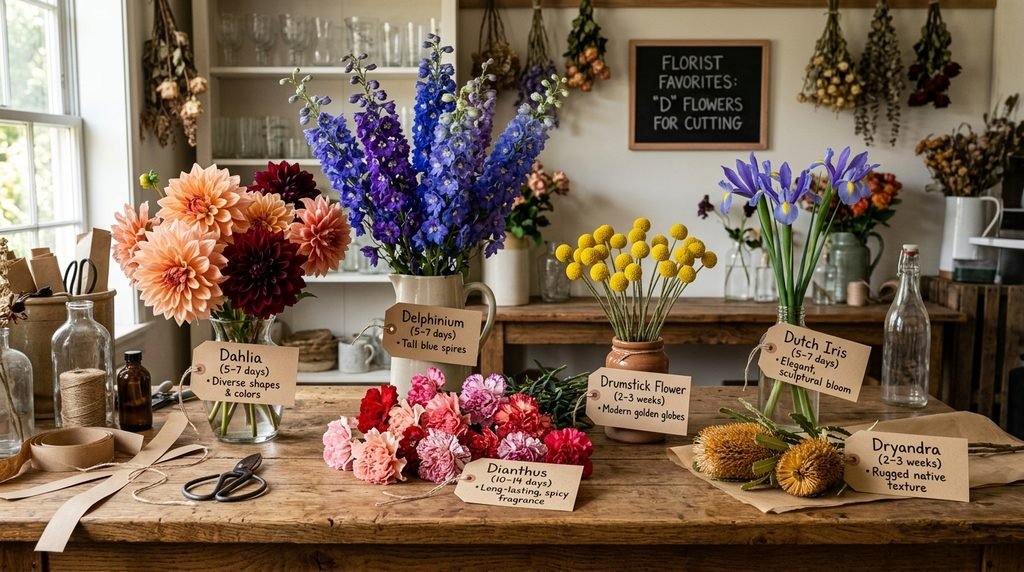
Drumstick flower, or craspedia, adds round, golden globes that look modern and never wilt, since they dry beautifully. Dutch iris brings elegant, sculptural blooms to spring bouquets. Dryandra, now classified with banksia, offers rugged native texture that stands out in Australian-style designs.
| Flower | Vase Life | Why Florists Use It |
| Dahlia | 5–7 days | Wide range of shapes and colors |
| Delphinium | 5–7 days | Tall spires, true blue color |
| Dianthus | 10–14 days | Long-lasting, spicy fragrance |
| Drumstick Flower | 2–3 weeks | Round golden globes that dry well |
| Dutch Iris | 5–7 days | Elegant, sculptural bloom |
| Dryandra | 2–3 weeks | Rugged native texture |
Drumstick flower leads this table for staying power. Because it dries on the stem, a single bunch can look good for months.
Rare Flowers: The Harder-to-Find Entries on This List
A handful of entries on this list are genuinely uncommon. Disa, a terrestrial orchid from South Africa, grows along cool, wet mountain streams and is famous for its brilliant red flowers. It needs very specific water quality and cool conditions, so even expert growers find it difficult. Dove orchid, also called the Holy Ghost orchid, produces waxy white flowers shaped like a dove in flight. It is the national flower of Panama and is rarely seen outside tropical collections.
Dracula orchid, native to cloud forests of Colombia and Ecuador, earns its place on this list for its odd, monkey-faced blooms. Dionysia, a tiny alpine cushion plant from Iran and Central Asia, forms tight mats covered in tiny flowers and is cherished by rock-garden specialists. Dragon’s mouth orchid, a native bog orchid of North America, is nearly impossible to grow outside its wet, cool home.
Color Groupings: Choosing D Flowers by Color
White tones run through this letter. Dogwood’s four-part bracts, daisy’s classic petals, and Deutzia’s sprays of tiny bells all offer clean white blooms. White works well in evening gardens, where pale petals stay visible after dusk. Desert lily and dwarf cornel add softer, more delicate whites for dry gardens and woodland edges.
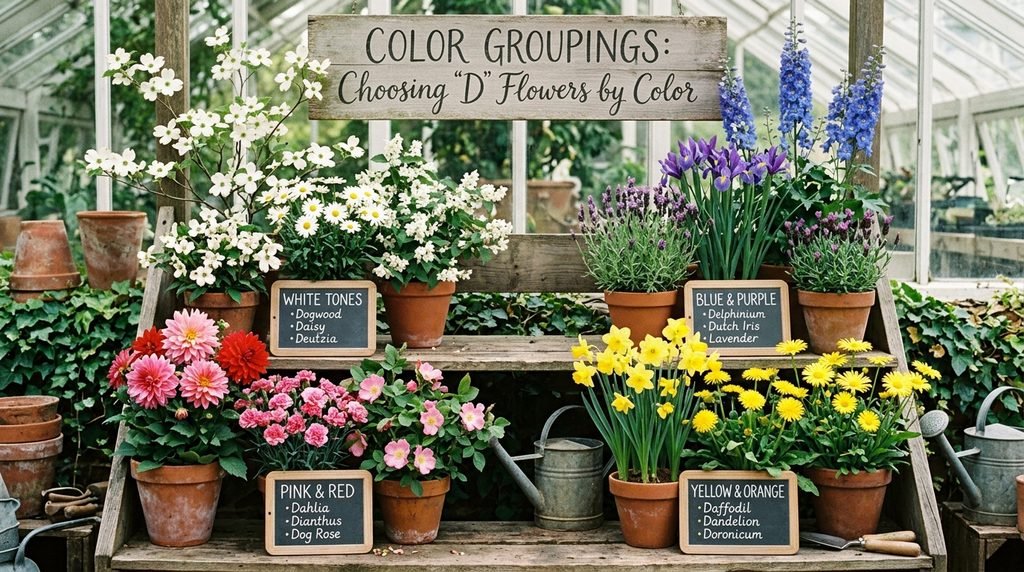
Blue and purple tones come from delphinium, Dutch iris, Dalmatian bellflower, Dutch lavender, and dwarf plumbago. These colors suit cottage borders and pollinator gardens, since bees favor blue and violet blooms. Pink and red tones are strong too, led by dahlia, dianthus, dicentra, dog rose, and damask rose. They bring warmth to spring and summer borders.
Yellow and orange tones show up in daffodil, dandelion, doronicum, desert marigold, and Darwin’s barberry. These bright colors work well in sunny beds and early-season plantings. Doronicum is a useful early pick, since its sunny daisy-like flowers open when many other perennials are still waking up.
Choosing by Life Cycle: Annuals, Perennials, Bulbs, and Beyond
Matching a flower’s life cycle to your planning horizon matters as much as matching its color. An annual needs replanting every year. A shrub or tree becomes a permanent fixture. Perennials make up the largest group among flowers that start with D. They return each season with less effort. Bulbs form a strong secondary group, including several early bloomers that finish quickly and go dormant.
True annuals are a smaller cluster, led by dorotheanthus, desert sand verbena, and dwarf morning glory. Trees and shrubs round out the list with showy spring bloomers such as dogwood, Deutzia, and desert willow.
| Flower | Life Cycle |
| Daffodil | Bulb |
| Dahlia | Tuberous perennial |
| Dahurian Rhododendron | Shrub |
| Daisy | Perennial |
| Daisy Bush | Shrub |
| Daisy Fleabane | Annual or biennial |
| Dalea | Perennial |
| Dalmatian Bellflower | Perennial |
| Dalmatian Iris | Perennial (rhizome) |
| Dame’s Rocket | Biennial |
| Damask Rose | Shrub |
| Dandelion | Perennial |
| Daphne | Shrub |
| Darling Pea | Perennial |
| Darwin Tulip | Bulb |
| Darwin’s Barberry | Evergreen shrub |
| Datura | Annual |
| Day Jessamine | Shrub |
| Dayflower | Annual |
| Daylily | Perennial |
| Dead Nettle | Perennial |
| Deerbrush | Shrub |
| Delosperma | Perennial |
| Delphinium | Perennial or biennial |
| Dendrobium | Perennial (epiphytic orchid) |
| Dendromecon | Shrub |
| Deptford Pink | Annual or biennial |
| Desert Chicory | Annual |
| Desert Evening Primrose | Annual |
| Desert Four O’Clock | Perennial |
| Desert Lily | Bulb |
| Desert Marigold | Perennial |
| Desert Rose | Succulent shrub |
| Desert Sand Verbena | Annual |
| Desert Sunflower | Annual |
| Desert Willow | Tree |
| Desmodium | Perennial |
| Deutzia | Shrub |
| Devil’s Bit Scabious | Perennial |
| Devil’s Claw | Annual |
| Devil’s Paintbrush | Perennial |
| Devil’s Walking Stick | Shrub |
| Dew Flower | Perennial (succulent) |
| Diascia | Perennial (grown as annual) |
| Dianthus | Perennial or biennial |
| Dicentra | Perennial |
| Dichelostemma | Bulb |
| Dichorisandra | Perennial |
| Dicliptera | Perennial shrub |
| Dictamnus | Perennial |
| Dierama | Perennial (corm) |
| Dietes | Perennial |
| Digiplexis | Perennial |
| Digitalis | Biennial |
| Dillenia | Tree |
| Dimorphotheca | Annual or perennial |
| Dinner Plate Hibiscus | Perennial |
| Dionysia | Perennial (alpine) |
| Diplacus | Shrub |
| Dipladenia | Vine |
| Disa | Perennial (terrestrial orchid) |
| Disphyma | Perennial (succulent) |
| Disporum | Perennial |
| Dissotis | Shrub |
| Dodecatheon | Perennial |
| Dogbane | Perennial |
| Dog Rose | Shrub |
| Dogtooth Violet | Bulb |
| Dogwood | Tree |
| Dombeya | Tree or shrub |
| Doronicum | Perennial |
| Dorotheanthus | Annual |
| Doryanthes | Perennial |
| Dove Orchid | Perennial (orchid) |
| Dracula Orchid | Perennial (orchid) |
| Dragon Arum | Perennial (tuber) |
| Dragon’s Mouth Orchid | Perennial (terrestrial orchid) |
| Dragonhead | Perennial |
| Dropwort | Perennial |
| Drumstick Allium | Bulb |
| Drumstick Flower | Perennial (grown as annual) |
| Drumstick Primula | Perennial |
| Dryandra | Shrub |
| Dryas | Perennial (evergreen) |
| Duranta | Shrub |
| Dusky Cranesbill | Perennial |
| Dutch Crocus | Bulb |
| Dutch Hyacinth | Bulb |
| Dutch Iris | Bulb |
| Dutch Lavender | Perennial shrub |
| Dutchman’s Breeches | Bulb (tuber) |
| Dutchman’s Pipe | Vine |
| Dwarf Bearded Iris | Perennial (rhizome) |
| Dwarf Cornel | Perennial |
| Dwarf Crested Iris | Perennial (rhizome) |
| Dwarf Fireweed | Perennial |
| Dwarf Iris | Bulb |
| Dwarf Morning Glory | Annual |
| Dwarf Plumbago | Perennial |
| Dyer’s Chamomile | Perennial |
| Dyer’s Greenweed | Shrub |
| Dyer’s Woad | Biennial |
This table shows the perennial-heavy nature of this letter at a glance. Bulbs and shrubs form strong secondary groups. True annuals remain a smaller but genuinely useful set for single-season color.
Why Botanical Names Matter for This Letter
Common names cause real confusion with this letter. Several unrelated plants share the same descriptive word. “Desert” covers nine different plants on this list, “Dutch” covers six, and “Dwarf” covers seven. The name “Dutchman’s” alone covers two entirely different plants, one a harmless woodland bulb and the other a vine with toxic compounds. A botanical name settles the question at once.
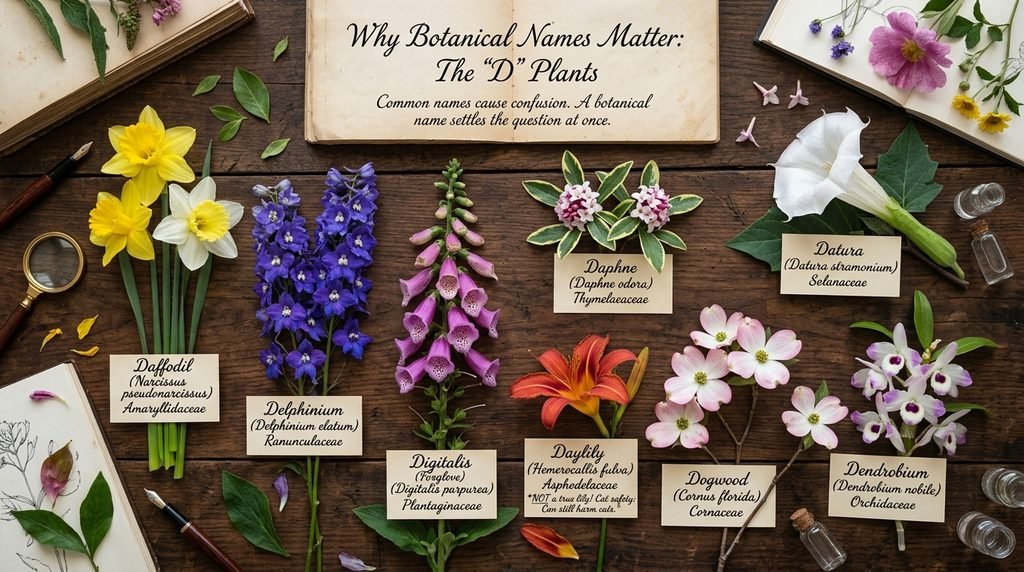
| Common Name | Botanical Name | Plant Family |
| Daffodil | Narcissus pseudonarcissus | Amaryllidaceae |
| Delphinium | Delphinium elatum | Ranunculaceae |
| Digitalis (Foxglove) | Digitalis purpurea | Plantaginaceae |
| Daphne | Daphne odora | Thymelaeaceae |
| Datura | Datura stramonium | Solanaceae |
| Daylily | Hemerocallis fulva | Asphodelaceae |
| Dogwood | Cornus florida | Cornaceae |
| Dendrobium | Dendrobium nobile | Orchidaceae |
Daylily is the entry most worth double-checking. It is not a true lily, yet it can still harm cats. The botanical name makes clear that it belongs to a different family from the true lilies.
What These Flowers Are Said to Represent
Symbolism across these flowers ranges from ancient tradition to modern association. Daffodil stands for rebirth and new beginnings, since it flowers when winter loosens its grip. In Victorian flower language, a single daffodil could also signal unrequited love. Dahlia has long suggested dignity and elegance, and it also carries a message of lasting commitment.
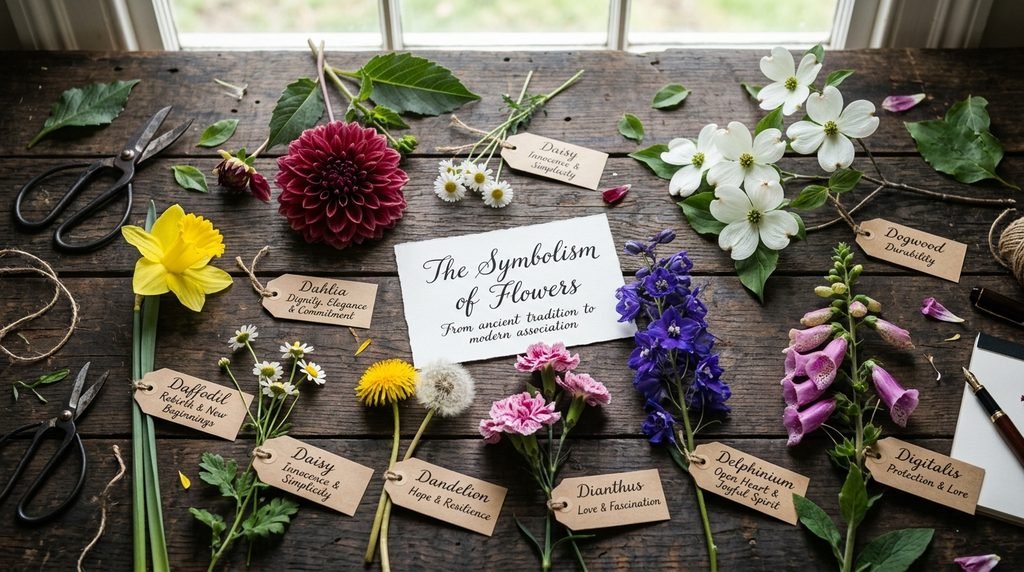
Daisy takes its name from the Old English phrase for day’s eye, because the flower opens at dawn and closes at dusk. It stands for innocence and simplicity. Dandelion symbolizes hope and resilience, and children still blow its seed heads to make a wish. Dianthus comes from Greek words meaning divine flower, and it is tied to love and fascination.
Delphinium suggests an open heart and joyful spirit. Dogwood stands for durability, a meaning that fits its tough wood and its reliable spring show. Digitalis carries a more mixed meaning, linked in older lore to both protection and insincerity. Many smaller entries, such as dichorisandra and dissotis, have no deep symbolic history, and it is more honest to say so than to invent one.
Decision Guide: Matching a Scenario to the Right D Flower
Sometimes the fastest way to choose a flower is not to scroll a full list. It helps to start from the real problem that needs solving, whether that is a shaded corner, a fragrant border, or a household with pets. The table below maps common gardening scenarios to the D flowers best suited to each one.
| If You Need… | Consider | Why |
| An easy, low-care perennial | Daylily, Daffodil | Both return reliably with little attention |
| A pet-safe cut flower | Dahlia (with care), Dianthus, Drumstick Flower | No documented severe toxicity for most pets |
| Early spring color | Daffodil, Dwarf Iris, Dutch Crocus | All three bloom before most perennials wake up |
| A pollinator magnet | Dalea, Devil’s Bit Scabious, Dutch Lavender | Long bloom windows, easy access for bees |
| Shade tolerance | Dicentra, Dusky Cranesbill, Dogtooth Violet | All three perform well in partial shade |
| A genuine rarity to chase | Disa, Dracula Orchid, Dionysia | All three are hard to source and grow |
| A plant to avoid around pets | Digitalis, Delphinium, Datura, Daphne | All four carry documented high toxicity |
Cat owners should look twice at daylily. It is a classic border plant, yet even small amounts of its pollen or petals have caused kidney failure in cats.
Caution: D Flowers That Need Careful Placement
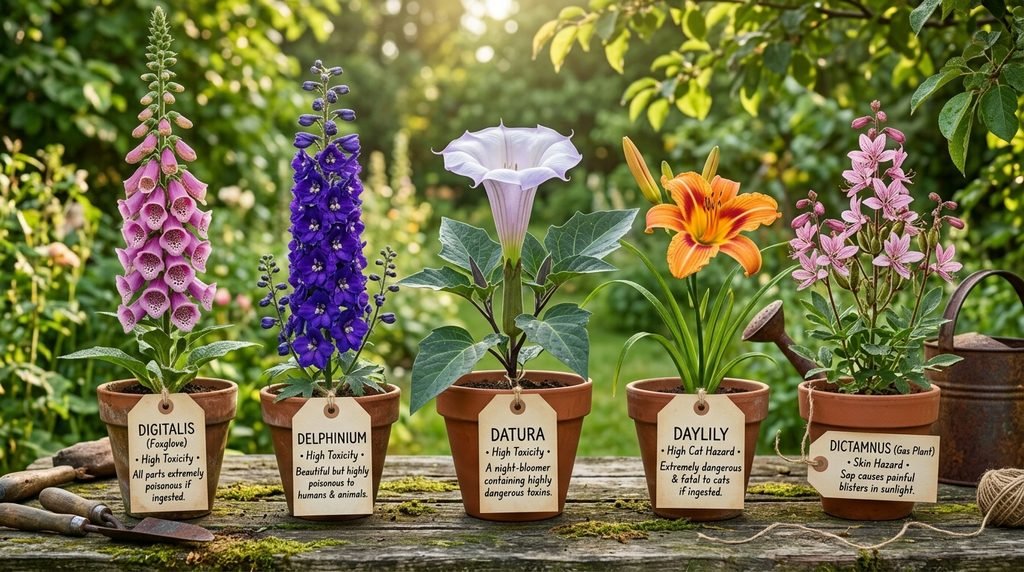
Toxicity risk varies sharply across this letter. A few entries deserve serious, specific attention. Digitalis contains cardiac glycosides throughout the plant, and even a small amount can disturb the heart. Delphinium is just as serious. Its alkaloids can cause digestive upset, muscle weakness, and heart problems in pets, livestock, and children.
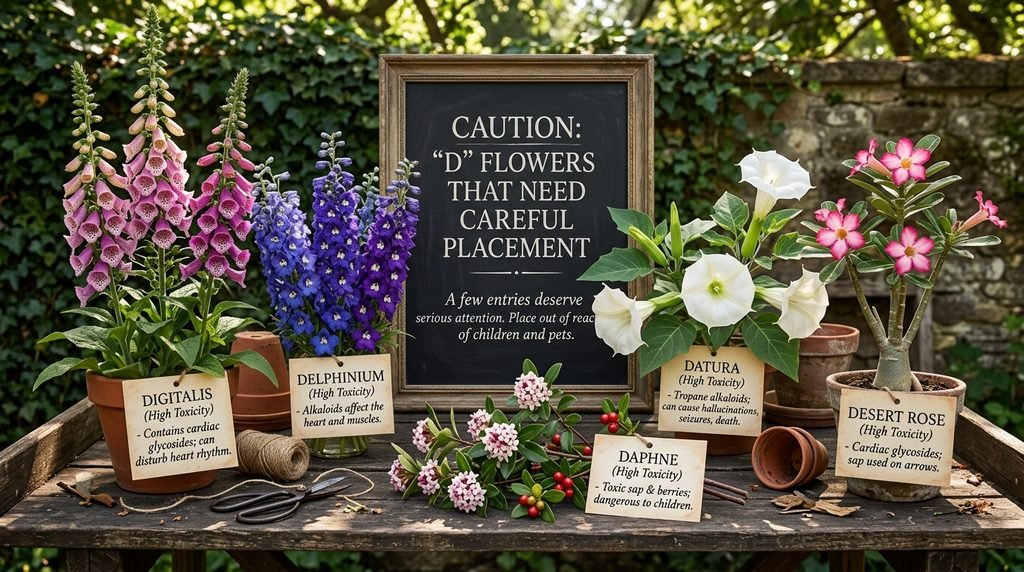
Datura carries tropane alkaloids that cause hallucinations, a racing heart, and, in severe cases,s death. Daphne is among the most toxic shrubs sold for gardens. Its berries and sap are dangerous, and children have been poisoned by the red fruit. Desert rose contains cardiac glycosides, and its sap has been used to poison arrows. Dutchman’s pipe contains aristolochic acid, which can damage the kidneys. DaJessaminene is hazardous mostly to livestock.
| Flower | Toxicity Level | Risk Details |
| Digitalis | High | Cardiac glycosides; can disturb heart rhythm |
| Delphinium | High | Alkaloids affect the heart and muscles |
| Datura | High | Tropane alkaloids; hallucinations, seizures, death |
| Daphne | High | Toxic sap and berries; poisonings in children |
| Desert Rose | High | Cardiac glycosides; sap used on arrows |
| Daylily | High (cats) | Can cause fatal kidney failure in cats |
| Dutchman’s Pipe | Moderate to High | Aristolochic acid; kidney damage |
Households with children or pets should treat digitalis, delphinium, datura, and daphne as an outright no. Placing them out of reach is not enough, since even handling the cut stems can cause problems.
Conclusion
Flowers that start with D span an extraordinary range, from easy bulbs and long-lived perennials to showy trees, rare orchids, and a concentrated cluster of dangerous species. Choosing among them comes down to matching a specific flower to an actual spot, household, or purpose, rather than working down an alphabetical list. With the comparison table, category breakdowns, and decision guide above, narrowing this list to the few that truly fit your garden should take far less trial and error than starting from scratch.
Frequently Asked Questions
1. How many flowers that start with D are there?
This guide covers more than one hundred verified flowers that start with D. They range from common garden perennials to rare orchids and several species that require serious caution.
2. What is the easiest D flower to grow?
Daylily and daffodil are both excellent for beginners. They tolerate a wide range of soils and return year after year with little care.
3. Which D flowers are toxic to pets?
Digitalis, delphinium, datura, and daphne are among the most dangerous. Daylily is especially risky for cats, even though it is not a true lily.
4. What does daffodil symbolize?
Daffodil stands for rebirth and new beginnings. In some older traditions, it also signals unrequited love.
5. What D flowers work well indoors?
Dendrobium, Dipladenia, and Dracula orchids are the most common indoor choices. Dendrobium is the easiest of the three for beginners.
6. Is foxglove safe to grow in a family garden?
It needs serious caution. Digitalis contains cardiac glycosides in every part, so it should be kept well away from children and pets.
7. What is the best D flower for cutting?
Dianthus and drumstick flower both last a long time in a vase. Drumstick flower also dries well and can look good for months.
8. Are any D flowers genuinely rare?
Yes. Disa, Dracula orchid, and dionysia are all uncommon. Each needs very specific growing conditions that most gardens cannot offer.
9. Is a daylily the same as a true lily?
No. Daylily belongs to a different plant family. Even so, it can cause kidney failure in cats, much like true lilies do.
10. Can dahlias come back every year?
Yes, in mild climates. In colder zones, the tubers should be dug up after the first frost, stored dry, and replanted in spring.
11. What D flower is best for a pollinator garden?
Dalea, devil’s bit scabious, and Dutch lavender are all strong choices. They offer long bloom windows that draw in bees and butterflies.
12. Is a dandelion really a flower?
Yes. Each dandelion head is made of many tiny flowers, and the plant provides early nectar for bees. It is also edible.
13. What is the biggest mistake people make with Daphne?
Underestimating its toxicity is the most serious mistake. The shrub is fragrant and lovely, yet its berries and sap are dangerous.
14. Do any D flowers bloom in late winter?
Yes. Daphne, dwarf iris, and Dutch crocus all bloom in late winter or very early spring, offering color before most other plants wake up.
15. What is a good starter combination of D flowers for a new gardener?
Daffodil for spring color, daylily for summer reliability, and dianthus for fragrant edging cover a wide range of needs without demanding much experience.
4 thoughts on “100+ Flowers That Start With D (Names, Meanings & Beautiful Photos)”