
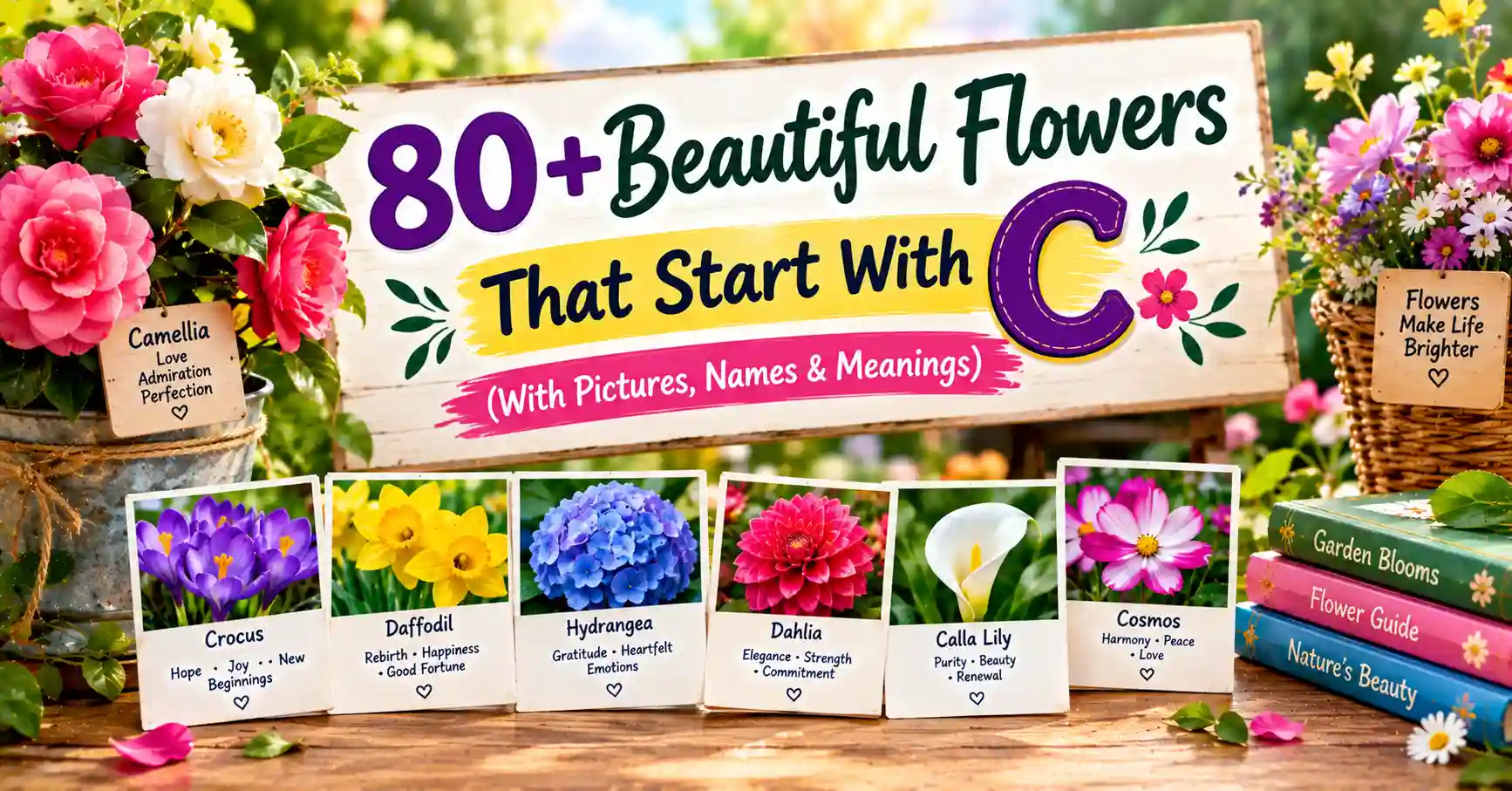
Flowers that start with C include some of the most loved blooms in the world. Carnation, chrysanthemum, camellia, and cherry blossom are the big names. But the letter C also holds quieter finds, like crown imperial, cuckoo flower, and the calypso orchid. This guide brings them all together in one place.
The list below covers more than 80 flowers that start with C. Each one is a real plant with a verified botanical name. You will find garden staples, houseplants, florist picks, wild natives, and a few rare species that most lists skip.
A long list of flowers that start with C only helps if you can use it. So every plant here is sorted by color, life cycle, and use. Each table comes with plain-language notes. You will never hit a bare spreadsheet.
Read straight through or jump ahead. Want a pet-safe border? Go to the toxicity section. Need a name for a school project? Use the alphabetical list. Want a fast pick? Try the decision table near the end.
Quick Answer: Ten Standout C Flowers
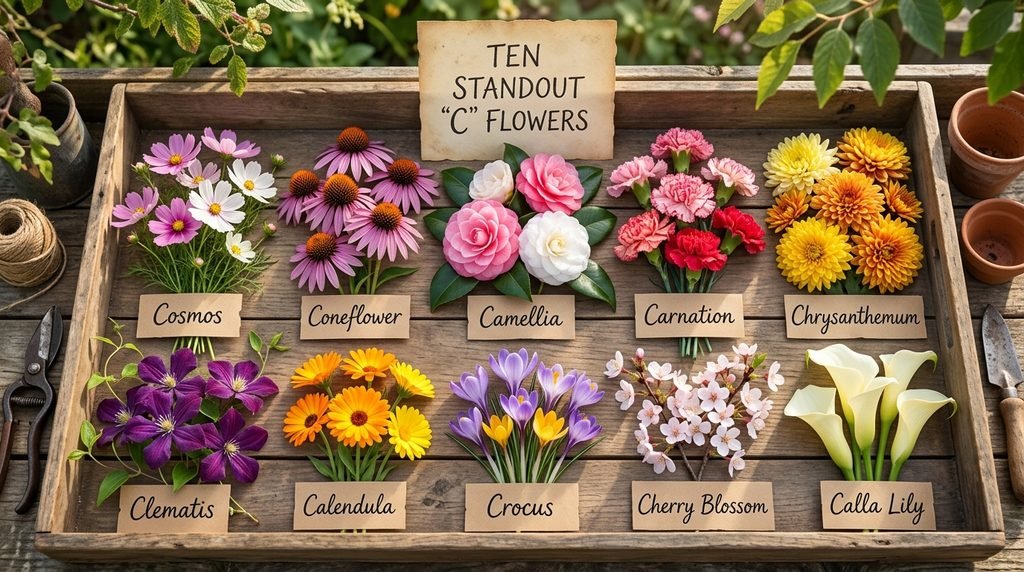
Cosmos is the easiest place to begin. It grows from seed and blooms until frost. Coneflower is the tough pollinator favorite for sunny beds. Camellia brings glossy leaves and winter color. Carnation and chrysanthemum are the florist classics, loved for long vase life. Clematis is the climber that turns a fence into a wall of bloom. Calendula is the cheerful, edible annual. Crocus is the first spark of spring. Cherry blossom is the iconic spring tree. Calla lily closes the list as the elegant, sculpted choice for weddings and patios.
Master Alphabetical List of Flowers That Start With C
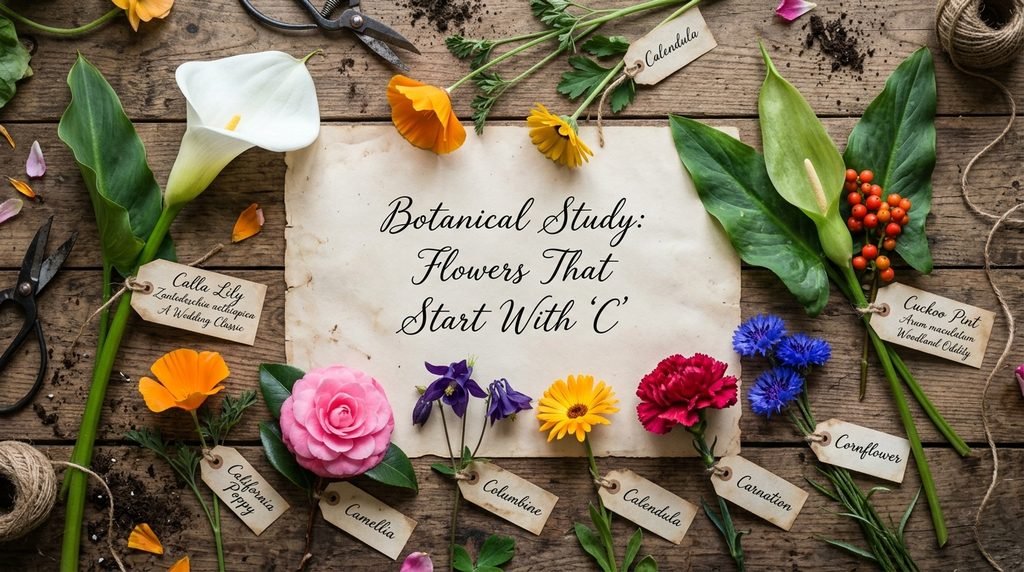
This list names more than 80 flowers that start with C. Most entries use a familiar common name. A few are better known by their botanical name, so those appear under the name nurseries print on their tags. Each row has a short note so you can tell at a glance what the plant looks like and where it grows best.
See More Flowers: 80+ Beautiful Flowers That Start With A (With Pictures, Names & Meanings)
| Flower | Botanical Name | Note |
| Cabbage Rose | Rosa centifolia | Full, fragrant pink old rose |
| Calendula (Pot Marigold) | Calendula officinalis | Orange or yellow daisy, edible petals |
| Calibrachoa | Calibrachoa × hybrida | Mini petunia-like blooms for baskets |
| California Poppy | Eschscholzia californica | Orange silky cups, state flower of California |
| Calla Lily | Zantedeschia aethiopica | Elegant white spathe around a yellow spike |
| Calypso Orchid | Calypso bulbosa | Rare pink woodland orchid |
| Camassia | Camassia quamash | Blue-violet star spikes from native bulbs |
| Camellia | Camellia japonica | Glossy leaves, rose-like winter blooms |
| Camellia Sasanqua | Camellia sasanqua | Earlier, smaller, fall-blooming camellia |
| Campion (Red) | Silene dioica | Bright pink-red blooms, woodland edge plant |
| Candytuft | Iberis sempervirens | White evergreen mounds, spring bloom |
| Canna Lily | Canna indica | Bold tropical leaves with orange or red spikes |
| Canterbury Bells | Campanula medium | Tall stems of large bell flowers |
| Cape Daisy | Osteospermum ecklonis | Daisy blooms that close at night |
| Cape Fuchsia | Phygelius capensis | Red-orange tubular blooms, hummingbird plant |
| Cape Primrose | Streptocarpus × hybridus | Trumpet blooms for bright indoor spots |
| Cardinal Flower | Lobelia cardinalis | Fiery red spikes for moist soil |
| Carnation | Dianthus caryophyllus | Ruffled, spicy-scented cut flower |
| Carolina Jessamine | Gelsemium sempervirens | Yellow fragrant vine, highly toxic |
| Cat’s Claw Vine | Dolichandra unguis-cati | Bright yellow trumpets on a fast climber |
| Cat’s Whiskers | Orthosiphon aristatus | White flowers with long, whisker-like stamens |
| Catalpa Blossom | Catalpa speciosa | White frilled bloom on a large shade tree |
| Catmint | Nepeta × faassenii | Lavender-blue spikes, long bloom time |
| Cattleya Orchid | Cattleya spp. | Large, ruffled, fragrant corsage orchid |
| Celosia | Celosia argentea | Plume or crest blooms in hot colors |
| Cherokee Rose | Rosa laevigata | Single white rose, state flower of Georgia |
| Cherry Blossom | Prunus serrulata | Pink-white clouds of spring bloom |
| Chenille Plant | Acalypha hispida | Long red fuzzy tails, tropical shrub |
| Chicory | Cichorium intybus | Sky-blue roadside daisy |
| Chilean Glory Flower | Eccremocarpus scaber | Orange-red tubular blooms on a climber |
| China Aster | Callistephus chinensis | Full pom-pom blooms, cut flower |
| China Rose | Rosa chinensis | Everblooming old rose in pink or red |
| Chinese Forget-Me-Not | Cynoglossum amabile | Deep blue small flowers |
| Chinese Fringe Flower | Loropetalum chinense | Pink spidery blooms on a dark-leaved shrub |
| Chinese Lantern | Physalis alkekengi | Orange papery lanterns around small blooms |
| Chinese Peony | Paeonia lactiflora | Huge, fragrant late-spring blooms |
| Chives Flower | Allium schoenoprasum | Purple pompoms, edible |
| Chocolate Cosmos | Cosmos atrosanguineus | Dark red blooms with a chocolate scent |
| Christmas Cactus | Schlumbergera × buckleyi | Pink or red winter blooms indoors |
| Christmas Rose | Helleborus niger | White winter bloom, toxic |
| Chrysanthemum | Chrysanthemum × morifolium | Fall mum in nearly every color |
| Cineraria | Pericallis × hybrida | Bright daisy clusters for cool rooms |
| Cinquefoil | Potentilla fruticosa | Yellow shrub blooms all summer |
| Citrus Blossom | Citrus × sinensis | Fragrant white bloom, grown mostly for fruit |
| Clarkia | Clarkia amoena | Silky pink cups, cool-season annual |
| Clematis | Clematis spp. | Large climbing blooms in many colors |
| Cleome | Cleome hassleriana | Spiky pink and white spider flowers |
| Clivia | Clivia miniata | Orange trumpet clusters for shady rooms |
| Clover (Red) | Trifolium pratense | Pink pom-pom blooms, bee favorite |
| Colchicum (Autumn Crocus) | Colchicum autumnale | Lilac blooms in fall, highly toxic |
| Columbine | Aquilegia vulgaris | Spurred blooms that look like tiny lanterns |
| Common Primrose | Primula vulgaris | Pale yellow early spring bloom |
| Coneflower | Echinacea purpurea | Pink petals around a spiky cone |
| Confederate Rose | Hibiscus mutabilis | Blooms that change from white to pink |
| Coral Bean | Erythrina herbacea | Red tubular spikes, red toxic seeds |
| Coral Bells | Heuchera sanguinea | Tiny red bells above colorful leaves |
| Coral Honeysuckle | Lonicera sempervirens | Red-orange trumpet vine, hummingbird favorite |
| Coral Tree | Erythrina crista-galli | Crimson, cockscomb-shaped blooms |
| Coral Vine | Antigonon leptopus | Pink heart-shaped sprays on a fast vine |
| Coreopsis | Coreopsis grandiflora | Golden daisies for months |
| Corn Poppy | Papaver rhoeas | Red papery blooms, symbol of remembrance |
| Cornflower | Centaurea cyanus | True-blue fringed blooms |
| Corydalis | Corydalis lutea | Yellow tubular blooms for shady walls |
| Cosmos | Cosmos bipinnatus | Airy pink, white, and magenta daisies |
| Cowslip | Primula veris | Yellow drooping clusters, spring meadows |
| Crabapple Blossom | Malus spp. | Pink-white spring bloom, bird-friendly fruit |
| Crape Myrtle | Lagerstroemia indica | Summer-long frilly blooms on a small tree |
| Cranesbill | Geranium spp. | Hardy, long-blooming perennial geranium |
| Creeping Buttercup | Ranunculus repens | Glossy yellow cups, spreads fast |
| Creeping Jenny | Lysimachia nummularia | Golden coins with small yellow flowers |
| Creeping Phlox | Phlox subulata | Carpet of spring color |
| Crepe Jasmine | Tabernaemontana divaricata | White pinwheel blooms, fragrant at night |
| Crimson Clover | Trifolium incarnatum | Bright red cone-shaped blooms |
| Crinum Lily | Crinum asiaticum | Large white spider-like blooms |
| Crocosmia | Crocosmia × crocosmiiflora | Fiery arching sprays in summer |
| Crocus | Crocus vernus | First blooms of spring, cup-shaped |
| Crown Imperial | Fritillaria imperialis | Tall stems topped with orange bells and leaves |
| Crown of Thorns | Euphorbia milii | Small red bracts on a spiny, tough houseplant |
| Cuckoo Flower | Cardamine pratensis | Pale lilac meadow bloom |
| Cuckoo Pint | Arum maculatum | Hooded green spathe, red toxic berries |
| Cup and Saucer Vine | Cobaea scandens | Purple bells sitting in green saucers |
| Cuphea (Cigar Flower) | Cuphea ignea | Red tubes tipped with white and black |
| Cyclamen | Cyclamen persicum | Swept-back petals over marbled leaves |
| Cymbidium Orchid | Cymbidium spp. | Long-lasting orchid sprays |
| Cypress Vine | Ipomoea quamoclit | Fine feathery leaves, small red stars |
That makes 85 distinct flowers that start with C. Calla lily and cuckoo pint sit far apart in safety and style. One is a wedding classic. The other is a woodland oddity with poisonous berries. Both show how much range this one letter holds.
Full Comparison Table: Sun, Water, and Bloom Time
Sun and water needs often decide which plant wins. The table below compares the main flowers that start with C from this guide. Check the sun column first. Then look at water needs and bloom season to see if the plant fits your space and calendar.
| Flower | Sun Needs | Water Needs | Bloom Season |
| Calendula | Full sun | Low to moderate | Spring to early summer, again in fall |
| California Poppy | Full sun | Low | Spring to summer |
| Calla Lily | Full sun to part shade | Moderate to high | Late spring to summer |
| Camellia | Part shade | Moderate | Fall to early spring |
| Canna Lily | Full sun | Moderate to high | Summer to fall |
| Cardinal Flower | Part shade | High | Late summer |
| Carnation | Full sun | Moderate | Spring to summer |
| Chrysanthemum | Full sun | Moderate | Fall |
| Christmas Cactus | Bright indirect light | Low to moderate | Late fall to winter |
| Clematis | Sun for the top, shade for the roots | Moderate | Spring to fall, by type |
| Columbine | Part shade | Moderate | Late spring |
| Coneflower | Full sun | Low to moderate | Summer to fall |
| Coral Bells | Part shade | Moderate | Late spring to summer |
| Coreopsis | Full sun | Low | Summer |
| Cosmos | Full sun | Low | Summer to frost |
| Crape Myrtle | Full sun | Low once established | Summer |
| Crocus | Full sun to part shade | Low | Late winter to early spring |
| Cyclamen | Bright indirect light | Moderate | Fall to spring |
Cosmos and coreopsis are the best picks for hot, dry spots. Both thrive on little water. Cardinal flower sits at the other end. It wants steady moisture and cool roots.
Garden Favorites Among Flowers That Start With C
A handful of C flowers earn a spot in almost every garden. Coneflower blooms for months and feeds bees and goldfinches. Coreopsis keeps flowering through summer heat. Columbine brings elegant, spurred blooms to part-shade beds. Catmint fills borders with soft blue spikes and needs almost no care.
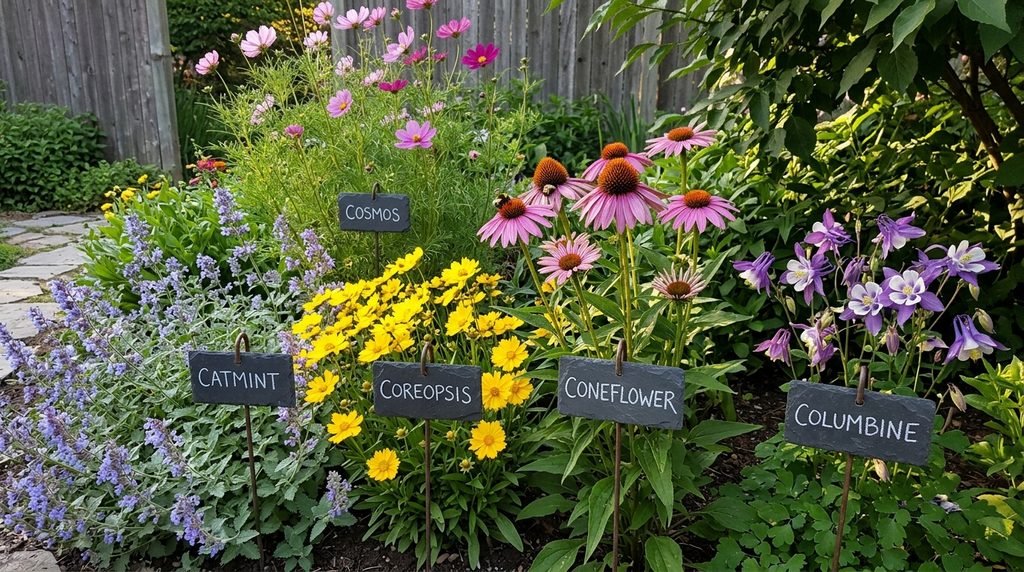
- Coneflower returns every year and draws pollinators all summer.
- Coreopsis blooms for weeks with little deadheading.
- Columbine self-seeds gently and brightens shady corners.
- Catmint blooms from late spring and rebounds after a trim.
- Cosmos grows quickly from seed and fills gaps in a bed.
Coneflower and catmint make a strong pair. One has bold, daisy-like heads. The other adds a soft, misty blue. Together they look full from early summer until frost.
Find More Ideas: 100+ Flowers That Start With B: Names, Meanings & Beautiful Photos
Indoor Plants Among Flowers That Start With C
Several C flowers do well indoors. Christmas cactus blooms in the darkest months and lives for decades. Cyclamen brings cool-season color to bright rooms. Clivia produces orange flower clusters in shade. Cape primrose rewards a sunny windowsill with repeat blooms.
- Christmas Cactus needs cool nights in fall to set buds.
- Cyclamen prefers cool rooms and bright light.
- Clivia blooms best when it is slightly root-bound.
- Cymbidium Orchid thrives in bright light with cooler nights.
- Crown of Thorns tolerates dry air and forgetful watering.
Crown of thorns is the pick for beginners. It handles neglect and blooms almost all year. Just wear gloves. Its sap can irritate skin.
Florist Favorites Among Flowers That Start With C
Florists rely on C flowers for color and staying power. Carnations last up to two weeks in a vase. Chrysanthemums hold their shape for just as long. Calla lilies bring clean, modern lines. Cosmos and cornflower add a soft, wildflower mood to loose bouquets.
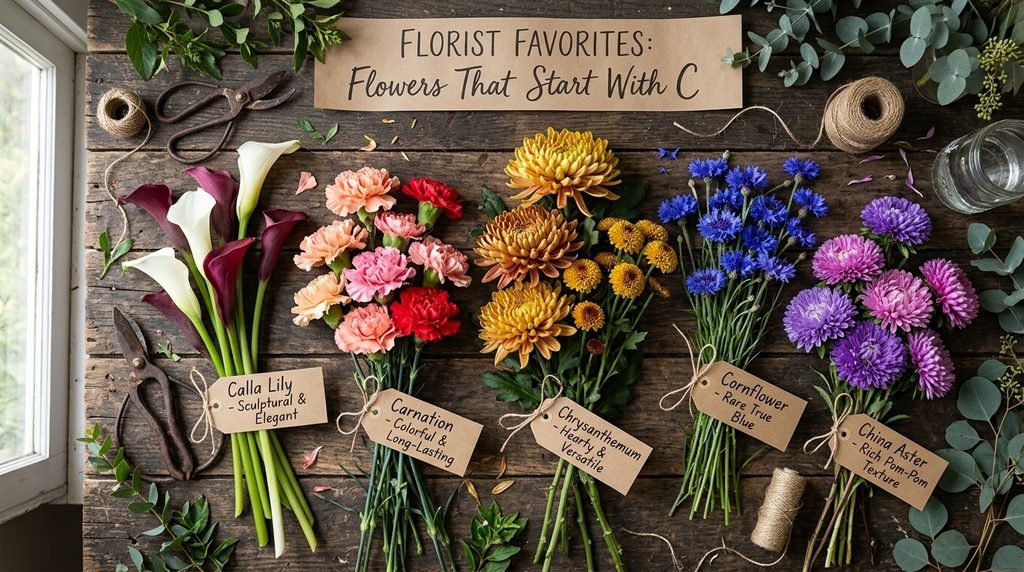
- Carnations last about two weeks and come in many colors.
- Chrysanthemum is long-lasting and ranges from buttons to giant blooms.
- Calla Lily gives sculptural elegance to weddings.
- Cornflower offers rare true blue.
- China Aster adds full, pom-pom texture.
Carnation and chrysanthemum are the quiet workhorses. They rarely steal the show. But a florist’s cooler would feel empty without them.
Rare Flowers That Start With C
Some C flowers are hard to find in the wild or at a nursery. Calypso orchid grows in cool northern forests and rarely survives transplanting. Crown imperial is an ancient garden bulb with a skunky smell and a crown of leaves above its bells. Chilean glory flower is a climber from the Andes that struggles in hot summers. Coral bean is a southeastern native with red spikes and bright seeds that most gardeners never see.
These four plants share one trait. Each wants a very specific home. That is why they stay special.
Caution: Toxic Flowers That Start With C
Several C flowers can harm pets, livestock, or people. Carolina jessamine and colchicum are the most dangerous. Every part of both plants is poisonous. Crown imperial and Christmas rose affect the heart. Calla lily, cuckoo pint, and cyclamen cause strong mouth irritation or stomach upset.
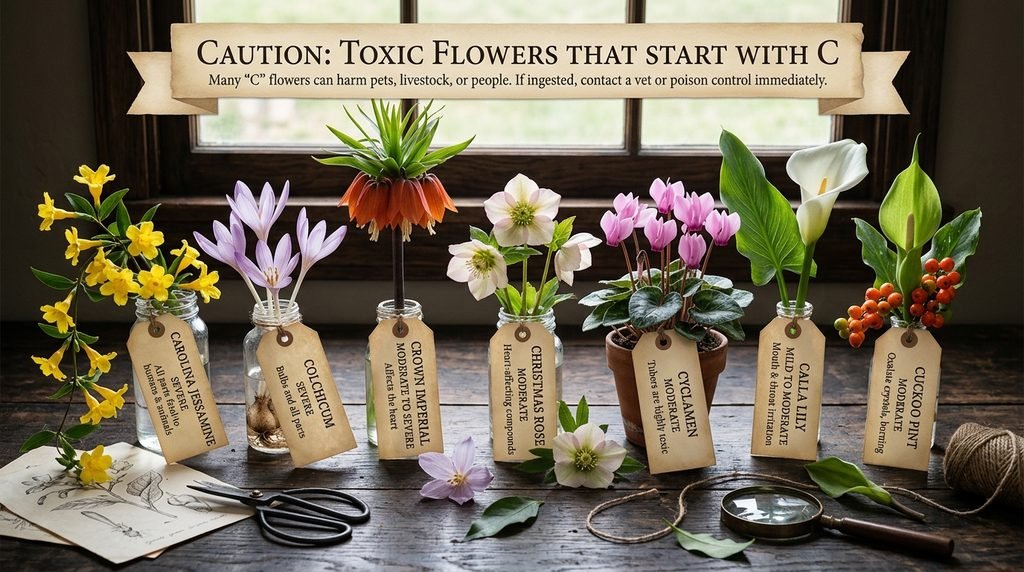
| Flower | Toxic To | Severity |
| Carolina Jessamine | Humans, dogs, cats, livestock | Severe — all parts, can be fatal |
| Colchicum (Autumn Crocus) | Humans, dogs, cats, livestock | Severe — bulbs and all parts |
| Crown Imperial | Dogs, cats, humans | Moderate to severe — affects the heart |
| Christmas Rose | Dogs, cats, horses | Moderate — heart-affecting compounds |
| Cuckoo Pint | Dogs, cats, humans | Moderate — oxalate crystals, burning mouth |
| Cyclamen | Dogs, cats | Moderate — tubers are the most toxic part |
| Calla Lily | Dogs, cats, humans | Mild to moderate — oral and throat irritation |
| Crinum Lily | Dogs, cats | Moderate — bulbs cause vomiting and drooling |
| Columbine | Dogs, cats, humans | Mild to moderate — seeds and roots are riskiest |
| Chrysanthemum | Dogs, cats, horses | Mild to moderate — drooling and stomach upset |
| Clematis | Dogs, cats, horses | Mild to moderate — sap irritates mouth and skin |
| Crown of Thorns | Dogs, cats, humans | Mild to moderate — sap irritates skin and eyes |
Carolina jessamine and colchicum deserve the loudest warning. Keep both away from children and pets. Chrysanthemum and clematis are milder, but a chewing dog can still get sick. If a pet eats any plant on this list, call a vet or poison control right away.
Explore More Blooms: 100+ Flowers That Start With D (Names, Meanings & Beautiful Photos)
C Flowers Grouped by Color
Pink and red lead the C list. Carnation, camellia, cosmos, cherry blossom, and crape myrtle all deliver shades from blush to deep rose. Cherry blossom and crape myrtle give the boldest show, since they bloom on whole trees. Cosmos and carnation suit cutting gardens and small beds.
White and cream flowers include calla lily, candytuft, Christmas rose, and Cherokee rose. White brightens shade and glows at dusk. Calla lily suits formal containers. Candytuft makes a clean edge along paths. Christmas rose is a rare winter gift.
Yellow and orange bring warmth. Calendula, California poppy, coreopsis, and crocosmia glow in full sun. They pair well in meadow-style plantings. California poppy and calendula are also easy from seed.
Blue and purple are rarer, but C does well here. Cornflower, catmint, clematis, and campanula add cool tones. Use them to calm down hot-colored beds. Cornflower and catmint suit sunny borders. Clematis climbs where blue is needed up high.
Red-hot accents come from cardinal flower, cape fuchsia, and coral honeysuckle. All three draw hummingbirds. Plant them where you can watch from a window.
Life-Cycle Groupings for Flowers That Start With C
A plant’s life cycle tells you how much work it will be. Annuals live one season, so you replant each year. Perennials return on their own. Bulbs and tubers need the right winter, cold or warm, to come back. Choose annuals for fresh color each year. Choose perennials for a bed that matures.
| Flower | Life Cycle | Typical Zones |
| Calendula | Annual | All zones (seasonal) |
| California Poppy | Annual (perennial in mild climates) | 8–10 (perennial), elsewhere annual |
| Cosmos | Annual | All zones (seasonal) |
| Cornflower | Annual | All zones (seasonal) |
| Celosia | Annual | All zones (seasonal) |
| Cleome | Annual | All zones (seasonal) |
| Candytuft | Perennial | 3–9 |
| Catmint | Perennial | 3–8 |
| Columbine | Perennial | 3–9 |
| Coneflower | Perennial | 3–9 |
| Coreopsis | Perennial | 4–9 |
| Coral Bells | Perennial | 4–9 |
| Creeping Phlox | Perennial | 3–9 |
| Carnation (Dianthus) | Perennial | 3–9 |
| Chrysanthemum (garden mum) | Perennial | 5–9 |
| Clematis | Perennial (vine) | 4–9 |
| Camellia | Perennial (shrub) | 7–9 |
| Crape Myrtle | Perennial (shrub or tree) | 7–9 |
| Crocus | Perennial (bulb) | 3–8 |
| Canna Lily | Tender perennial (rhizome) | 7–10 |
| Calla Lily | Tender perennial (rhizome) | 8–10 |
Garden mums and canna lilies are the two to watch. Many people buy mums in fall and assume they are annuals. Planted early, they often return. Cannas look tropical but survive winter only in warmer zones or when lifted and stored.
Botanical Name Crosswalk
Common names change from place to place. Botanical names do not. Nursery tags and seed packets use Latin for this reason. It also helps you search online with confidence. Two different plants can share one common name, so the Latin name protects you from a wrong purchase.
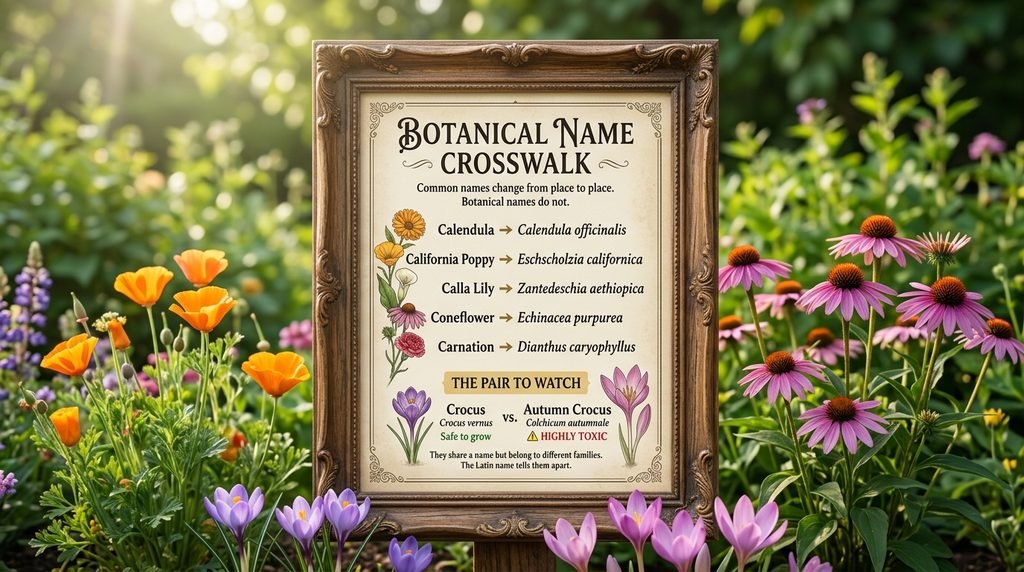
| Common Name | Botanical Name |
| Calendula | Calendula officinalis |
| California Poppy | Eschscholzia californica |
| Calla Lily | Zantedeschia aethiopica |
| Camellia | Camellia japonica |
| Carnation | Dianthus caryophyllus |
| Chrysanthemum | Chrysanthemum × morifolium |
| Clematis | Clematis spp. |
| Columbine | Aquilegia vulgaris |
| Coneflower | Echinacea purpurea |
| Coreopsis | Coreopsis grandiflora |
| Cornflower | Centaurea cyanus |
| Cosmos | Cosmos bipinnatus |
| Crocus | Crocus vernus |
| Cyclamen | Cyclamen persicum |
| Autumn Crocus | Colchicum autumnale |
Crocus and autumn crocus are the pair to watch. They share a name but belong to different families. True crocus is safe to grow. Colchicum, called autumn crocus, is highly toxic. The Latin name tells them apart.
What C Flowers Mean
Flower meanings vary by culture, but a few C flowers carry steady symbolism. Carnation stands for love and fascination. Its color changes the message. Pink often means a mother’s love. Red means deep admiration. Yellow can suggest disappointment. The chrysanthemum is a symbol of long life and honor in Japan, where it appears on imperial crests. In parts of Europe, it is tied to mourning, so context matters.
Camellia has long meant admiration and perfection. In Victorian flower language, a red camellia said you were a flame in someone’s heart. The calla lily stands for beauty and rebirth, which is why it appears at weddings and Easter. The cherry blossom is the symbol of renewal and the fleeting nature of life, especially in Japan.
Cosmos stands for order, harmony, and peace. Cornflower carries hope and delicacy. Crocus speaks of youthful joy, since it is among the first blooms of spring. Clematis stands for mental beauty and clever thinking. Corn poppy is a symbol of remembrance in many countries. Calendula has a double meaning, with joy in some cultures and grief in others. Pick the flower that fits your message and your audience.
Decision Table: Which C Flower Fits Your Situation
You do not need to read the whole list to choose well. Start with your goal in the left column. The right column names the best C flower for it. Then check the toxicity section if you have pets or children.
| If You Want… | Choose This C Flower |
| Easy color from seed | Cosmos, Calendula, or Cornflower |
| Pollinator support | Coneflower, Catmint, or Cardinal Flower |
| A shady spring show | Columbine or Coral Bells |
| A long-blooming sunny border | Coreopsis or Coneflower |
| A climbing vine | Clematis |
| A winter-blooming shrub | Camellia |
| A houseplant with blooms | Christmas Cactus or Cyclamen |
| Wedding or bouquet flowers | Calla Lily, Carnation, or Chrysanthemum |
| A low spring carpet | Creeping Phlox or Crocus |
| A pet-friendlier garden | Cosmos, Calendula, or Coneflower |
Cosmos appears twice because it is easy, bright, and not on the toxic list in this guide. Coneflower and calendula are good partners for it. If you want flowers that start with C for a family garden, begin with those three.
Conclusion
Flowers that start with C give you more choice than almost any other letter. They run from the humble cornflower to the stately crown imperial. This guide sorted more than 80 of them by color, life cycle, and use so you can pick with confidence. Whether you want a pollinator border, a winter shrub, or a bouquet classic, there is a C flower that fits. Use the tables above, check the toxicity notes, and start planting.
Frequently Asked Questions
How many flowers start with C? More than 80 well-known flowers start with C. This guide lists 85 of them, from common garden plants to rare wildflowers.
What is the most popular flower that starts with C? Carnation, chrysanthemum, and cosmos are among the most popular. Camellia and cherry blossom are the best-known flowering trees and shrubs.
What are the easiest flowers that start with C to grow? Cosmos, calendula, cornflower, and California poppy are very easy to grow from seed. Coneflower and coreopsis are easy perennials.
Which C flowers attract butterflies and hummingbirds? Coneflower, catmint, cardinal flower, and cape fuchsia are top picks. Coral honeysuckle and cuphea also draw hummingbirds.
Are calla lilies poisonous to pets? Yes. Calla lilies contain crystals that irritate the mouth and throat. Chewing can cause drooling and vomiting, so keep pets away.
Which C flower is the most dangerous? Carolina jessamine and colchicum are the most dangerous. Every part of both plants is toxic to people, pets, and livestock.
Is autumn crocus the same as crocus?
No. Colchicum, called autumn crocus, is highly toxic. True crocus belongs to a different plant family and is safe to grow.
What does a carnation symbolize?
A carnation stands for love and fascination. Pink often means a mother’s love, red means admiration, and yellow can mean disappointment.
Which C flowers bloom in winter?
Camellia and Christmas rose bloom in the cold months. Christmas cactus and cyclamen brighten homes in winter.
Do chrysanthemums come back every year?
Garden mums often do in zones 5 to 9 if planted early enough to root before winter. Florist mums are usually short-lived.
Which C flowers work best for shade? Columbine, coral bells, camellia, and clivia do well in shade. Cardinal flower likes part shade with steady moisture.
Which C flowers make good cut flowers? Carnation, chrysanthemum, calla lily, cosmos, and cornflower all cut well. China aster and celosia also work.
What is the rarest flower that starts with C?
Calypso orchid and crown imperial are among the rarest. Calypso orchid is very hard to grow outside its native forests.
3 thoughts on “80+ Beautiful Flowers That Start With C (With Pictures, Names & Meanings)”