
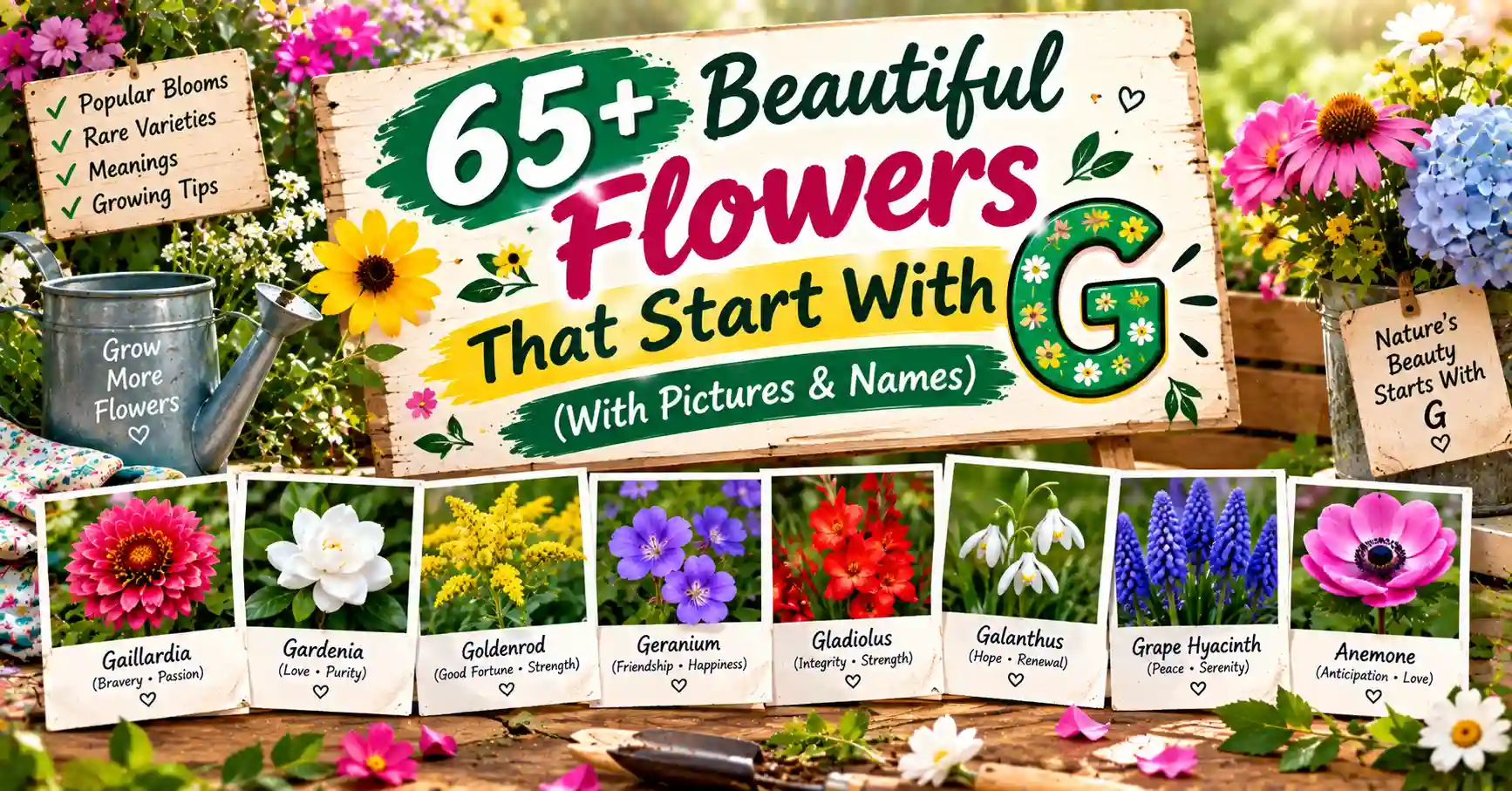
Flowers that start with G run from the cheerful gerbera to the legendary gardenia. Gladiolus, geranium, goldenrod, and grape hyacinth are names most gardeners know. But the letter G also hides lovely surprises, like globeflower, glory-of-the-snow, and a tree that drips with golden chains. This guide gathers 68 of them in one place.
Every plant below is real and has a verified botanical name. You will find border favorites, houseplants, florist picks, wildflowers, and a few rarities that most lists never mention. Nothing here is filler.
A long list only helps if you can use it. So this guide sorts the plants by color, life cycle, and use. A bloom’s beauty means little if it dies in your climate. It means even less if it harms a child or a pet. Each table is explained in plain words first, so you never face a bare spreadsheet.
Quick Answer: Ten Standout G Flowers
Gerbera daisy is the easy crowd-pleaser, with huge, bright blooms that last in a vase. Gardenia wins on fragrance, filling a room with scent from a single flower. Gaillardia, or blanket flower, is the tough sunny-border star that blooms until frost. Gladiolus brings tall, dramatic spikes for cutting, and goldenrod feeds late-season bees and butterflies.
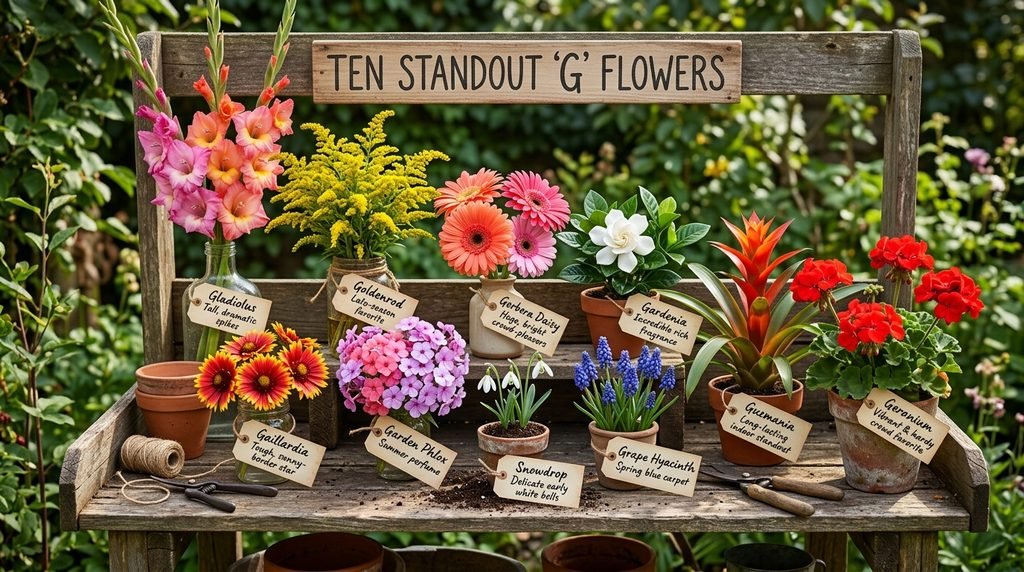
Garden phlox adds summer perfume to a border, while snowdrop opens the year with delicate white bells. Grape hyacinth carpets spring beds in blue, and Guzmania rounds out the list as the long-lasting bromeliad for bright rooms.
Explore More Flower Guides: 100+ Flowers That Start With D (Names, Meanings & Beautiful Photos)
Master Alphabetical List of Flowers That Start With G
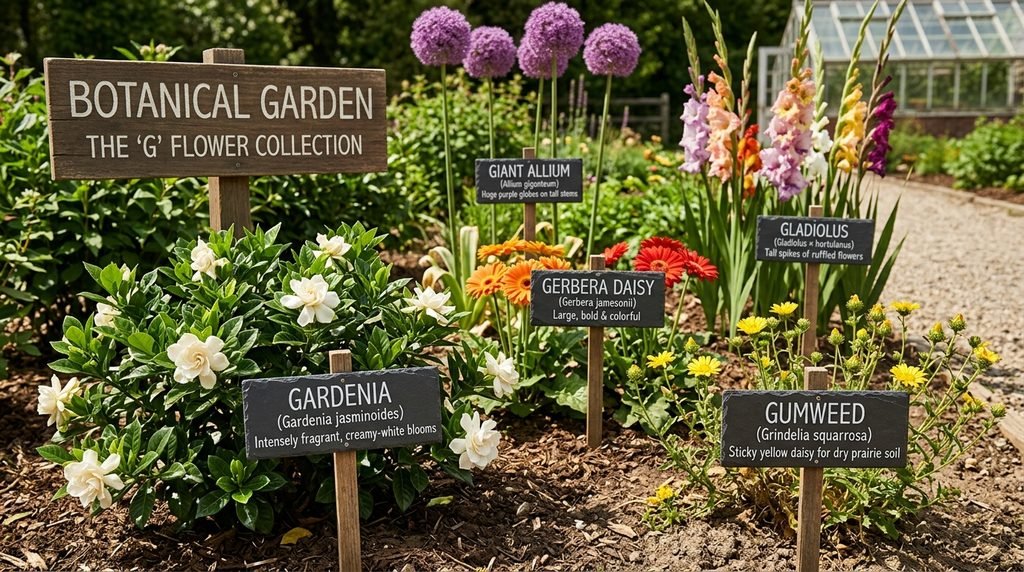
This list names 68 flowers. Most entries use a common name that gardeners already know. A few are better known by their botanical name, so they appear under the name nurseries print on plant tags. Each row has a short note, so you can see at a glance what the plant looks like and where it grows best.
| Flower | Botanical Name | Note |
| Gaillardia (Blanket Flower) | Gaillardia × grandiflora | Red and gold daisies, heat- and drought-tolerant |
| Galanthus (Snowdrop) | Galanthus nivalis | White nodding bells in late winter |
| Garden Phlox | Phlox paniculata | Fragrant summer clusters in many colors |
| Gardenia | Gardenia jasminoides | Creamy, intensely fragrant blooms |
| Garland Daphne | Daphne cneorum | Pink, sweetly scented spring carpet |
| Gas Plant | Dictamnus albus | Pink-white spikes, skin-irritating sap |
| Gaura | Oenothera lindheimeri | Airy white-pink sprays that dance in the wind |
| Gayfeather | Liatris spicata | Purple bottlebrush spikes, butterfly favorite |
| Gazania | Gazania rigens | Bright daisies that close at night |
| Gentian | Gentiana septemfida | Deep blue trumpets in late summer |
| Gentian Sage | Salvia patens | Rare true-blue salvia |
| Geraldton Wax | Chamelaucium uncinatum | Waxy pink star blooms, long vase life |
| Gerbera Daisy | Gerbera jamesonii | Large, bold daisy in nearly every color |
| German Chamomile | Matricaria chamomilla | Tiny white daisies, used for tea |
| German Iris | Iris germanica | Ruffled blooms in late spring |
| Germander | Teucrium chamaedrys | Small pink-purple spikes on a neat edging shrub |
| Geum | Geum chiloense | Red or orange cups on wiry stems |
| Giant Allium | Allium giganteum | Huge purple globes on tall stems |
| Giant Coneflower | Rudbeckia maxima | Tall yellow petals around a dark cone |
| Giant Hyssop | Agastache foeniculum | Lavender spikes, bee and hummingbird magnet |
| Giant Scabious | Cephalaria gigantea | Pale yellow pincushions on tall stems |
| Giant Snowdrop | Galanthus elwesii | Larger, early-blooming snowdrop |
| Gilia (Bird’s Eyes) | Gilia tricolor | Tiny blue-violet flowers with yellow centers |
| Ginger Lily | Hedychium coronarium | White, fragrant, butterfly-shaped tropical blooms |
| Gladiolus | Gladiolus × hortulanus | Tall spikes of ruffled flowers |
| Gladwin Iris | Iris foetidissima | Muted purple bloom, bright orange seeds |
| Globe Amaranth | Gomphrena globosa | Round, papery magenta pom-poms |
| Globe Candytuft | Iberis umbellata | Rounded pink, white, or purple clusters |
| Globeflower | Trollius × cultorum | Golden, ball-shaped blooms for moist soil |
| Globemallow | Sphaeralcea ambigua | Orange cups, desert wildflower |
| Gloriosa Lily | Gloriosa superba | Red and yellow climbing lily, highly toxic |
| Glory Bush | Tibouchina urvilleana | Velvet purple blooms on a tender shrub |
| Glory-of-the-Snow | Scilla forbesii | Blue star flowers, very early spring bulb |
| Gloxinia | Sinningia speciosa | Velvety trumpets for bright indoor spots |
| Goat’s Beard | Aruncus dioicus | Creamy plumes for part shade |
| Goat’s Rue | Galega officinalis | Lilac pea-like spikes, toxic to livestock |
| Godetia | Clarkia amoena | Silky pink cups in late spring |
| Golden Alexanders | Zizia aurea | Yellow umbels, native pollinator plant |
| Golden Chain Tree | Laburnum × watereri | Hanging yellow chains, highly toxic |
| Golden Currant | Ribes aureum | Spicy-scented yellow spring tassels |
| Golden Dewdrop | Duranta erecta | Violet-blue sprays and golden berries |
| Golden Marguerite | Anthemis tinctoria | Yellow daisies that bloom for weeks |
| Golden Rain Tree | Koelreuteria paniculata | Yellow summer plumes on a small tree |
| Golden Shower Tree | Cassia fistula | Cascading yellow tropical blooms |
| Golden Trumpet | Allamanda cathartica | Large yellow trumpets, toxic milky sap |
| Goldenrod | Solidago canadensis | Golden fall plumes, pollinator powerhouse |
| Goldfields | Lasthenia californica | Carpets of tiny yellow daisies |
| Goldflame Honeysuckle | Lonicera × heckrottii | Pink and yellow fragrant climber |
| Gooseneck Loosestrife | Lysimachia clethroides | Curved white spikes, spreads quickly |
| Gorse | Ulex europaeus | Coconut-scented yellow, spiny shrub |
| Granny’s Bonnet | Aquilegia vulgaris | Old-fashioned columbine with spurred blooms |
| Grape Hyacinth | Muscari armeniacum | Tight blue clusters in early spring |
| Grass Pink | Calopogon tuberosus | Magenta wild orchid for bogs |
| Grass Widow | Olsynium douglasii | Purple-pink spring wildflower |
| Gray-Headed Coneflower | Ratibida pinnata | Drooping yellow petals on a tall prairie plant |
| Great Blue Lobelia | Lobelia siphilitica | Blue spikes for moist soil |
| Great Willowherb | Epilobium hirsutum | Tall pink wetland wildflower |
| Greek Valerian | Polemonium reptans | Soft blue spring bells |
| Greek Windflower | Anemone blanda | Blue, pink, or white daisies in early spring |
| Grevillea | Grevillea spp. | Spidery, nectar-rich Australian blooms |
| Ground Orchid | Spathoglottis plicata | Easy tropical orchid with purple spikes |
| Guernsey Lily | Nerine sarniensis | Glittering pink-red autumn flowers |
| Guinea Hen Flower | Fritillaria meleagris | Checkered, nodding purple bells |
| Gumweed | Grindelia squarrosa | Sticky yellow daisies for dry soil |
| Guzmania | Guzmania lingulata | Long-lasting red bract on a bromeliad |
| Gypsophila | Gypsophila paniculata | Airy white clouds, bouquet filler |
| Garland Chrysanthemum | Glebionis coronaria | Yellow-and-white daisy, edible leaves |
| Gentian Speedwell | Veronica gentianoides | Pale blue spring spikes |
That table names 68 distinct flowers that start with G. Gardenia and gumweed sit at opposite ends of the style range. One is a pampered, perfumed beauty. The other grows in dry, sticky prairie soil. Both show how wide this single letter reaches.
You May Also Like: Beautiful Flowers That Start With F: Names, Pictures & Symbolism
Full Comparison Table: Sun, Water, and Bloom Time
When two plants seem equally good, sun and water needs usually pick the winner. The table below compares the main G flowers from this guide. Read the sun column first. Then check the water column and the bloom season to see if the plant fits your space and your calendar.
| Flower | Sun Needs | Water Needs | Bloom Season |
| Gaillardia | Full sun | Low | Summer to fall |
| Snowdrop | Part shade | Moderate | Late winter |
| Garden Phlox | Full sun to part shade | Moderate | Midsummer to early fall |
| Gardenia | Bright light, part shade | Moderate to high | Late spring to summer |
| Gaura | Full sun | Low | Summer to fall |
| Gayfeather | Full sun | Low to moderate | Midsummer |
| Gazania | Full sun | Low | Spring to fall |
| Gerbera Daisy | Full sun to bright light | Moderate | Spring to fall |
| German Iris | Full sun | Low to moderate | Late spring |
| Geum | Full sun to part shade | Moderate | Late spring to summer |
| Giant Allium | Full sun | Low to moderate | Late spring |
| Gladiolus | Full sun | Moderate | Summer |
| Globeflower | Part shade | High | Late spring |
| Goat’s Beard | Part shade | Moderate to high | Early summer |
| Goldenrod | Full sun | Low to moderate | Late summer to fall |
| Grape Hyacinth | Full sun to part shade | Low to moderate | Early spring |
| Greek Windflower | Full sun to part shade | Low to moderate | Early spring |
| Guzmania | Bright indirect light | Low to moderate | Spring to summer |
Gaillardia, gaura, and gazania are the best picks for hot, dry spots. All three thrive on little water. Globe flower and goat’s beard sit at the other end. They want cool roots, part shade, and steady moisture.
Garden Favorites Among G Flowers
A handful of G flowers earn a place in almost every garden. Gaillardia blooms for months and shrugs off drought. Garden phlox fills midsummer borders with color and perfume. Gayfeather sends up purple spikes that butterflies love. Goldenrod lights up the end of the season and feeds bees when little else is in bloom.
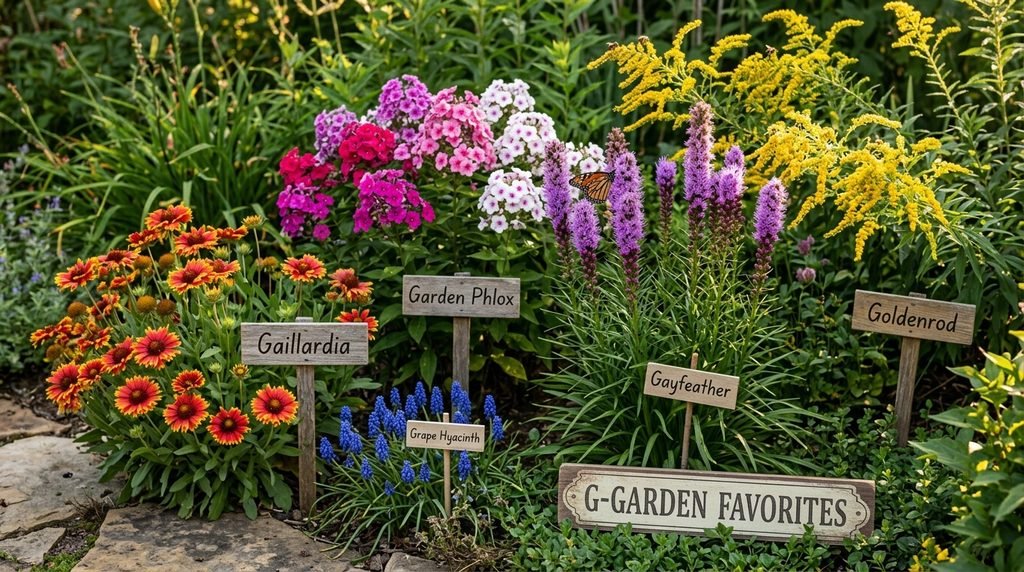
- Gaillardia flowers from summer to frost with almost no care.
- Garden Phlox brings scent and bold color to midsummer borders.
- Gayfeather thrives in sun and draws butterflies all summer.
- Goldenrod feeds late pollinators and does not cause hay fever.
- Grape Hyacinth spreads slowly and carpets spring beds in blue.
Gaillardia and gayfeather make a strong pair. One gives warm, daisy-like color. The other adds cool purple spikes. Together they keep a sunny border interesting from early summer to fall.
A few care habits keep these plants happy. Give garden phlox good airflow and water at the base. This prevents mildew. Do not overfeed gaillardia, or it will flop. Leave goldenrod seed heads in place, since birds will eat them. Plant grape hyacinth bulbs in fall, in a spot that dries out after spring.
Indoor Plants Among G Flowers
Only a few G flowers thrive indoors, but they are worth knowing. Guzmania is the easiest. Its bright bracts can hold their color for months. Gloxinia offers velvety, trumpet-shaped blooms in bright rooms. Gerbera daisy brightens a sunny window for weeks at a time. Gardenia can bloom indoors, but it is fussy and likes humidity.
- Guzmania wants bright light and a little water in its central cup.
- Gloxinia prefers warmth and humidity, and rests after blooming.
- Gerbera Daisy needs plenty of light and soil that drains well.
- Gardenia needs humidity, acid soil, and a steady temperature.
Guzmania is the pick for beginners. It forgives missed waterings. Just keep it out of hot, direct afternoon sun, or the leaves will scorch.
Light matters more than anything else for indoor G flowers. A bright east window suits Guzmania and gloxinia. Gerbera wants more direct sun. Avoid cold drafts and soggy saucers. Most of these plants fail from too much water, not too little.
Florist Favorites Among G Flowers
Florists lean on G flowers for color, scent, and height. Gerbera daisies are bold and cheerful and last up to a week or more in a vase. Gladiolus brings dramatic height to big arrangements. Gypsophila adds a cloud of white filler to nearly every bouquet. Geraldton wax adds soft pink stars and holds up for weeks. Gardenia is the luxury pick for scent, especially in bridal work.
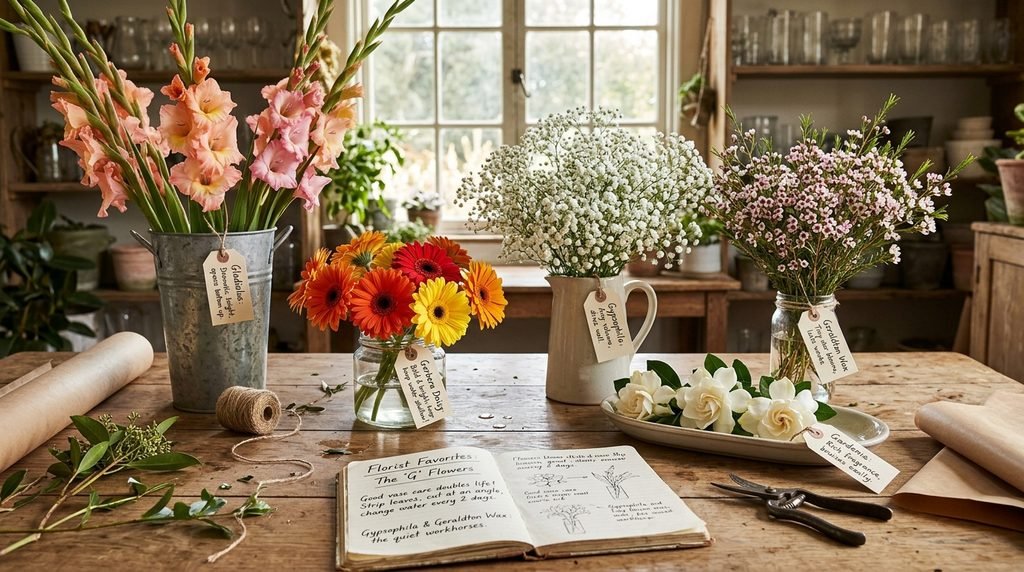
- Gerbera Daisy is long-lasting and comes in many bright colors.
- Gladiolus adds height and opens from the bottom up.
- Gypsophila gives airy volume and dries well.
- Geraldton Wax adds tiny star blooms and lasts for weeks.
- Gardenia brings strong fragrance but bruises easily.
Gypsophila and Geraldton Wax are the quiet workhorses. They rarely steal the show. But many bouquets would feel thin without them.
Good vase care doubles the life of any cut flower. Strip the leaves below the water line. Recut the stems at an angle. Change the water every two days. With gerbera, keep the water shallow, since the stems rot quickly in deep water.
Read More: 100+ Flowers That Start With D (Names, Meanings & Beautiful Photos)
Rare and Unusual G Flowers
Some G plants are hard to find or hard to grow. Glory-of-the-snow is a Turkish mountain bulb that blooms through melting snow. Grass pink is a wild orchid of North American bogs that dislikes transplanting. Guernsey lily glitters with tiny crystal-like petals in autumn but needs a warm, sheltered spot. Gentian sage is a rare true-blue salvia that is hard to overwinter in cold zones.
These four plants share one trait. Each wants a very specific home. That is why they stay special. If you want to grow one, buy nursery-grown plants only. Never dig wild plants, since many rare G species are protected by law.
Caution: Toxic G Flowers
Several G flowers can harm pets, livestock, or people. Gloriosa lily and golden chain tree are the most dangerous. Every part of both plants is poisonous. Golden trumpet carries a milky sap that irritates and upsets the stomach. Goat’s rue is a serious risk to grazing animals. Gas plant releases a sap that can burn skin in sunlight.
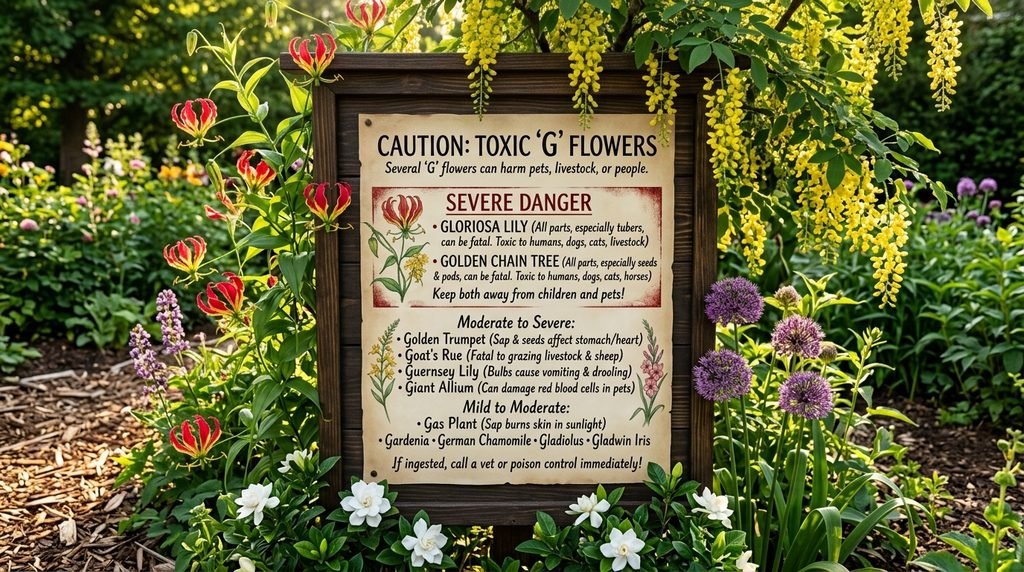
| Flower | Toxic To | Severity |
| Gloriosa Lily | Humans, dogs, cats, livestock | Severe — all parts, especially tubers, can be fatal |
| Golden Chain Tree | Humans, dogs, cats, horses | Severe — all parts, especially seeds and pods |
| Golden Trumpet | Humans, dogs, cats | Moderate to severe — sap and seeds affect the stomach and heart |
| Goat’s Rue | Livestock, horses, sheep | Moderate to severe — grazing can be fatal |
| Guernsey Lily | Dogs, cats, humans | Moderate — bulbs cause vomiting and drooling |
| Giant Allium | Dogs, cats | Moderate — can damage red blood cells in large amounts |
| Gas Plant | Humans, pets | Mild to moderate — sap can cause burns in sunlight |
| Gardenia | Dogs, cats, horses | Mild to moderate — stomach upset and drooling |
| German Chamomile | Dogs, cats, horses | Mild to moderate — stomach upset, skin irritation |
| Gladiolus | Dogs, cats, horses | Mild to moderate — corms upset the stomach |
| Gladwin Iris | Dogs, cats, humans | Mild to moderate — rhizomes upset the stomach |
Gloriosa lily and golden chain tree deserve the loudest warning. Keep both away from children and pets. Gardenia and gladiolus are milder, but a chewing dog can still get sick. If a pet or child eats any plant on this list, call a vet or poison control right away.
G Flowers Grouped by Color
Yellow and orange lead the G list. Goldenrod, golden marguerite, goldfields, golden alexanders, and gazania all glow in full sun. Goldenrod and golden alexanders also feed native pollinators. Gazania and goldfields suit dry, sunny beds. Golden chain tree and golden rain tree bring yellow high into the air.
White and cream flowers include gardenia, snowdrop, gypsophila, goat’s beard, and ginger lily. White brightens shade and glows at dusk. Gardenia and ginger lily are the fragrant, formal choices. Snowdrop and goat’s beard suit woodland-style gardens.
Pink and red tones show up in gaillardia, garden phlox, gerbera daisy, geum, and guernsey lily. Gerbera gives the boldest show. Geum and gaillardia bring warm, long-lasting color to borders. Guernsey lily adds sparkle in autumn.
Blue and purple are the cool side of G. Grape hyacinth, Greek windflower, gentian, giant allium, and gayfeather all deliver blue, violet, or lilac tones. Use them to calm hot-colored beds. Giant allium makes a bold statement. Grape hyacinth and Greek windflower carpet spring beds.
Life-Cycle Groupings for G Flowers
A plant’s life cycle tells you how much work to expect. Annuals live one season, so you replant each year. Perennials return on their own. Bulbs and corms need the right winter, cold or warm, to come back. Tender plants need warmth or winter protection. Zones below are approximate and vary by variety, so check your own plant tag.
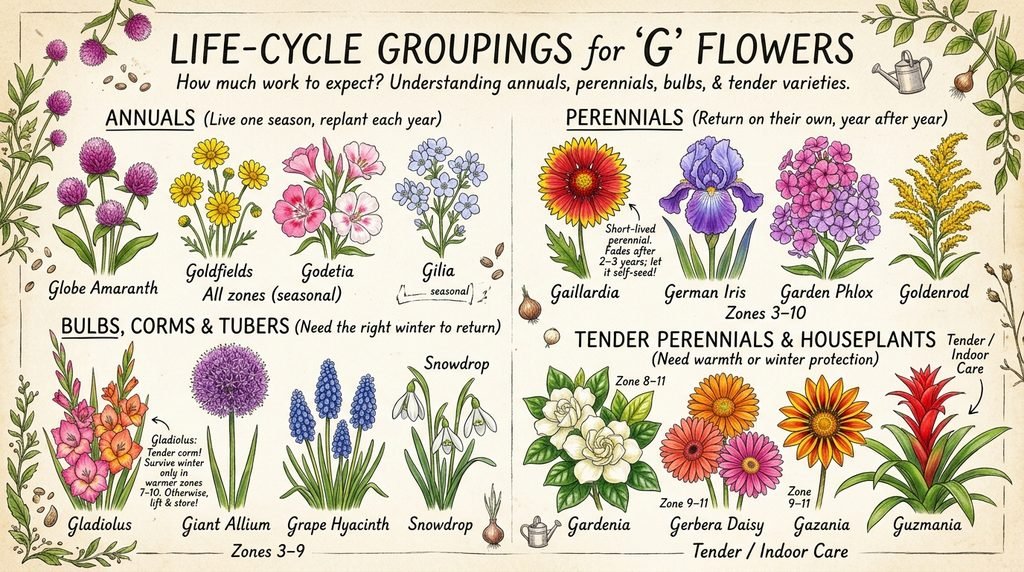
| Flower | Life Cycle | Typical Zones |
| Globe Amaranth | Annual | All zones (seasonal) |
| Goldfields | Annual | All zones (seasonal) |
| Godetia | Annual | All zones (seasonal) |
| Gilia | Annual | All zones (seasonal) |
| Gazania | Tender perennial, grown as annual | 9–11 (perennial), elsewhere annual |
| Gaillardia | Short-lived perennial | 3–10 |
| Garden Phlox | Perennial | 4–8 |
| Gayfeather | Perennial | 3–9 |
| Goldenrod | Perennial | 3–9 |
| German Iris | Perennial | 3–9 |
| Geum | Perennial | 5–9 |
| Globeflower | Perennial | 3–7 |
| Goat’s Beard | Perennial | 3–7 |
| Gypsophila | Perennial | 3–9 |
| Snowdrop | Perennial (bulb) | 3–8 |
| Grape Hyacinth | Perennial (bulb) | 4–9 |
| Giant Allium | Perennial (bulb) | 4–8 |
| Greek Windflower | Perennial (tuber) | 4–9 |
| Gladiolus | Tender perennial (corm) | 7–10 |
| Guernsey Lily | Tender perennial (bulb) | 8–10 |
| Gardenia | Tender perennial (shrub) | 8–11 |
| Gerbera Daisy | Tender perennial | 9–11 (indoors or annual elsewhere) |
| Guzmania | Tender perennial (houseplant) | 10–12 (indoors elsewhere) |
Gladiolus and gaillardia are the two to watch. Many people expect gladiolus corms to return everywhere. In truth, they survive winter only in warmer zones, or if you lift and store them. Gaillardia often fades after two or three years, so let it self-seed.
Botanical Name Crosswalk
Common names change from place to place. Botanical names do not. Nursery tags and seed packets use Latin for this reason. It also helps you search online with confidence. Two different plants can share one common name, so the Latin name protects you from a wrong purchase.
| Common Name | Botanical Name |
| Gaillardia | Gaillardia × grandiflora |
| Gardenia | Gardenia jasminoides |
| Garden Phlox | Phlox paniculata |
| Gayfeather | Liatris spicata |
| Gerbera Daisy | Gerbera jamesonii |
| German Iris | Iris germanica |
| Giant Allium | Allium giganteum |
| Gladiolus | Gladiolus × hortulanus |
| Globeflower | Trollius × cultorum |
| Goat’s Beard | Aruncus dioicus |
| Goldenrod | Solidago canadensis |
| Grape Hyacinth | Muscari armeniacum |
| Greek Windflower | Anemone blanda |
| Guzmania | Guzmania lingulata |
| Snowdrop | Galanthus nivalis |
Gayfeather shows why this matters. It is also called blazing star, and both names point to the same plant, Liatris spicata. Also, do not confuse goat’s beard with goat’s rue. They are unrelated, and goat’s rue is toxic to livestock.
What G Flowers Mean
Flower meanings vary by culture, but a good number of G flowers carry steady symbolism. Gardenia stands for purity, refinement, and secret love. In Victorian times, giving one meant a love too delicate to say aloud. Gladiolus takes its name from the Latin word for sword, and it stands for strength of character and integrity. Gerbera daisy is the flower of cheerfulness and innocence, which suits its bright, open face.
Snowdrop carries the message of hope. It pushes through frost to announce that winter will end, and it is the birth flower of January. Gentian stands for sweetness and quiet loyalty. Gloxinia, with its rich, velvety bells, is tied to love at first sight in some traditions.
Goldenrod stands for encouragement and good fortune. It is the state flower of Kentucky, Nebraska, and South Carolina. Gorse has a hardy, enduring meaning, and an old English saying claims that when gorse is out of bloom, kissing is out of fashion. Gloriosa lily is the national flower of Zimbabwe and stands for glory and pride. Match the flower to your message, and remember that the same bloom can mean something different in another culture.
Decision Table: Which G Flower Fits Your Situation
You do not have to read the whole list to choose well. Start with your goal in the left column. The right column names the best G flower for it. Then check the toxicity section if you have pets or children.
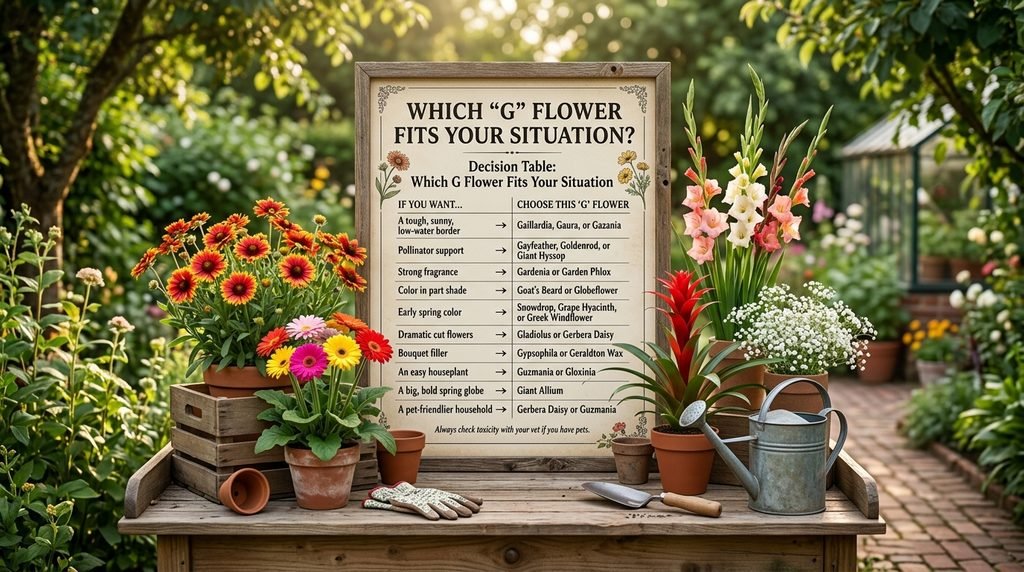
| If You Want… | Choose This G Flower |
| A tough, sunny, low-water border | Gaillardia, Gaura, or Gazania |
| Pollinator support | Gayfeather, Goldenrod, or Giant Hyssop |
| Strong fragrance | Gardenia or Garden Phlox |
| Color in part shade | Goat’s Beard or Globeflower |
| Early spring color | Snowdrop, Grape Hyacinth, or Greek Windflower |
| Dramatic cut flowers | Gladiolus or Gerbera Daisy |
| Bouquet filler | Gypsophila or Geraldton Wax |
| An easy houseplant with blooms | Guzmania or Gloxinia |
| A big, bold spring globe | Giant Allium |
| A pet-friendlier household | Gerbera Daisy or Guzmania |
Gerbera daisy appears twice because it is bright, easy, and generally listed as non-toxic to pets. Guzmania is a good partner for it indoors. Always double-check any plant with your vet if a pet is likely to chew it.
Conclusion
Flowers that start with G offer a very wide choice, from the humble grape hyacinth to the dramatic gladiolus. This guide sorted 68 of them by color, life cycle, and use, so you can pick with confidence. Whether you want a sunny pollinator border, a fragrant corner, or a bright houseplant, there is a G flower that fits. Use the tables above, read the toxicity notes, and start planting.
Frequently Asked Questions
More than 65 well-known flowers start with G. This guide lists 68, from common garden plants to rare wildflowers and tropical climbers.
Gerbera daisy, gladiolus, gardenia, and geranium are among the most popular. Goldenrod and grape hyacinth are favorites for native and spring gardens.
Gaillardia, goldenrod, gayfeather, and grape hyacinth are very easy. Gazania is easy in hot, dry spots. Guzmania is the easiest G houseplant.
Gayfeather, goldenrod, and golden alexanders draw butterflies. Giant hyssop and gaillardia also draw pollinators, and giant hyssop draws hummingbirds.
Yes. Every part of the gloriosa lily, especially the tuber, is poisonous to people, pets, and livestock. Wear gloves when handling it and keep it away from children.
Gloriosa lily and golden chain tree are the most dangerous. Both can cause severe poisoning if any part is eaten.
Gerbera daisy is generally listed as non-toxic to dogs and cats. Still, check with your vet if a pet tends to chew plants
Gardenia stands for purity, refinement, and secret love. It is a popular choice for weddings and formal events.
Snowdrop is the best-known late-winter bloomer. Glory-of-the-snow and giant snowdrop follow soon after, and garland daphne perfumes the early spring garden.
No. Goldenrod pollen is heavy and sticky, and insects carry it. Ragweed, which blooms at the same time, is the real cause of most fall allergies.
2 thoughts on “65+ Beautiful Flowers That Start With G (With Pictures & Names)”