
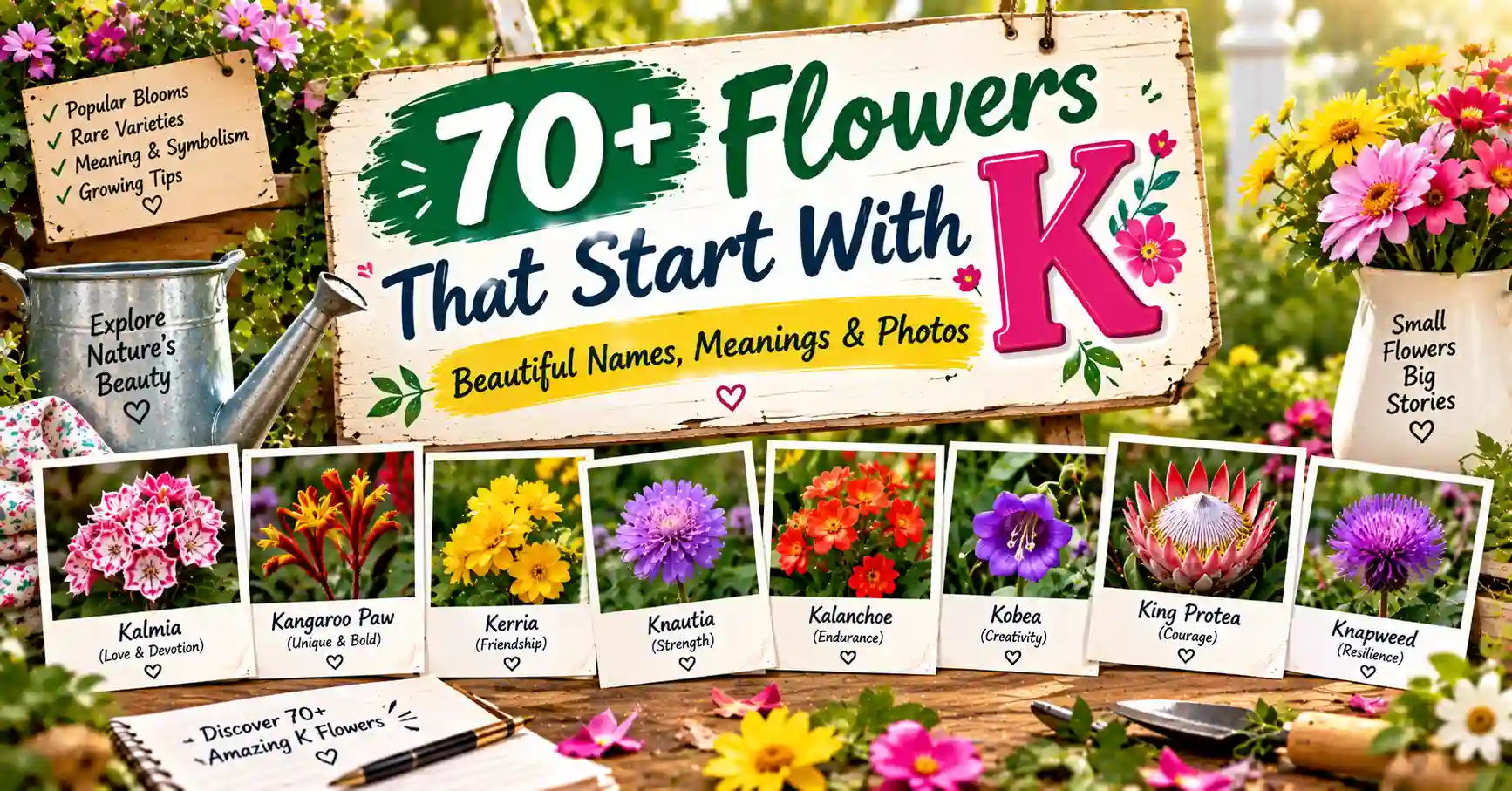
Flowers that start with K are bold, unusual, and full of surprises. Kangaroo paw, kerria, kniphofia, and kousa dogwood are the names most gardeners know. But the letter K also hides a plant that blooms only once every twelve years, a flower that opens for a single night, and the national flower of South Africa. This guide gathers 72 of them in one place.
Every plant below is real and has a verified botanical name. You will find border favorites, houseplants, florist picks, trees, wildflowers, and several rarities from Asia, Australia, New Zealand, and Hawaii. Three entries are grown mainly for fiber, fruit, or ground cover, and each one is clearly marked as an exception.
A long list only helps if you can use it. So this guide sorts the plants by color, life cycle, and use. A bloom’s beauty means little if it dies in your climate. It means even less if it harms a child or a pet. Each table is explained in plain words first, so you never face a bare spreadsheet.
Quick Answer: Ten Standout K Flowers
Kniphofia is the show-off, with torch-like spikes of orange and yellow that hummingbirds love. Kangaroo paw is the quirky Australian bloom with fuzzy, paw-shaped flowers in red, yellow, and green. Kerria lights up shady spring corners with golden blooms on bright green stems, and kousa dogwood adds layers of pointed white bracts in early summer.
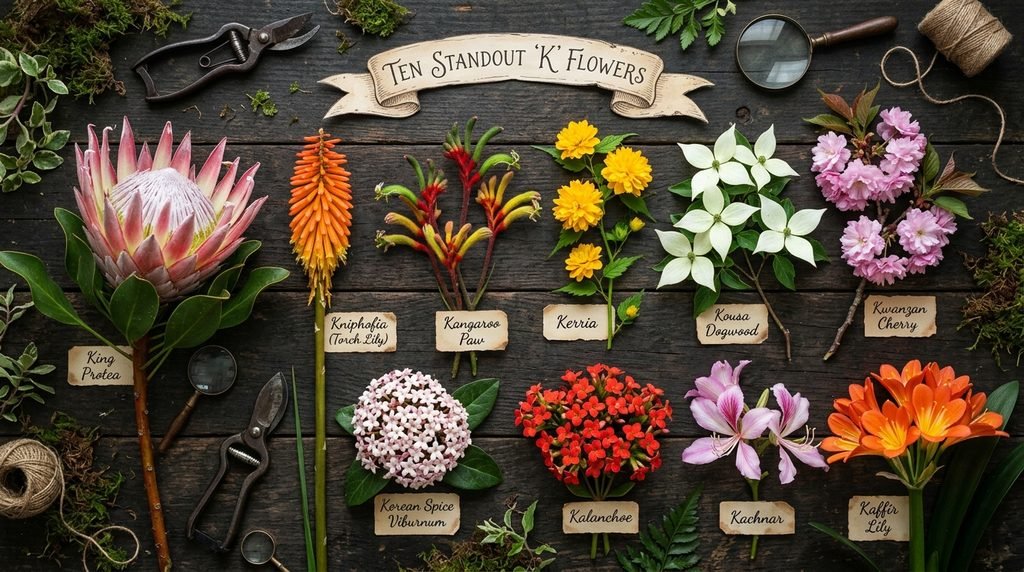
Kwanzan cherry is the famous double pink blossom, while Korean spice viburnum fills the air with a clove-like scent. Kalanchoe is the easy houseplant that blooms through winter. King protea is the dramatic, dinner-plate flower of South Africa, and kachnar brings orchid-like blooms and edible buds to warm South Asian gardens.
Gardening Tips You May Like: 60+ Beautiful Flowers That Start With I (With Pictures & Names)
Master Alphabetical List of Flowers That Start With K
This list names 72 flowers. Most entries use a common name that gardeners already know. A few are better known by their botanical name, so they appear under the name nurseries print on plant tags. Each row has a short note, so you can see at a glance what the plant looks like and where it grows best. Three entries are marked as exceptions because the flower is not the main reason people grow them.
| Flower | Botanical Name | Note |
| Kachnar | Bauhinia variegata | Orchid-like pink-purple blooms, edible buds in South Asia |
| Kadupul Flower | Epiphyllum oxypetalum | White night-bloomer that fades by dawn |
| Kahili Ginger | Hedychium gardnerianum | Yellow and red fragrant spikes, invasive in Hawaii |
| Kaempferia (Peacock Ginger) | Kaempferia pulchra | Small lilac blooms over patterned leaves |
| Kakabeak | Clianthus puniceus | Rare New Zealand shrub with red claw-shaped blooms |
| Kalanchoe | Kalanchoe blossfeldiana | Long-lasting clusters in red, pink, orange, or yellow |
| Kalimeris | Kalimeris indica | Small lavender daisies on a tidy plant |
| Kalmia (Mountain Laurel) | Kalmia latifolia | Cup-shaped pink-white blooms, highly toxic |
| Kalmiopsis | Kalmiopsis leachiana | Rare pink-flowered shrub from Oregon |
| Kamahi | Weinmannia racemosa | White flower spikes on a New Zealand forest tree |
| Kamchatka Stonecrop | Phedimus kamtschaticus | Golden star flowers on a hardy groundcover |
| Kaner (Oleander) | Nerium oleander | Pink or white clusters, highly toxic |
| Kangaroo Apple | Solanum aviculare | Purple star flowers, toxic unripe fruit |
| Kangaroo Paw | Anigozanthos flavidus | Fuzzy tubular blooms in red, yellow, and green |
| Kangaroo Thorn | Acacia paradoxa | Golden yellow puffs on a prickly Australian shrub |
| Kanuka | Kunzea ericoides | White starry blooms on a New Zealand shrub |
| Kansas Gayfeather | Liatris pycnostachya | Tall purple-pink spikes, butterfly favorite |
| Kapok | Ceiba pentandra | Tropical tree with large pale flowers pollinated by bats |
| Kashmir Bouquet | Clerodendrum bungei | Domed pink fragrant clusters |
| Kaufmanniana Tulip | Tulipa kaufmanniana | Very early star-shaped tulip |
| Kenaf (exception) | Hibiscus cannabinus | Cream hibiscus-like bloom on a fiber crop |
| Kennedia (Coral Pea) | Kennedia prostrata | Scarlet pea flowers on a spreading Australian groundcover |
| Kenilworth Ivy | Cymbalaria muralis | Tiny lilac flowers on trailing wall plants |
| Kentucky Wisteria | Wisteria macrostachya | Violet clusters on a less aggressive wisteria |
| Kerria | Kerria japonica | Golden yellow spring blooms on green stems |
| Keurboom | Virgilia divaricata | Pink pea flowers on a fast-growing South African tree |
| Kewra (Screwpine) | Pandanus odorifer | Strongly scented flower used for kewra water |
| Kidney Vetch | Anthyllis vulneraria | Yellow clustered pea flowers for dry, chalky soil |
| Kidneyleaf Buttercup | Ranunculus abortivus | Small yellow woodland buttercup |
| Kigelia (Sausage Tree) | Kigelia africana | Maroon bell flowers, bat-pollinated, huge hanging fruit |
| King Alfred Daffodil | Narcissus ‘King Alfred’ | Classic large golden trumpet daffodil |
| King Protea | Protea cynaroides | Giant pink flower head, national flower of South Africa |
| King’s Crown | Justicia carnea | Pink plume-like tropical shrub bloom |
| King’s Spear | Asphodeline lutea | Tall yellow spikes, Mediterranean native |
| Kingcup | Caltha palustris | Bright yellow cups for wet ground, toxic |
| Kingfisher Daisy | Felicia bergeriana | Small sky-blue daisies, low-growing |
| Kinnikinnick | Arctostaphylos uva-ursi | Small pink-white bells on a tough groundcover |
| Kirengeshoma | Kirengeshoma palmata | Waxy pale yellow bells for shade |
| Kiss-Me-Over-the-Garden-Gate | Persicaria orientalis | Drooping crimson tassels on a tall annual |
| Kiku | Chrysanthemum × morifolium | Japanese name for the chrysanthemum, emblem of the emperor |
| Knapweed | Centaurea nigra | Purple thistle-like meadow flower |
| Knautia | Knautia macedonica | Deep crimson pincushion blooms |
| Kniphofia | Kniphofia uvaria | Orange and yellow torch spikes |
| Koa | Acacia koa | Hawaiian tree with pale yellow flower puffs |
| Koelreuteria (Golden Rain Tree) | Koelreuteria paniculata | Yellow summer plumes on a small tree |
| Kohleria | Kohleria amabilis | Spotted tubular blooms, indoor favorite |
| Kokia | Kokia drynarioides | Rare Hawaiian tree with red hibiscus-like flowers |
| Kolkwitzia (Beautybush) | Kolkwitzia amabilis | Arching shrub covered in pink bells |
| Kopsia | Kopsia fruticosa | Pink-white pinwheel blooms on a tropical shrub |
| Korean Azalea | Rhododendron yedoense var. poukhanense | Fragrant lavender-pink spring blooms |
| Korean Bellflower | Campanula takesimana | Large pale bells with purple freckles |
| Korean Chrysanthemum | Chrysanthemum zawadskii | Hardy daisy-like fall bloom |
| Korean Forsythia | Forsythia ovata | One of the earliest and hardiest forsythias |
| Korean Lilac | Syringa meyeri | Compact, fragrant purple-pink blooms |
| Korean Mint | Agastache rugosa | Purple spikes loved by bees and hummingbirds |
| Korean Rhododendron | Rhododendron mucronulatum | Bright pink blooms in very early spring |
| Korean Spice Viburnum | Viburnum carlesii | Clove-scented pink-white clusters |
| Korean Stewartia | Stewartia pseudocamellia var. koreana | White camellia-like summer blooms |
| Kosteletzkya (Seashore Mallow) | Kosteletzkya pentacarpos | Pink hibiscus-like blooms for wet coastal soil |
| Kou | Cordia subcordata | Orange trumpet flowers on a Pacific coastal tree |
| Kousa Dogwood | Cornus kousa | White pointed bracts in early summer |
| Kōwhai | Sophora tetraptera | Hanging golden bells, New Zealand favorite |
| Kōtukutuku | Fuchsia excorticata | Tree fuchsia with purple and blue-green blooms |
| Kleinhovia | Kleinhovia hospita | Pink flower clusters on a tropical tree |
| Koromiko | Veronica stricta | White to lilac spikes on a New Zealand shrub |
| Kudzu (exception) | Pueraria montana | Fragrant purple pea flowers on an invasive vine |
| Kumquat Blossom (exception) | Citrus japonica | Fragrant white bloom on a fruit tree |
| Kunzea | Kunzea ambigua | White fluffy blooms on an Australian shrub |
| Kurinji | Strobilanthes kunthiana | Blue-purple blooms, once every twelve years |
| Kurrajong | Brachychiton populneus | Creamy bells on a tough Australian shade tree |
| Kurume Azalea | Rhododendron × obtusum | Small, dense blooms in many colors |
| Kwanzan Cherry | Prunus ‘Kanzan’ | Double pink spring blossoms |
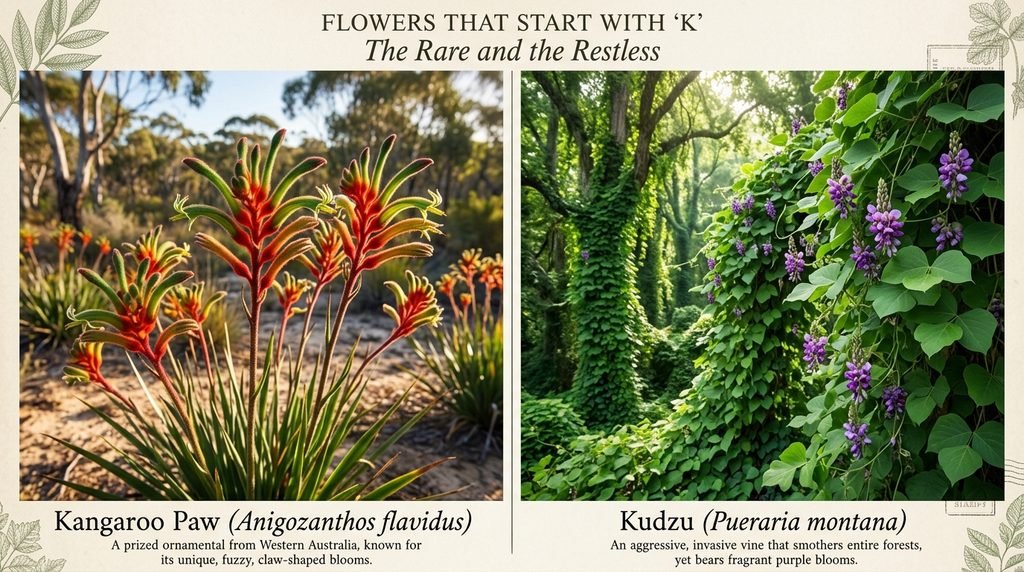
That table names 72 distinct flowers that start with K. Kangaroo paw and kudzu sit at opposite ends of the story. One is a prized ornamental from Western Australia. The other is an invasive vine that smothers whole forests. Both show how wide this single letter reaches.
Full Comparison Table: Sun, Water, and Bloom Time
When two plants seem equally good, sun and water needs usually pick the winner. The table below compares the main K flowers from this guide. Read the sun column first. Then check the water column and the bloom season to see if the plant fits your space and your calendar.
| Flower | Sun Needs | Water Needs | Bloom Season |
| Kangaroo Paw | Full sun | Low | Spring to summer |
| Kalanchoe | Bright light | Low | Winter to spring |
| Kansas Gayfeather | Full sun | Low to moderate | Late summer |
| Kerria | Part shade | Moderate | Spring |
| Kirengeshoma | Part to full shade | Moderate to high | Late summer to fall |
| Knautia | Full sun | Low to moderate | Summer to fall |
| Kniphofia | Full sun | Moderate | Summer to fall |
| Korean Mint | Full sun to part shade | Moderate | Summer to fall |
| Kousa Dogwood | Full sun to part shade | Moderate | Late spring to early summer |
| Kwanzan Cherry | Full sun | Moderate | Mid-spring |
| Korean Spice Viburnum | Full sun to part shade | Moderate | Spring |
| King Protea | Full sun | Low | Winter to spring in mild climates |
| Kachnar | Full sun | Low to moderate | Late winter to spring |
| Kingcup | Full sun to part shade | High | Early spring |
| King Alfred Daffodil | Full sun | Moderate | Early to mid-spring |
| Kaufmanniana Tulip | Full sun | Low to moderate | Very early spring |
| Kolkwitzia | Full sun | Low to moderate | Late spring |
| Kalmia | Part shade | Moderate | Late spring to early summer |
King protea and kangaroo paw are the best picks for hot, dry, lean soil. Both resent heavy fertilizer and wet feet. Kingcup and kirengeshoma sit at the other end. They want damp soil and cool roots.
Garden Favorites Among K Flowers
A handful of K flowers earn a place in almost every garden. Kniphofia brings fiery spikes to sunny beds from summer to fall. Kerria fills a shady corner with gold in spring and keeps green stems for winter interest. Knautia floats crimson pincushions above a border all summer. Kansas gayfeather sends up purple spikes that butterflies cannot resist.
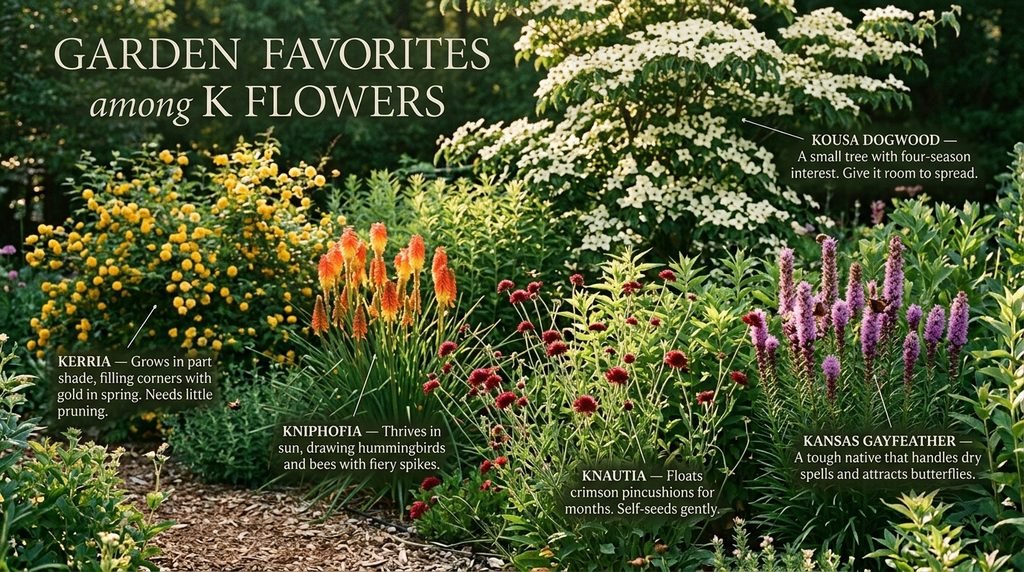
- Kniphofia thrives in sun and draws hummingbirds and bees.
- Kerria grows in part shade and needs little pruning.
- Knautia blooms for months and self-seeds gently.
- Kansas Gayfeather is a tough native that handles dry spells.
- Kousa Dogwood is a small tree with four-season interest.
Kniphofia and knautia make a strong pair. One gives hot orange spears, and the other gives deep red pincushions. Together they carry a sunny border from midsummer to fall.
A few care habits keep these plants happy. Plant kniphofia in well-drained soil, since wet winter roots can kill it. Prune kerria right after it blooms. Leave knautia seed heads for finches. Give kousa dogwood room to spread, because it grows wide with age.
Explore More: 60+ Beautiful Flowers That Start With J (With Pictures & Names)
Indoor and Container Picks Among K Flowers
Only a few K plants thrive indoors, but they are worth knowing. Kalanchoe is the easiest, blooming for weeks in winter with almost no care. Kohleria produces spotted, tubular blooms in bright rooms. Kaempferia, called peacock ginger, grows patterned leaves with small lilac flowers in summer. Kangaroo paw grows well in pots on sunny patios in cooler climates.
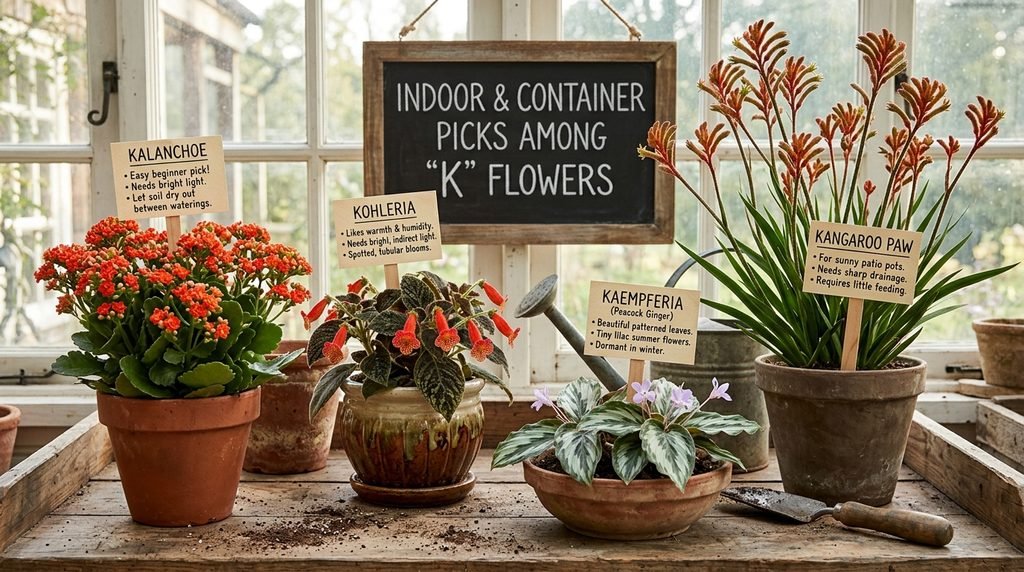
- Kalanchoe wants bright light and soil that dries out between waterings.
- Kalanchoe likes warmth, humidity, and bright, indirect light.
- Kaempferia goes dormant in winter and wakes in spring.
- Kangaroo Paw needs sun, sharp drainage, and little feeding.
Kalanchoe is the pick for beginners. It forgives missed waterings. Just remember that it blooms when days are short, so give it long, dark nights in autumn to set buds.
Light matters more than anything else for indoor K plants. A bright east or south window suits kalanchoe and kohleria. Avoid cold drafts and soggy saucers. Most of these plants fail from too much water, not too little.
Florist Favorites Among K Flowers
Florists use K flowers for drama, shape, and long vase life. King protea is the luxury showpiece, lasting two weeks or more and drying beautifully. Kangaroo paw brings fuzzy, architectural stems to modern bouquets. Kniphofia adds hot-colored spikes to large arrangements. Branches of Kwanzan cherry and kerria can be cut and forced indoors in late winter.
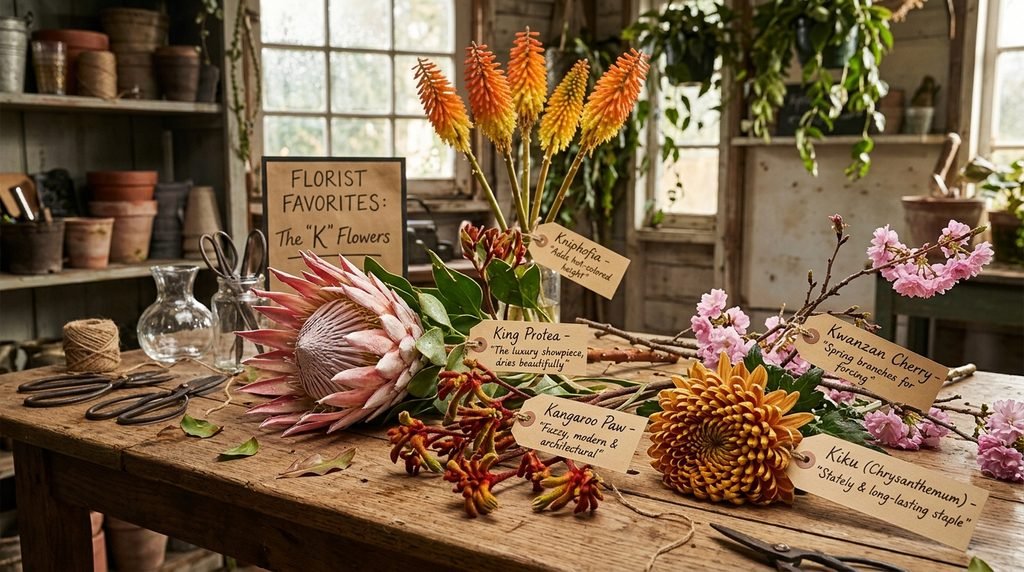
- King Protea is dramatic, long-lasting, and dries well.
- Kangaroo Paw adds a quirky, modern look and lasts about two weeks.
- Kniphofia gives height and color to big arrangements.
- Kwanzan Cherry branches bring spring indoors early.
- Kiku (Chrysanthemum) is a staple in Japanese floral art and lasts well.
King protea and kangaroo paw are the statement flowers. They stand out in any vase. A florist’s bouquet using both would look bold, modern, and unforgettable.
You May Also Like: 80+ Beautiful Flowers That Start With C (With Pictures, Names & Meanings)
Good vase care doubles the life of any cut flower. Strip the leaves below the water line. Recut the stems at an angle. Change the water every two days. For protea, keep the water shallow, since the thick stems rot quickly if they sit too deep.
Rare and Unusual K Flowers
Some K plants are hard to find or hard to grow. Kurinji is the most famous. It blooms in blue-purple waves across the hills of southern India only once every twelve years, and the hills there are named for it. Kadupul is a night-blooming cactus flower from Sri Lanka that opens after dark and fades before dawn. Kokia is a rare Hawaiian tree with red hibiscus-like flowers that survives in very small numbers. Kakabeak is a New Zealand shrub with red claw-shaped blooms that is threatened in the wild.
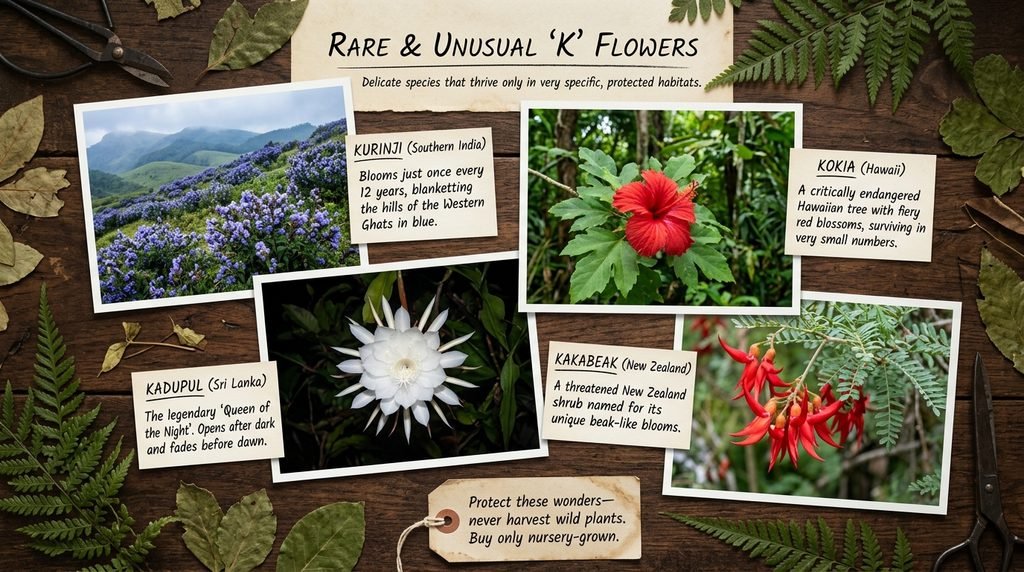
These four plants share one trait. Each wants a very specific home. That is why they stay special. If you want to grow one, buy nursery-grown plants only. Never dig wild plants, since many rare K species are protected by law.
Caution: Toxic K Flowers
Several K plants can harm pets, livestock, or people. Kaner, also called oleander, is the most dangerous. Every part of the plant is poisonous, and even small amounts can affect the heart. Kalmia, known as mountain laurel, is toxic to pets and grazing animals. Kalanchoe contains compounds that can upset the stomach and heart in cats and dogs. Kangaroo apple has toxic unripe berries.
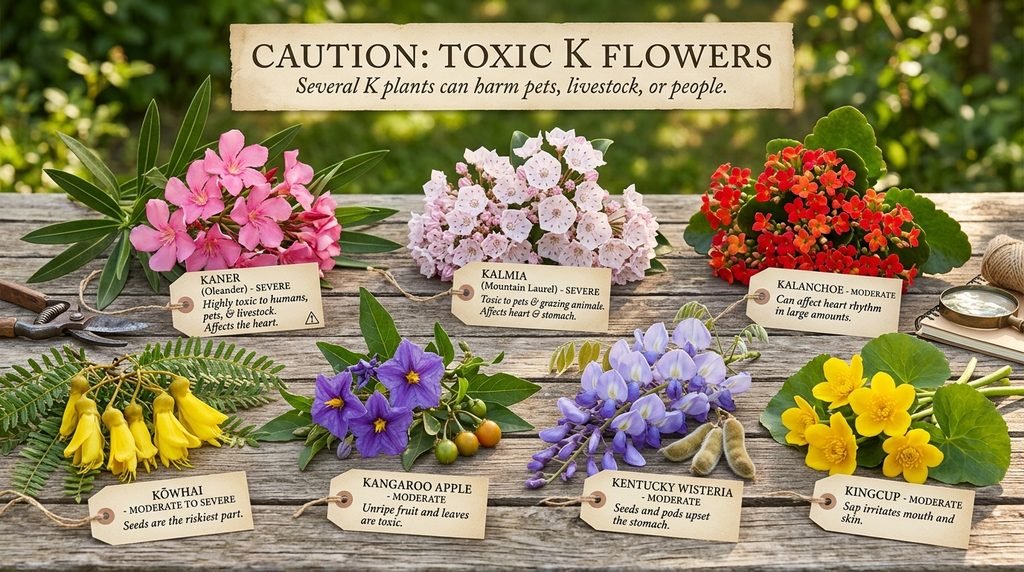
| Flower | Toxic To | Severity |
| Kaner (Oleander) | Humans, dogs, cats, horses, livestock | Severe — all parts affect the heart, can be fatal |
| Kalmia (Mountain Laurel) | Dogs, cats, horses, livestock | Severe — all parts affect the heart and stomach |
| Kōwhai | Humans, dogs, cats, livestock | Moderate to severe — seeds are the riskiest part |
| Kangaroo Apple | Humans, dogs, cats, livestock | Moderate — unripe fruit and leaves |
| Kalanchoe | Dogs, cats, horses | Moderate — can affect heart rhythm in large amounts |
| Kentucky Wisteria | Dogs, cats, horses | Moderate — seeds and pods upset the stomach |
| Kingcup | Dogs, cats, livestock | Moderate — sap irritates mouth and skin |
| Kidneyleaf Buttercup | Dogs, cats, livestock | Mild to moderate — sap irritates mouth and skin |
| Kigelia | Humans, livestock | Moderate — raw, unripe fruit is toxic |
Kaner and kalmia deserve the loudest warning. Keep both away from children, pets, and livestock. Kingcup and kidneyleaf buttercup are milder, but a chewing dog can still get sick. If a pet or child eats any plant on this list, call a vet or poison control right away.
K Flowers Grouped by Color
Pink and rose tones run through Kwanzan cherry, kolkwitzia, king protea, kachnar, and Korean rhododendron. Kwanzan cherry and kolkwitzia give the biggest show, since the whole plant fills with blooms. King protea brings pink on a giant, sculptural scale. Kachnar adds pink and purple to warm South Asian streets and gardens.
Yellow and gold bring warmth. Kerria, kirengeshoma, kingcup, King Alfred daffodil, and Koelreuteria all glow in sun or light shade. King Alfred daffodil and kingcup arrive in early spring. Kerria lights up shaded corners, and Koelreuteria carries gold into summer.
Red and orange accents come from kniphofia, kangaroo paw, knautia, kakabeak, and kalanchoe. Kniphofia and kangaroo paw are the bold, tropical-looking pair. Knautia gives a darker, wine-red note. Kalanchoe brings red indoors through winter.
White and cream flowers include kousa dogwood, Korean spice viburnum, kanuka, kamahi, and kumquat blossom. White brightens shade and glows at dusk. Kousa dogwood and Korean spice viburnum are the best choices for spring and early summer scent and elegance.
Purple, blue, and lilac are the cool side of K. Korean mint, Kansas gayfeather, Korean lilac, Korean bellflower, and kurinji all bring these shades. Korean mint and Kansas gayfeather suit pollinator beds. Kurinji is the rare, dramatic showpiece of the group.
Life-Cycle Groupings for K Flowers
A plant’s life cycle tells you how much work to expect. Annuals live one season, so you replant each year. Perennials return on their own. Bulbs need the right winter, cold or warm, to come back. Trees and shrubs take longer to bloom but last for decades. Zones below are approximate and vary by variety, so check your own plant tag.
| Flower | Life Cycle | Typical Zones |
| Kiss-Me-Over-the-Garden-Gate | Annual | All zones (seasonal) |
| Kansas Gayfeather | Perennial | 3–9 |
| Knautia | Perennial | 5–9 |
| Kniphofia | Perennial | 5–9 |
| Kirengeshoma | Perennial | 5–8 |
| Korean Mint | Perennial | 4–9 |
| Kingcup | Perennial | 3–7 |
| Knapweed | Perennial | 3–8 |
| Kenilworth Ivy | Perennial | 4–9 |
| King Alfred Daffodil | Perennial (bulb) | 3–9 |
| Kaufmanniana Tulip | Perennial (bulb) | 3–8 |
| Kangaroo Paw | Tender perennial | 9–11 |
| Kalanchoe | Tender perennial (houseplant) | 10–12 (indoors elsewhere) |
| Kahili Ginger | Tender perennial | 8–11 |
| Kerria | Perennial (shrub) | 4–9 |
| Kolkwitzia | Perennial (shrub) | 4–8 |
| Korean Spice Viburnum | Perennial (shrub) | 4–7 |
| Kurume Azalea | Perennial (shrub) | 6–9 |
| Kalmia | Perennial (shrub) | 5–9 |
| Kousa Dogwood | Perennial (tree) | 5–8 |
| Kwanzan Cherry | Perennial (tree) | 5–9 |
| King Protea | Tender perennial (shrub) | 9–11 |
| Kachnar | Tender perennial (tree) | 9–11 |
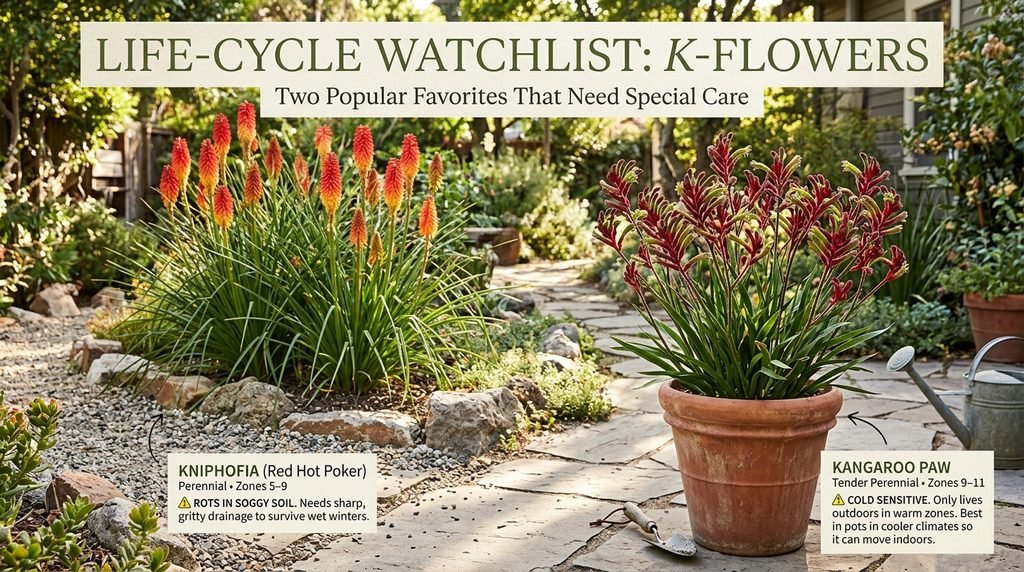
Kniphofia and kangaroo paw are the two to watch. Many gardeners expect both to survive cold, wet winters. In truth, kniphofia rots in soggy soil, and kangaroo paw only lives outdoors in warm zones. Both need sharp drainage, and kangaroo paw does best in a pot in cooler climates.
Botanical Name Crosswalk
Common names change from place to place. Botanical names do not. Nursery tags and seed packets use Latin for this reason. It also helps you search online with confidence. Two different plants can share one common name, so the Latin name protects you from a wrong purchase.
| Common Name | Botanical Name |
| Kangaroo Paw | Anigozanthos flavidus |
| Kerria | Kerria japonica |
| Kniphofia | Kniphofia uvaria |
| Knautia | Knautia macedonica |
| Kousa Dogwood | Cornus kousa |
| Kwanzan Cherry | Prunus ‘Kanzan’ |
| Korean Spice Viburnum | Viburnum carlesii |
| Korean Mint | Agastache rugosa |
| Kalanchoe | Kalanchoe blossfeldiana |
| King Protea | Protea cynaroides |
| Kachnar | Bauhinia variegata |
| Kaner | Nerium oleander |
| Kalmia | Kalmia latifolia |
| Kurinji | Strobilanthes kunthiana |
| Kingcup | Caltha palustris |
Kaner shows why this matters. In Urdu and Hindi, kaner is the common name for oleander, one of the most poisonous garden plants. Also, do not confuse kingcup with true buttercups or with marsh marigold sold under another name. Kingcup and marsh marigold are the same plant, Caltha palustris, and it is toxic.
What K Flowers Mean
Flower meanings vary by culture, but a good number of K flowers carry steady symbolism. The king protea is the national flower of South Africa, and it stands for strength, diversity, and transformation. Kangaroo paw is the floral emblem of Western Australia and stands for the wild beauty of that region. Kōwhai is closely tied to spring in New Zealand, and its golden bells signal that winter is over.
Kiku, the Japanese chrysanthemum, is the emblem of the emperor of Japan and stands for long life and nobility. Kwanzan cherry shares the wider cherry blossom message of renewal and the fleeting nature of life. Kalanchoe stands for lasting affection, which suits a plant that blooms for weeks and weeks.
Kurinji carries a deep cultural meaning in southern India. Its twelve-year bloom marks the passage of time, and some local communities have counted their ages by it. Kadupul is treasured in Sri Lanka because it opens for only one night and cannot be sold, since it fades by morning.
In South Asia, kewra and kachnar are tied to food and festivals. Kewra water flavors sweets and drinks, and kachnar buds are cooked as a vegetable. Kaner, the oleander, carries a warning in Victorian flower language, where it meant caution. Match the flower to your message, and remember that the same bloom can mean something different in another culture.
Decision Table: Which K Flower Fits Your Situation
You do not have to read the whole list to choose well. Start with your goal in the left column. The right column names the best K flower for it. Then check the toxicity section if you have pets or children.
| If You Want… | Choose This K Flower |
| Hot color for a sunny bed | Kniphofia or Kangaroo Paw |
| Color in part shade | Kerria or Kirengeshoma |
| Butterfly and bee support | Kansas Gayfeather, Korean Mint, or Knautia |
| Fragrance in spring | Korean Spice Viburnum or Korean Lilac |
| A flowering tree | Kwanzan Cherry or Kousa Dogwood |
| An easy houseplant with blooms | Kalanchoe |
| Dramatic cut flowers | King Protea or Kangaroo Paw |
| A wet-soil or pond edge flower | Kingcup |
| Very early spring color | Kaufmanniana Tulip or Korean Rhododendron |
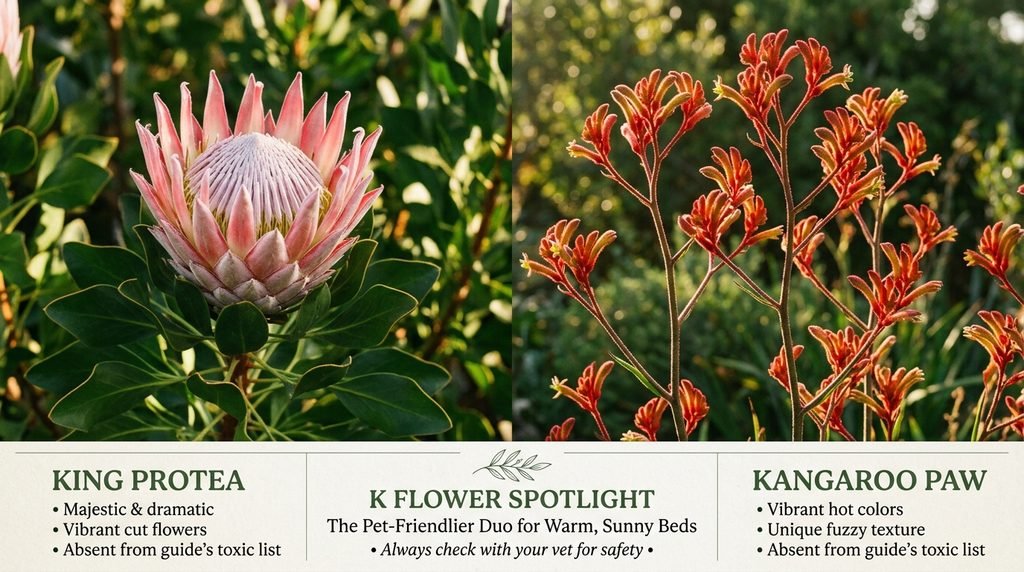
| A pet-friendlier garden | Kangaroo Paw, King Protea, or Kerria (all absent from this guide’s toxic list) |
Kangaroo paw appears twice because it is showy, easy in the right climate, and not on the toxic list in this guide. King protea is a good partner for it in a warm, sunny bed. Always double-check any plant with your vet if a pet is likely to chew it.
Conclusion
Flowers that start with K offer a very wide choice, from the glowing kniphofia to the rare kurinji. This guide sorted 72 of them by color, life cycle, and use, so you can pick with confidence. Whether you want a sunny hummingbird border, a fragrant spring shrub, or an easy winter houseplant, there is a K flower that fits. Use the tables above, read the toxicity notes, and start planting.
Frequently Asked Questions
How many flowers start with K?
More than 70 well-known flowers start with K. This guide lists 72, from common garden plants to rare tropical trees and wildflowers.
What is the most popular flower that starts with K?
Kniphofia, kerria, kangaroo paw, kousa dogwood, and kalanchoe are among the most popular. King protea is the most famous rare showpiece.
What are the easiest flowers that start with K to grow?
Kalanchoe, kerria, knautia, and Kansas gayfeather are very easy. King Alfred daffodil is an easy bulb for early spring.
Which K flowers attract butterflies and hummingbirds?
Kansas gayfeather, knautia, and Korean mint draw butterflies and bees. Kniphofia, Korean mint, and kakabeak draw hummingbirds or nectar birds.
Is oleander (kaner) poisonous?
Yes. Kaner, or oleander, is one of the most poisonous garden plants. Every part can affect the heart, and even dried leaves are dangerous.
Which K flower is the most dangerous?
Kaner (oleander) and kalmia (mountain laurel) are the most dangerous. Both can cause severe poisoning in people, pets, and livestock.
What is kachnar?
Kachnar is Bauhinia variegata, a tree with orchid-like pink and purple blooms. In South Asia, the buds and flowers are cooked and eaten.
What is kewra used for?
Kewra, from Pandanus odorifer, produces a strongly scented water and essence. It flavors sweets, rice dishes, and drinks across South Asia.
What does king protea symbolize?
King protea is the national flower of South Africa. It stands for strength, diversity, and change.
Which K flowers bloom in very early spring?
Kaufmanniana tulip, Korean rhododendron, Korean forsythia, and kingcup bloom early. King Alfred daffodil follows soon after.
1 thought on “70+ Flowers That Start With K: Beautiful Names, Meanings & Photos”