
Flowers that start with P include some of the most loved blooms on earth. Peony, petunia, pansy, poppy, and primrose are the names most people know. But the letter P also hides showy surprises, like the fiery gulmohar tree, a carnivorous pitcher plant, and a turquoise-flowered bromeliad. This guide gathers 83 of them in one place.
Every plant below is real and has a verified botanical name. You will find border favorites, annuals, houseplants, florist picks, trees, vines, and a few rarities. Only one entry is grown mainly for its leaves, and it is clearly marked as an exception.
A long list only helps if you can use it. So this guide sorts the plants by color, life cycle, and use. A bloom’s beauty means little if it dies in your climate. It means even less if it harms a child or a pet. Each table is explained in plain words first, so you never face a bare spreadsheet.
P is a big letter, and many names repeat the words peacock, prairie, purple, and pink. Those words are clues to color, shape, or habitat. Read straight through or jump to what you need. Have a pet? Check the toxicity section first. Want a quick pick? Try the decision table near the end.
Quick Answer: Ten Standout P Flowers
Peony is the queen of late spring, with huge perfumed blooms that return for decades. Petunia and pansy are the easy bedding stars, one for hot summers and the other for cool seasons. Garden phlox fills midsummer with scent, and purple coneflower feeds bees and finches for months.
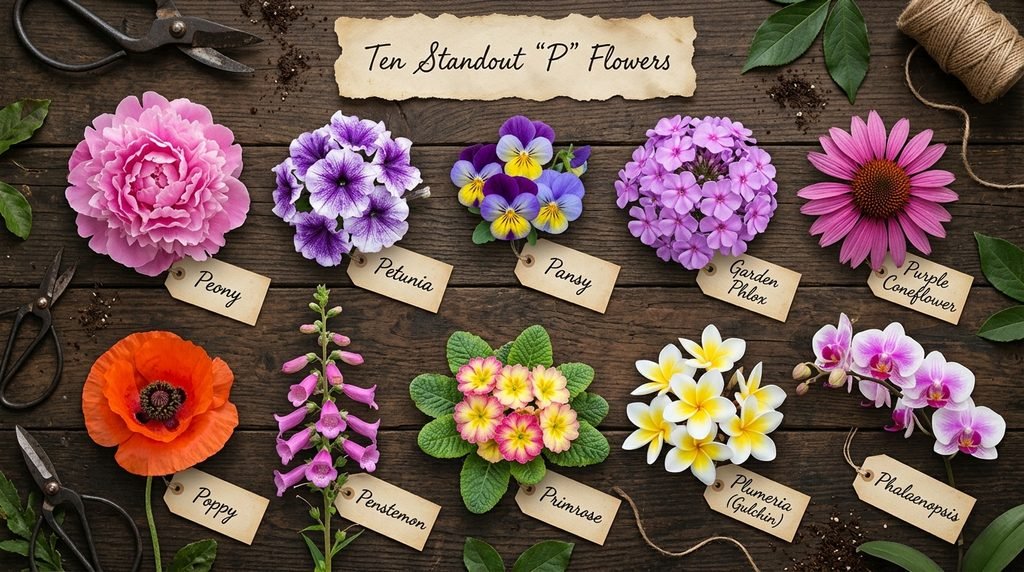
Poppy brings papery color and deep meaning, while penstemon draws hummingbirds with tubular spikes. Primrose is the first cheerful face of spring. Plumeria, called gulchin in Urdu, perfumes warm gardens with waxy blooms, and phalaenopsis is the easy orchid for a bright windowsill.
Simple Read More: Flowers That Start With N: 60+ Beautiful Names, Meanings & Photos
Master Alphabetical List of Flowers That Start With P
This list names 83 flowers. Most entries use a common name that gardeners already know. A few are better known by their botanical name, so they appear under the name nurseries print on plant tags. Each row has a short note, so you can see at a glance what the plant looks like and where it grows best. One entry is marked as an exception because the flower is not the main reason people grow it.
| Flower | Botanical Name | Note |
| Pagoda Flower | Clerodendrum paniculatum | Orange-red pagoda-shaped tiers |
| Painted Daisy | Tanacetum coccineum | Pink and red daisies, long vase life |
| Painted Tongue | Salpiglossis sinuata | Veined velvety trumpets |
| Painted Trillium | Trillium undulatum | White blooms with red-pink V marks |
| Pansy | Viola × wittrockiana | Cool-season faces in many colors |
| Pansy Orchid | Miltoniopsis hybrids | Flat, face-like orchid blooms |
| Paper Flower | Psilostrophe cooperi | Yellow papery desert blooms |
| Paperwhite | Narcissus papyraceus | Fragrant white winter bulb |
| Paphiopedilum | Paphiopedilum spp. | Pouch-shaped lady slipper orchid |
| Parrot Tulip | Tulipa ‘Parrot’ | Ruffled, feathered tulip petals |
| Parrot’s Beak | Lotus berthelotii | Red-orange beak-shaped blooms on silver trails |
| Pasqueflower | Pulsatilla vulgaris | Purple furry spring cups, toxic |
| Passionflower | Passiflora caerulea | Intricate blue-and-white vine blooms |
| Peace Lily | Spathiphyllum wallisii | White spathes for shady rooms |
| Peach Blossom | Prunus persica | Pink spring blossom on bare branches |
| Peacock Flower | Caesalpinia pulcherrima | Red and yellow flowers with long stamens |
| Peacock Orchid | Gladiolus murielae | White fragrant blooms with a dark center |
| Pearl Bush | Exochorda racemosa | Pearl-like buds open into white sprays |
| Pearly Everlasting | Anaphalis margaritacea | Papery white clusters, silvery leaves |
| Pelargonium | Pelargonium × hortorum | Round clusters in red, pink, or white |
| Pelican Flower | Aristolochia grandiflora | Giant, odd-smelling pelican-shaped bloom |
| Penstemon | Penstemon spp. | Tubular spikes, hummingbird favorite |
| Pentas | Pentas lanceolata | Star clusters, butterfly magnet |
| Peony | Paeonia lactiflora | Huge perfumed late-spring blooms |
| Peony (Tree) | Paeonia suffruticosa | Giant blooms on a woody shrub |
| Perennial Sweet Pea | Lathyrus latifolius | Magenta-pink climbing sprays, toxic seeds |
| Periwinkle | Vinca minor | Blue-purple groundcover for shade, toxic |
| Persian Buttercup | Ranunculus asiaticus | Layered rose-like blooms |
| Persian Violet | Exacum affine | Lavender fragrant indoor blooms |
| Peruvian Daffodil | Hymenocallis narcissiflora | White spidery fragrant summer bulb |
| Peruvian Lily | Alstroemeria spp. | Streaked blooms with a long vase life |
| Petunia | Petunia × hybrida | Trumpet blooms all summer |
| Phacelia | Phacelia campanularia | Deep blue bells for dry spots |
| Phalaenopsis (Moth Orchid) | Phalaenopsis spp. | Easy houseplant orchid |
| Phlox (Creeping) | Phlox subulata | Spring carpet of pink, white, or blue |
| Phlox (Garden) | Phlox paniculata | Fragrant summer clusters |
| Pickerelweed | Pontederia cordata | Blue-violet spikes for pond margins |
| Pieris | Pieris japonica | Dangling white bells, highly toxic |
| Pigsqueak | Bergenia cordifolia | Pink spring spikes over glossy leaves |
| Pincushion Flower | Scabiosa columbaria | Lavender-blue domes for butterflies |
| Pineapple Lily | Eucomis comosa | Spikes topped with a leafy crown |
| Pineapple Sage | Salvia elegans | Red fall spikes, pineapple-scented leaves |
| Pink Powder Puff | Calliandra haematocephala | Fluffy red-pink puffs on a tropical shrub |
| Pinks | Dianthus plumarius | Clove-scented fringed blooms |
| Pipevine | Aristolochia macrophylla | Pipe-shaped blooms, swallowtail host, toxic |
| Pitcher Plant | Sarracenia purpurea | Nodding red flowers on a carnivorous plant |
| Plains Coreopsis | Coreopsis tinctoria | Gold and mahogany daisies |
| Plantain Lily (exception) | Hosta plantaginea | Fragrant white blooms on a foliage plant |
| Pleione | Pleione formosana | Pink miniature orchid |
| Plum Blossom | Prunus cerasifera | Early pink-white spring blossom |
| Plumbago | Plumbago auriculata | Sky-blue clusters in warm weather |
| Plume Poppy | Macleaya cordata | Tall airy cream plumes |
| Plumed Cockscomb | Celosia plumosa | Feathery plumes in hot colors |
| Plumeria | Plumeria rubra | Waxy fragrant blooms, used in leis |
| Poached Egg Plant | Limnanthes douglasii | White-edged yellow blooms |
| Pocketbook Plant | Calceolaria herbeohybrida | Puffy pouch blooms in bright colors |
| Poinciana (Gulmohar) | Delonix regia | Fiery red blooms on a spreading shade tree |
| Poinsettia | Euphorbia pulcherrima | Red bracts at Christmas, mildly toxic |
| Polyanthus | Primula × polyanthus | Bright clustered primroses |
| Polygala | Polygala myrtifolia | Purple sweet-pea-like blooms on a shrub |
| Pomegranate Blossom | Punica granatum | Orange-red crinkled blooms |
| Pond Lily | Nymphaea odorata | Fragrant white floating bloom |
| Poppy (Field) | Papaver rhoeas | Red papery blooms of remembrance |
| Poppy (Iceland) | Papaver nudicaule | Cool-season cups in bright colors |
| Poppy Mallow | Callirhoe involucrata | Magenta cups on a sprawling native |
| Pot Marigold | Calendula officinalis | Orange daisies, edible petals |
| Potentilla | Potentilla fruticosa | Yellow summer blooms on a tough shrub |
| Prairie Clover | Dalea purpurea | Purple cones that feed native bees |
| Prairie Rose | Rosa setigera | Pink single wild climbing rose |
| Prairie Smoke | Geum triflorum | Pink nodding blooms, feathery seed heads |
| Prickly Pear | Opuntia ficus-indica | Yellow or orange cactus blooms |
| Pride of Madeira | Echium candicans | Blue-purple spires, bee magnet |
| Primrose | Primula vulgaris | Pale yellow early spring bloom |
| Princess Flower | Tibouchina urvilleana | Velvet purple blooms on a tender shrub |
| Protea (Sugarbush) | Protea repens | Cream and pink flower head, South African native |
| Pulmonaria | Pulmonaria saccharata | Pink-to-blue blooms over spotted leaves |
| Purple Coneflower | Echinacea purpurea | Pink-purple petals around a spiky cone |
| Purple Loosestrife | Lythrum salicaria | Magenta spikes, invasive in wetlands |
| Purple Rock Cress | Aubrieta deltoidea | Spring carpet of purple for walls |
| Purple Sage | Salvia leucophylla | Lavender whorls for dry slopes |
| Purple Wreath | Petrea volubilis | Blue-violet sprays on a tropical vine |
| Pussytoes | Antennaria dioica | Fuzzy pink-white tufts on a mat |
| Puya | Puya berteroniana | Turquoise flower spikes on a bromeliad |
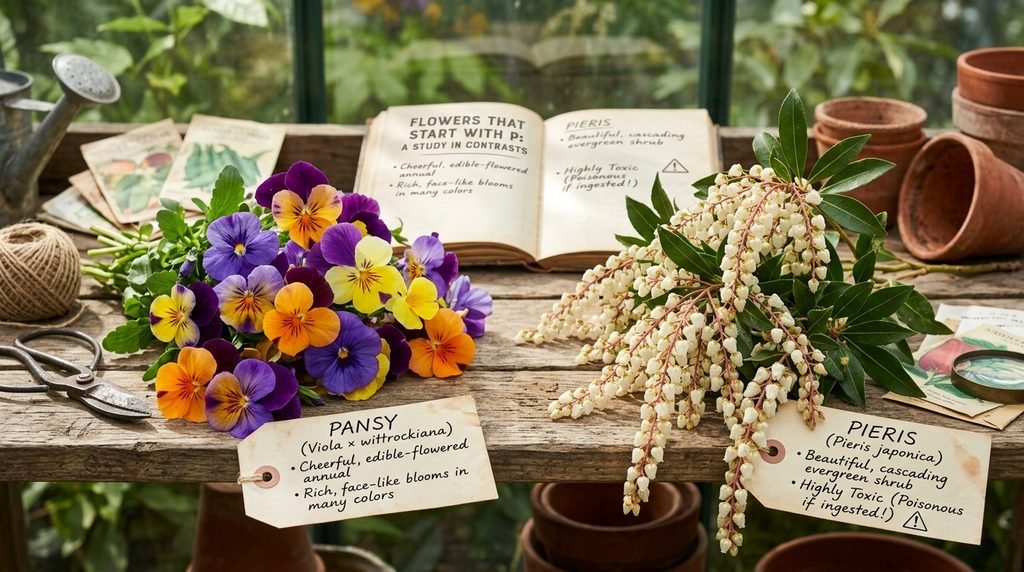
That table names 83 distinct flowers that start with P. Pansy and pieris sit far apart in character. One is a cheerful, edible-flowered annual. The other is a pretty shrub that is highly toxic. Both show how wide this single letter reaches.
Full Comparison Table: Sun, Water, and Bloom Time
When two plants seem equally good, sun and water needs usually pick the winner. The table below compares the main P flowers from this guide. Read the sun column first. Then check the water column and the bloom season to see if the plant fits your space and your calendar.
| Flower | Sun Needs | Water Needs | Bloom Season |
| Pansy | Full sun to part shade | Moderate | Fall to spring in cool weather |
| Petunia | Full sun | Moderate | Spring to frost |
| Phlox (Garden) | Full sun to part shade | Moderate | Midsummer |
| Peony | Full sun | Moderate | Late spring |
| Primrose | Part shade | Moderate to high | Early spring |
| Penstemon | Full sun | Low | Late spring to summer |
| Purple Coneflower | Full sun | Low to moderate | Summer to fall |
| Pincushion Flower | Full sun | Moderate | Summer to fall |
| Pasqueflower | Full sun | Low | Early spring |
| Pelargonium | Full sun | Low to moderate | Spring to fall |
| Plumbago | Full sun to part shade | Moderate | Summer to fall in warm climates |
| Plumeria | Full sun | Low | Summer |
| Poinciana (Gulmohar) | Full sun | Low to moderate | Late spring to summer |
| Passionflower | Full sun to part shade | Moderate | Summer to fall |
| Peace Lily | Low to medium light | Moderate | Spring to summer indoors |
| Phalaenopsis | Bright indirect light | Moderate | Often winter to spring |
| Pickerelweed | Full sun | Aquatic | Summer |
| Pineapple Sage | Full sun to part shade | Moderate | Fall |
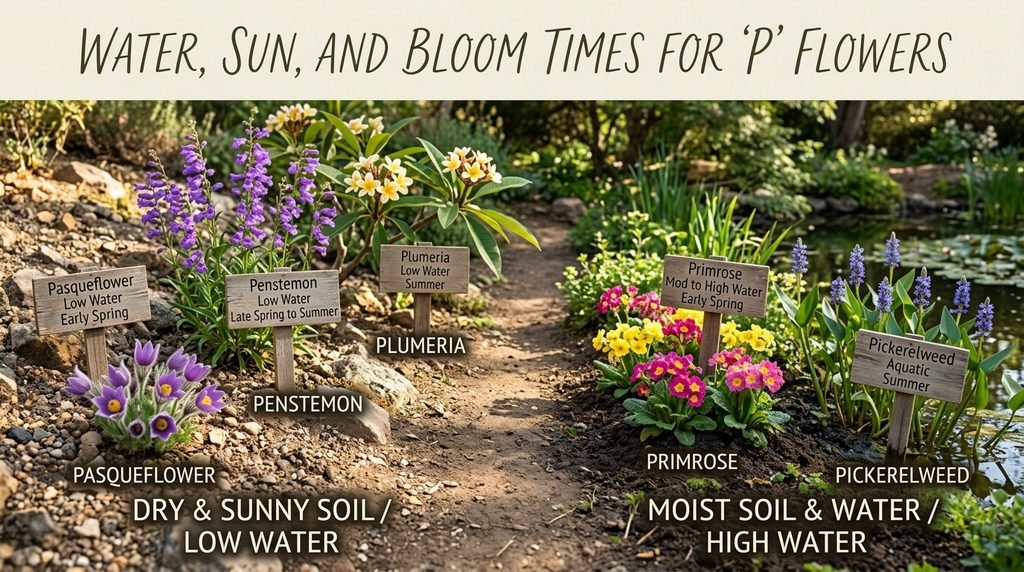
Penstemon, pasqueflower, and plumeria are the best picks for hot, dry, lean soil. All three bloom better when they are not overwatered. Primrose and pickerelweed sit at the other end. They want moist soil, cool roots, or standing water.
Explore More Flower Guides: 50+ Beautiful Flowers That Start With O (With Pictures & Names)
Garden Favorites Among P Flowers
A handful of P flowers earn a place in almost every garden. Peony returns every spring and lives for decades. Garden phlox fills midsummer with scent and color. Purple coneflower blooms for months and feeds goldfinches in fall. Penstemon sends up tubular spikes that hummingbirds love.
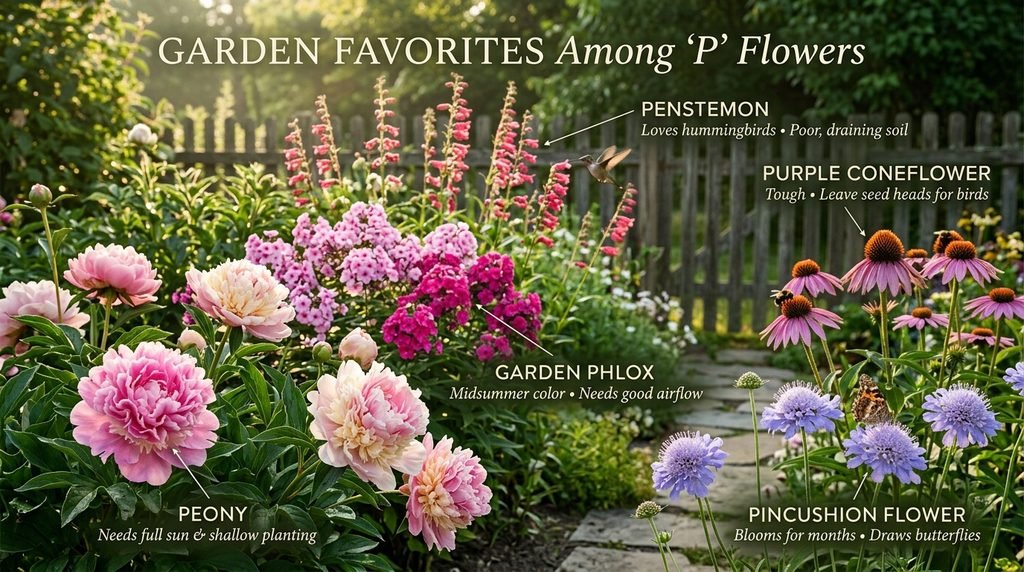
- Peony needs full sun and shallow planting to bloom well.
- Garden Phlox brings fragrance and long summer color.
- Purple Coneflower is tough, long-blooming, and bee-friendly.
- Penstemon thrives in poor, sharp-draining soil.
- Pincushion Flower blooms for months and draws butterflies.
Peony and garden phlox make a strong pair. One carries late spring, and the other carries midsummer. Together they keep a border full from May to August.
A few care habits keep these plants happy. Plant peony roots no deeper than two inches below the soil, or it will not bloom. Give garden phlox good airflow to avoid mildew. Leave purple coneflower seed heads for the birds. Cut penstemon back lightly after its first flush.
Indoor and Container Picks Among P Flowers
Only a few P plants thrive indoors, but they are worth knowing. Phalaenopsis, the moth orchid, is one of the easiest orchids to grow, rewarding a bright window with weeks of blooms. Peace lily blooms in low light and signals when it needs water by drooping. Persian violet brings fragrant lavender blooms to a bright room. Petunia, pelargonium, and pansy thrive in sunny pots and baskets.
- Phalaenopsis wants bright, indirect light and a loose, bark-based mix.
- Peace Lily tolerates low light, but needs steady moisture.
- Persian Violet is short-lived, and it likes cool rooms and even moisture.
- Pelargonium blooms for months in sunny pots and window boxes.
The peace lily is the pick for beginners. It forgives missed waterings. Just keep it away from pets, since it contains crystals that can upset the stomach.
Light matters more than anything else for indoor P plants. A bright east window suits phalaenopsis and Persian violet. Avoid cold drafts and soggy saucers. Most of these plants fail from too much water, not too little.
You May Also Like: 60+ Beautiful Flowers That Start With J (With Pictures & Names)
Florist Favorites Among P Flowers
Florists use P flowers for fragrance, ruffles, and drama. Peonies are the top luxury flower of late spring, loved for their huge, perfumed blooms. Painted daisies, Peruvian lilies, and poppies bring color to casual bouquets. Pincushion flowers add soft texture. Protea brings a bold, sculptural focal point.
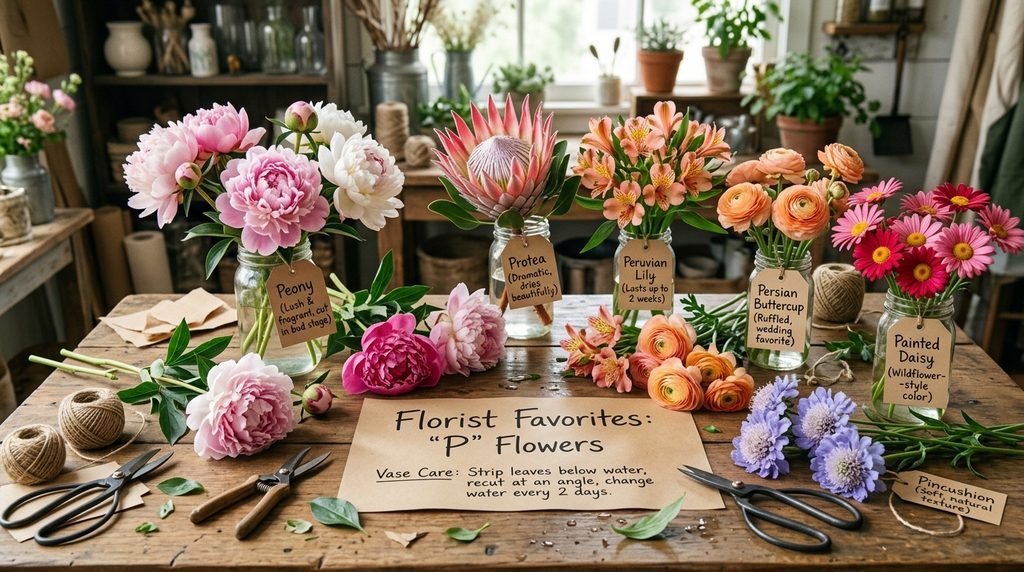
- Peony is lush and fragrant, and it is best cut in the bud stage.
- Peruvian Lily lasts up to two weeks in a vase.
- Protea (Sugarbush) is dramatic and dries beautifully.
- Painted Daisy gives long-lasting, wildflower-style color.
- Persian Buttercup looks like a ruffled rose and is a wedding favorite.
Peruvian lily and painted daisy are the quiet workhorses. They hold up in the vase long after softer blooms fade. A florist’s cooler in summer would feel empty without them.
Good vase care doubles the life of any cut flower. Strip the leaves below the water line. Recut the stems at an angle. Change the water every two days. For peonies, cut them when buds feel soft like a marshmallow, then let them open in water.
Rare and Unusual P Flowers
Some P plants are hard to find or hard to grow. Puya is a bromeliad from the Chilean Andes with turquoise flower spikes that rise from a spiky rosette. Pleione is a miniature orchid from the mountains of Asia that blooms before its leaves appear. Painted trillium is a delicate woodland wildflower from cool northern forests that resists transplanting. Pelican flower is a giant tropical vine whose bloom looks like a pelican and smells strange to attract flies.
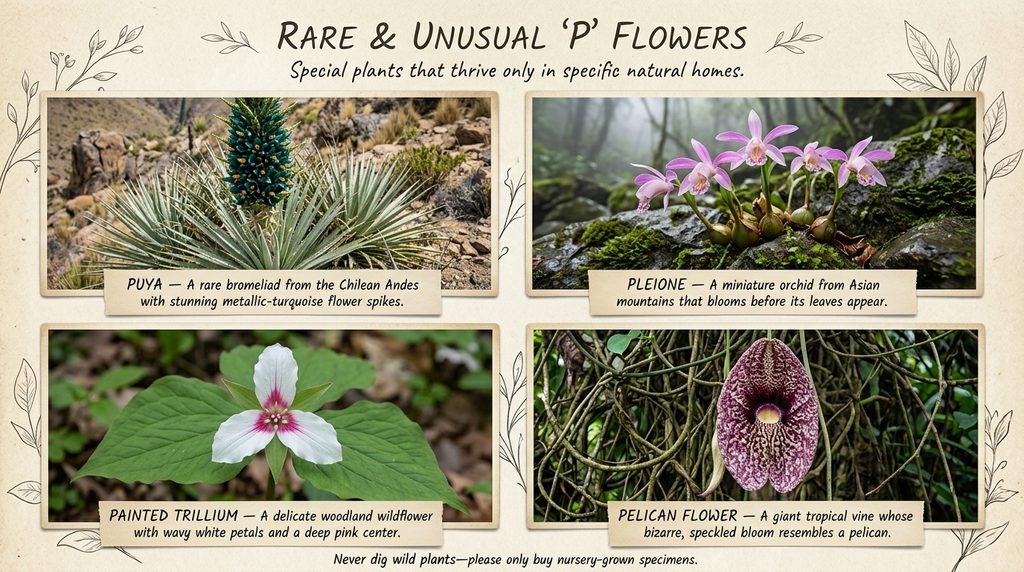
These four plants share one trait. Each wants a very specific home. That is why they stay special. If you want to grow one, buy nursery-grown plants only. Never dig wild plants, since many rare P species are protected by law.
Caution: Toxic P Flowers
Several P plants can harm pets, livestock, or people. Pieris is the most dangerous. Every part of the shrub is poisonous, and it affects the heart. Pasqueflower and pipevine are also toxic. Perennial sweet pea seeds, periwinkle, and Peruvian daffodil bulbs can cause real illness. Peace lily, peony, pelargonium, and poinsettia cause milder problems, but they can still make pets sick.
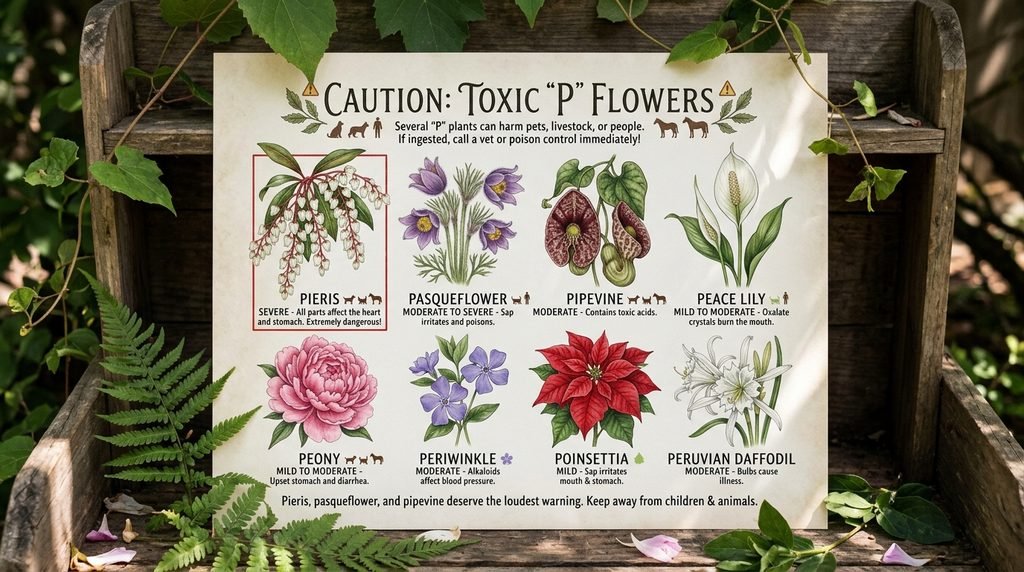
| Flower | Toxic To | Severity |
| Pieris | Dogs, cats, horses, livestock | Severe — all parts affect the heart and stomach |
| Pasqueflower | Dogs, cats, horses, livestock | Moderate to severe — sap irritates and poisons |
| Pipevine | Dogs, cats, humans | Moderate — contains aristolochic acids |
| Perennial Sweet Pea | Dogs, cats, horses | Moderate — seeds and pods upset the stomach |
| Periwinkle | Dogs, cats | Moderate — alkaloids can affect blood pressure |
| Peruvian Daffodil | Dogs, cats, horses | Moderate — bulbs cause vomiting and drooling |
| Peace Lily | Dogs, cats, humans | Mild to moderate — oxalate crystals burn the mouth |
| Peony | Dogs, cats, horses | Mild to moderate — vomiting and diarrhea |
| Pelargonium | Dogs, cats, horses | Mild to moderate — vomiting and skin irritation |
| Poinsettia | Dogs, cats | Mild — sap irritates mouth and stomach |
| Plumeria | Dogs, cats | Mild to moderate — milky sap irritates |
| Poppy (Field) | Dogs, cats, horses | Mild to moderate — sap upsets the stomach |
| Peruvian Lily | Dogs, cats | Mild — can cause drooling and vomiting |
Pieris, pasqueflower, and pipevine deserve the loudest warning. Keep them away from children and pets. Peace lily and peony are milder, but a chewing dog can still get sick. Pansy and petunia, by contrast, are not on this list. If a pet or child eats any plant on this list, call a vet or poison control right away.
P Flowers Grouped by Color
Pink and rose lead the P list. Peony, phlox, petunia, pentas, pinks, and peach blossom all deliver shades from blush to deep rose. Peach blossom and plum blossom give the biggest show, since whole trees bloom on bare branches. Peony brings pink on a luxury scale. Pinks and phlox bring pink with a spicy scent.
Purple, blue, and lilac are the cool side of P. Pansy, plumbago, penstemon, pincushion flower, and purple coneflower bring these tones. Plumbago gives sky-blue clusters in warm weather. Pincushion flower and penstemon suit sunny borders. Pansy carries violet through the cool months.
Red and orange accents come from poinciana, poppy, pelargonium, pineapple sage, and peacock flower. Poinciana, also called gulmohar, covers whole trees in fire-red blooms before summer. Poppy and pelargonium suit sunny beds and pots. Pineapple sage lights up the fall garden and draws hummingbirds.
White and cream flowers include paperwhite, peace lily, pearl bush, plumeria, and pond lily. White glows at dusk and brightens shade. Paperwhite and plumeria add scent. Peace lily suits low-light rooms. Pond lily suits quiet water.
Yellow and gold bring warmth. Primrose, potentilla, pot marigold, plains coreopsis, and pocketbook plant glow in sun or light shade. Primrose arrives first, in early spring. Pot marigold and plains coreopsis carry yellow through summer. Potentilla suits tough, low-water hedges.
Life-Cycle Groupings for P Flowers
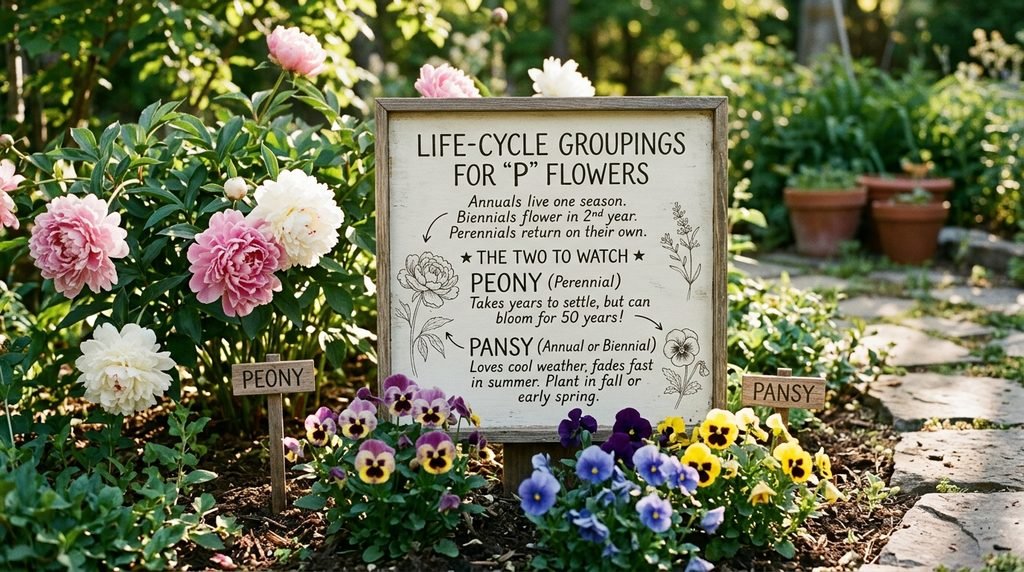
A plant’s life cycle tells you how much work to expect. Annuals live one season, so you replant each year. Biennials flower in their second year. Perennials return on their own. Bulbs need the right winter, cold or warm, to come back. Trees and shrubs take longer to bloom but last for decades. Zones below are approximate and vary by variety, so check your own plant tag.
| Flower | Life Cycle | Typical Zones |
| Pansy | Annual or biennial (cool season) | All zones (seasonal) |
| Petunia | Tender perennial, grown as annual | All zones (seasonal) |
| Pot Marigold | Annual | All zones (seasonal) |
| Plains Coreopsis | Annual | All zones (seasonal) |
| Poppy (Field) | Annual | All zones (seasonal) |
| Pelargonium | Tender perennial, often grown as annual | 10–11 (perennial), elsewhere annual |
| Pentas | Tender perennial, often grown as annual | 10–11 (perennial), elsewhere annual |
| Phlox (Garden) | Perennial | 4–8 |
| Phlox (Creeping) | Perennial | 3–9 |
| Peony | Perennial | 3–8 |
| Primrose | Perennial | 4–8 |
| Polyanthus | Perennial | 3–8 |
| Penstemon | Perennial | 3–9 |
| Purple Coneflower | Perennial | 3–9 |
| Pincushion Flower | Perennial | 3–7 |
| Pinks | Perennial | 3–9 |
| Pasqueflower | Perennial | 3–7 |
| Plume Poppy | Perennial | 3–8 |
| Painted Daisy | Perennial | 3–7 |
| Pickerelweed | Perennial (aquatic) | 3–11 |
| Pond Lily | Perennial (aquatic) | 3–10 |
| Peruvian Lily | Perennial | 7–10 |
| Peacock Orchid | Tender perennial (corm) | 8–10 |
| Pearl Bush | Perennial (shrub) | 4–8 |
| Potentilla | Perennial (shrub) | 2–7 |
| Peach Blossom | Perennial (small tree) | 5–9 |
| Plumbago | Tender perennial (shrub) | 9–11 |
| Plumeria | Tender perennial (small tree) | 10–12 |
| Poinciana (Gulmohar) | Tender perennial (tree) | 10–12 |
| Peace Lily | Tender perennial (houseplant) | 11–12 (indoors elsewhere) |
Peony and pansy are the two to watch. Peony takes a couple of years to settle, but then it can bloom for fifty years. Pansy is the opposite. It loves cool weather and fades fast in summer heat, so plant it in fall or very early spring in warm regions.
Botanical Name Crosswalk
Common names change from place to place. Botanical names do not. Nursery tags and seed packets use Latin for this reason. It also helps you search online with confidence. Two different plants can share one common name, so the Latin name protects you from a wrong purchase.
| Common Name | Botanical Name |
| Pansy | Viola × wittrockiana |
| Petunia | Petunia × hybrida |
| Peony | Paeonia lactiflora |
| Phlox (Garden) | Phlox paniculata |
| Primrose | Primula vulgaris |
| Purple Coneflower | Echinacea purpurea |
| Pincushion Flower | Scabiosa columbaria |
| Pasqueflower | Pulsatilla vulgaris |
| Passionflower | Passiflora caerulea |
| Peace Lily | Spathiphyllum wallisii |
| Phalaenopsis (Moth Orchid) | Phalaenopsis spp. |
| Plumeria | Plumeria rubra |
| Poinciana (Gulmohar) | Delonix regia |
| Pot Marigold | Calendula officinalis |
| Pieris | Pieris japonica |
Peace lily shows why this matters. Despite the name, it is not a true lily. True lilies, from the genus Lilium, are deadly to cats, while the peace lily is milder but still toxic. Also, do not mix up pot marigold and the common marigold. Pot marigold is Calendula, and common marigold is Tagetes. They are different plants.
What P Flowers Mean
Flower meanings vary by culture, but a good number of P flowers carry steady symbolism. Peony stands for prosperity, honor, and happy marriage. In China, it has long been called the king of flowers. Poppy stands for remembrance, and the red field poppy is worn each year to honor soldiers who died in war.
Pansy takes its name from the French word pensée, which means thought, so it stands for thoughtful remembrance. Primrose stands for young love and the first days of spring. Passionflower is named for the Passion of Christ, since Spanish missionaries saw its parts as symbols of the story. Pasqueflower is named for Easter, and it is the state flower of South Dakota.
Plumeria stands for devotion, new beginnings, and warm welcome. In Hawaii, it is strung into leis, and in Laos it is the national flower. In Pakistan, it is called gulchin and is often planted near homes and shrines. Poinciana, known as gulmohar, lights up South Asian streets with red blooms in early summer and marks the arrival of the hot season.
Peace lily stands for peace and sympathy, which is why it is a common gift for funerals. Phlox stands for unity and sweet dreams. Protea stands for change and courage, and the king protea is the national flower of South Africa. Petunia carried a double meaning in Victorian times, with both comfort and resentment. Match the flower to your message, and remember that the same bloom can mean something different in another culture.
Decision Table: Which P Flower Fits Your Situation
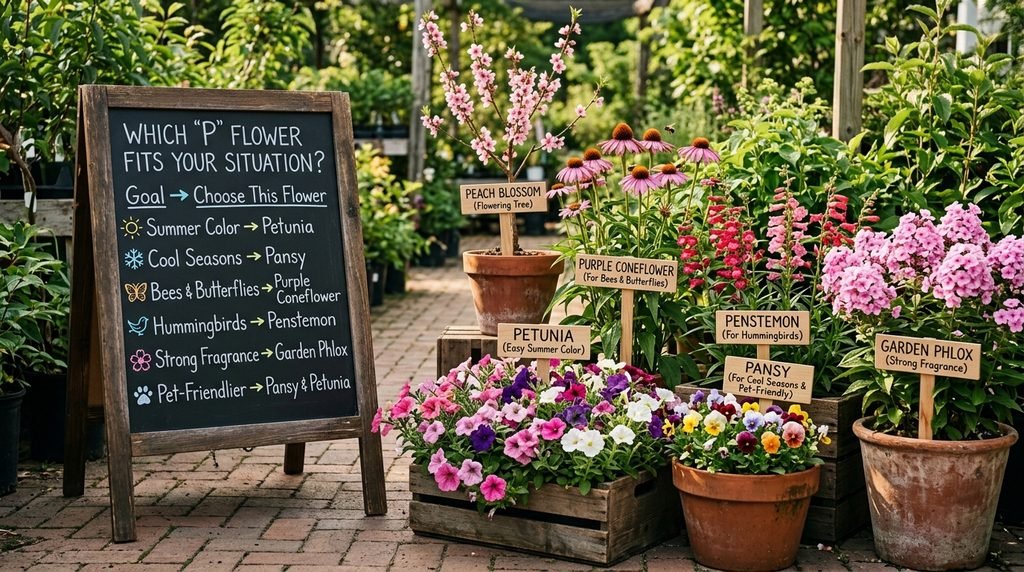
You do not have to read the whole list to choose well. Start with your goal in the left column. The right column names the best P flower for it. Then check the toxicity section if you have pets or children.
| If You Want… | Choose This P Flower |
| Easy color all summer | Petunia, Pot Marigold, or Plains Coreopsis |
| Color in cool seasons | Pansy, Polyanthus, or Primrose |
| Bees and butterflies | Purple Coneflower, Pincushion Flower, or Pentas |
| Hummingbirds | Penstemon, Pineapple Sage, or Pagoda Flower |
| Strong fragrance | Garden Phlox, Paperwhite, or Plumeria |
| A flowering tree | Poinciana (Gulmohar), Peach Blossom, or Plum Blossom |
| An easy houseplant with blooms | Phalaenopsis (Moth Orchid) |
| A pond or water flower | Pond Lily or Pickerelweed |
| Hot, dry, low-water gardens | Penstemon, Plumeria, or Prickly Pear |
| A pet-friendlier garden | Pansy, Petunia, or Phalaenopsis (absent from this guide’s toxic list) |
Petunia appears first because it is easy, bright, and not on the toxic list in this guide. Pansy is a good partner for it, since the two cover warm and cool seasons. Always double-check any plant with your vet if a pet is likely to chew it.
Conclusion
Flowers that start with P offer a very wide choice, from the cheerful pansy to the fiery gulmohar. This guide sorted 83 of them by color, life cycle, and use, so you can pick with confidence. Whether you want a perfumed peony border, a pollinator garden, or an easy orchid for a sunny window, there is a P flower that fits. Use the tables above, read the toxicity notes, and start planting.
Frequently Asked Questions
How many flowers start with P?
More than 80 well-known flowers start with P. This guide lists 83, from common garden plants to rare orchids and tropical trees.
What is the most popular flower that starts with P?
Peony, petunia, pansy, poppy, and primrose are among the most popular. Plumeria and poinciana are favorites in warm climates.
What are the easiest flowers that start with P to grow?
Petunia, pot marigold, plains coreopsis, purple coneflower, and penstemon are very easy. Phalaenopsis is the easiest P houseplant.
Which P flowers attract butterflies and hummingbirds?
Purple coneflower, pincushion flower, and penstemon draw butterflies and bees. Penstemon, pineapple sage, and pagoda flower draw hummingbirds.
Is peace lily poisonous to pets?
Yes, mildly. Peace lily contains crystals that burn the mouth and can cause drooling and vomiting. It is not a true lily, and it is far less dangerous to cats than true lilies.
Which P flower is the most dangerous?
PIRAEIS is the most dangerous for people and pets. Pasqueflower, pipevine, and perennial sweet pea seeds are also serious risks.
Are pansies safe for pets?
Pansies are generally listed as non-toxic to dogs and cats, and the flowers are edible. Still, check with your vet if a pet tends to chew plants.
What does a peony symbolize?
Peony stands for prosperity, honor, and a happy marriage. In China, it is called the king of flowers.
What is gulmohar?
Gulmohar is the South Asian name for Poinciana, Delonix regia. It is a spreading tree that covers itself in fiery red blooms in early summer.
What is gulchin?
Gulchin is the Urdu name for plumeria, Plumeria rubra. It has waxy, fragrant flowers and grows best in warm climates.
1 thought on “Flowers That Start With P: Beautiful Names, Meanings & Photos”