
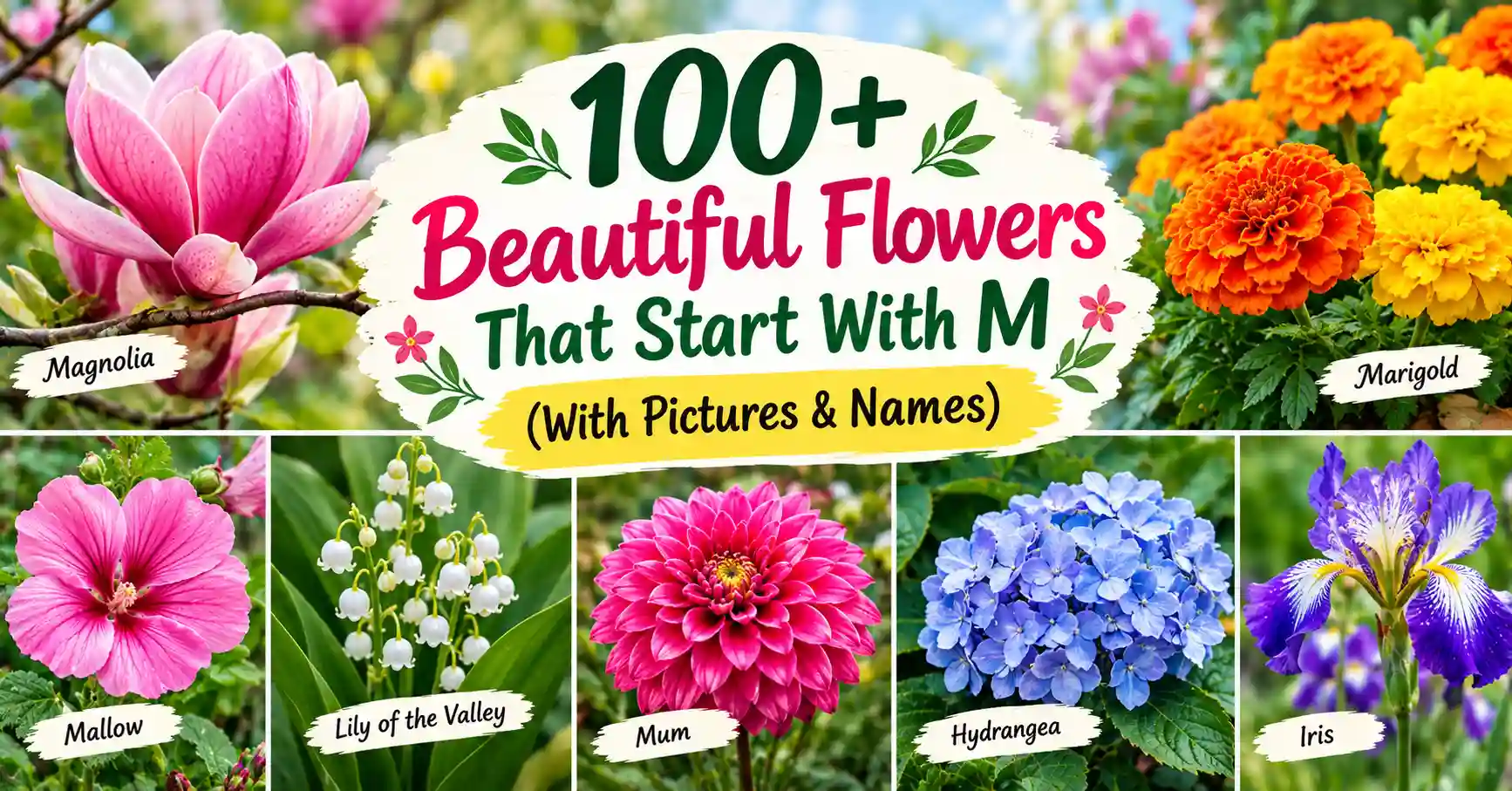
Flowers that start with M cover some of the most famous names in the garden. Marigold, magnolia, morning glory, and moth orchid are the ones most people know. But the letter M also hides rare gems, like the sky-blue Himalayan poppy, the monkey-faced orchid, and a vine that opens its white flowers only after dark. This guide gathers 104 of them in one place.
Every plant below is real and has a verified botanical name. You will find border favorites, vines, houseplants, florist picks, trees, wildflowers, and a few strange rarities. Three entries are grown mainly for dye, leaves, or safety awareness, and each one is clearly marked as an exception.
A long list only helps if you can use it. So this guide sorts the plants by color, life cycle, and use. A bloom’s beauty means little if it dies in your climate. It means even less if it harms a child or a pet. Each table is explained in plain words first, so you never face a bare spreadsheet.
M is a big letter, so you will see many plants with the words meadow, mountain, marsh, and Mexican in their names. Those words hint at where each plant likes to grow. Read straight through or jump to what you need. Have a pet? Check the toxicity section first. Want a quick pick? Try the decision table near the end.
Quick Answer: Ten Standout M Flowers
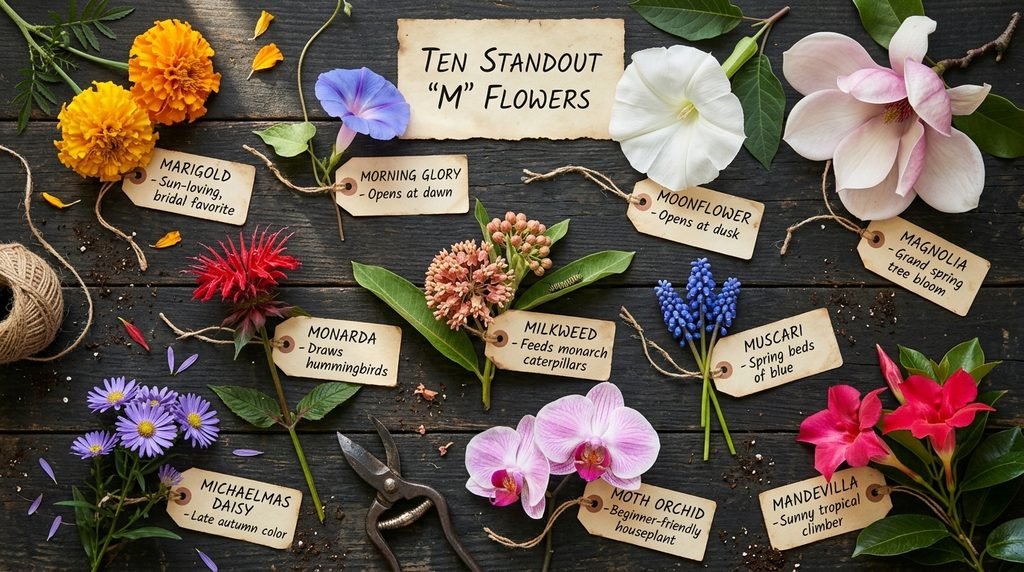
Marigold is the easy star, a sun-loving annual that blooms for months and is woven into garlands at weddings across South Asia. Morning glory and moonflower pair well on a fence, one opening at dawn and the other at dusk. Magnolia is the grand spring tree, covered in huge goblet blooms before the leaves arrive. Monarda draws hummingbirds, and milkweed feeds monarch caterpillars, so the two make a strong pollinator team. Muscari carpets spring beds in blue, while Michaelmas daisy carries color deep into autumn. Moth orchid is the beginner-friendly houseplant, and mandevilla gives a sunny patio a tropical look.
Simple Read More: 60+ Beautiful Flowers That Start With I (With Pictures & Names)
Master Alphabetical List of Flowers That Start With M
This list names 104 flowers. Most entries use a common name that gardeners already know. A few are better known by their botanical name, so they appear under the name nurseries print on plant tags. Each row has a short note, so you can see at a glance what the plant looks like and where it grows best. Three entries are marked as exceptions because the flower is not the main reason people grow them.
| Flower | Botanical Name | Note |
| Madagascar Periwinkle | Catharanthus roseus | Heat-tolerant pink or white pinwheels |
| Madder (exception) | Rubia tinctorum | Tiny yellow flowers on a historic dye plant |
| Madonna Lily | Lilium candidum | Pure white fragrant trumpets, deadly to cats |
| Magnolia | Magnolia × soulangeana | Large pink-white goblets on bare branches |
| Mahonia | Mahonia aquifolium | Yellow winter-spring clusters, blue berries |
| Maiden Pink | Dianthus deltoides | Low pink carpet, clove-scented |
| Mallow | Malva sylvestris | Pink-purple veined summer blooms |
| Malope | Malope trifida | Satin magenta or white summer cups |
| Maltese Cross | Lychnis chalcedonica | Scarlet star-shaped clusters |
| Malva Zebrina | Malva sylvestris ‘Zebrina’ | Striped purple-and-white blooms |
| Mandevilla | Mandevilla × amabilis | Tropical vine with glossy pink trumpets |
| Mandrake | Mandragora officinarum | Purple spring blooms, highly toxic roots |
| Manuka | Leptospermum scoparium | Small white or pink blooms, honey source |
| Marguerite Daisy | Argyranthemum frutescens | Long-blooming white daisy for pots |
| Marigold | Tagetes erecta | Easy orange and gold annual |
| Mariposa Lily | Calochortus venustus | Delicate tulip-like western wildflower |
| Marsh Blue Violet | Viola cucullata | Violet blooms for damp ground |
| Marsh Cinquefoil | Comarum palustre | Dark purple-red star flowers for bogs |
| Marsh Mallow | Althaea officinalis | Pale pink blooms, wetland herb |
| Marsh Marigold | Caltha palustris | Bright yellow cups for wet ground, toxic |
| Marsh Orchid | Dactylorhiza majalis | Purple wild orchid spikes for wet meadows |
| Martagon Lily | Lilium martagon | Nodding spotted pink turk’s-cap, deadly to cats |
| Marvel of Peru | Mirabilis jalapa | Trumpets that open late afternoon |
| Masterwort | Astrantia major | Papery pink-white pincushions |
| Matilija Poppy | Romneya coulteri | Huge white crepe-paper blooms |
| Matthiola (Stock) | Matthiola incana | Fragrant spring spikes |
| May Apple | Podophyllum peltatum | White woodland bloom under umbrella leaves, toxic |
| Mayflower | Epigaea repens | Fragrant pink-white woodland bloom |
| Maypop | Passiflora incarnata | Hardy passionflower with lavender fringed blooms |
| Mazus | Mazus reptans | Tiny purple groundcover for paths |
| Meadow Anemone | Anemone canadensis | White buttercup-like blooms, spreads in moist soil |
| Meadow Beauty | Rhexia virginica | Magenta four-petaled wildflower for wet sandy soil |
| Meadow Blazing Star | Liatris ligulistylis | Purple spikes, favorite of monarchs |
| Meadow Buttercup | Ranunculus acris | Glossy yellow cups, toxic to grazers |
| Meadow Cranesbill | Geranium pratense | Blue-violet cottage garden perennial |
| Meadow Foam | Limnanthes douglasii | White-edged yellow blooms, bee favorite |
| Meadow Phlox | Phlox maculata | Fragrant pink-purple summer clusters |
| Meadow Rue | Thalictrum aquilegiifolium | Fluffy lilac clouds on tall stems |
| Meadow Saffron | Colchicum autumnale | Lilac fall blooms, highly toxic |
| Meadow Sage | Salvia pratensis | Purple-blue spikes for sunny meadows |
| Meadowsweet | Filipendula ulmaria | Frothy, almond-scented white blooms |
| Mealycup Sage | Salvia farinacea | Blue-violet spikes, long summer bloom |
| Meconopsis (Himalayan Blue Poppy) | Meconopsis betonicifolia | Rare sky-blue silky poppy |
| Melastoma | Melastoma malabathricum | Bright pink-purple tropical blooms |
| Mexican Bush Sage | Salvia leucantha | Velvety purple fall spikes |
| Mexican Evening Primrose | Oenothera speciosa | Pink cups that spread in sun |
| Mexican Hat | Ratibida columnifera | Drooping petals around a tall cone |
| Mexican Heather | Cuphea hyssopifolia | Tiny lavender stars on a neat shrub |
| Mexican Marigold | Tagetes lemmonii | Shrubby, citrus-scented, fall bloom |
| Mexican Orange Blossom | Choisya ternata | Fragrant white spring blooms |
| Mexican Petunia | Ruellia simplex | Purple trumpets, spreads in warm zones |
| Mexican Prickly Poppy (exception) | Argemone mexicana | Yellow weedy poppy, toxic, listed for safety |
| Mexican Sunflower | Tithonia rotundifolia | Tall orange butterfly magnet |
| Mexican Tulip Poppy | Hunnemannia fumariifolia | Yellow silky poppy for hot, dry beds |
| Mexican Zinnia | Zinnia haageana | Orange and mahogany daisies, heat-tough |
| Michaelmas Daisy | Symphyotrichum novi-belgii | Late-season purple asters |
| Michelia (Banana Shrub) | Magnolia figo | Banana-scented small cream blooms |
| Mickey Mouse Plant | Ochna serrulata | Yellow blooms, then black-and-red fruit |
| Mignonette | Reseda odorata | Fast fragrant annual |
| Milk Thistle | Silybum marianum | Purple thistle heads, marbled leaves |
| Milkweed | Asclepias syriaca | Pink clusters, monarch host plant |
| Milkwort | Polygala vulgaris | Small blue, pink, or white meadow flower |
| Million Bells | Calibrachoa × hybrida | Mini petunia-like trailing blooms |
| Mimosa (Sensitive Plant) | Mimosa pudica | Pink puffs, leaves fold when touched |
| Mimosa (Silk Tree) | Albizia julibrissin | Feathery pink summer plumes |
| Miniature Rose | Rosa (miniature types) | Compact roses for pots |
| Mist Flower | Conoclinium coelestinum | Fluffy blue fall clusters |
| Moccasin Flower | Cypripedium acaule | Pink wild orchid for acidic woods |
| Mock Orange | Philadelphus coronarius | Orange-blossom scented white blooms |
| Moluccella (Bells of Ireland) | Moluccella laevis | Green bells, popular in cut arrangements |
| Monarda (Bee Balm) | Monarda didyma | Shaggy red blooms, hummingbird favorite |
| Moneywort | Lysimachia nummularia | Yellow cups on a spreading groundcover |
| Monkey Flower | Mimulus guttatus | Yellow snapdragon-like blooms for wet soil |
| Monkey Orchid | Dracula simia | Rare orchid with a monkey-face bloom |
| Monkshood | Aconitum napellus | Purple hooded spikes, highly toxic |
| Montbretia | Crocosmia × crocosmiiflora | Arching orange-red summer sprays |
| Moon Daisy | Leucanthemum vulgare | White meadow daisy with a yellow eye |
| Moonflower | Ipomoea alba | White night-blooming vine |
| Moraea | Moraea huttonii | Yellow iris-like African bloom |
| Morning Glory | Ipomoea purpurea | Fast vine, opens at dawn, toxic seeds |
| Moss Campion | Silene acaulis | Pink cushions for alpine rockeries |
| Moss Phlox | Phlox subulata | Spring carpet of pink, white, or blue |
| Moss Rose | Portulaca grandiflora | Drought-proof, sun-loving carpet |
| Moss Verbena | Glandularia pulchella | Low purple spreading clusters |
| Moth Orchid | Phalaenopsis spp. | Easy houseplant orchid |
| Mother of Thousands (exception) | Kalanchoe daigremontiana | Grown for plantlets, orange-pink bells |
| Mountain Avens | Dryas octopetala | White eight-petaled alpine flower |
| Mountain Bluet | Centaurea montana | Blue-fringed spring blooms |
| Mountain Fleece | Persicaria amplexicaulis | Red bottlebrush spikes in late season |
| Mountain Laurel | Kalmia latifolia | Cup-shaped pink-white blooms, highly toxic |
| Mountain Mint | Pycnanthemum muticum | Pollinator magnet, minty scent |
| Mountain Pride | Penstemon newberryi | Rose-pink tubular blooms for rocky slopes |
| Mourning Bride | Scabiosa atropurpurea | Deep maroon pincushion blooms |
| Mourning Widow Geranium | Geranium phaeum | Deep maroon blooms for shade |
| Mulla Mulla | Ptilotus exaltatus | Pink fluffy Australian blooms |
| Mullein | Verbascum thapsus | Tall yellow spike |
| Mum | Chrysanthemum × morifolium | Fall flower in every color |
| Muscari (Grape Hyacinth) | Muscari armeniacum | Tight blue spring clusters |
| Musk Flower | Mimulus moschatus | Yellow bloom, once strongly musk-scented |
| Musk Mallow | Malva moschata | Pale pink blooms for part shade |
| Musk Rose | Rosa moschata | Old climbing rose, strong fragrance |
| Myosotis (Forget-Me-Not) | Myosotis sylvatica | Tiny sky-blue spring blooms |
| Myrtle | Myrtus communis | White fragrant blooms, bridal tradition |
| Myrtle Spurge | Euphorbia myrsinites | Chartreuse bracts, irritating sap |
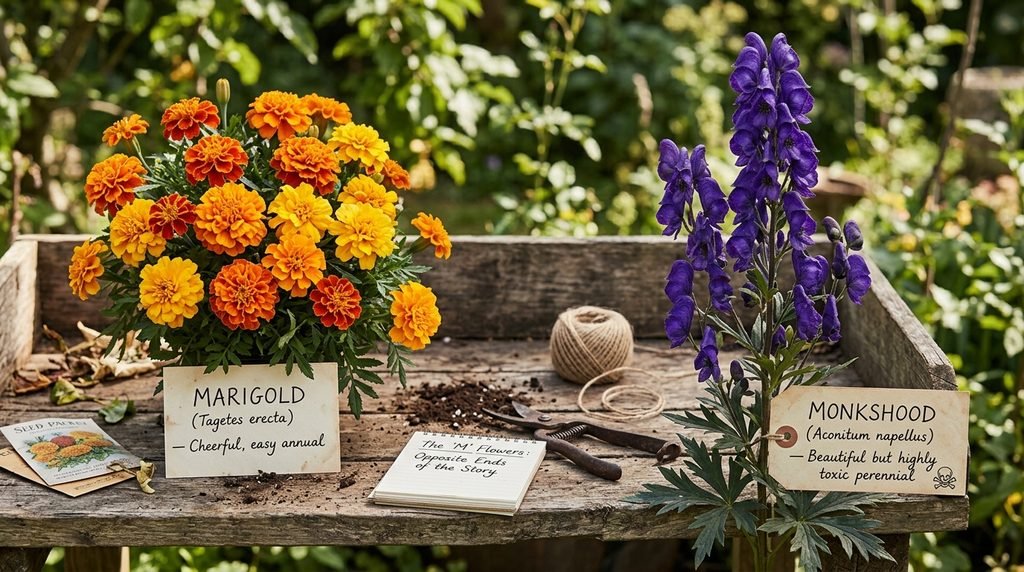
That table names 104 distinct flowers that start with M. Marigold and monkshood sit at opposite ends of the story. One is a cheerful, easy annual. The other is a beautiful but deadly perennial. Both show how wide this single letter reaches.
Explore More: 80+ Beautiful Flowers That Start With L (With Pictures & Names)
Full Comparison Table: Sun, Water, and Bloom Time
When two plants seem equally good, sun and water needs usually pick the winner. The table below compares the main M flowers from this guide. Read the sun column first. Then check the water column and the bloom season to see if the plant fits your space and your calendar.
| Flower | Sun Needs | Water Needs | Bloom Season |
| Marigold | Full sun | Low to moderate | Late spring to frost |
| Moss Rose | Full sun | Low | Summer |
| Morning Glory | Full sun | Moderate | Summer to fall |
| Moonflower | Full sun | Moderate | Summer to fall (opens at dusk) |
| Mandevilla | Full sun to part shade | Moderate | Late spring to fall |
| Muscari | Full sun to part shade | Low to moderate | Early spring |
| Monarda | Full sun to part shade | Moderate to high | Midsummer |
| Milkweed | Full sun | Low to moderate | Summer |
| Michaelmas Daisy | Full sun | Moderate | Fall |
| Mexican Sunflower | Full sun | Low to moderate | Summer to fall |
| Mexican Hat | Full sun | Low | Summer to fall |
| Mealycup Sage | Full sun | Low to moderate | Summer to fall |
| Maiden Pink | Full sun | Low | Late spring to early summer |
| Mock Orange | Full sun to part shade | Moderate | Late spring |
| Magnolia | Full sun to part shade | Moderate | Spring |
| Mountain Laurel | Part shade | Moderate | Late spring |
| Moth Orchid | Bright indirect light | Moderate | Often winter to spring |
| Mullein | Full sun | Low | Summer |
Moss rose, Mexican hat, and maiden pink are the best picks for hot, poor, dry soil. All three bloom better when they are not fed or watered too much. Monarda sits at the other end. It wants moist soil and good airflow to avoid mildew.
You May Also Like: Flowers That Start With E: 85 Beautiful Blooms With Names & Pictures
Garden Favorites Among M Flowers
A handful of M flowers earn a place in almost every garden. Marigold fills beds with gold and orange all summer. Monarda brings shaggy color and hummingbirds to midsummer borders. Michaelmas daisy lights up the end of the season when most plants are tired. Muscari sneaks into lawns and beds each spring with almost no effort.
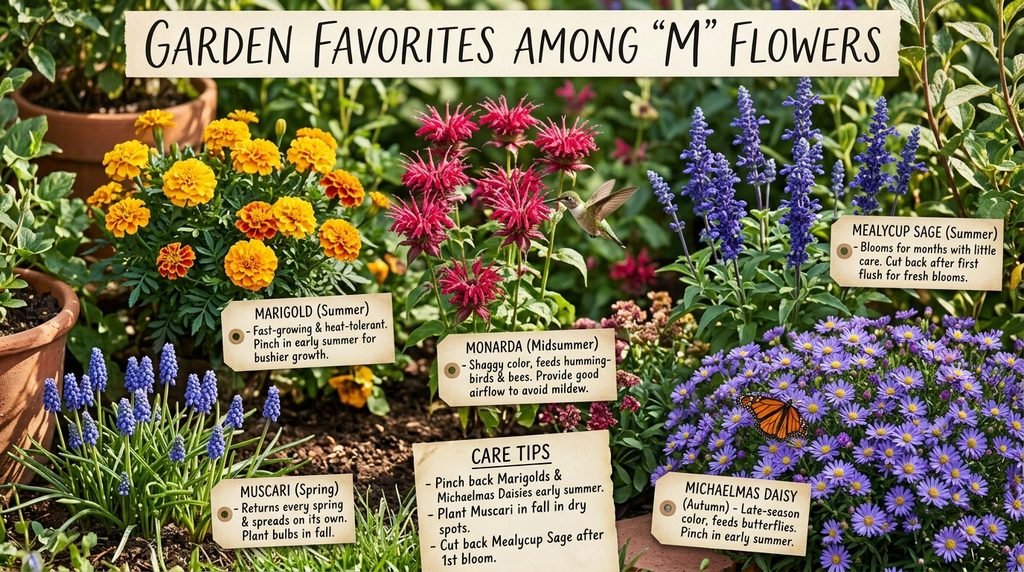
- Marigold grows fast from seed and tolerates heat and poor soil.
- Monarda spreads slowly and feeds hummingbirds and bees.
- Michaelmas Daisy blooms in autumn and feeds late butterflies.
- Muscari returns every spring and spreads on its own.
- Mealycup Sage blooms for months with very little care.
Monarda and Michaelmas daisy make a strong pair. One carries the heat of midsummer, and the other carries the color of fall. Together they keep a border alive for months.
A few care habits keep these plants happy. Pinch back marigolds and Michaelmas daisies in early summer for bushier plants. Give monarda good airflow, or it may get powdery mildew. Plant muscari bulbs in fall, in a spot that dries out after spring. Cut mealycup sage back after its first flush for fresh blooms.
Explore More Flower Guides: 80+ Beautiful Flowers That Start With C (With Pictures, Names & Meanings)
Indoor and Container Picks Among M Flowers
Only a few M plants thrive indoors, but they are worth knowing. Moth orchid is one of the easiest orchids to grow, rewarding a bright window with weeks of blooms. Mandevilla grows well in a large pot on a sunny patio and can winter indoors in cold climates. Miniature rose and million bells suit containers on balconies and sunny steps. Moss rose thrives in a hot, dry pot with almost no care.
- Moth Orchid wants bright, indirect light and a loose, bark-based mix.
- Mandevilla needs sun, a trellis, and a warm spot for winter.
- Million Bells trails from baskets and blooms until frost.
- Moss Rose loves hot, sunny pots and tolerates missed waterings.
The moth orchid is the pick for beginners. It blooms for a long time and forgives small mistakes. Just avoid overwatering, since soggy bark is the fastest way to lose it.
Light matters more than anything else for indoor M plants. A bright, east-facing window suits most orchids. A south window or a sunny balcony suits mandevilla and moss rose. Avoid cold drafts and soggy saucers. Most of these plants fail from too much water, not too little.
Florist Favorites Among M Flowers
Florists use M flowers for scent, texture, and unusual shapes. Moluccella, called bells of Ireland, adds green spires to modern bouquets. Mums are the staple of autumn arrangements and last for two weeks or more. Matthiola, or stock, brings a spicy perfume to spring work. Magnolia branches add drama to large displays, and mimosa branches are famous in Italy on March 8.
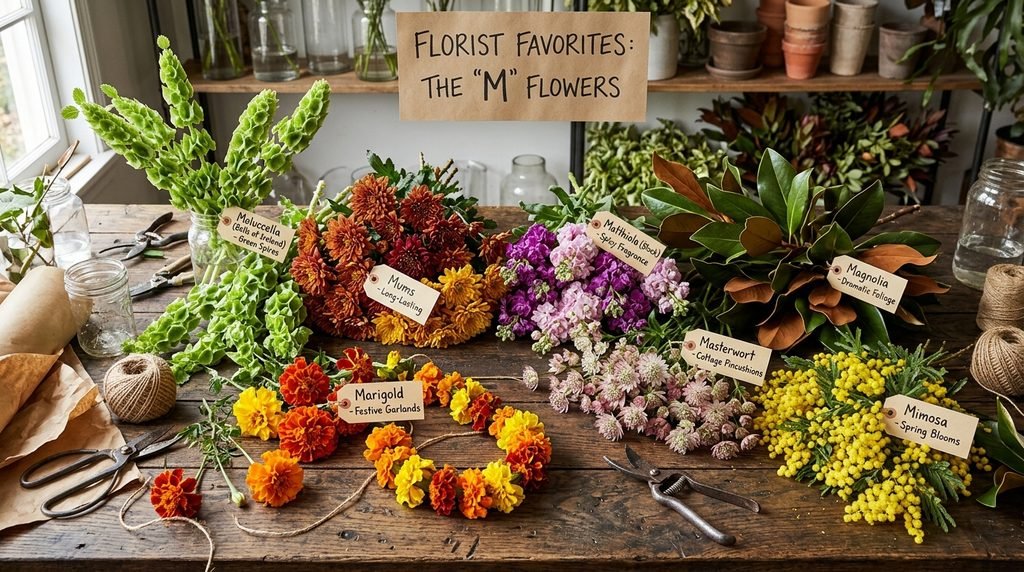
- Moluccella (Bells of Ireland) adds tall green spikes and dries well.
- Mum lasts a long time and comes in every color.
- Matthiola (Stock) gives strong fragrance and ruffled spikes.
- Marigold is strung into garlands for weddings and festivals.
- Masterwort adds papery pincushions to cottage-style bouquets.
Moluccella and mums are the quiet workhorses. They hold their shape long after softer blooms fade. A florist’s cooler in autumn would feel empty without mums.
Good vase care doubles the life of any cut flower. Strip the leaves below the water line. Recut the stems at an angle. Change the water every two days. For magnolia branches, crush the woody stem ends so they can drink.
Rare and Unusual M Flowers
Some M plants are hard to find or hard to grow. Meconopsis, the Himalayan blue poppy, is the most famous. Its silky sky-blue petals need cool, damp summers, and it sulks in heat. Monkey orchid, Dracula simia, is a rare cloud-forest orchid whose bloom looks like a tiny monkey face. Matilija poppy is a California native with huge white petals like crepe paper and golden centers. Mountain avens is a tough alpine plant from cold, rocky places, with white eight-petaled flowers.
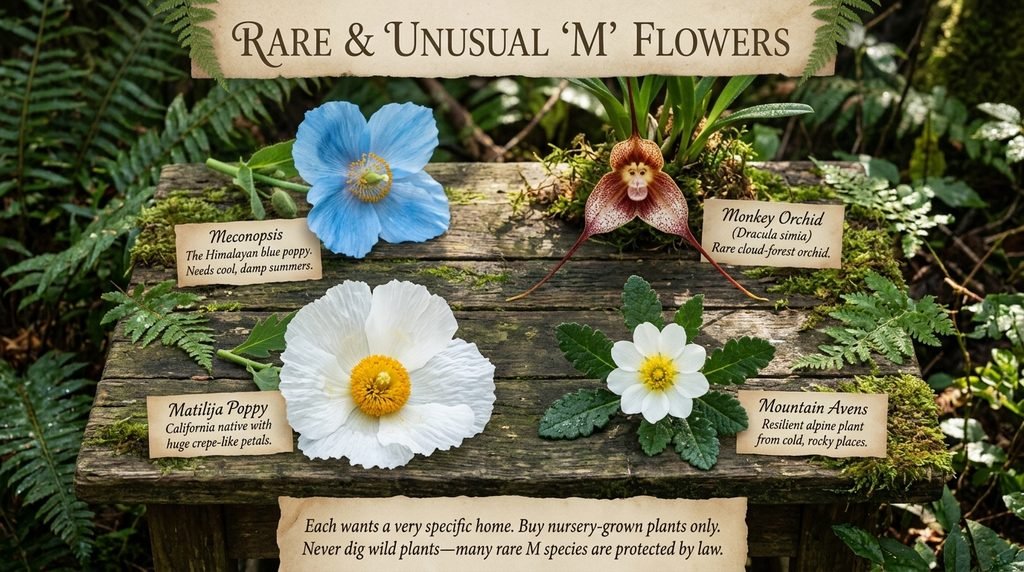
These four plants share one trait. Each wants a very specific home. That is why they stay special. If you want to grow one, buy nursery-grown plants only. Never dig wild plants, since many rare M species are protected by law.
Caution: Toxic M Flowers
Several M plants can harm pets, livestock, or people. Monkshood, mountain laurel, mandrake, and meadow saffron are the most dangerous. Every part of each plant is poisonous. Cat owners need to know about two more. Madonna lily and martagon lily are true lilies, and even a small nibble or a lick of pollen can cause kidney failure in cats.
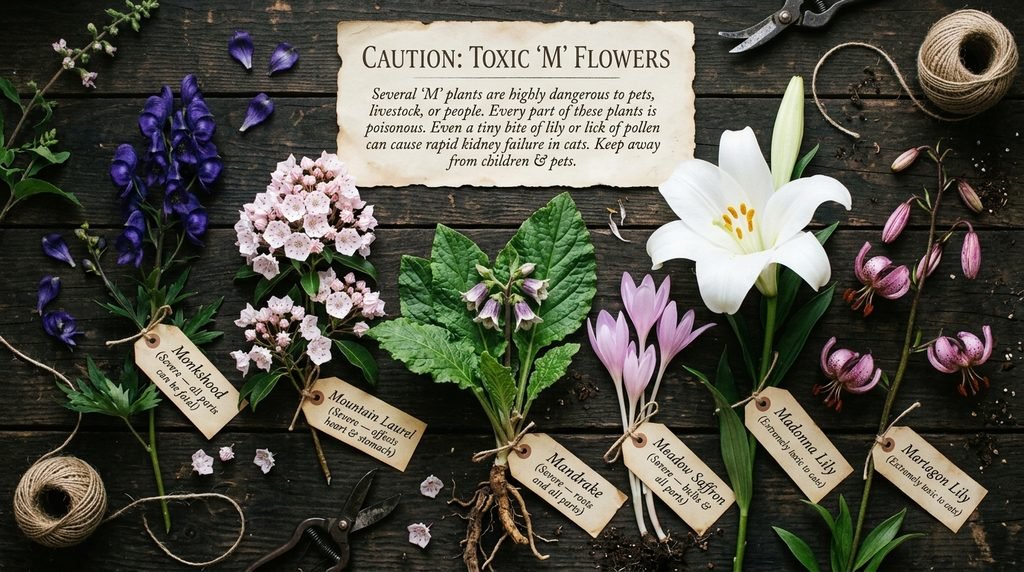
| Flower | Toxic To | Severity |
| Monkshood | Humans, dogs, cats, horses, livestock | Severe — all parts, can be fatal |
| Mountain Laurel | Dogs, cats, horses, livestock | Severe — all parts affect the heart and stomach |
| Mandrake | Humans, dogs, cats, livestock | Severe — roots and all parts |
| Meadow Saffron | Humans, dogs, cats, livestock | Severe — bulbs and all parts |
| Madonna Lily | Cats (extremely), dogs (mild) | Severe for cats — can cause kidney failure |
| Martagon Lily | Cats (extremely), dogs (mild) | Severe for cats — can cause kidney failure |
| May Apple | Humans, dogs, cats, livestock | Moderate to severe — roots, leaves, and unripe fruit |
| Milkweed | Dogs, cats, horses, livestock | Moderate to severe — cardiac glycosides |
| Marsh Marigold | Dogs, cats, livestock | Moderate — sap irritates mouth and skin |
| Myrtle Spurge | Dogs, cats, humans | Moderate — milky sap burns skin and eyes |
| Morning Glory | Dogs, cats, humans | Mild to moderate — seeds upset the stomach |
| Mum | Dogs, cats, horses | Mild to moderate — drooling and stomach upset |
Monkshood, mountain laurel, mandrake, meadow saffron, and the two lilies for cats deserve the loudest warning. Keep them away from children and pets. Morning glory and mum are milder, but a chewing dog can still get sick. If a pet or child eats any plant on this list, call a vet or poison control right away.
You May Also Like: 80+ Beautiful Flowers That Start With H (With Pictures & Names)
M Flowers Grouped by Color
Pink and rose tones run through magnolia, mallow, maiden pink, moss campion, and mimosa. Magnolia gives the biggest show, since huge goblet blooms cover bare branches in early spring. Mimosa brings feathery pink puffs in summer. Maiden pink and moss campion suit rock gardens and sunny edges.
Yellow, gold, and orange bring warmth. Marigold, Mexican sunflower, monkey flower, mullein, and marsh marigold all glow in sun or damp soil. Marigold is the easiest, and it grows well from seed. Mexican sunflower reaches six feet and feeds butterflies. Marsh marigold arrives first, in early spring.
Purple, blue, and lilac are the cool side of M. Muscari, myosotis, mealycup sage, meadow cranesbill, and Michaelmas daisy; all deliver these shades. Muscari and myosotis carpet spring beds. Mealycup sage and Michaelmas daisy keep summer and fall cool and calm.
White and cream flowers include mock orange, moonflower, madonna lily, meadowsweet, and magnolia. White glows at dusk and brightens shade. Mock orange and madonna lily bring scent. Moonflower opens at night. Meadowsweet suits damp meadows and cottage borders.
Red and scarlet accents come from monarda, maltese cross, montbretia, and mountain pride. Monarda and montbretia draw hummingbirds. Maltese cross gives a bold, old-fashioned red star. Mountain pride suits rocky, sunny slopes.
Life-Cycle Groupings for M Flowers
A plant’s life cycle tells you how much work to expect. Annuals live one season, so you replant each year. Biennials flower in their second year. Perennials return on their own. Bulbs need the right winter, cold or warm, to come back. Trees and shrubs take longer to bloom but last for decades. Zones below are approximate and vary by variety, so check your own plant tag.
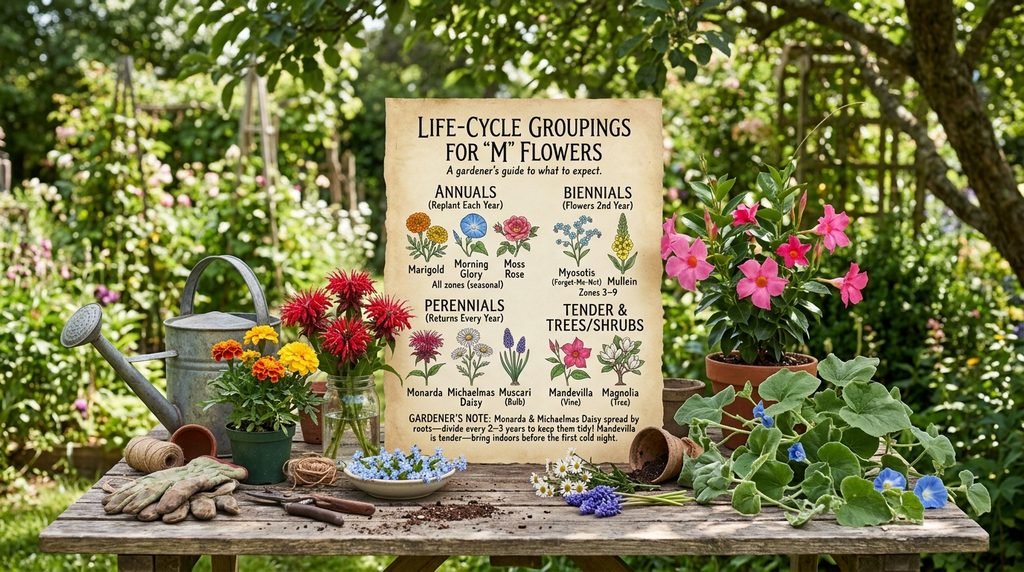
| Flower | Life Cycle | Typical Zones |
| Marigold | Annual | All zones (seasonal) |
| Moss Rose | Annual | All zones (seasonal) |
| Morning Glory | Annual | All zones (seasonal) |
| Moonflower | Annual or tender perennial | 10–11 (perennial), elsewhere annual |
| Mignonette | Annual | All zones (seasonal) |
| Meadow Foam | Annual | All zones (seasonal) |
| Million Bells | Tender perennial, grown as annual | 9–11 (perennial), elsewhere annual |
| Myosotis (Forget-Me-Not) | Biennial or short-lived perennial | 3–9 |
| Mullein | Biennial | 3–9 |
| Monarda | Perennial | 4–9 |
| Milkweed | Perennial | 3–9 |
| Michaelmas Daisy | Perennial | 4–8 |
| Mexican Hat | Perennial | 3–9 |
| Maiden Pink | Perennial | 3–9 |
| Moss Phlox | Perennial | 3–9 |
| Meadow Rue | Perennial | 4–8 |
| Meadowsweet | Perennial | 3–8 |
| Masterwort | Perennial | 4–7 |
| Marsh Marigold | Perennial | 3–7 |
| Muscari (Grape Hyacinth) | Perennial (bulb) | 4–9 |
| Mandevilla | Tender perennial (vine) | 9–11 |
| Mock Orange | Perennial (shrub) | 4–8 |
| Mountain Laurel | Perennial (shrub) | 5–9 |
| Magnolia | Perennial (tree) | 4–9 |
| Mimosa (Silk Tree) | Perennial (tree) | 6–9 |
Monarda and Michaelmas daisy are the two to watch. Both spread by roots and can crowd out neighbors. Divide them every two or three years to keep them healthy and tidy. Mandevilla is the opposite. It looks tough but cannot take frost, so bring it indoors before the first cold night.
Botanical Name Crosswalk
Common names change from place to place. Botanical names do not. Nursery tags and seed packets use Latin for this reason. It also helps you search online with confidence. Two different plants can share one common name, so the Latin name protects you from a wrong purchase.
| Common Name | Botanical Name |
| Marigold | Tagetes erecta |
| Moss Rose | Portulaca grandiflora |
| Morning Glory | Ipomoea purpurea |
| Moonflower | Ipomoea alba |
| Magnolia | Magnolia × soulangeana |
| Mandevilla | Mandevilla × amabilis |
| Monarda | Monarda didyma |
| Milkweed | Asclepias syriaca |
| Muscari | Muscari armeniacum |
| Michaelmas Daisy | Symphyotrichum novi-belgii |
| Moth Orchid | Phalaenopsis spp. |
| Monkshood | Aconitum napellus |
| Mountain Laurel | Kalmia latifolia |
| Mock Orange | Philadelphus coronarius |
| Mum | Chrysanthemum × morifolium |
Morning glory and moonflower are worth double-checking. Both belong to the genus Ipomoea, but they open at opposite times of day. Also, do not mix up the two mimosas. Mimosa pudica is the sensitive plant, and Albizia julibrissin is the silk tree. They are different plants, and the common name on a tag may not tell you which is which.
What M Flowers Mean
Flower meanings vary by culture, but a good number of M flowers carry steady symbolism. Marigold stands for passion and the warmth of the sun. In Mexico, orange marigolds guide spirits home during Día de los Muertos. In South Asia, marigold garlands, called genda, are used at weddings, festivals, and prayers.
Magnolia stands for dignity, nobility, and perseverance. It is the state flower of Louisiana and Mississippi. Madonna lily stands for purity and has long been linked with the Virgin Mary. Myrtle stands for love and marriage, and brides once wore it in their wreaths. Moss rose, in Victorian times, was a way to confess love.
Forget-me-not, or myosotis, stands for true love and remembrance. Michaelmas daisy meant farewell, since it blooms as the garden year ends. Mullein, in Victorian language, stood for good nature. Monkshood carries a warning. In old flower language,e it meant danger, and it is still among the deadliest plants in the garden.
Mountain laurel is the state flower of Connecticut and Pennsylvania. Mayflower, the trailing arbutus, is the state flower of Massachusetts. In Italy, mimosas, a branch is given to women on March 8. Match the flower to your message, and remember that the same bloom can mean something different in another culture.
Decision Table: Which M Flower Fits Your Situation
You do not have to read the whole list to choose well. Start with your goal in the left column. The right column names the best M flower for it. Then check the toxicity section if you have pets or children.
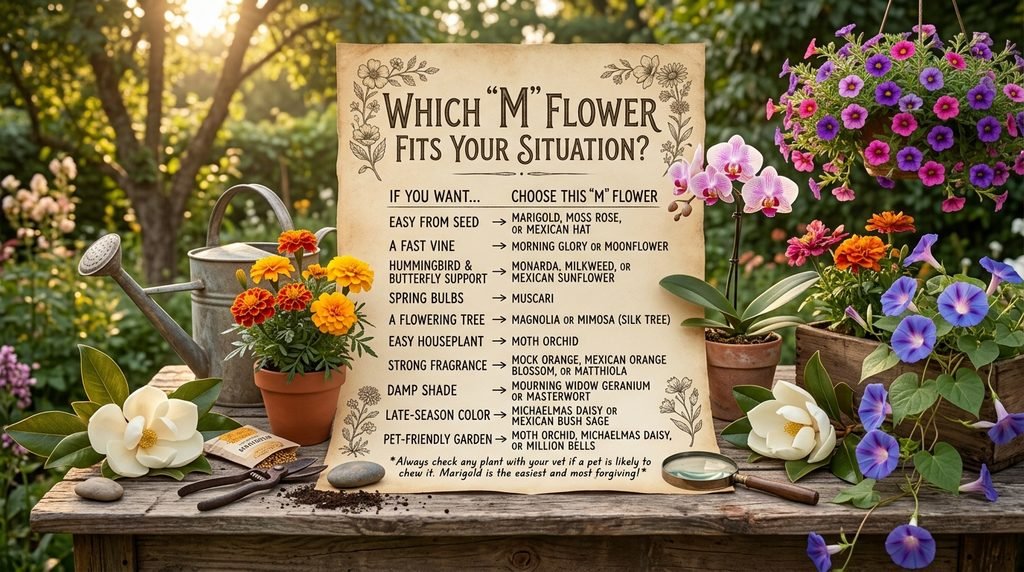
| If You Want… | Choose This M Flower |
| Easy color from seed | Marigold, Moss Rose, or Mexican Hat |
| A fast vine for a fence | Morning Glory or Moonflower |
| Hummingbird and butterfly support | Monarda, Milkweed, or Mexican Sunflower |
| Spring bulbs that spread | Muscari |
| A flowering tree | Magnolia or Mimosa (Silk Tree) |
| An easy houseplant with blooms | Moth Orchid |
| Strong fragrance | Mock Orange, Mexican Orange Blossom, or Matthiola |
| Color in damp shade | Mourning Widow Geranium or Masterwort |
| Late-season color | Michaelmas Daisy or Mexican Bush Sage |
| A pet-friendlier garden | Moth Orchid, Michaelmas Daisy, or Million Bells (absent from this guide’s toxic list) |
Marigold appears first because it is the easiest and most forgiving. Moth orchid and Million Bells are good partners for it in a family home. Always double-check any plant with your vet if a pet is likely to chew it.
Conclusion
Flowers that start with M offer a very wide choice, from the cheerful marigold to the rare Himalayan blue poppy. This guide sorted 104 of them by color, life cycle, and use, so you can pick with confidence. Whether you want a sunny pollinator border, a fast-growing vine, or an easy windowsill orchid, there is an M flower that fits. Use the tables above, read the toxicity notes, and start planting.
Frequently Asked Questions
How many flowers start with M?
More than 100 well-known flowers start with M. This guide lists 104, from common garden plants to rare orchids and alpine wildflowers.
What is the most popular flower that starts with M?
Marigold, magnolia, morning glory, and moth orchid are among the most popular. Monarda, muscari, and mum are also widely grown.
What are the easiest flowers that start with M to grow? Marigold, moss rose, mealycup sage, Mexican hat, and mallow are very easy. Moth orchid is the easiest M houseplant.
Which M flowers attract butterflies and hummingbirds?
Milkweed, Mexican sunflower, mist flower, and Michaelmas daisy draw butterflies. Monarda, mandevilla, and mountain pride draw hummingbirds.
Is monkshood poisonous?
Yes. Every part of monkshood is deadly poisonous. Wear gloves when handling it and keep it away from children, pets, and livestock.
Which M flower is the most dangerous?
Monkshood, mountain laurel, mandrake, and meadow saffron are the most dangerous for people and pets. Madonna lily and martagon lily are the most dangerous for cats.
Are marigolds safe for pets?
Marigolds can cause mild stomach upset or skin irritation if a pet eats a lot of them. They are far less risky than the plants in the toxicity table. Check with your vet if your pet chews plants.
What do marigolds symbolize?
Marigolds stand for passion and the warmth of the sun. In Mexico, they guide spirits home, and in South Asia they decorate weddings and festivals.
What is the difference between morning glory and moonflower?
Both belong to the genus Ipomoea. Morning glory opens at dawn and closes by afternoon, while moonflower opens at dusk and stays open through the night.
Which M flowers bloom in very early spring?
Marsh marigold, muscari, mahonia, and magnolia bloom very early. Moss phlox and mountain bluet follow soon after.
1 thought on “100+ Beautiful Flowers That Start With M (With Pictures & Names)”