
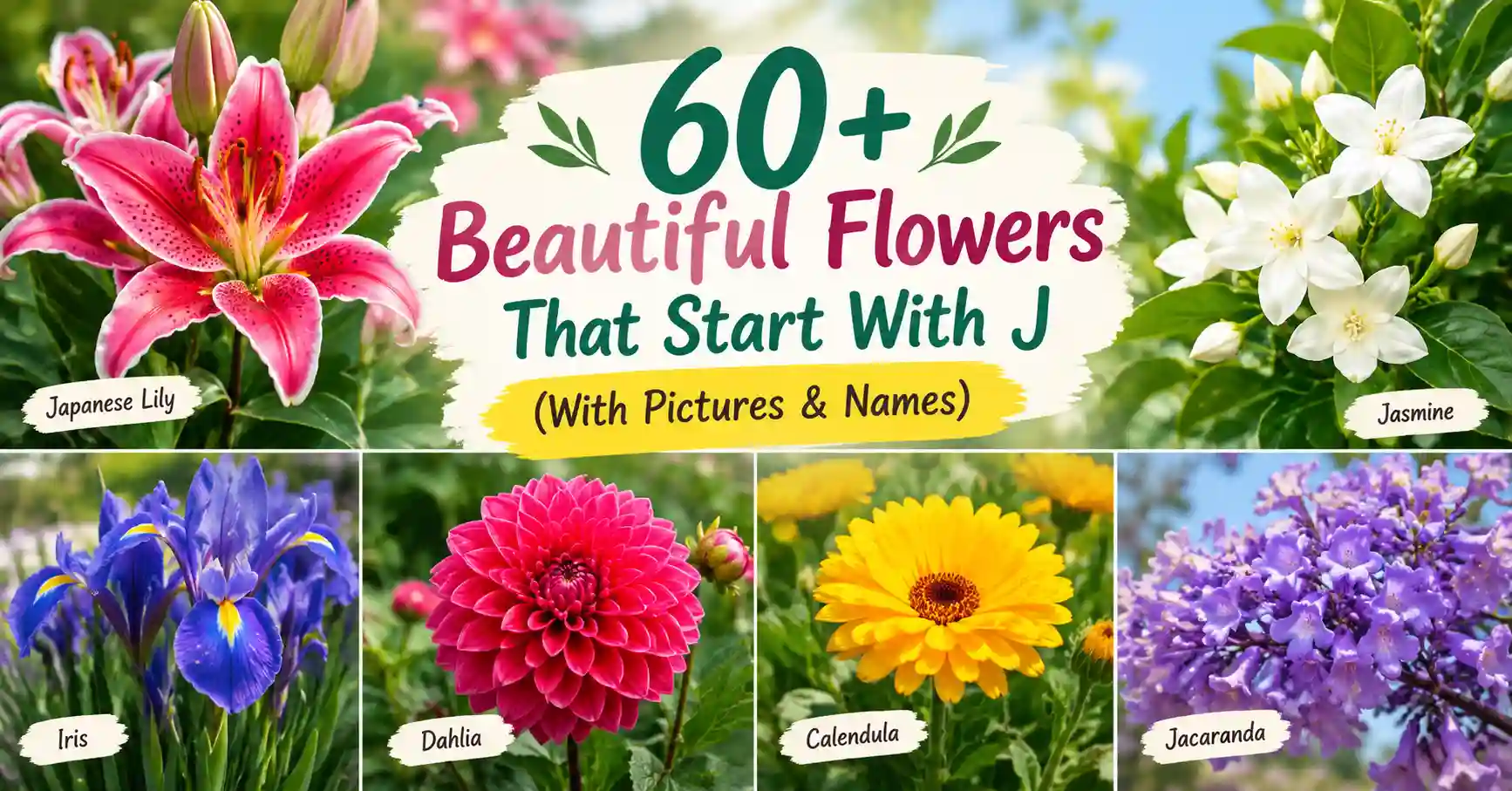
Flowers that start with J include some of the garden’s most fragrant and dramatic blooms. Most people know jasmine, jacaranda, jonquil, and Japanese iris. But the letter J also hides rare treasures, like the glowing jade vine, the blood-red Jacobean lily, and the heart-shaped blooms of the Judas tree. This guide gathers 64 of them in one place.
Every plant below is real and has a verified botanical name. You will find border favorites, container plants, florist picks, wildflowers, and a few rarities that most lists skip. A handful of entries are grown mainly for leaves, tubers, or safety awareness, and each one is clearly marked as an exception.
A long list only helps if you can use it. So this guide sorts the plants by color, life cycle, and use. A bloom’s beauty means little if it dies in your climate. It means even less if it harms a child or a pet. Each table is explained in plain words first, so you never face a bare spreadsheet.
Quick Answer: Ten Standout J Flowers
Jasmine is the fragrance champion, filling a whole evening garden with scent from small white stars. Japanese anemone brings calm pink and white blooms to the shade just when summer fades, and Japanese iris gives huge, flat flowers to wet corners. Jacaranda is the tropical showstopper, covering whole trees in lilac-blue.
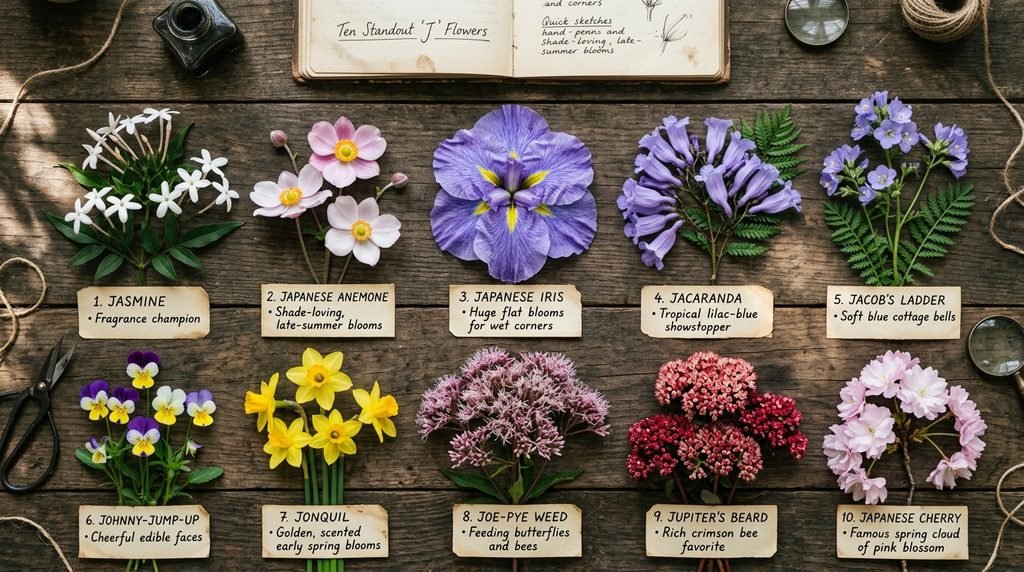
Jacob’s ladder and Johnny-jump-up are the easy cottage-garden pair, one for soft blue bells and the other for cheerful faces that even go in salads. Jonquil sends golden, scented blooms into early spring, while Joe-Pye weed and Jupiter’s beard feed butterflies and bees for months. Japanese cherry closes the list as the famous spring cloud of pink blossom.
Simple Read More: 80+ Beautiful Flowers That Start With H (With Pictures & Names)
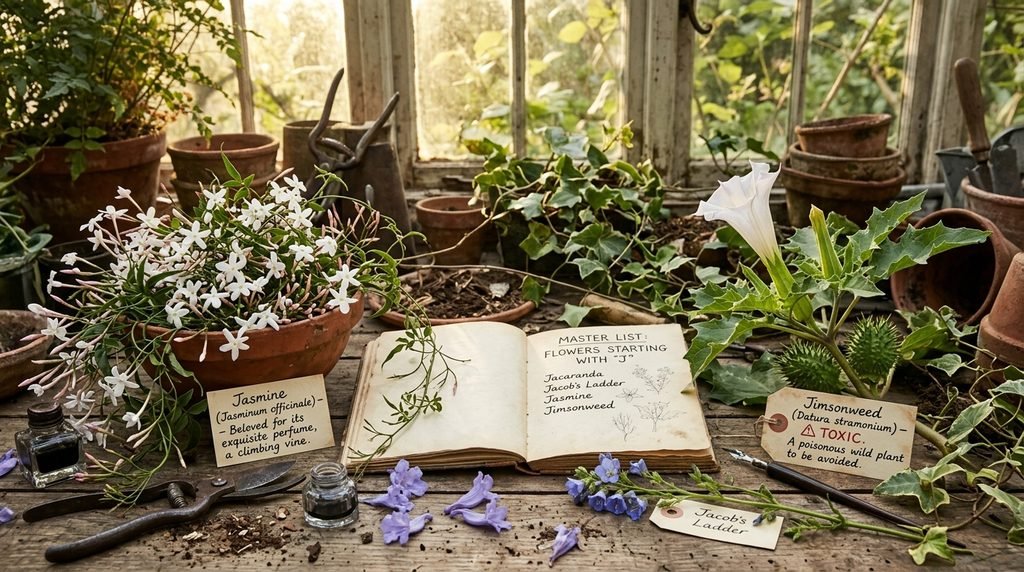
Master Alphabetical List of Flowers That Start With J
This list names 64 flowers. Most entries use a common name that gardeners already know. A few are better known by their botanical name, so they appear under the name nurseries print on plant tags. Each row has a short note, so you can see at a glance what the plant looks like and where it grows best. Four entries are marked as exceptions because the flower is not the main reason people grow them.
| Flower | Botanical Name | Note |
| Jacaranda | Jacaranda mimosifolia | Lilac-blue trumpets covering a tropical tree |
| Jack-in-the-Pulpit | Arisaema triphyllum | Hooded woodland bloom, toxic red berries |
| Jacob’s Ladder | Polemonium caeruleum | Blue bells over ladder-like leaves |
| Jacob’s Rod | Asphodelus lutea | Tall yellow spikes, Mediterranean native |
| Jacobean Lily | Sprekelia formosissima | Blood-red, orchid-like bulb bloom |
| Jacobinia | Justicia carnea | Pink plume-like tropical shrub bloom |
| Jacquemontia | Jacquemontia pentantha | Sky-blue morning-glory-like vine |
| Jade Plant (exception) | Crassula ovata | Succulent grown for leaves, small star flowers |
| Jade Vine | Strongylodon macrobotrys | Turquoise claw-shaped hanging clusters |
| Japanese Anemone | Anemone hupehensis var. japonica | Pink or white blooms in late summer |
| Japanese Apricot | Prunus mume | Fragrant pink or white winter blossom |
| Japanese Aster | Kalimeris pinnatifida | Small white daisies on a tidy plant |
| Japanese Azalea | Rhododendron japonicum | Orange-red spring blooms on a shrub |
| Japanese Bush Clover | Lespedeza thunbergii | Arching pink-purple sprays in fall |
| Japanese Camellia | Camellia japonica | Glossy leaves, rose-like winter blooms |
| Japanese Cherry | Prunus serrulata | Pink-white clouds of spring bloom |
| Japanese Flowering Crabapple | Malus floribunda | Pink buds opening to white spring blossom |
| Japanese Forsythia | Forsythia japonica | Yellow spring blooms on a compact shrub |
| Japanese Honeysuckle | Lonicera japonica | Fragrant white-yellow vine, invasive in some regions |
| Japanese Hydrangea | Hydrangea serrata | Lacy blue or pink flower heads |
| Japanese Hydrangea Vine | Schizophragma hydrangeoides | Climbing vine with flat white bracts |
| Japanese Iris | Iris ensata | Huge flat blooms for moist soil |
| Japanese Kerria | Kerria japonica | Golden yellow spring blooms on green stems |
| Japanese Lilac Tree | Syringa reticulata | Creamy plumes on a small, tough tree |
| Japanese Magnolia | Magnolia kobus | White spring blooms on bare branches |
| Japanese Pagoda Tree | Styphnolobium japonicum | Creamy summer plumes on a large tree |
| Japanese Peony | Paeonia japonica | White woodland peony with golden centers |
| Japanese Pieris | Pieris japonica | Dangling white bells, highly toxic |
| Japanese Primrose | Primula japonica | Tiered pink or white rings for damp shade |
| Japanese Quince | Chaenomeles japonica | Orange-red spring blooms on thorny stems |
| Japanese Skimmia | Skimmia japonica | Fragrant buds, red berries on female plants |
| Japanese Snowbell | Styrax japonicus | Dangling white bells in early summer |
| Japanese Spirea | Spiraea japonica | Pink flat-topped clusters all summer |
| Japanese Stewartia | Stewartia pseudocamellia | White camellia-like blooms, peeling bark |
| Japanese Toad Lily | Tricyrtis hirta | Orchid-like spotted fall blooms |
| Japanese Wisteria | Wisteria floribunda | Very long violet clusters, late spring |
| Japanese Wood Poppy | Hylomecon japonica | Yellow poppy-like woodland bloom |
| Jasione | Jasione montana | Blue pincushion blooms for poor soil |
| Jasmine (Arabian) | Jasminum sambac | Very fragrant white blooms used for tea and garlands |
| Jasmine (Common) | Jasminum officinale | Climbing vine, famous scent, national flower of Pakistan |
| Jasmine (Pink) | Jasminum polyanthum | Pink buds opening to white, fragrant vine |
| Jasmine (Spanish) | Jasminum grandiflorum | Large white fragrant blooms in warm climates |
| Jasmine (Winter) | Jasminum nudiflorum | Bright yellow, unscented, blooms on bare stems |
| Jatropha | Jatropha integerrima | Red star clusters, toxic seeds |
| Jeffersonia (Twinleaf) | Jeffersonia diphylla | White spring bloom, butterfly-shaped leaves |
| Jerusalem Artichoke (exception) | Helianthus tuberosus | Sunflower-like blooms on a tuber crop |
| Jerusalem Cowslip | Pulmonaria officinalis | Pink buds turning blue, spotted leaves |
| Jerusalem Sage | Phlomis fruticosa | Yellow whorls on gray-green shrubs |
| Jerusalem Thorn | Parkinsonia aculeata | Yellow blooms on a thorny, drought-proof tree |
| Jessamine (Carolina) | Gelsemium sempervirens | Yellow fragrant vine, highly toxic |
| Jewel Flower | Streptanthus tortuosus | Rare purple-brown California wildflower |
| Jewel Orchid (exception) | Ludisia discolor | Grown for velvet leaves, small white flower spikes |
| Jewelweed | Impatiens capensis | Orange blooms, seed pods that pop when touched |
| Jewels of Opar | Talinum paniculatum | Tiny pink blooms, then red berries |
| Jimsonweed (exception) | Datura stramonium | Highly toxic wild trumpet, listed for safety |
| Joe-Pye Weed | Eutrochium purpureum | Tall dusty-pink clusters, butterfly magnet |
| Johnny-Jump-Up | Viola tricolor | Small purple, yellow, and white faces, edible |
| Jonquil | Narcissus jonquilla | Fragrant golden clusters in early spring |
| Judas Tree | Cercis siliquastrum | Pink blooms that burst from bare branches |
| Juneberry | Amelanchier canadensis | White spring blossom, later edible berries |
| Juno Iris | Iris bucharica | Bulb iris with yellow and white blooms |
| Jungle Geranium | Ixora coccinea | Red-orange clusters on a tropical shrub |
| Jupiter’s Beard | Centranthus ruber | Red-pink clusters that self-seed in walls |
| Jupiter’s Distaff | Salvia glutinosa | Pale yellow sticky-stemmed sage for shade |
That table names 64 distinct flowers that start with J. Jasmine and jimsonweed sit at opposite ends of the story. One is loved for its perfume across many cultures. The other is a poisonous wild plant you should know only to avoid. Both show how wide this single letter reaches.
Explore More: Beautiful Flowers That Start With F: Names, Pictures & Symbolism
Full Comparison Table: Sun, Water, and Bloom Time
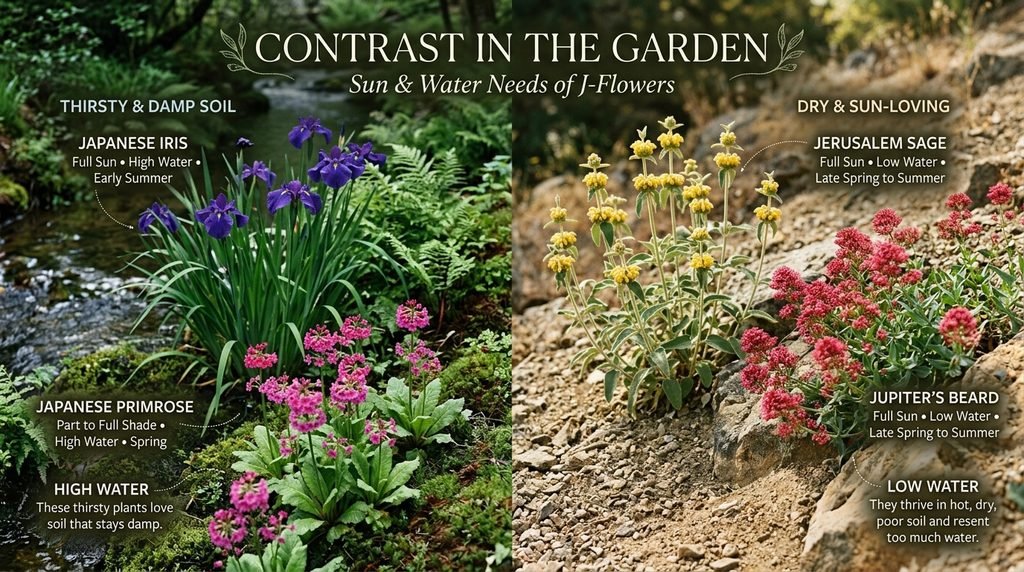
When two plants seem equally good, sun and water needs usually pick the winner. The table below compares the main J flowers from this guide. Read the sun column first. Then check the water column and the bloom season to see if the plant fits your space and your calendar.
| Flower | Sun Needs | Water Needs | Bloom Season |
| Jacob’s Ladder | Part shade | Moderate | Late spring |
| Jacaranda | Full sun | Low to moderate | Late spring to early summer (warm climates) |
| Japanese Anemone | Part shade | Moderate | Late summer to fall |
| Japanese Iris | Full sun | High | Early summer |
| Japanese Primrose | Part to full shade | High | Spring |
| Japanese Spirea | Full sun | Moderate | Summer |
| Japanese Kerria | Part shade | Moderate | Spring |
| Japanese Wisteria | Full sun | Moderate | Late spring |
| Japanese Cherry | Full sun | Moderate | Spring |
| Jasmine (Common) | Full sun to part shade | Moderate | Summer to early fall |
| Jasmine (Winter) | Full sun to part shade | Low to moderate | Winter to early spring |
| Jerusalem Sage | Full sun | Low | Late spring to summer |
| Joe-Pye Weed | Full sun to part shade | Moderate to high | Late summer |
| Johnny-Jump-Up | Full sun to part shade | Moderate | Spring to fall in cool weather |
| Jonquil | Full sun | Moderate | Early spring |
| Judas Tree | Full sun | Low to moderate | Spring, before the leaves |
| Jupiter’s Beard | Full sun | Low | Late spring to summer |
| Jewelweed | Part to full shade | High | Summer to fall |
Japanese iris and Japanese primrose are the thirstiest plants here. Both want soil that stays damp. Jerusalem sage and Jupiter’s beard sit at the other end. They thrive in hot, dry, poor soil and resent too much water.
Garden Favorites Among J Flowers
A handful of J flowers earn a place in almost every garden. Japanese anemone fills shady borders with late color when most plants are tired. Jacob’s ladder gives soft blue bells and tidy leaves in spring. Jupiter’s beard turns a dry wall or gravel bed into a river of pink and red. Joe-Pye weed brings height and a swarm of butterflies to the back of a sunny border.
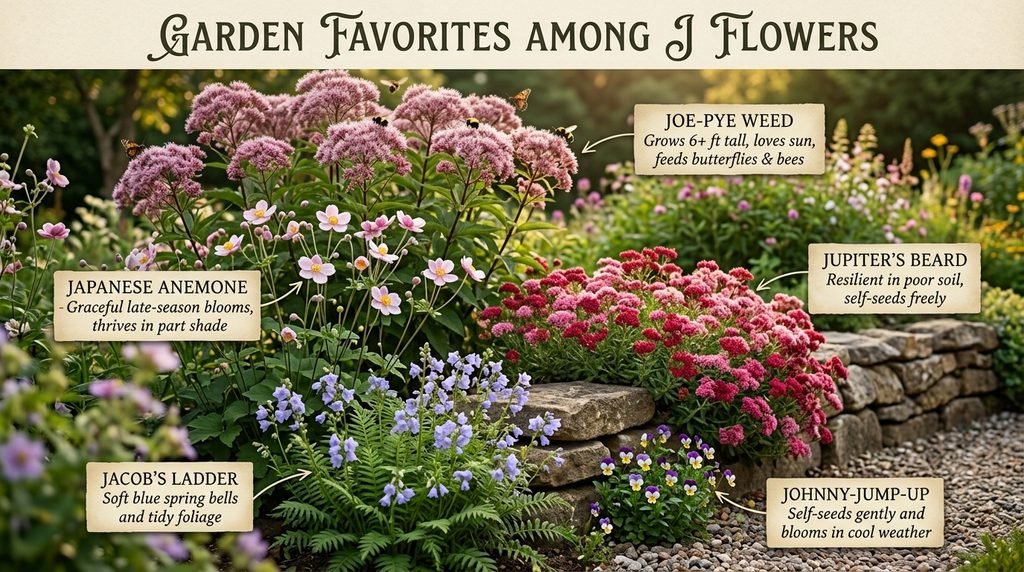
- Japanese Anemone blooms from late summer to fall and spreads slowly in part shade.
- Jacob’s Ladder forms neat clumps and blooms in late spring.
- Jupiter’s Beard thrives in poor soil and self-seeds freely.
- Joe-Pye Weed grows tall and feeds butterflies and bees.
- Johnny-Jump-Up self-seeds gently and blooms in cool weather.
Japanese anemone and Joe-Pye weed make a strong pair. One brings quiet shade color, and the other brings sunny height. Together they carry a border from midsummer into fall.
A few care habits keep these plants happy. Give Japanese anemone time to settle, since it can sulk for a year before it spreads. Cut Jupiter’s beard back after its first flush for a second bloom. Plant Joe-Pye weed where it has room, because it can reach six feet or more. Water Japanese iris well in summer, but never let it sit in standing water in winter.
Indoor and Container Picks Among J Flowers
Only a few J plants thrive indoors, but they are worth knowing. Pink jasmine fills a bright room with scent and can bloom on a sunny windowsill in winter. Jacobean lily grows from a bulb and can flower in a pot with strong light. Jungle geranium, also called ixora, brings red-orange clusters to a warm, bright spot. Jacobinia gives pink plumes in a sunny room.
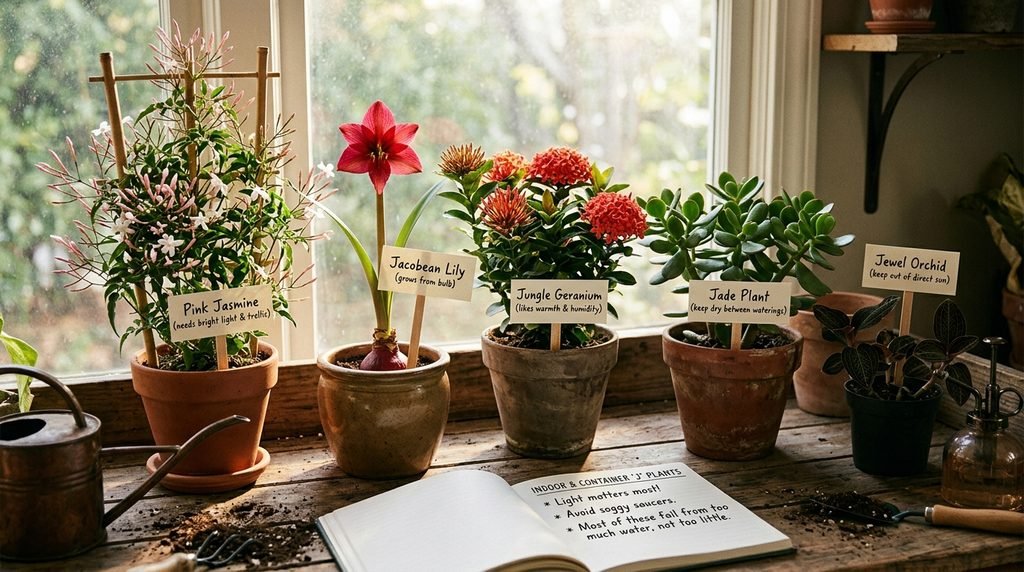
- Jasmine (Pink) needs bright light, cool nights, and a trellis to climb.
- Jacobean Lily blooms from a bulb and rests in winter.
- Jungle Geranium wants warmth, humidity, and acidic soil.
- Jade Plant (exception) is grown for thick leaves, and old plants may flower in winter.
- Jewel Orchid (exception) is grown for velvet leaves, with small flower spikes in winter.
Jade plant and jewel orchid are included only as exceptions. People buy them for their leaves, not their flowers. Both are easy for beginners. Just keep the jade plant dry between waterings, and keep the jewel orchid out of direct sun.
Light matters more than anything else for indoor J plants. A bright south or east window suits jasmine and jacobean lily. Avoid cold drafts and soggy saucers. Most of these plants fail from too much water, not too little.
Florist Favorites Among J Flowers
Florists use J flowers for scent, branches, and charm. Jasmine vines add fragrance and trailing greenery to bridal work. Jonquil stems bring golden, fragrant color to early spring bouquets. Branches of Japanese cherry, Japanese quince, and Judas tree can be cut and forced indoors in late winter. Johnny-jump-ups appear on cakes and plates as edible garnish.
- Jasmine adds scent and trailing stems to wedding work.
- Jonquil gives fragrant spring color and lasts about a week.
- Japanese Cherry branches can be forced into bloom indoors.
- Japanese Anemone gives airy, long-stemmed fall blooms.
- Johnny-Jump-Up works as an edible garnish and in tiny posies.
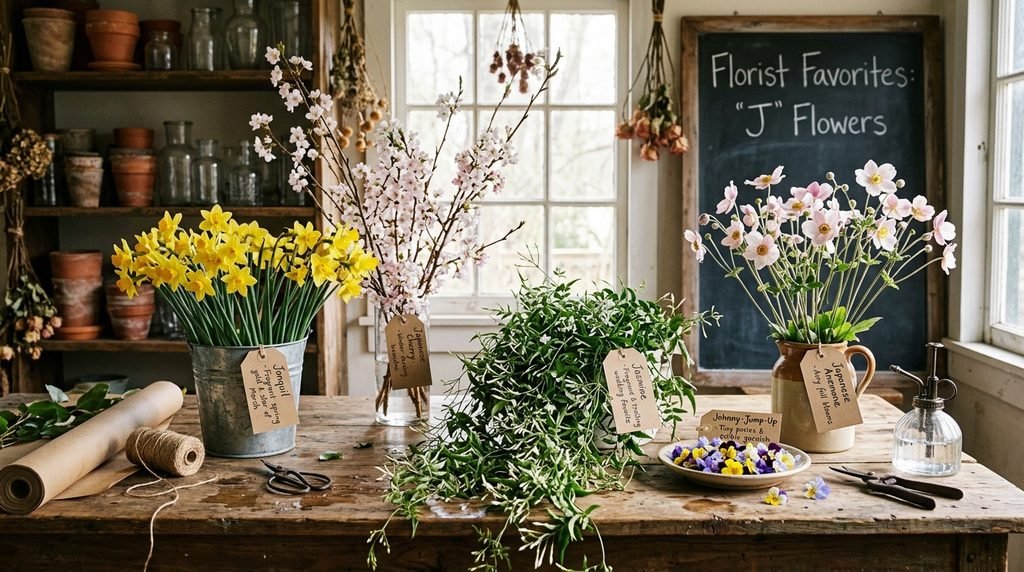
Jonquil and Japanese cherry are the seasonal stars. They arrive when the garden is still bare. A florist’s shop in March would feel empty without them.
Good vase care doubles the life of any cut flower. Strip the leaves below the water line. Recut the stems at an angle. Change the water every two days. For narcissus like jonquil, let the stems sit alone in water for an hour first, since their sap can harm other cut flowers.
Rare and Unusual J Flowers
Some J plants are hard to find or hard to grow. Jade vine is the most famous. Its hanging, claw-shaped clusters glow turquoise, and it comes from the rainforests of the Philippines, where bats pollinate it. Jacobean lily is a blood-red bulb from Mexico and Guatemala with a shape like an orchid. Juno iris is a bulb iris from Central Asia that dislikes wet summers. Jeffersonia, called twinleaf, is a woodland native named for Thomas Jefferson, and it prefers cool, rich, shady soil.
These four plants share one trait. Each wants a very specific home. That is why they stay special. If you want to grow one, buy nursery-grown plants only. Never dig wild plants, since many rare J species are protected by law.
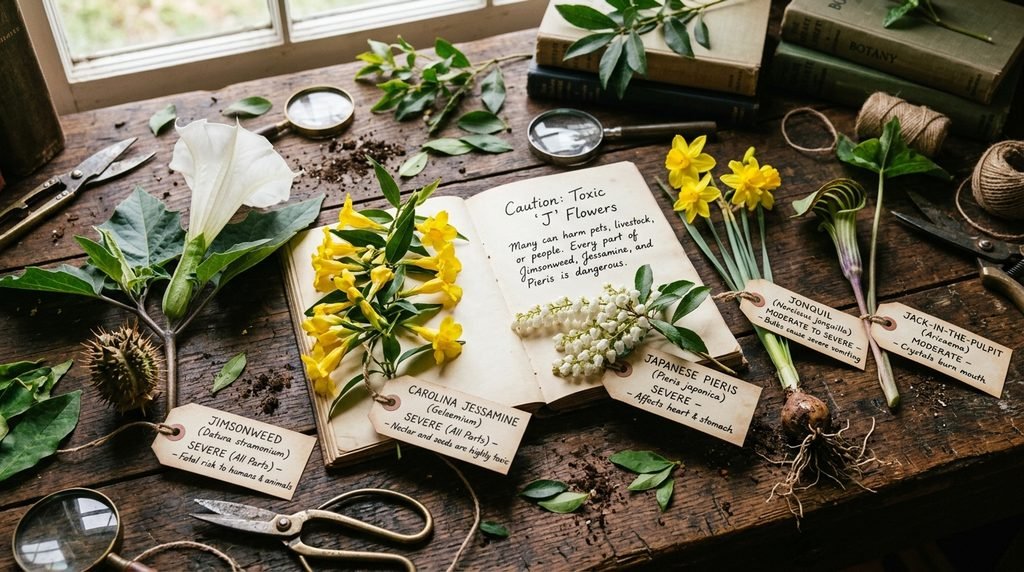
Caution: Toxic J Flowers
Several J plants can harm pets, livestock, or people. Jimsonweed and Carolina jessamine are the most dangerous. Every part of both plants is poisonous. Japanese pieris is toxic to pets and grazing animals, and jatropha seeds can cause serious illness. Jack-in-the-pulpit contains crystals that burn the mouth. Jonquil bulbs can cause vomiting and drooling.
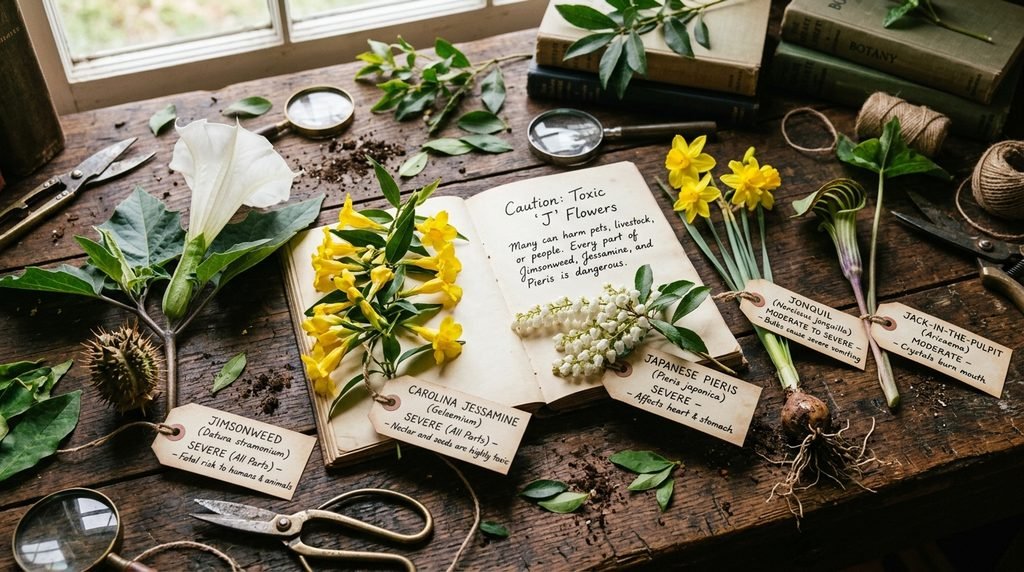
| Flower | Toxic To | Severity |
| Jimsonweed | Humans, dogs, cats, livestock | Severe — all parts, can be fatal |
| Jessamine (Carolina) | Humans, dogs, cats, livestock | Severe — all parts, especially nectar and seeds |
| Japanese Pieris | Dogs, cats, horses, livestock | Severe — all parts affect the heart and stomach |
| Jatropha | Humans, dogs, cats | Moderate to severe — seeds and sap |
| Jonquil | Dogs, cats, horses | Moderate to severe — bulbs are the riskiest part |
| Japanese Wisteria | Dogs, cats, horses | Moderate — seeds and pods upset the stomach |
| Jack-in-the-Pulpit | Dogs, cats, humans | Moderate — oxalate crystals burn the mouth |
| Jade Plant | Dogs, cats | Mild to moderate — vomiting and drowsiness |
| Japanese Hydrangea | Dogs, cats, horses | Mild to moderate — stomach upset |
| Japanese Iris | Dogs, cats, humans | Mild to moderate — rhizomes upset the stomach |
| Japanese Honeysuckle | Dogs, cats, horses | Mild — berries and leaves may upset the stomach |
Jimsonweed, Carolina jessamine, and Japanese pieris deserve the loudest warning. Keep all three away from children and pets. Jade plant and Japanese iris are milder, but a chewing dog can still get sick. True jasmine, by contrast, is generally listed as non-toxic to dogs and cats. If a pet or child eats any plant on this list, call a vet or poison control right away.
J Flowers Grouped by Color
Pink and rose tones run through Japanese cherry, Japanese anemone, Judas tree, Jupiter’s beard, and Joe-Pye weed. Japanese cherry and Judas tree give the biggest show, since whole trees bloom before the leaves appear. Japanese anemone suits shade. Jupiter’s beard and Joe-Pye weed suit sunny borders and feed butterflies.
White and cream flowers include jasmine, Japanese snowbell, Japanese stewartia, juneberry, and Japanese pagoda tree. White glows at dusk and brightens shade. Jasmine is the scented star, and it suits patios and doorways. Japanese snowbell and Japanese stewartia suit small woodland-style gardens.
Purple, blue, and lilac are the cool side of J. Jacaranda, Jacob’s ladder, Japanese wisteria, Japanese iris, and Johnny-jump-up all bring these shades. Jacaranda and wisteria give the drama. Jacob’s ladder and Johnny-jump-up suit cottage borders. Japanese iris loves wet edges and pond sides.
Yellow and gold bring warmth. Jonquil, Jerusalem sage, Japanese kerria, winter jasmine, and Jerusalem thorn glow in the sun. Jonquil and kerria arrive in spring. Winter jasmine lights up the coldest months. Jerusalem sage and Jerusalem thorn suit hot, dry gardens.
Red and orange accents come from Jacobean lily, jatropha, jungle geranium, Japanese quince, and jewelweed. Jacobean lily and Japanese quince are the bold, rare ones. Jewelweed grows wild and feeds hummingbirds. Jungle geranium suits warm climates and tropical beds.
Life-Cycle Groupings for J Flowers
A plant’s life cycle tells you how much work to expect. Annuals live one season, so you replant each year. Perennials return on their own. Bulbs need the right winter, cold or warm, to come back. Trees and shrubs take longer to bloom but last for decades. Zones below are approximate and vary by variety, so check your own plant tag.
| Flower | Life Cycle | Typical Zones |
| Jewelweed | Annual | All zones (seasonal) |
| Johnny-Jump-Up | Annual, biennial, or short-lived perennial | 3–9 |
| Jacob’s Ladder | Perennial | 3–8 |
| Japanese Anemone | Perennial | 4–8 |
| Japanese Iris | Perennial | 4–9 |
| Japanese Primrose | Perennial | 4–8 |
| Jupiter’s Beard | Perennial | 5–9 |
| Joe-Pye Weed | Perennial | 4–9 |
| Jonquil | Perennial (bulb) | 4–9 |
| Juno Iris | Perennial (bulb) | 5–9 |
| Jacobean Lily | Tender perennial (bulb) | 9–10 |
| Jewels of Opar | Tender perennial | 9–11 (annual elsewhere) |
| Japanese Spirea | Perennial (shrub) | 4–8 |
| Japanese Kerria | Perennial (shrub) | 4–9 |
| Jerusalem Sage | Perennial (shrub) | 7–9 |
| Japanese Camellia | Perennial (shrub) | 7–9 |
| Japanese Wisteria | Perennial (vine) | 4–9 |
| Jasmine (Common) | Perennial (vine) | 7–10 |
| Jasmine (Winter) | Perennial (shrub) | 6–9 |
| Japanese Cherry | Perennial (tree) | 5–8 |
| Judas Tree | Perennial (tree) | 6–9 |
| Jacaranda | Tender perennial (tree) | 9–11 |
Johnny-jump-up and Jupiter’s beard are the two to watch. Johnny-jump-up does not stay put as a single plant, but it self-seeds so well that the patch often returns every year. Jupiter’s beard can spread quickly in poor soil, so give it room or deadhead it before the seeds ripen.
Botanical Name Crosswalk
Common names change from place to place. Botanical names do not. Nursery tags and seed packets use Latin for this reason. It also helps you search online with confidence. Two different plants can share one common name, so the Latin name protects you from a wrong purchase.
| Common Name | Botanical Name |
| Jacaranda | Jacaranda mimosifolia |
| Jacob’s Ladder | Polemonium caeruleum |
| Japanese Anemone | Anemone hupehensis var. japonica |
| Japanese Iris | Iris ensata |
| Japanese Cherry | Prunus serrulata |
| Japanese Wisteria | Wisteria floribunda |
| Japanese Kerria | Kerria japonica |
| Jasmine (Common) | Jasminum officinale |
| Jasmine (Winter) | Jasminum nudiflorum |
| Jonquil | Narcissus jonquilla |
| Joe-Pye Weed | Eutrochium purpureum |
| Johnny-Jump-Up | Viola tricolor |
| Judas Tree | Cercis siliquastrum |
| Jupiter’s Beard | Centranthus ruber |
| Jade Vine | Strongylodon macrobotrys |
Japanese anemone shows why this matters. Despite the name, it comes from China and was brought to Japan long ago. Also, do not confuse Jasmine with Carolina jessamine. True jasmine belongs to the genus Jasminum and is generally safe for pets. Carolina jessamine is a different plant, Gelsemium sempervirens, and it is highly toxic.
What J Flowers Mean
Flower meanings vary by culture, but a good number of J flowers carry steady symbolism. Jasmine stands for love, grace, and purity. It is the national flower of Pakistan, where it is called chambeli, and the Arabian jasmine, known as sampaguita, is the national flower of the Philippines. Its scent is tied to weddings and welcome in many regions.
Japanese cherry stands for renewal and the fleeting nature of life. In Japan, families gather under the blossoms each spring to celebrate and reflect. Jacaranda is linked with rebirth and good luck. In some places, a folk saying claims that a falling jacaranda blossom on your head brings good fortune.
Jonquil, in Victorian flower language, meant a wish that affection be returned. Jacob’s ladder takes its name from the Bible story of a ladder to heaven, and the leaves look like rungs. Johnny-jump-up belongs to the viola family, which stood for thoughtfulness and remembrance.
Judas tree carries a darker folk story, since legend says Judas hanged himself on a tree of this kind and its white blooms blushed pink in shame. Joe-Pye weed is said to be named after a Native American healer. Jade vine, with its rare glowing color, stands for rarity and wonder. Match the flower to your message, and remember that the same bloom can mean something different in another culture.
Decision Table: Which J Flower Fits Your Situation
You do not have to read the whole list to choose well. Start with your goal in the left column. The right column names the best J flower for it. Then check the toxicity section if you have pets or children.
| If You Want… | Choose This J Flower |
| Strong evening fragrance | Jasmine (Common or Arabian) |
| Color in shade | Japanese Anemone, Jacob’s Ladder, or Japanese Primrose |
| A pond or wet-soil flower | Japanese Iris or Jewelweed |
| A tough, dry-soil flower | Jupiter’s Beard or Jerusalem Sage |
| Butterfly and bee support | Joe-Pye Weed or Jupiter’s Beard |
| Early spring color | Jonquil or Japanese Kerria |
| A flowering tree | Japanese Cherry, Judas Tree, or Jacaranda |
| A flowering vine | Japanese Wisteria or Jasmine |
| Winter color | Winter Jasmine or Japanese Apricot |
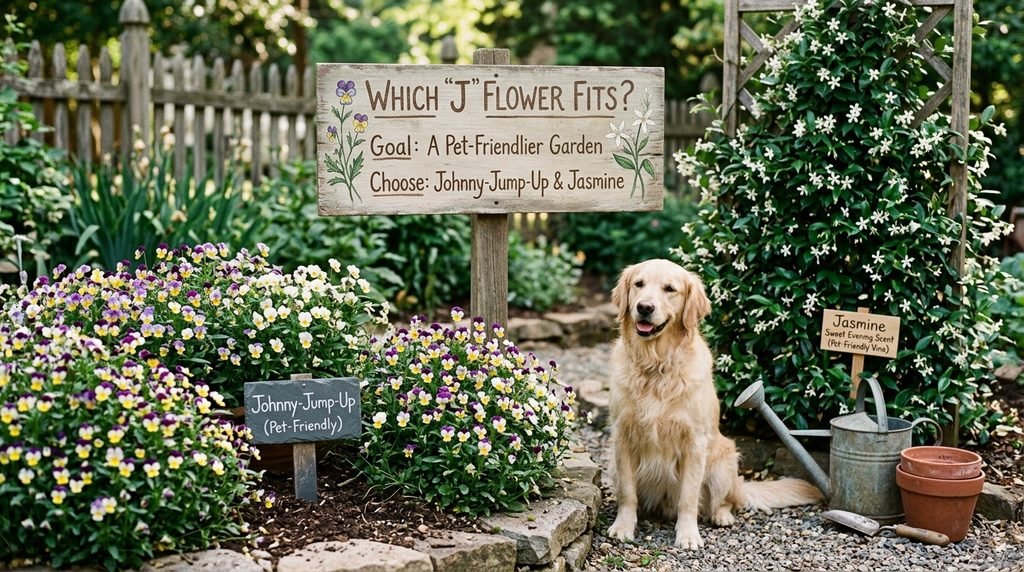
| A pet-friendlier garden | Johnny-Jump-Up, Jasmine, or Jewelweed |
Johnny-jump-up appears in several uses because it is easy, charming, and not on the toxic list in this guide. Jasmine is a good partner for it in a family garden. Always double-check any plant with your vet if a pet is likely to chew it.
Conclusion
Flowers that start with J offer a very wide choice, from the scented jasmine to the glowing jade vine. This guide sorted 64 of them by color, life cycle, and use, so you can pick with confidence. Whether you want a shady border, a fragrant corner, or a flowering tree, there is a J flower that fits. Use the tables above, read the toxicity notes, and start planting.
Frequently Asked Questions
How many flowers start with J?
More than 60 well-known flowers start with J. This guide lists 64, from common garden plants to rare tropical vines and woodland wildflowers.
What is the most popular flower that starts with J?
Jasmine is the most popular, loved for its scent. Japanese cherry, Japanese iris, jonquil, and jacaranda are also widely loved.
What are the easiest flowers that start with J to grow?
Johnny-jump-up, Jacob’s ladder, Jupiter’s beard, and Japanese spirea are very easy. Jonquil is an easy bulb for early spring.
Which J flowers attract butterflies and hummingbirds?
Joe-Pye weed and Jupiter’s beard draw butterflies and bees. Jewelweed and Japanese quince draw hummingbirds, and jacaranda is another hummingbird favorite.
Is jasmine safe for pets?
True jasmine, from the genus Jasminum, is generally listed as non-toxic to dogs and cats. Carolina jessamine is a different plant and is highly toxic, so check the botanical name.
Which J flower is the most dangerous?
Jimsonweed and Carolina jessamine are the most dangerous. Every part of both plants is poisonous to people, pets, and livestock.
Is Japanese anemone really from Japan?
Not originally. Japanese anemone comes from China and was brought to Japan long ago. It blooms in late summer and fall and prefers part shade.
What does jasmine symbolize?
Jasmine stands for love, grace, and purity. It is the national flower of Pakistan, and Arabian jasmine is the national flower of the Philippines.
Which J flowers bloom in winter?
Winter jasmine, Japanese apricot, and Japanese camellia bloom in the cold months. Jerusalem cowslip and jonquil follow in late winter and early spring.
Does winter jasmine smell?
No. Winter jasmine has bright yellow blooms but is generally unscented. For fragrance, choose common jasmine or Arabian jasmine instead.
3 thoughts on “60+ Beautiful Flowers That Start With J (With Pictures & Names)”