
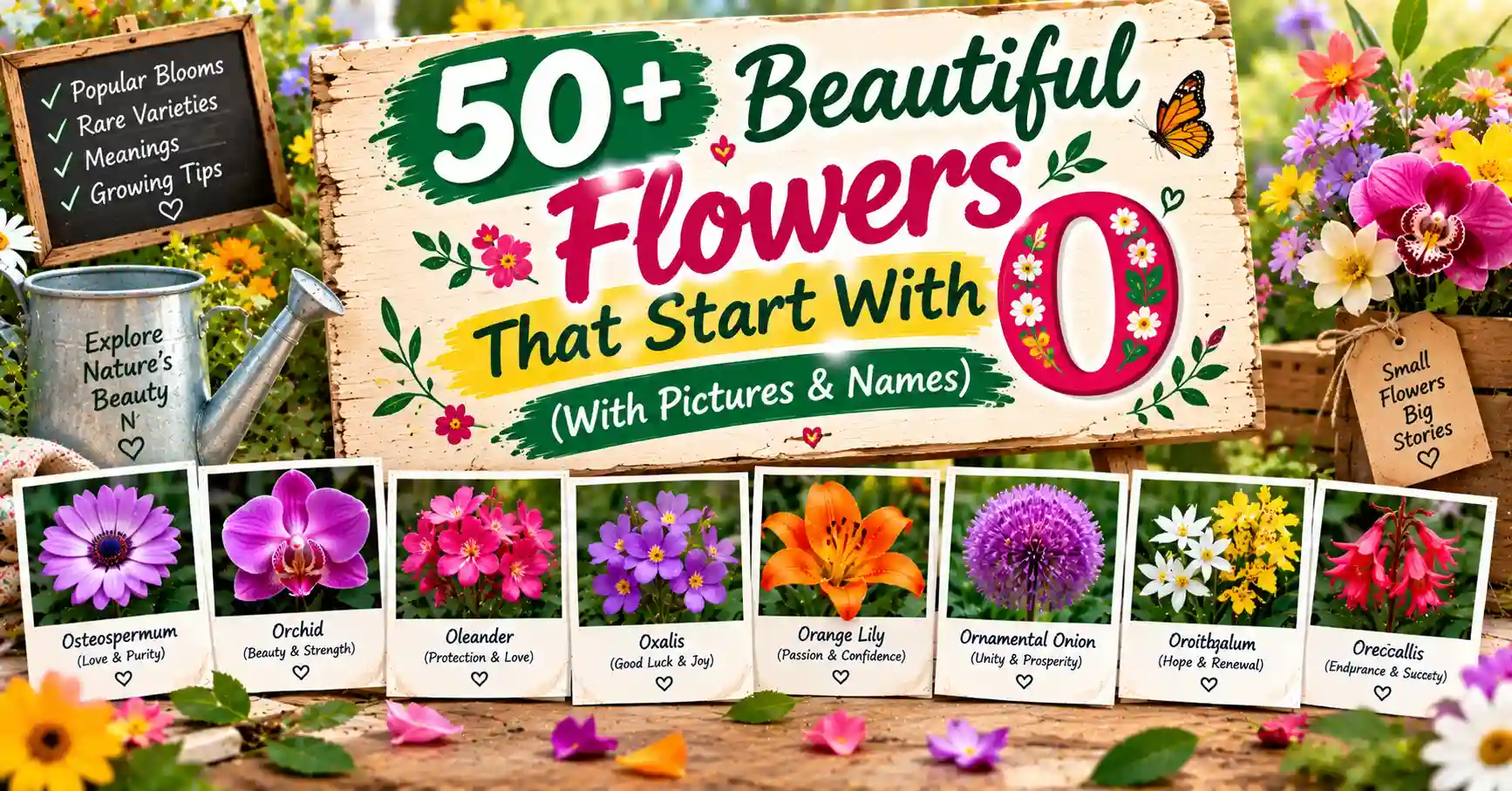
Flowers that start with O range from sweet orange blossoms to towering desert torches. Orchids, oriental poppies, oleander, and osteospermum are the names most people know. But the letter O also hides special finds, like a rare Hawaiian shrub, a bell-flowered wildflower from the Appalachians, and a bee-shaped orchid. This guide gathers 56 of them in one place.
Every plant below is real and has a verified botanical name. Each one is grown mainly for its flowers, so no entries needed an exception label. You will find border favorites, houseplants, florist picks, trees, wildflowers, and a few rarities.
A long list only helps if you can use it. So this guide sorts the plants by color, life cycle, and use. A bloom’s beauty means little if it dies in your climate. It means even less if it harms a child or a pet. Each table is explained in plain words first, so you never face a bare spreadsheet.
You will see many names that start with Orange, Oregon, and Oriental. Those words hint at color or place, and they help you spot a plant quickly. Read straight through or jump to what you need. Have a cat? Check the toxicity section first, because some lilies and daylilies are deadly to cats. Want a quick pick? Try the decision table near the end.
Quick Answer: Ten Standout O Flowers
Obedient plant is the easy late-summer star, with pink spikes that feed bees and hold their shape in a vase. Oakleaf hydrangea brings cone-shaped blooms, bold leaves, and red fall color to part shade.

Oriental poppy gives giant, papery blooms in early summer, while oriental lily gives perfume and drama, though it is deadly to cats. Orange coneflower and oxeye sunflower carry gold through the heat of summer. Osteospermum is the cheerful daisy for sunny pots, and Oswego tea draws hummingbirds with shaggy red blooms. Osmanthus and orange blossom are the scent stars of the group, and orchid tree rounds out the list as a tropical bloom with orchid-like flowers.
Read More: 60+ Beautiful Flowers That Start With I (With Pictures & Names)
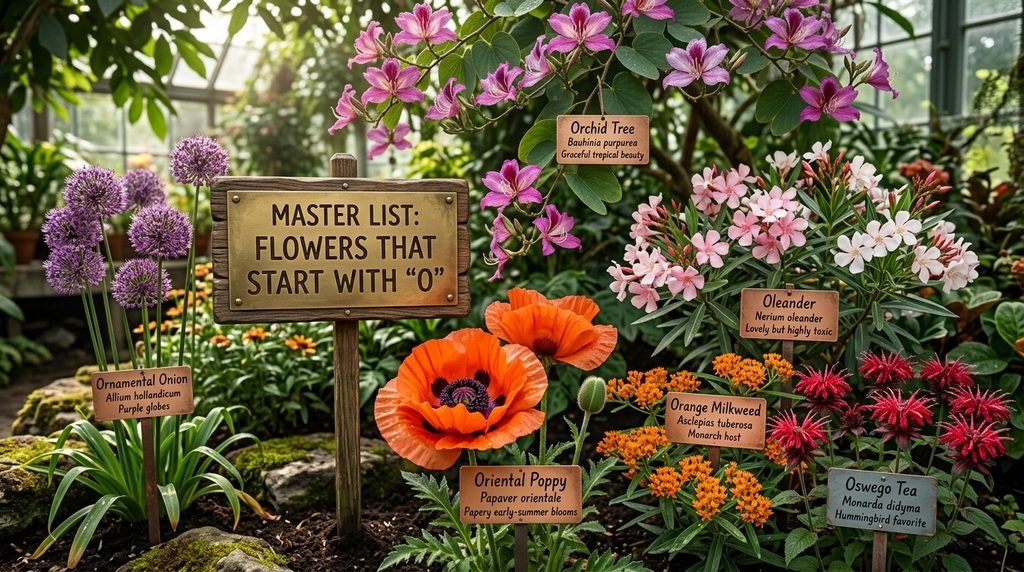
Master Alphabetical List of Flowers That Start With O
This list names 56 flowers. Most entries use a common name that gardeners already know. A few are better known by their botanical name, so they appear under the name nurseries print on plant tags. Each row has a short note, so you can see at a glance what the plant looks like and where it grows best.
| Flower | Botanical Name | Note |
| Oakleaf Hydrangea | Hydrangea quercifolia | White cone-shaped blooms and red fall leaves |
| Obedient Plant | Physostegia virginiana | Pink spikes whose flowers stay where you turn them |
| Ocean Spray | Holodiscus discolor | Creamy plumes on a western native shrub |
| Oconee Bells | Shortia galacifolia | Rare white bells from the southern Appalachians |
| Ocotillo | Fouquieria splendens | Red torch flowers on spiny desert stems |
| Odontoglossum | Odontoglossum crispum | Cool-growing orchid with ruffled white blooms |
| Odontonema (Firespike) | Odontonema strictum | Red tubular spikes, hummingbird favorite |
| Oenothera (Evening Primrose) | Oenothera biennis | Yellow cups that open at dusk |
| Ohai | Sesbania tomentosa | Rare Hawaiian shrub with orange-red flowers |
| Ohia Lehua | Metrosideros polymorpha | Red brush flowers, sacred in Hawaii |
| Ohio Spiderwort | Tradescantia ohiensis | Blue-violet three-petaled prairie native |
| Oklahoma Redbud | Cercis reniformis | Magenta-pink blooms on a glossy-leaved tree |
| Old Blush Rose | Rosa chinensis ‘Old Blush’ | Soft pink, nearly everblooming old rose |
| Old Garden Rose | Rosa gallica | Fragrant, full-petaled heirloom rose |
| Old Man’s Beard | Clematis vitalba | Creamy flowers, then fluffy seed heads, invasive in places |
| Oleander | Nerium oleander | Pink or white clusters, highly toxic |
| Olearia (Daisy Bush) | Olearia × haastii | White daisy clusters on a tough coastal shrub |
| Olympic Bellflower | Campanula piperi | Rare violet-blue alpine bells |
| Oncidium (Dancing Lady Orchid) | Oncidium spp. | Sprays of small yellow-and-brown orchid blooms |
| Ophrys (Bee Orchid) | Ophrys apifera | Wild orchid that mimics a bee |
| Orange Ball Tree | Buddleja globosa | Round orange-yellow flower balls, honey-scented |
| Orange Blossom | Citrus × sinensis | Fragrant white blooms, wedding tradition |
| Orange Clock Vine | Thunbergia gregorii | Bright orange vine blooms with dark centers |
| Orange Coneflower | Rudbeckia fulgida | Golden-orange daisies with dark cones |
| Orange Cosmos | Cosmos sulphureus | Bright orange and gold heat-loving daisies |
| Orange Daylily | Hemerocallis fulva | Roadside orange daylily, toxic to cats |
| Orange Honeysuckle | Lonicera ciliosa | Orange tubular blooms, hummingbird vine |
| Orange Jessamine | Murraya paniculata | Jasmine-scented white blooms on a hedge shrub |
| Orange Milkweed | Asclepias tuberosa | Bright orange clusters, monarch host plant |
| Orange Sneezeweed | Hymenoxys hoopesii | Orange mountain daisies, toxic to livestock |
| Orange Trumpet Vine | Pyrostegia venusta | Orange flame-colored trumpets on a fast vine |
| Orchid Cactus | Epiphyllum hybrids | Large showy blooms in red, pink, or orange |
| Orchid Primrose | Primula vialii | Violet spikes with red buds for damp shade |
| Orchid Tree | Bauhinia purpurea | Orchid-like pink-purple blooms on a tropical tree |
| Oregon Fawn Lily | Erythronium oregonum | Cream nodding blooms with mottled leaves |
| Oregon Grape | Mahonia aquifolium | Yellow spring clusters, blue berries |
| Oregon Iris | Iris tenax | Lavender wild iris from the Pacific Northwest |
| Oregon Sunshine | Eriophyllum lanatum | Golden daisies over silvery wool |
| Oriental Lily | Lilium (Oriental hybrids) | Huge, perfumed late-summer lilies, deadly to cats |
| Oriental Poppy | Papaver orientale | Giant papery orange-red blooms in early summer |
| Ornamental Onion | Allium hollandicum | Purple globes on tall stems |
| Ornamental Oregano | Origanum laevigatum | Pink hop-like bracts with purple flowers |
| Ornithogalum (Arabian Star Flower) | Ornithogalum arabicum | White stars with a black center, toxic |
| Orpine | Sedum telephium | Pink fall flower heads on thick leaves |
| Osmanthus (Sweet Olive) | Osmanthus fragrans | Tiny, intensely apricot-scented blooms |
| Osteospermum (African Daisy) | Osteospermum ecklonis | Daisies in bright colors that close at night |
| Oswego Tea | Monarda didyma | Red shaggy blooms, hummingbird favorite |
| Our Lord’s Candle | Hesperoyucca whipplei | Towering cream flower spike on a desert yucca |
| Owl’s Clover | Castilleja exserta | Purple-pink carpets in California spring |
| Ox-Eye Daisy | Leucanthemum vulgare | Classic white meadow daisy |
| Oxalis (Purple Shamrock) | Oxalis triangularis | Pale pink flowers above purple clover-like leaves |
| Oxeye Sunflower | Heliopsis helianthoides | Long-blooming golden daisies for hot sun |
| Oxlip | Primula elatior | Pale yellow nodding meadow primrose |
| Oyama Magnolia | Magnolia sieboldii | Nodding white cups with crimson centers |
| Ozark Sundrops | Oenothera macrocarpa | Big yellow cups on a sprawling prairie plant |
| Ozark Witch Hazel | Hamamelis vernalis | Winter spidery blooms in red and orange |
That table names 56 distinct flowers that start with O. Orchid tree and oleander sit far apart in character. One is a graceful tropical beauty. The other is a lovely shrub that is deadly poisonous. Both show how wide this single letter reaches.
Full Comparison Table: Sun, Water, and Bloom Time
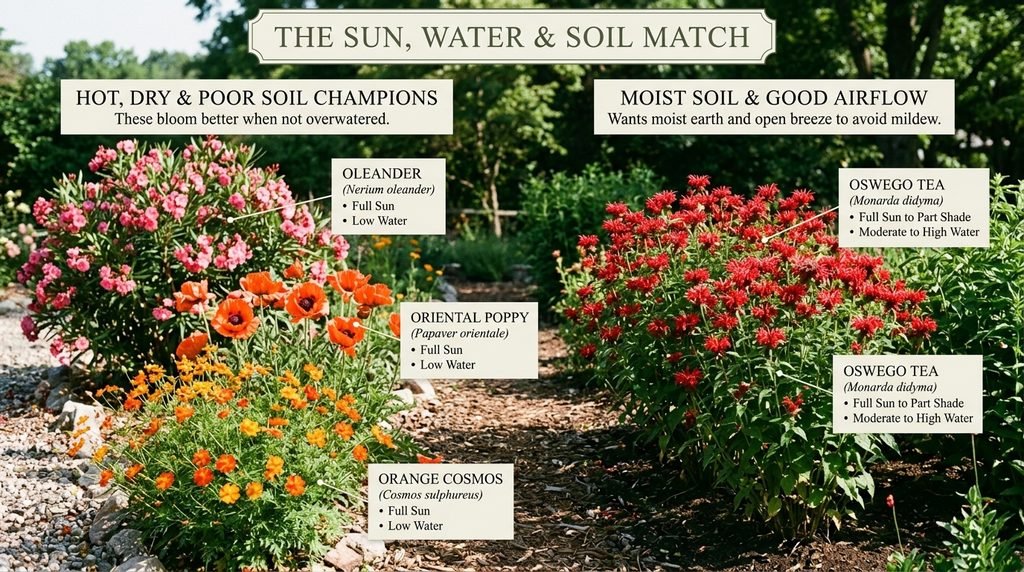
When two plants seem equally good, sun and water needs usually pick the winner. The table below compares the main O flowers from this guide. Read the sun column first. Then check the water column and the bloom season to see if the plant fits your space and your calendar.
| Flower | Sun Needs | Water Needs | Bloom Season |
| Obedient Plant | Full sun to part shade | Moderate | Late summer to fall |
| Oakleaf Hydrangea | Part shade | Moderate | Early to midsummer |
| Oleander | Full sun | Low | Summer |
| Oriental Lily | Full sun to part shade | Moderate | Late summer |
| Oriental Poppy | Full sun | Low | Late spring to early summer |
| Orange Coneflower | Full sun | Moderate | Midsummer to fall |
| Orange Daylily | Full sun to part shade | Low | Early to midsummer |
| Oswego Tea | Full sun to part shade | Moderate to high | Midsummer |
| Ox-Eye Daisy | Full sun | Low | Late spring to summer |
| Oxeye Sunflower | Full sun | Low to moderate | Summer |
| Osteospermum | Full sun | Low to moderate | Spring to fall |
| Oxalis (Purple Shamrock) | Bright indirect light | Moderate | Spring to fall (indoors) |
| Osmanthus | Full sun to part shade | Moderate | Fall, with a lighter spring flush |
| Orchid Tree | Full sun | Low to moderate | Winter to spring |
| Oncidium | Bright indirect light | Moderate | Often fall to winter |
| Ornamental Onion | Full sun | Low to moderate | Late spring |
| Oregon Grape | Part shade | Low to moderate | Early spring |
| Orange Cosmos | Full sun | Low | Summer to frost |
Oleander, oriental poppy, and orange cosmos are the best picks for hot, dry, poor soil. All three bloom better when they are not overwatered. Oswego tea sits at the other end. It wants moist soil and good airflow to avoid mildew.
Explore More Flower Guides: 80+ Beautiful Flowers That Start With H (With Pictures & Names)
Garden Favorites Among O Flowers
A handful of O flowers earn a place in almost every sunny garden. Orange coneflower and oxeye sunflower keep gold in the border for months. Obedient plant gives pink spikes in the last weeks of summer. Oswego tea fills midsummer with hummingbirds. Ornamental onion adds purple globes in late spring, just when tulips fade.
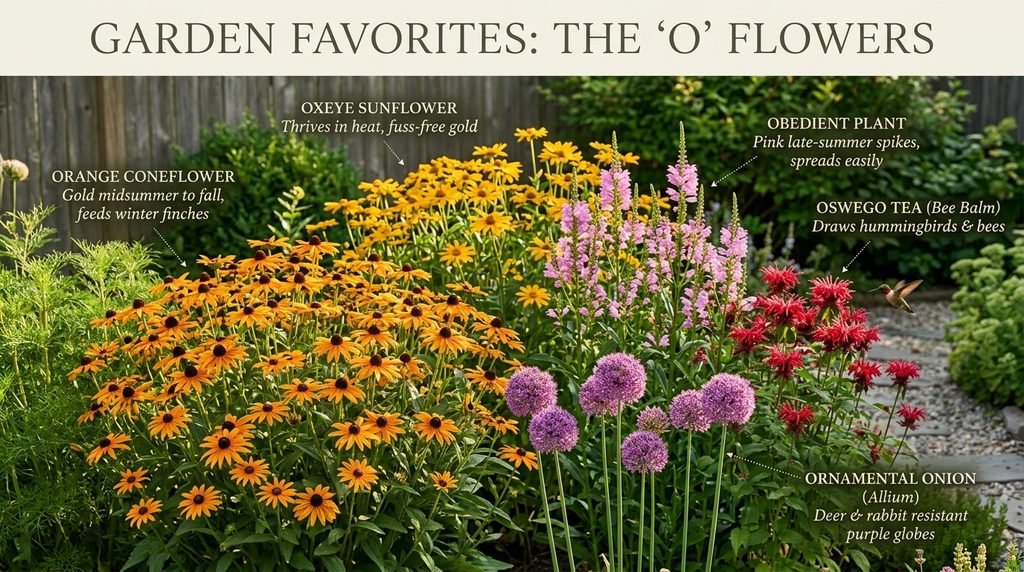
- Orange Coneflower blooms from midsummer to fall and feeds finches in winter.
- Oxeye Sunflower thrives in heat and needs almost no fussing.
- Obedient Plant spreads by roots and gives long-lasting late color.
- Oswego Tea draws hummingbirds and bees to the border.
- Ornamental Onion is ignored by deer and rabbits.
Orange coneflower and obedient plant make a strong pair. One carries gold, and the other carries pink. Together they keep a sunny border interesting through the late season.
A few care habits keep these plants happy. Divide the obedient plant every two or three years, since it spreads fast. Give Oswego tea good airflow to avoid powdery mildew. Cut oriental poppies to the ground after they bloom, because the leaves die back in summer heat. Leave orange coneflower seed heads standing for birds.
Indoor and Container Picks Among O Flowers
Only a few O plants thrive indoors, but they are worth knowing. Oncidium, called the dancing lady orchid, sends up sprays of small yellow flowers on a bright windowsill. Odontoglossum and other orchids suit cooler rooms with bright, indirect light. Purple shamrock, or oxalis, brings pale pink blooms above its purple leaves. Osteospermum thrives in sunny pots on balconies and patios.
- Oncidium likes bright light, a loose mix, and a drier rest after blooming.
- Oxalis (Purple Shamrock) closes its leaves at night and blooms most of the year.
- Osteospermum needs full sun, and its flowers close in shade or at night.
- Orchid Cactus wants bright light and a cool, dry rest in winter.
Purple shamrock is the pick for beginners. It forgives missed waterings. Just keep it away from pets, since oxalis contains crystals that can upset the stomach.
Light matters more than anything else for indoor O plants. A bright east window suits oncidium and oxalis. Avoid cold drafts and soggy saucers. Most of these plants fail from too much water, not too little.
You May Also Like: 60+ Beautiful Flowers That Start With I (With Pictures & Names)
Florist Favorites Among O Flowers
Florists use O flowers for scent, drama, and color. Oriental lilies give big, perfumed blooms to wedding and event work. Orange blossom and osmanthus bring a sweet scent to small posies and wreaths. Osteospermum and orange cosmos add bright daisy color to casual bouquets. Obedient plant stems hold up well in a vase and add height.
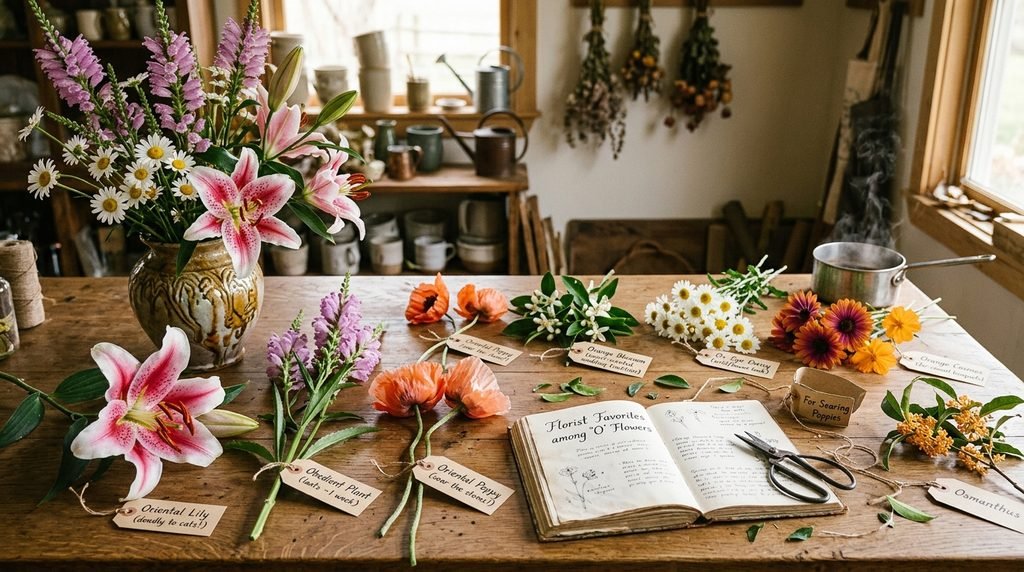
- Oriental Lily is dramatic and fragrant, but it is deadly to cats.
- Orange Blossom is the traditional wedding flower and smells sweet.
- Obedient Plant lasts about a week and adds long pink spikes.
- Oriental Poppy is stunning but short-lived, and the stems need searing.
- Ox-Eye Daisy gives a wildflower look to relaxed bouquets.
Oriental lily and obedient plant are the quiet workhorses. They hold up in the vase long after softer blooms fade. A florist’s bouquet in late summer would feel empty without them.
Good vase care doubles the life of any cut flower. Strip the leaves below the water line. Recut the stems at an angle. Change the water every two days. For oriental poppy, sear the cut stem ends in hot water for a few seconds to stop the sap from clogging them.
Rare and Unusual O Flowers
Some O plants are hard to find or hard to grow. Oconee bells is a tiny evergreen from the southern Appalachians with white bell flowers, and it is rare in the wild. Ohai is a Hawaiian shrub with orange-red flowers that is critically endangered and grows in only a few dry places. Ocotillo is a spiny desert plant that sprouts red flowers at the tips of bare stems after rain. Our Lord’s candle is a desert yucca that sends up a towering cream flower spike once in its life and then dies.
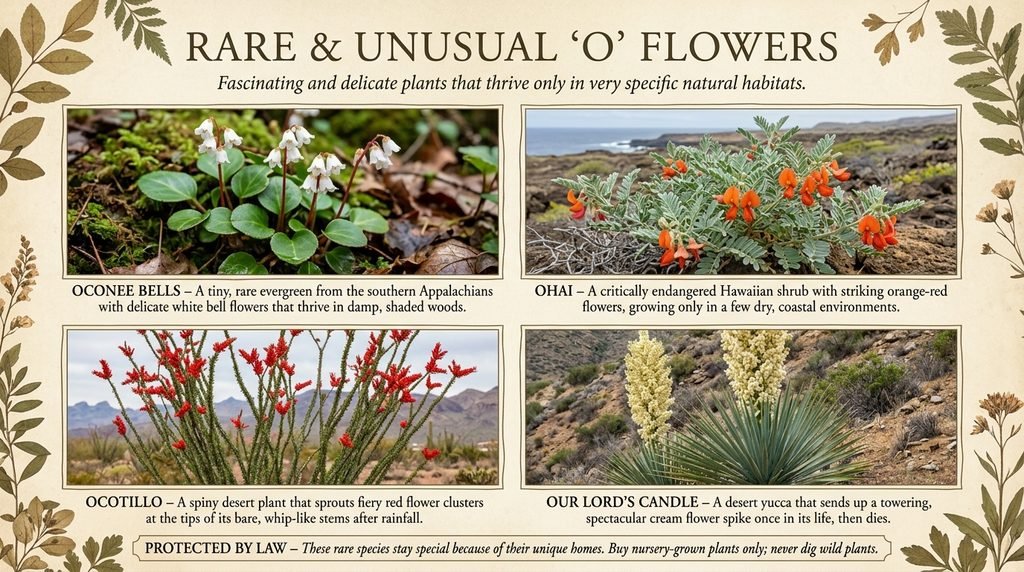
These four plants share one trait. Each wants a very specific home. That is why they stay special. If you want to grow one, buy nursery-grown plants only. Never dig wild plants, since many rare O species are protected by law.
Caution: Toxic O Flowers
Several O plants can harm pets, livestock, or people. Oleander is the most dangerous. Every part of the plant is poisonous, and even a small amount can affect the heart. Cat owners need to know about oriental lily and orange daylily. Even a small nibble or a lick of pollen can cause kidney failure in cats. Orange milkweed and Arabian star flower carry heart-affecting compounds, and orange sneezeweed poisons grazing animals.
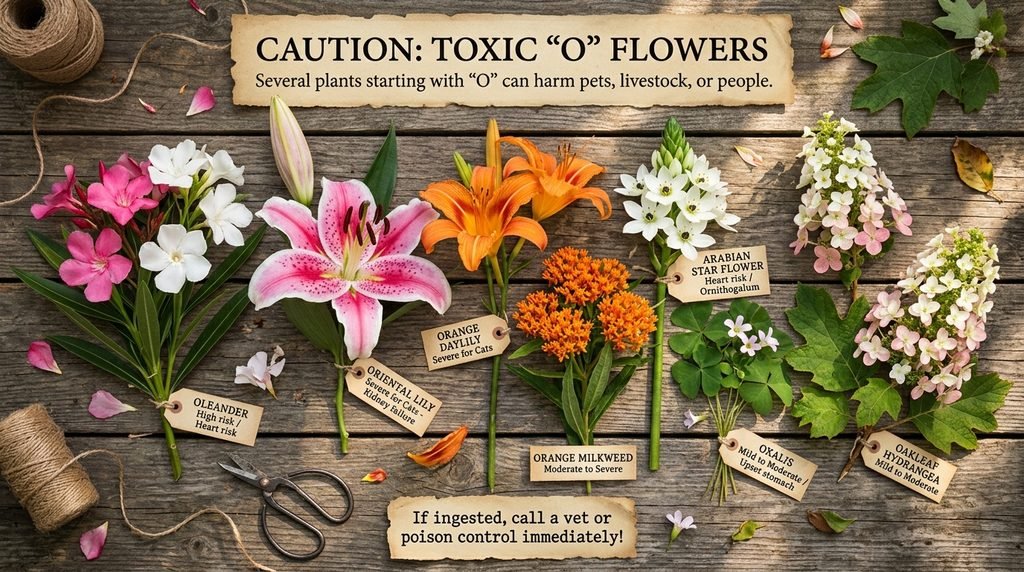
| Flower | Toxic To | Severity |
| Oleander | Humans, dogs, cats, horses, livestock | Severe — all parts affect the heart, can be fatal |
| Oriental Lily | Cats (extremely), dogs (mild) | Severe for cats — can cause kidney failure |
| Orange Daylily | Cats (extremely), dogs (mild) | Severe for cats — daylilies can cause kidney failure |
| Orange Milkweed | Dogs, cats, horses, livestock | Moderate to severe — cardiac glycosides |
| Orange Sneezeweed | Sheep, cattle, horses | Moderate to severe — grazing can be fatal |
| Ornithogalum (Arabian Star Flower) | Dogs, cats, horses | Moderate to severe — heart-affecting compounds |
| Ornamental Onion | Dogs, cats | Moderate — can damage red blood cells in large amounts |
| Oxalis | Dogs, cats, horses | Mild to moderate — oxalate crystals upset the stomach |
| Old Man’s Beard | Dogs, cats, horses | Mild to moderate — sap irritates mouth and skin |
| Oakleaf Hydrangea | Dogs, cats, horses | Mild to moderate — stomach upset |
Oleander, oriental lily, and orange daylily deserve the loudest warning. Keep them away from children and pets, and never bring lilies into a home with a cat. Oxalis and oakleaf hydrangea are milder, but a chewing dog can still get sick. If a pet or child eats any plant on this list, call a vet or poison control right away.
O Flowers Grouped by Color
Orange and red bring warmth, and the letter O has plenty of both. Orange daylily, orange milkweed, orange trumpet vine, orange clock vine, orange honeysuckle, and oriental poppy all glow in the sun. Ocotillo and ohia lehua add true red to desert and tropical scenes.
Yellow and gold come next. Oxeye sunflower, orange coneflower, Oregon grape, Oregon sunshine, and Ozark sundrops fill sunny beds with gold. Oregon grape blooms early, in the first weeks of spring. Oxeye sunflower and orange coneflower carry gold through the hottest months. Evening primrose opens its yellow cups at dusk.
Pink, rose, and magenta show up in oriental lily, Oklahoma redbud, old blush rose, orchid tree, and obedient plant. Oklahoma redbud and orchid tree give the biggest show, since whole trees bloom. Old blush rose and old garden rose bring fragrance and an old-fashioned charm. Obedient plant keeps pink going into fall.
White and cream flowers include orange blossom, osmanthus, orange jessamine, oakleaf hydrangea, ocean spray, and ox-eye daisy. White glows at dusk and brightens shade. Orange blossom, osmanthus, and orange jessamine add scent to patios. Oakleaf hydrangea and ocean spray suit woodland-style gardens.
Purple, blue, and violet are the cool side of O. Ornamental onion, Oregon iris, Ohio spiderwort, and Olympic bellflower bring these shades. Ornamental onion gives bold globes. Ohio spiderwort and Oregon iris suit natural borders. Olympic bellflower is a rare alpine treasure.
Life-Cycle Groupings for O Flowers
A plant’s life cycle tells you how much work to expect. Annuals live one season, so you replant each year. Biennials flower in their second year. Perennials return on their own. Bulbs need the right winter, cold or warm, to come back. Trees and shrubs take longer to bloom but last for decades. Zones below are approximate and vary by variety, so check your own plant tag.
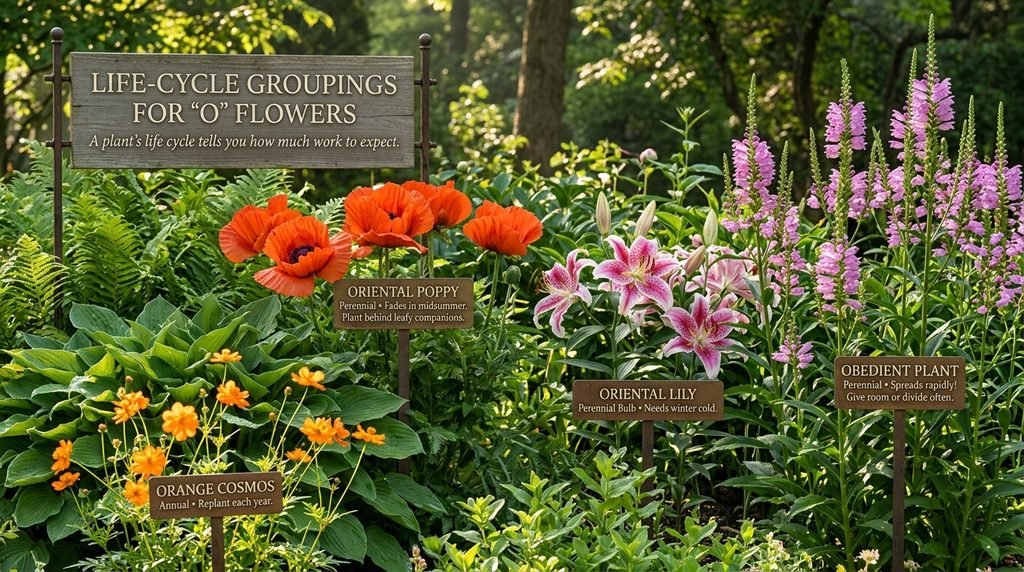
| Flower | Life Cycle | Typical Zones |
| Orange Cosmos | Annual | All zones (seasonal) |
| Owl’s Clover | Annual | All zones (seasonal) |
| Osteospermum | Tender perennial, often grown as annual | 10–11 (perennial), elsewhere annual |
| Oenothera (Evening Primrose) | Biennial | 4–9 |
| Obedient Plant | Perennial | 3–9 |
| Oswego Tea | Perennial | 4–9 |
| Orange Coneflower | Perennial | 4–9 |
| Oxeye Sunflower | Perennial | 3–9 |
| Ox-Eye Daisy | Perennial | 3–8 |
| Oriental Poppy | Perennial | 3–8 |
| Orange Daylily | Perennial | 3–9 |
| Oxlip | Perennial | 4–8 |
| Ozark Sundrops | Perennial | 4–8 |
| Oriental Lily | Perennial (bulb) | 4–9 |
| Ornamental Onion | Perennial (bulb) | 4–8 |
| Oakleaf Hydrangea | Perennial (shrub) | 5–9 |
| Oregon Grape | Perennial (shrub) | 5–9 |
| Old Garden Rose | Perennial (shrub) | 4–9 |
| Oleander | Perennial (shrub) | 8–10 |
| Osmanthus | Perennial (shrub) | 7–11 |
| Oyama Magnolia | Perennial (small tree) | 5–8 |
| Orchid Tree | Tender perennial (tree) | 9–11 |
| Oxalis (Purple Shamrock) | Tender perennial | 8–11 (indoors elsewhere) |
Oriental poppy and obedient plant are the two to watch. Oriental poppy disappears in midsummer, so plant it behind something leafy that fills the gap. Obedient plant spreads quickly, so give it room or divide it often.
Botanical Name Crosswalk
Common names change from place to place. Botanical names do not. Nursery tags and seed packets use Latin for this reason. It also helps you search online with confidence. Two different plants can share one common name, so the Latin name protects you from a wrong purchase.
| Common Name | Botanical Name |
| Obedient Plant | Physostegia virginiana |
| Oakleaf Hydrangea | Hydrangea quercifolia |
| Oleander | Nerium oleander |
| Oriental Poppy | Papaver orientale |
| Oriental Lily | Lilium (Oriental hybrids) |
| Orange Coneflower | Rudbeckia fulgida |
| Orange Daylily | Hemerocallis fulva |
| Oswego Tea | Monarda didyma |
| Ox-Eye Daisy | Leucanthemum vulgare |
| Oxeye Sunflower | Heliopsis helianthoides |
| Osteospermum | Osteospermum ecklonis |
| Osmanthus | Osmanthus fragrans |
| Orchid Tree | Bauhinia purpurea |
| Orange Blossom | Citrus × sinensis |
| Oncidium | Oncidium spp. |
Daisy names cause the most confusion. Ox-eye daisy and oxeye sunflower sound alike, but they are different plants. Ox-eye daisy is Leucanthemum vulgare. Oxeye sunflower is Heliopsis helianthoides. Also, oriental lily and orange daylily are both toxic to cats, even though only one is a true lily. Always check the Latin name before you bring a lily-like plant home.
What O Flowers Mean
Flower meanings vary by culture, but a good number of orange flowers carry steady symbolism. Orange blossom stands for purity, hope, and fertility, which is why brides have worn it for centuries. It is the state flower of Florida. Citrus blossoms also perfume orchards in many warm regions, including Punjab, and orange blossom water flavors sweets and drinks in the Middle East.
Orchids stand for love, luxury, and rare beauty. Osmanthus carries a meaning of love and honor in China, where its flowers perfume the Mid-Autumn Festival and flavor cakes and tea. Oriental lily stands for prosperity and passion in modern flower language. Old garden roses carry the classic meaning of love.
Some meanings are wry and old. In Victorian flower language, ox-eye daisy meant patience, and evening primrose meant inconstancy. Oleander carried a warning and meant caution. Oxalis, often sold as a lucky shamrock, is a popular gift for good luck.
Ohia lehua has a Hawaiian legend of two lovers, Ohia and Lehua, who were separated by a goddess and changed into a tree and its flower. Oswego tea is tied to American history, since settlers used its leaves as a tea substitute after the Boston Tea Party. Match the flower to your message, and remember that the same bloom can mean something different in another culture.
Decision Table: Which O Flower Fits Your Situation
You do not have to read the whole list to choose well. Start with your goal in the left column. The right column names the best O flower for it. Then check the toxicity section if you have pets or children.

| If You Want… | Choose This O Flower |
| Gold for a sunny border | Orange Coneflower, Oxeye Sunflower, or Orange Cosmos |
| Late-summer pink | Obedient Plant |
| Hummingbird and butterfly support | Oswego Tea, Orange Milkweed, or Odontonema |
| Strong fragrance | Osmanthus, Orange Blossom, or Orange Jessamine |
| Color in part shade | Oakleaf Hydrangea or Oregon Grape |
| An easy houseplant with blooms | Oxalis (keep away from pets) or Oncidium |
| A pot or basket flower | Osteospermum |
| A flowering tree | Orchid Tree, Oklahoma Redbud, or Oyama Magnolia |
| Dry, hot, low-water gardens | Oriental Poppy, Orange Cosmos, or Oleander (keep away from pets) |
| A pet-friendlier garden | Oncidium, Osteospermum, or Obedient Plant (absent from this guide’s toxic list) |
Orange coneflower appears first because it is easy and long-blooming. Obedient plant is a good partner for it in a family garden. Always double-check any plant with your vet if a pet is likely to chew it.
Conclusion
Flowers that start with O offer a very wide choice, from the sweet orange blossom to the rare Oconee bells. This guide sorted 56 of them by color, life cycle, and use, so you can pick with confidence. Whether you want a golden summer border, a scented patio, or an easy orchid for a sunny window, there is an O flower that fits. Use the tables above, read the toxicity notes, and start planting.
Frequently Asked Questions
How many flowers start with O?
More than 50 well-known flowers start with O. This guide lists 56, from common garden plants to rare orchids and desert natives.
What is the most popular flower that starts with O?
Orchid, oriental poppy, oleander, and osteospermum are among the most popular. Orange blossom and oriental lily are favorites for weddings.
What are the easiest flowers that start with O to grow?
Orange coneflower, oxeye sunflower, obedient plant, orange cosmos, and ox-eye daisy are very easy. Oxalis is the easiest O houseplant.
Which O flowers attract butterflies and hummingbirds?
Orange milkweed, obedient plant, and orange coneflower draw butterflies and bees. Oswego tea, odontonema, and orange honeysuckle draw hummingbirds.
Is oleander poisonous? Yes.
Oleander is one of the most poisonous garden plants. Every part can affect the heart, and even dried leaves are dangerous.
Which O flower is the most dangerous?
Oleander is the most dangerous for people and pets. Oriental lily and orange daylily are the most dangerous for cats.
Are oriental lilies safe around cats?
No. Oriental lilies are among the most dangerous plants for cats. Even a small bite or a lick of pollen can cause kidney failure, so keep them out of the house.
What does orange blossom symbolize? Orange blossom stands for purity, hope, and fertility. It is a traditional bridal flower and the state flower of Florida.
Which O flowers have the strongest scent?
Osmanthus, orange blossom, orange jasmine, and oriental lily have the strongest scent. Evening primrose is scented at dusk.
Which O flowers bloom in early spring?
Oregon grape, oxlip, Oklahoma redbud, and Ozark witch hazel bloom early. Ornamental onion follows in late spring.
Which O flowers work well in dry, sunny gardens?
Oriental poppy, orange cosmos, oxeye sunflower, ox-eye daisy, and ocotillo thrive in dry sun. Oleander also loves heat but must be kept away from pets and children.
Can I grow orchids that start with O indoors?
Yes. Oncidium and odontoglossum orchids grow well in bright, indirect light. Oncidium is easier for beginners, and odontoglossum prefers cooler rooms.
What is the rarest flower that starts with O?
Ohai, Oconee bells, and Olympic bellflower are among the rarest. All three are hard to grow outside their home habitats.
Which O flowers make good cut flowers?
Oriental lily, obedient plant, osteospermum, ox-eye daisy, and orange coneflower all cut well. Keep lilies away from cats.
Where can I find a full list of flowers that start with O?
You are in the right place. The master alphabetical list above names 56 flowers that start with O, with botanical names and short notes.
3 thoughts on “50+ Beautiful Flowers That Start With O (With Pictures & Names)”