
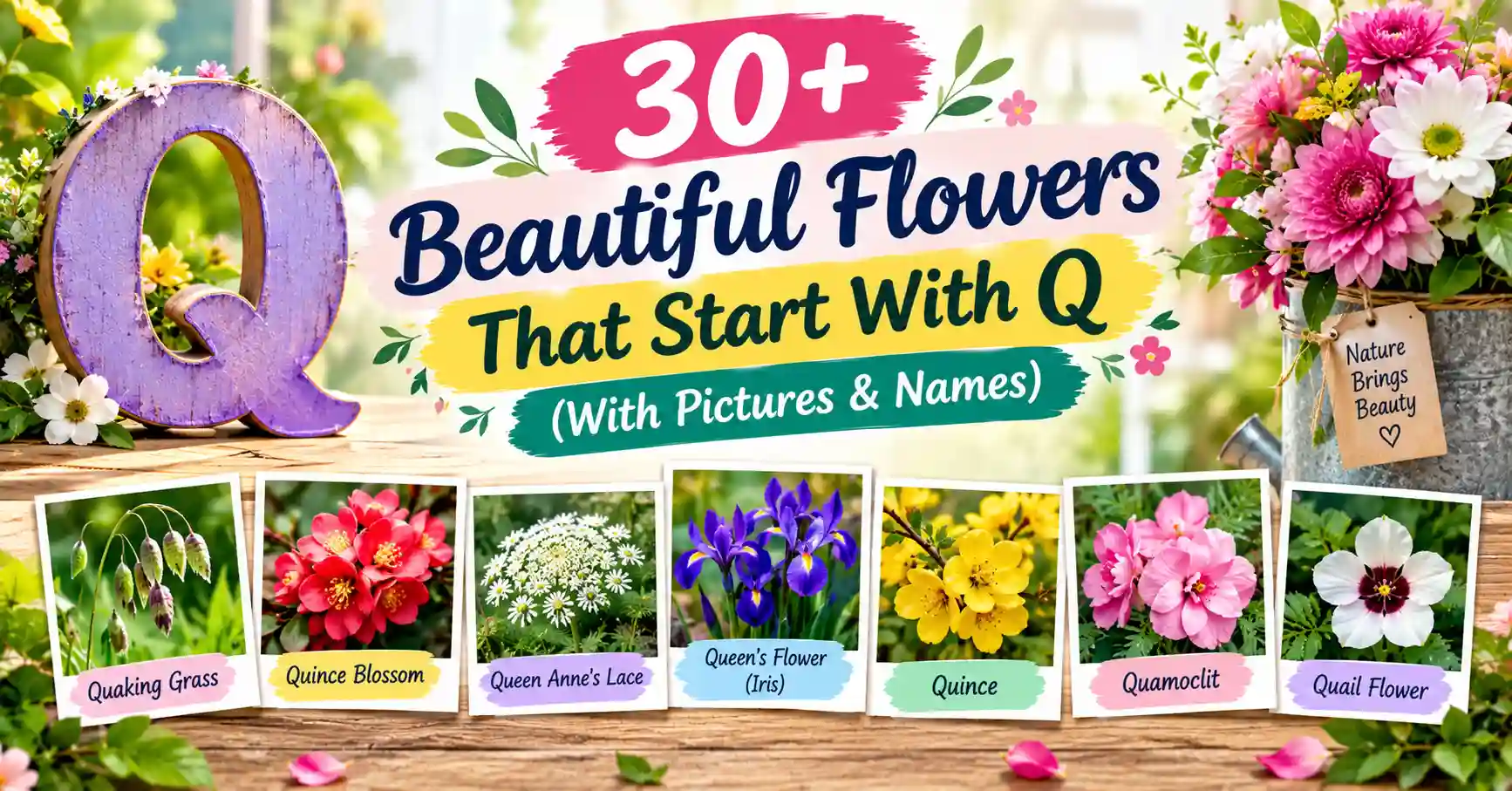
Flowers that start with Q are rare, regal, and full of stories. Queen Anne’s lace, quince, and the queen of the night are the names most people know. But the letter Q also hides giants, like a plant that blooms only once in its life after eighty years, and a tropical creeper that changes color as it ages. This guide gathers 33 of them in one place.
Q is one of the least common letters in plant names. That is why so many entries begin with the words Queen or Quince. Every plant below is real and has a verified botanical name. Two entries are grown mainly for seed heads or fruit, and each one is clearly marked as an exception.
A short list still needs to be useful. So this guide sorts the plants by color, life cycle, and use. A bloom’s beauty means little if it dies in your climate. It means even less if it harms a child or a pet. Each table is explained in plain words first, so you never face a bare spreadsheet.
Quick Answer: Ten Standout Q Flowers
Queen Anne’s lace is the lacy wild classic, loved by pollinators and florists alike. Queen of the prairie and queen of the meadow, it brings tall, frothy plumes to damp, sunny beds. Flowering quince lights up late winter with coral-red blooms on bare branches, and quamash carpets meadows in blue-violet stars.
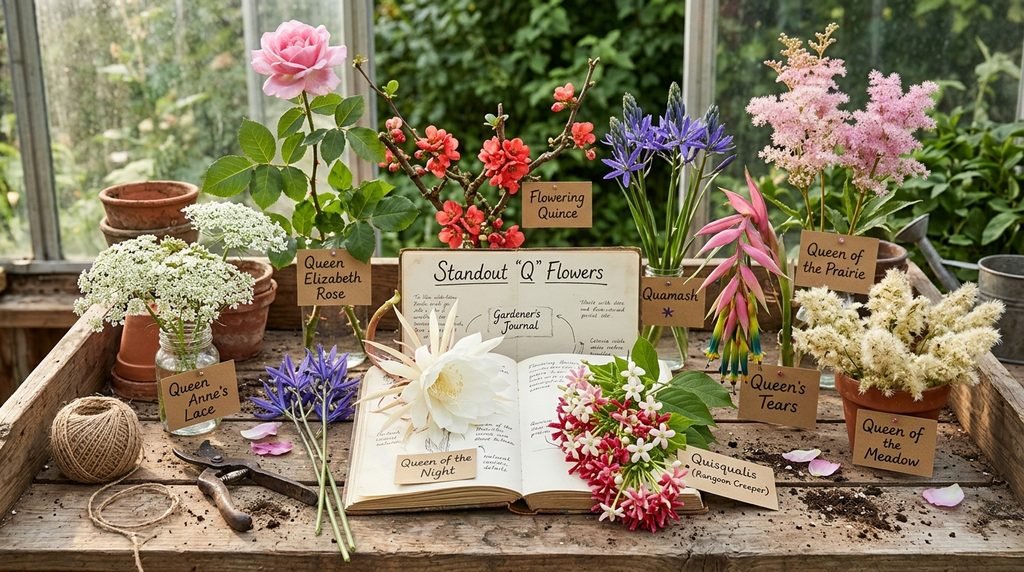
Queen Elizabeth rose is the tall, dependable pink rose of formal gardens. Queen of the night cactus opens huge, perfumed flowers for a single night. Quisqualis, known as Rangoon creeper, is the fragrant climber that turns from white to pink to red, and Queen’s tears is the easy bromeliad for a bright room.
Read More: Flowers That Start With P: Beautiful Names, Meanings & Photos
Master Alphabetical List of Flowers That Start With Q
This list names 33 flowers. Most entries use a common name that gardeners already know. A few are better known by their botanical name, so they appear under the name nurseries print on plant tags. Each row has a short note, so you can see at a glance what the plant looks like and where it grows best. Two entries are marked as exceptions because the flower is not the main reason people grow them.
| Flower | Botanical Name | Note |
| Quaker Ladies | Houstonia caerulea | Tiny pale blue four-petaled spring flowers |
| Quaking Grass (exception) | Briza media | Grown for dainty quivering seed heads |
| Quaking Bell | Pimelea physodes | Rare bell-shaped Western Australian bracts in red and green |
| Quamash | Camassia quamash | Blue-violet starry spikes, historic food plant |
| Quamoclit | Ipomoea quamoclit | Small red stars on a feathery-leaved vine |
| Queen Anne’s Lace | Daucus carota | Lacy white umbels, wild carrot |
| Queen Anne’s Thimbles | Gilia capitata | Blue-violet globes for dry, sunny spots |
| Queen Elizabeth Rose | Rosa ‘Queen Elizabeth’ | Tall, classic pink grandiflora rose |
| Queen Emma Lily | Crinum augustum | Huge pink lily-like summer blooms |
| Queen of Denmark Rose | Rosa ‘Königin von Dänemark’ | Quartered, fragrant pink old rose |
| Queen of the Andes | Puya raimondii | Giant bromeliad that blooms once, then dies |
| Queen of the Meadow | Filipendula ulmaria | Frothy, almond-scented white blooms |
| Queen of the Night (Cactus) | Epiphyllum oxypetalum | White fragrant blooms that open for one night |
| Queen of the Night (Cereus) | Selenicereus grandiflorus | Huge night-blooming cactus flower |
| Queen of the Night Tulip | Tulipa ‘Queen of Night’ | Deep maroon, nearly black tulip |
| Queen of the Prairie | Filipendula rubra | Tall pink cotton-candy plumes |
| Queen Protea | Protea magnifica | Large woolly pink-and-cream flower head |
| Queen Victoria Lobelia | Lobelia ‘Queen Victoria’ | Scarlet spikes over dark bronze leaves |
| Queen’s Cup | Clintonia uniflora | White woodland bloom, blue berries |
| Queen’s Delight | Stillingia sylvatica | Yellow-orange spikes on a southeastern native |
| Queen’s Tears | Billbergia nutans | Pendant pink-and-green blooms on a bromeliad |
| Queen’s Wreath | Petrea volubilis | Blue-violet sprays on a tropical vine |
| Queensland Firewheel Tree | Stenocarpus sinuatus | Red wheel-shaped flower clusters |
| Queensland Silver Wattle | Acacia podalyriifolia | Golden puffs on silvery foliage in winter |
| Quesnelia | Quesnelia marmorata | Pink flower spikes on a bromeliad |
| Quick Fire Hydrangea | Hydrangea paniculata ‘Quick Fire’ | Early white cones that age to pink and red |
| Quickthorn | Crataegus monogyna | White May blossom on a hedgerow tree |
| Quince (Chinese) | Pseudocydonia sinensis | Pink spring blossom and fragrant fruit |
| Quince (Common) (exception) | Cydonia oblonga | Pale pink blossoms on a fruit tree |
| Quince (Flowering) | Chaenomeles speciosa | Bright coral-red spring blooms on thorny stems |
| Quince (Japanese) | Chaenomeles japonica | Orange-red blooms on a low shrub |
| Quintinia | Quintinia serrata | Small white flower sprays on a New Zealand tree |
| Quisqualis (Rangoon Creeper) | Combretum indicum | Fragrant blooms that change from white to pink to red |
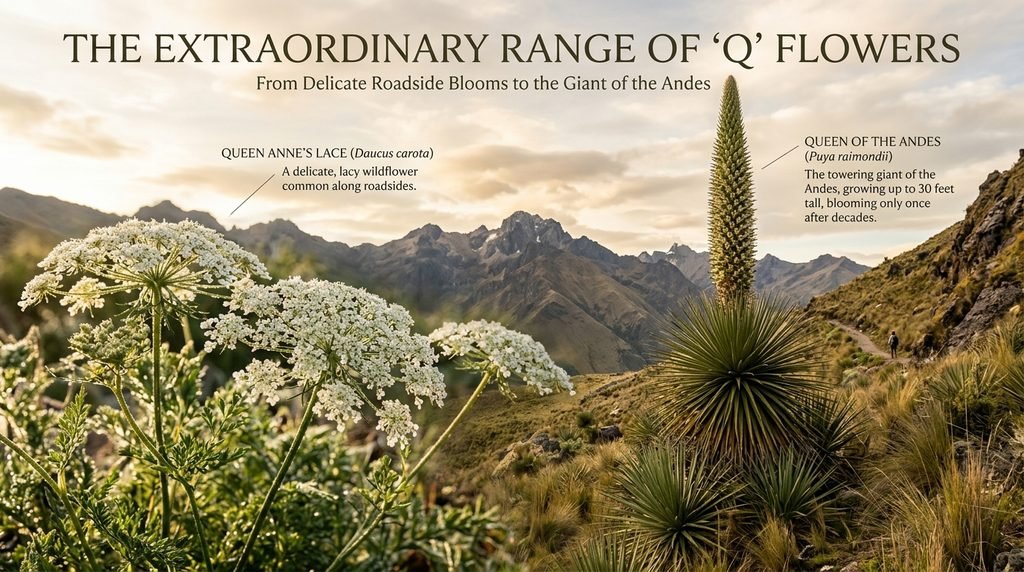
That table names 33 distinct flowers that start with Q. Queen Anne’s lace and the queen of the Andes sit at opposite ends of the scale. One is a wild roadside flower. The other is the giant of the Andes. Both show how much range this single letter holds.
Full Comparison Table: Sun, Water, and Bloom Time
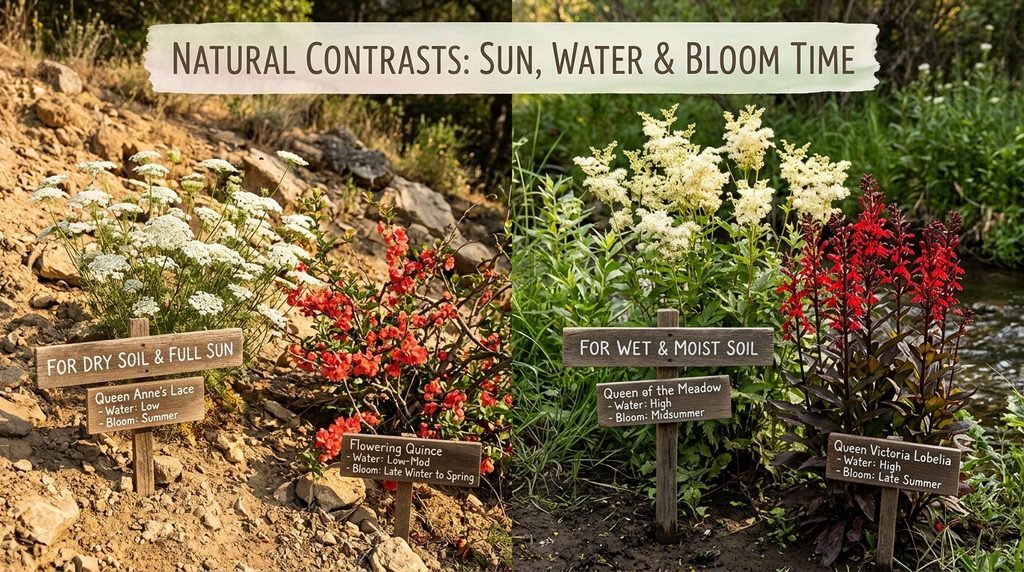
When two plants seem equally good, sun and water needs usually pick the winner. The table below compares the main Q flowers from this guide. Read the sun column first. Then check the water column and the bloom season to see if the plant fits your space and your calendar.
| Flower | Sun Needs | Water Needs | Bloom Season |
| Quaker Ladies | Full sun to part shade | Moderate | Spring |
| Quamash | Full sun to part shade | Moderate in spring, dry in summer | Late spring |
| Queen Anne’s Lace | Full sun | Low | Summer |
| Queen Elizabeth Rose | Full sun | Moderate | Summer to fall |
| Queen Emma Lily | Full sun | Moderate | Summer |
| Queen of the Meadow | Full sun to part shade | High | Midsummer |
| Queen of the Prairie | Full sun to part shade | Moderate to high | Early summer |
| Queen Victoria Lobelia | Full sun to part shade | High | Late summer |
| Queen’s Cup | Part to full shade | Moderate | Late spring |
| Queen’s Tears | Bright indirect light | Low | Spring to summer |
| Queen of the Night (Cactus) | Bright indirect light | Low | Summer nights |
| Queen of the Night Tulip | Full sun | Moderate | Late spring |
| Queensland Firewheel Tree | Full sun | Moderate | Summer |
| Quesnelia | Bright indirect light | Low to moderate | Spring to summer |
| Quick Fire Hydrangea | Full sun to part shade | Moderate | Early summer |
| Quickthorn | Full sun | Low to moderate | Late spring |
| Quince (Flowering) | Full sun | Low to moderate | Late winter to spring |
| Quisqualis | Full sun | Moderate | Summer to fall |
Queen Anne’s lace and flowering quince are the best picks for poor, dry soil. Both bloom well without pampering. Queen of the meadow and Queen Victoria lobelia sit at the other end. They want soil that stays wet.
Explore More Flower Guides: 70+ Flowers That Start With K: Beautiful Names, Meanings & Photos
Garden Favorites Among Q Flowers
A handful of Q flowers earn a place in many gardens. Queen of the prairie gives tall pink plumes to a damp meadow border. Queen of the meadow does the same in white, with a sweet almond scent. Quick Fire hydrangea opens weeks earlier than most hydrangeas. Flowering quince brings color when everything else is still bare.
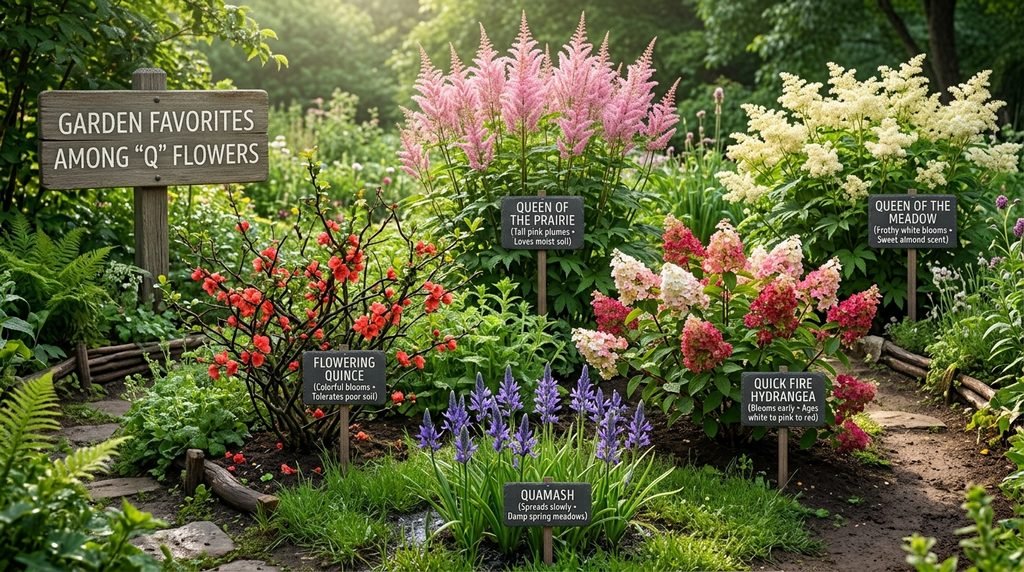
- Queen of the Prairie loves moist soil and grows up to eight feet tall.
- Queen of the Meadow gives frothy white blooms and a sweet scent.
- Quick Fire Hydrangea blooms early and ages from white to pink to red.
- Flowering Quince blooms on bare stems and tolerates poor soil.
- Quamash spreads slowly and suits damp spring meadows.
Queen of the Prairie and Quick Fire hydrangea make a strong pair. One carries early summer, and the other starts even sooner. Together they keep a moist border full from June onward.
A few care habits keep these plants happy. Give queen of the prairie and queen of the meadow plenty of water. Prune flowering quince right after it blooms. Cut Quick Fire hydrangea back in late winter for strong stems. Plant quamash bulbs in fall where the soil stays damp in spring and dries in summer.
Indoor and Container Picks Among Q Flowers
Only a few Q plants thrive indoors, but they are worth knowing. Queen’s Tears is a bromeliad with pendant pink-and-green blooms that is very easy to keep. Quesnelia is another bromeliad that sends up pink flower spikes in a bright room. Queen of the night cactus can bloom indoors if it gets enough light and a cool, dry rest. Queen Elizabeth rose also grows well in a large pot on a sunny patio.
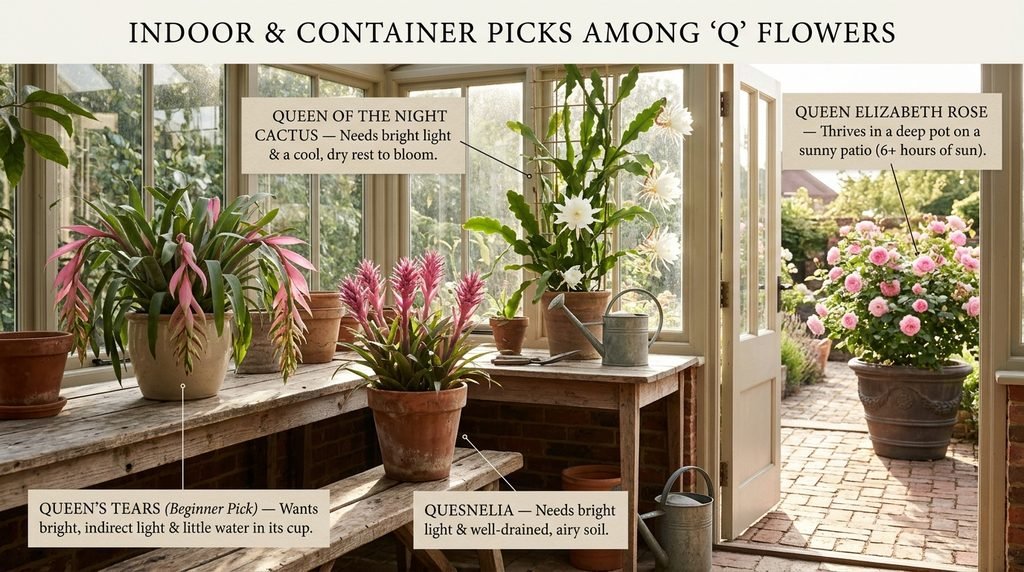
- Queen’s Tears wants bright, indirect light and a little water in its cup.
- Quesnelia needs bright light and well-drained, airy soil.
- Queen of the Night (Cactus) needs bright light and a long wait for its one-night bloom.
- Queen Elizabeth Rose needs a deep pot and six hours of sun.
Queen’s Tears is the pick for beginners. It forgives missed waterings. Just keep its central cup clean, and do not let water sit there for weeks.
Light matters more than anything else for indoor Q plants. A bright east window suits Queen’s Tears and quesnelia. Avoid cold drafts and soggy saucers. Most of these plants fail from too much water, not too little.
Florist Favorites Among Q Flowers
Florists use Q flowers for lace, drama, and old-fashioned charm. Queen Anne’s lace adds airy white texture to wedding and cottage bouquets. Queen Elizabeth rose is a classic tall pink rose for formal arrangements.
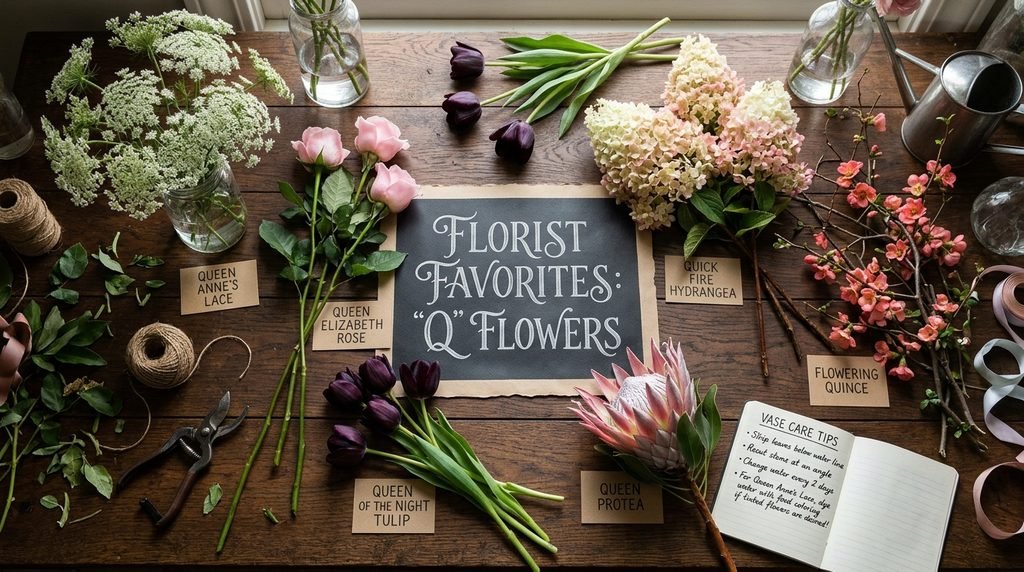
- Queen Anne’s Lace adds a lacy look and lasts about a week.
- Queen Elizabeth Rose gives long stems and a soft pink color.
- Queen of the Night Tulip is a dramatic dark accent for spring.
- Quick Fire Hydrangea gives large cones that dry well.
- Quince (Flowering) branches can be forced indoors in late winter.
They add shape and volume to a bouquet. A florist’s cooler in summer would feel plain without them.
Good vase care doubles the life of any cut flower. Strip the leaves below the water line. Recut the stems at an angle. Change the water every two days. For Queen Anne’s lace, dye the water with food coloring if you want tinted flowers.
You May Also Like: 60+ Beautiful Flowers That Start With I (With Pictures & Names)
Rare and Unusual Q Flowers
Some Q plants are hard to find or hard to grow. Queen of the Andes, Puya raimondii, is the most famous. It is the largest bromeliad in the world, and it lives in the high Andes of Peru and Bolivia. It blooms only once, after decades of growth, and then it dies. Qualup bell is a rare Western Australian shrub with bell-shaped red and green bracts that is hard to grow outside its home soils.
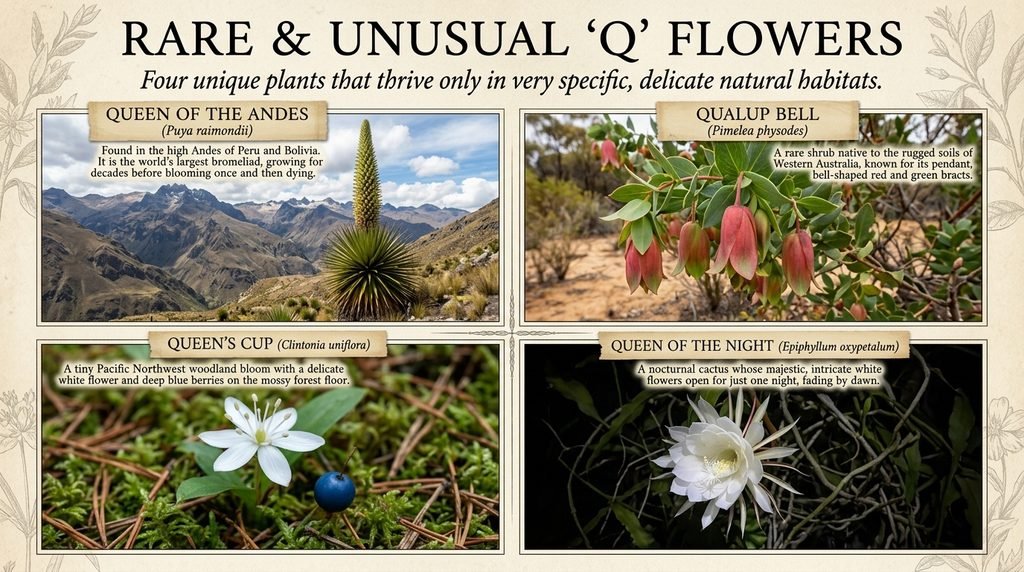
Queen’s cup is a tiny Pacific Northwest woodland bloom with a white flower and blue berries. Queen of the night cactus opens for just one night, and its petals fade by dawn.
These four plants share one trait. Each wants a very specific home. That is why they stay special. If you want to grow one, buy nursery-grown plants only. Never dig wild plants, since many rare Q species are protected by law.
Caution: Toxic and Look-Alike Q Flowers
Only a few Q plants are truly toxic, but safety matters here. Queen Anne’s lace looks a lot like poison hemlock, which is deadly. Always be sure of your plant before you touch or taste any wild lacy white flower. Quamash, or camas, is a traditional food plant, but it grows near death camas, which is poisonous. Queen Emma lily, Queen Victoria lobelia, and the seeds of common quince can cause illness if eaten.
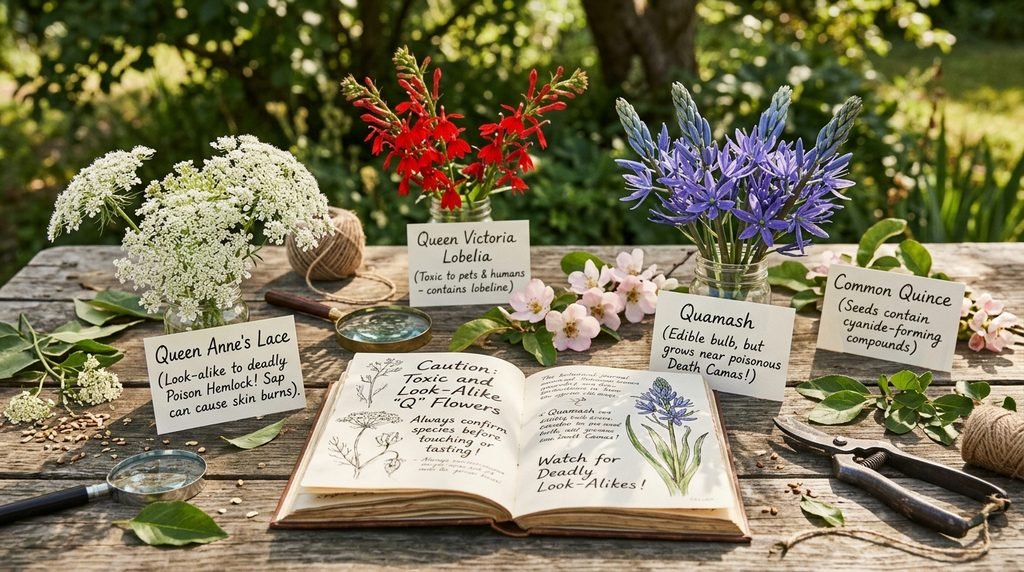
| Flower | Toxic To | Severity |
| Queen Victoria Lobelia | Dogs, cats, horses, humans | Moderate — contains lobeline-type alkaloids |
| Queen Emma Lily | Dogs, cats, horses | Moderate — bulbs cause vomiting and drooling |
| Quince (Common) | Humans, dogs, cats | Mild to moderate — seeds contain cyanide-forming compounds |
| Quisqualis (Rangoon Creeper) | Dogs, cats, humans | Mild to moderate — seeds upset the stomach |
| Quick Fire Hydrangea | Dogs, cats, horses | Mild to moderate — stomach upset |
| Queen Anne’s Lace | Humans, dogs, cats | Mild — sap can cause skin burns in sunlight; look-alike to deadly hemlock |
| Quamash | Look-alike risk | Bulbs were a food plant, but death camas grows in the same places |
Never eat a wild plant unless an expert has confirmed it. Queen Anne’s lace and Queen Victoria lobelia are the garden plants that need the most caution. If a pet or child eats any plant on this list, call a vet or poison control right away.
Q Flowers Grouped by Color
Pink and rose tones lead the Q list. Queen of the prairie, Queen Elizabeth rose, Queen Emma lily, Queen protea, and Quick Fire hydrangea all bring shades from blush to deep rose. Queen of the prairie and Quick Fire hydrangea suit moist and sunny borders.
White and cream flowers include Queen Anne’s lace, Queen of the meadow, Queen of the night, Queen’s cup, and quickthorn. White glows at dusk and brightens shade. Queen of the night opens after dark. Queen Anne’s lace and Queen of the meadow suit meadow-style planting. Queen’s cup suits cool woodland shade.
Blue, purple, and violet are the cool side of Q. Quamash, Quaker Ladies, Queen Anne’s Thimbles, and Queen’s Wreath bring these shades. Quamash and Quaker Ladies carpet spring meadows. Queen’s Wreath gives showers of blue-violet on a tropical vine. Queen of the night tulip adds deep maroon that looks almost black.
Red, orange, and coral bring heat. Flowering quince, Japanese quince, Queensland firewheel tree, Queen Victoria lobelia, and quisqualis glow in the sun. Flowering quince and Japanese quince arrive first, in late winter. Queen Victoria lobelia lights up late summer. Quisqualis changes from white to red as each cluster ages.
Yellow and gold come from Queensland silver wattle and queen’s delight. Silver wattle covers a small tree in golden puffs in winter. Queen’s delight is a quiet native for dry southeastern soils.
Life-Cycle Groupings for Q Flowers
A plant’s life cycle tells you how much work to expect. Annuals live one season, so you replant each year. Biennials flower in their second year. Perennials return on their own. Bulbs need the right winter, cold or warm, to come back. Trees and shrubs take longer to bloom but last for decades. Zones below are approximate and vary by variety, so check your own plant tag.
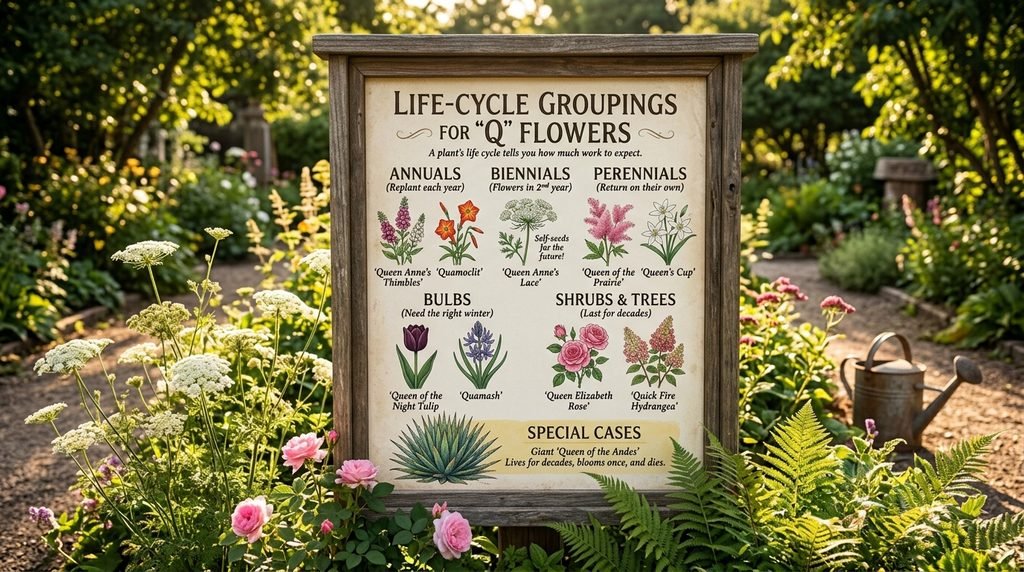
| Flower | Life Cycle | Typical Zones |
| Queen Anne’s Thimbles | Annual | All zones (seasonal) |
| Quamoclit | Annual | All zones (seasonal) |
| Queen Anne’s Lace | Biennial | 3–9 |
| Quaker Ladies | Perennial | 3–8 |
| Queen of the Meadow | Perennial | 3–8 |
| Queen of the Prairie | Perennial | 3–8 |
| Queen Victoria Lobelia | Perennial | 3–8 |
| Queen’s Cup | Perennial | 4–7 |
| Quamash | Perennial (bulb) | 4–9 |
| Queen of the Night Tulip | Perennial (bulb) | 4–8 |
| Queen Emma Lily | Tender perennial (bulb) | 8–11 |
| Quick Fire Hydrangea | Perennial (shrub) | 3–8 |
| Quince (Flowering) | Perennial (shrub) | 4–9 |
| Quince (Japanese) | Perennial (shrub) | 5–9 |
| Quickthorn | Perennial (small tree) | 4–8 |
| Queen Elizabeth Rose | Perennial (shrub) | 5–9 |
| Queensland Firewheel Tree | Tender perennial (tree) | 9–11 |
| Quisqualis | Tender perennial (vine) | 10–12 |
| Queen’s Tears | Tender perennial (houseplant) | 10–12 (indoors elsewhere) |
| Queen of the Night (Cactus) | Tender perennial (houseplant) | 10–12 (indoors elsewhere) |
Queen Anne’s lace and the queen of the Andes are the two special cases. Queen Anne’s lace is a biennial that flowers in its second year and then self-seeds.
Botanical Name Crosswalk
Common names change from place to place. Botanical names do not. Nursery tags and seed packets use Latin for this reason. It also helps you search online with confidence. Two different plants can share one common name, so the Latin name protects you from a wrong purchase.
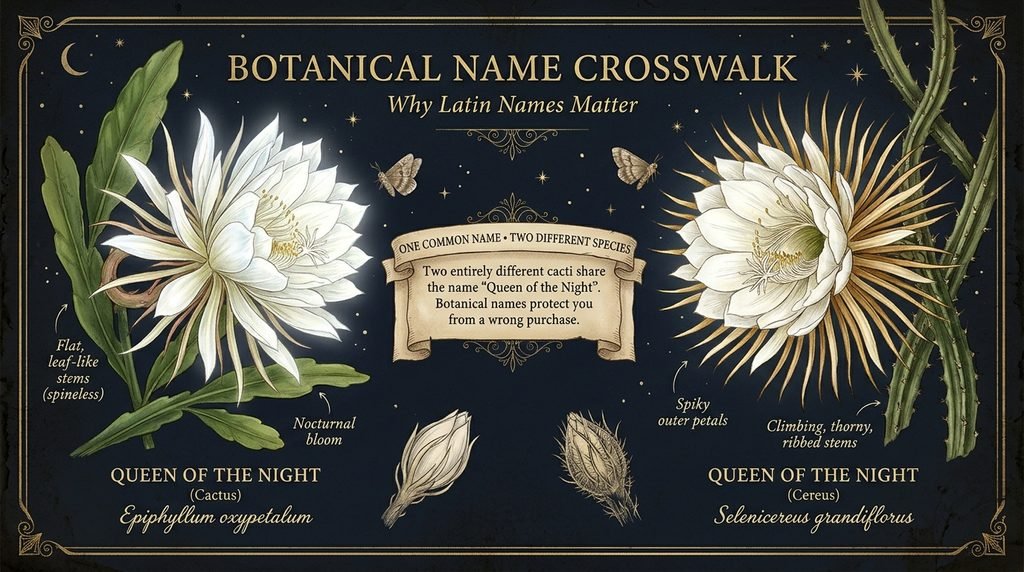
| Common Name | Botanical Name |
| Queen Anne’s Lace | Daucus carota |
| Queen of the Meadow | Filipendula ulmaria |
| Queen of the Prairie | Filipendula rubra |
| Queen of the Night (Cactus) | Epiphyllum oxypetalum |
| Queen of the Night (Cereus) | Selenicereus grandiflorus |
| Queen of the Andes | Puya raimondii |
| Queen Emma Lily | Crinum augustum |
| Queen Elizabeth Rose | Rosa ‘Queen Elizabeth’ |
| Queen’s Tears | Billbergia nutans |
| Quamash | Camassia quamash |
| Quince (Flowering) | Chaenomeles speciosa |
| Quince (Common) | Cydonia oblonga |
| Quick Fire Hydrangea | Hydrangea paniculata ‘Quick Fire’ |
| Quickthorn | Crataegus monogyna |
| Quisqualis | Combretum indicum |
Queen of the night shows why this matters. Two different cacti share the name, Epiphyllum oxypetalum and Selenicereus grandiflorus. Both open at night, but they are different plants. Also, quisqualis is now classified as Combretum indicum, so older tags may use the name Quisqualis indica.
What Q Flowers Mean
Flower meanings vary by culture, but a good number of Q flowers carry steady symbolism. Queen Anne’s lace stands for sanctuary and safety. A well-known legend says Queen Anne pricked her finger while sewing lace, and the single dark floret in the center of the flower is her drop of blood. Queen of the night stands for fleeting beauty, because its giant bloom lasts only hours.
Quince has a long history of symbolism. In ancient Greece, it was tied to love and marriage, and in Victorian flower language, quince blossom meant temptation. Quickthorn, or hawthorn, stands for hope and protection. Old folk belief also said that cutting its branches brought bad luck, and some people still avoid bringing the blossom indoors.
Quamash, or camas, stands for nourishment and community. Many Native peoples of the Pacific Northwest harvested its bulbs as a staple food. Queen Elizabeth rose stands for admiration and loyalty. Queen of the Andes stands for patience and endurance, since it grows for decades before one great bloom.
In South Asia, quisqualis, or Rangoon creeper, is known as madhumalti. Its sweet-smelling blossoms are loved for their changing colors, and the vine is often trained over gates and verandas. Match the flower to your message, and remember that the same bloom can mean something different in another culture.
Decision Table: Which Q Flower Fits Your Situation
You do not have to read the whole list to choose well. Start with your goal in the left column. The right column names the best Q flower for it. Then check the toxicity section if you have pets or children.
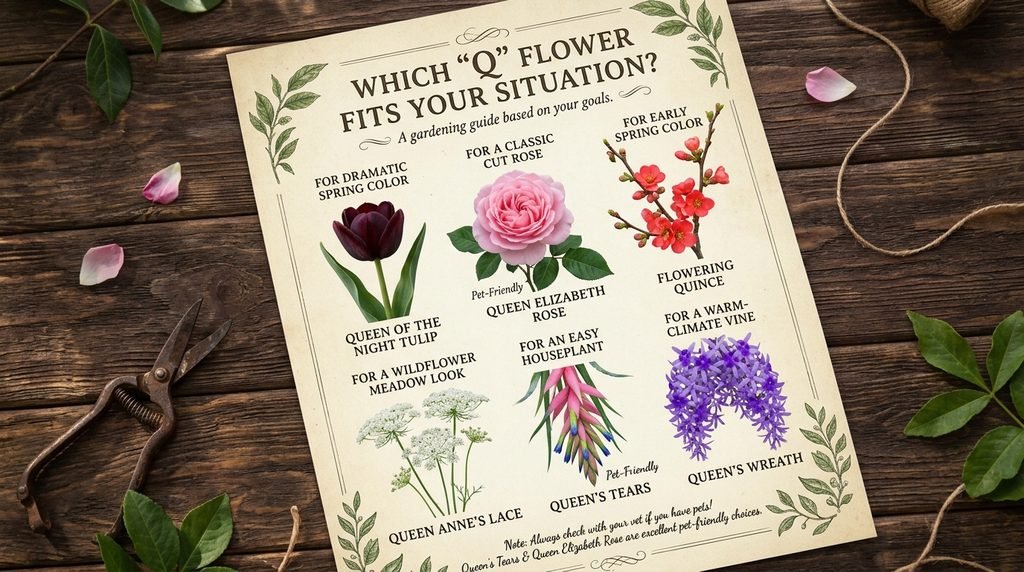
| If You Want… | Choose This Q Flower |
| Tall plumes for a damp border | Queen of the Prairie or Queen of the Meadow |
| Early spring color | Flowering Quince or Quaker Ladies |
| Native wildflower meadow look | Queen Anne’s Lace, Quamash, or Queen of the Prairie |
| An easy houseplant with blooms | Queen’s Tears or Quesnelia |
| Evening fragrance | Quisqualis or Queen of the Night |
| A flowering shrub for summer | Quick Fire Hydrangea |
| A classic cut rose | Queen Elizabeth Rose |
| A dramatic spring tulip | Queen of the Night Tulip |
| A warm-climate vine | Quisqualis or Queen’s Wreath |
| A pet-friendlier garden | Queen Elizabeth Rose, Queen’s Tears, or Quesnelia (absent from this guide’s toxic list) |
Queen’s Tears appears twice because it is easy, long-lasting, and not on the toxic list in this guide. Queen Elizabeth rose is a good partner for it in a family home. Always double-check any plant with your vet if a pet is likely to chew it.
Conclusion
Flowers that start with Q are few, but they are full of character, from the lacy Queen Anne’s lace to the giant queen of the Andes. This guide sorted 33 of them by color, life cycle, and use, so you can pick with confidence. Whether you want a moist meadow border, a fragrant climber, or an easy bromeliad for a bright window, there is a Q flower that fits. Use the tables above, read the toxicity notes, and start planting.
Frequently Asked Questions
How many flowers start with Q?
More than 30 well-known flowers start with Q. This guide lists 33, from common garden plants to rare giants of the Andes.
What is the most popular flower that starts with Q?
Queen Anne’s lace, flowering quince, and queen of the night are among the most popular. Queen Elizabeth rose is a favorite for formal gardens.
What are the easiest flowers that start with Q to grow?
Queen Anne’s lace, flowering quince, queen of the prairie, and quamash are easy. Queen’s tears is the easiest Q houseplant.
Which Q flowers attract butterflies and bees?
Queen Anne’s lace, queen of the meadow, queen of the prairie, and quickthorn feed bees and butterflies. Queen of the prairie is especially good for native pollinators.
Is Queen Anne’s lace safe to touch?
Its sap can cause skin burns in sunlight for some people. It also looks very much like poison hemlock, which is deadly. Never eat a wild plant unless an expert has confirmed it.
Which Q flower is the most dangerous?
No Q flower in this guide is as dangerous as oleander or monkshood, but Queen Victoria lobelia and Queen Emma lily need caution. The biggest risk is mistaking Queen Anne’s lace for poison hemlock.
What does queen of the night symbolize?
Queen of the night stands for fleeting beauty. Its huge, fragrant flower opens after dark and fades before morning.
What is madhumalti? Madhumalti is the South Asian name for quisqualis, also called Rangoon creeper. Its flowers change from white to pink to red as they age.
Which Q flowers bloom in very early spring?
Flowering quince, Japanese quince, Quaker ladies, and Queensland silver wattle bloom early. Quamash follows in late spring.
Which Q flowers work well in dry, sunny gardens?
Queen Anne’s lace, flowering quince, Queen Anne’s thimbles, and Queen’s Delight tolerate dry sun. Queen of the night tulip also does well in a sunny bed.
Can I grow queen of the night cactus indoors?
Yes. It needs bright light, a cool, dry rest in winter, and patience. Its flowers open for just one night, so watch the buds closely.
What is the rarest flower that starts with Q?
Queen of the Andes, Qualup bell, and queen’s cup are among the rarest. All three are hard to grow outside their home habitats.
Which Q flowers make good cut flowers?
Queen Anne’s lace, Queen Elizabeth rose, Quick Fire hydrangea, Queen protea, and flowering quince branches all cut well.
Where can I find a full list of flowers that start with Q?
You are in the right place. The master alphabetical list above names 33 flowers that start with Q, with botanical names and short notes.