
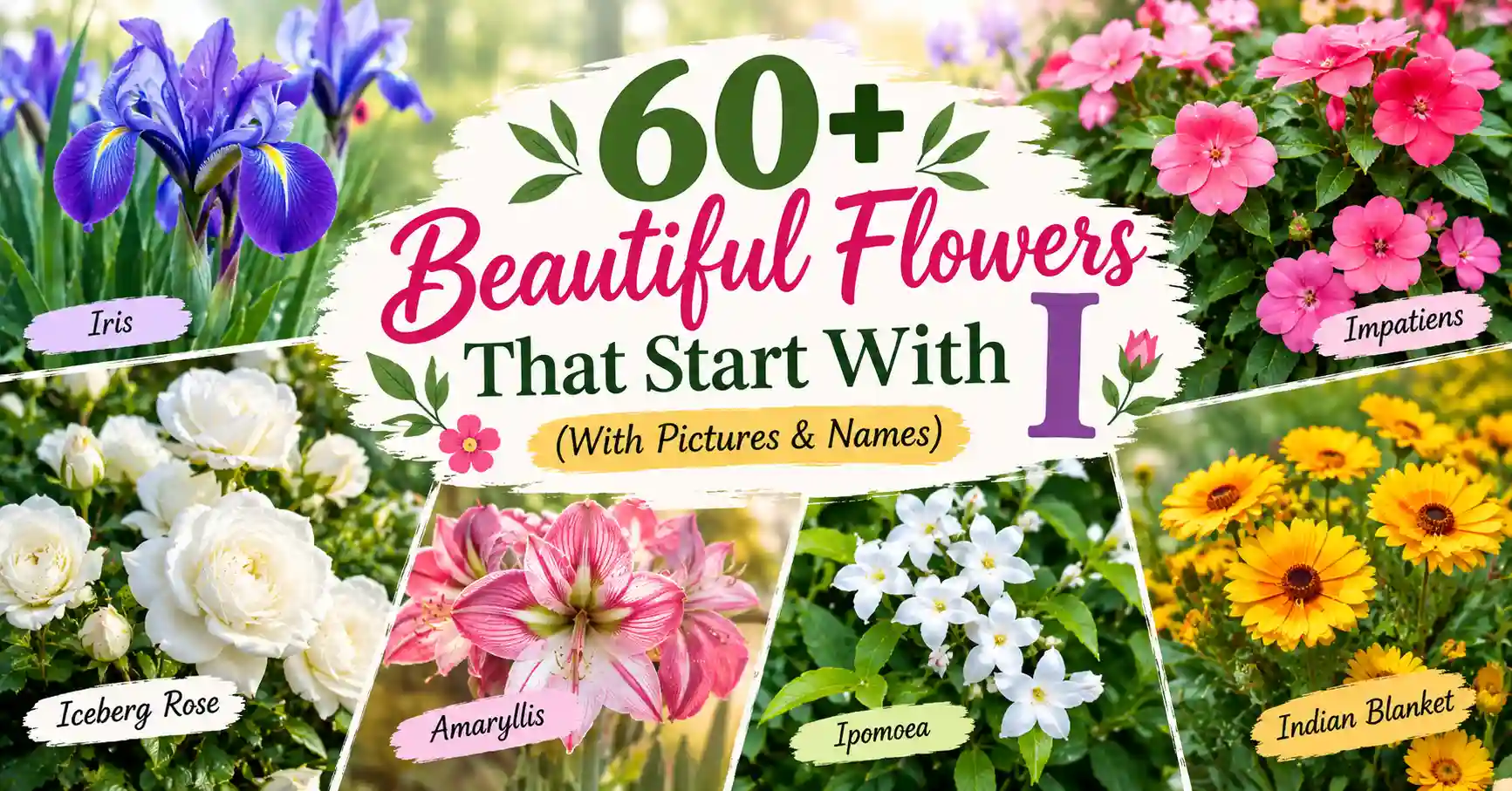
Flowers that start with I offer a surprising range of choices. The list runs from classic Iris to cheerful Impatiens. It includes tropical Ixora, tall Indian Bean Trees, and a ghostly white plant called Indian Pipe. This guide brings more than 60 of them together in one place, with clear notes on care and safety.
Every plant here is real, and the flower is the main reason people grow it. Botanical names, native regions, bloom seasons, and toxicity notes were checked against more than one source. Safety facts got extra care. A few I plants can harm pets, livestock, or people, so those get plain warnings.
The guide opens with a quick answer and a full alphabetical list. A comparison table follows. Then come sections on garden plants, houseplants, cut flowers, rare finds, and toxic plants. Color groups, life cycles, botanical names, and meanings come next. A short decision table closes the guide.
Quick Answer: Top Flowers That Start With I
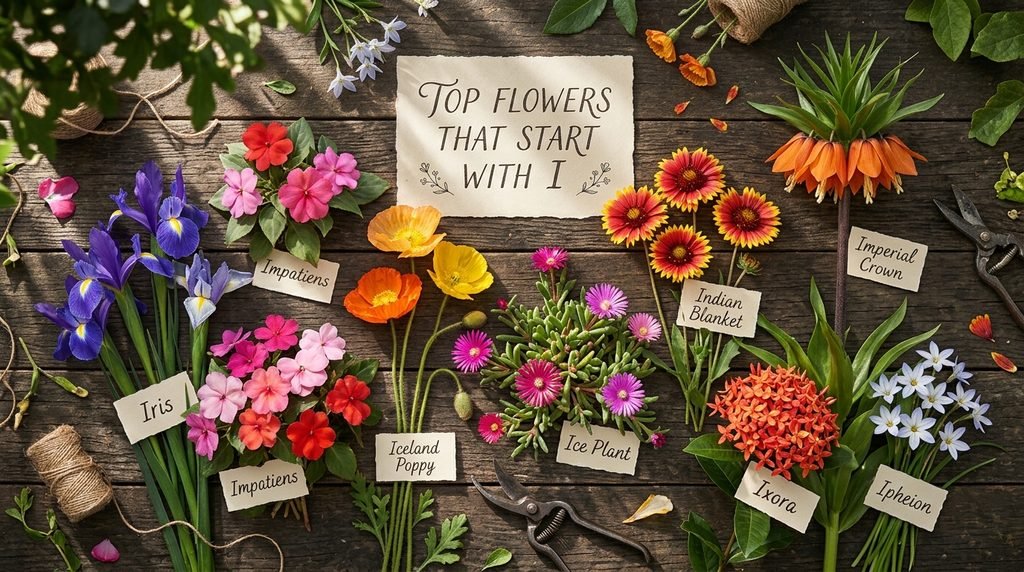
Iris, Impatiens, Iceland Poppy, Candytuft, and Virginia Sweetspire give gardeners the best mix of color and reliability. Iris suits sun, shade, and even pond edges, depending on the type. Impatiens brightens shady beds, while Iceland Poppy adds silky color in cool weather. Ice Plant and Indian Blanket thrive in hot, dry spots with little water. Imperial Crown brings drama in spring, Ixora gives year-round color in warm climates, and Ipheion carpets the ground with starry blooms, which shows how many needs flowers that start with I can meet.
Master List of Flowers That Start With I
The list below mixes common names and botanical names. Where people usually search by common name, that name comes first, such as Ice Plant or Indian Blanket. Where the botanical name is better known, it leads instead, such as Iberis or Ixia.
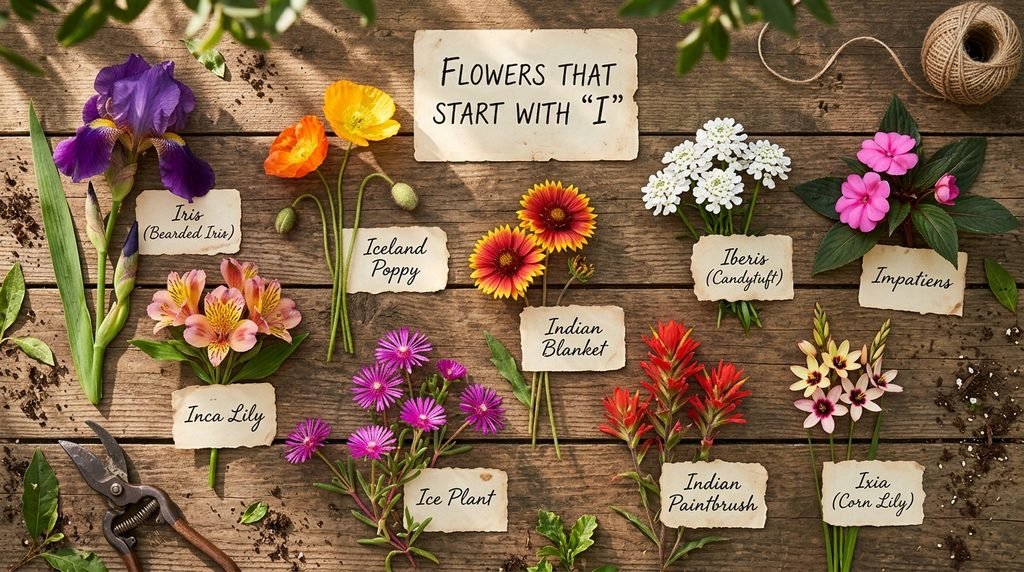
- Iberis amara (Rocket Candytuft)
- Iberis sempervirens (Evergreen Candytuft)
- Iberis umbellata (Globe Candytuft)
- Ice Plant
- Iceland Poppy
- Illawarra Flame Tree
- Impatiens balsamina (Garden Balsam)
- Impatiens hawkeri (New Guinea Impatiens)
- Impatiens walleriana (Busy Lizzie)
- Imperial Crown (Crown Imperial)
- Inca Lily
- Incarvillea (Hardy Gloxinia)
- Indian Bean Tree
- Indian Blanket
- Indian Coral Tree
- Indian Cork Tree
- Indian Hawthorn
- Indian Laburnum
- Indian Lotus
- Indian Paintbrush
- Indian Physic
- Indian Pink
- Indian Pipe
- Indian Plum
- Indian Poke
- Indian Rhubarb
- Indian Shot
- Indian Tobacco
- Indian Tulip Tree
- Indigofera (Indigo)
- Inula (Elecampane)
- Iochroma (Violet Tubeflower)
- Ionopsidium (Diamond Flower)
- Ipheion (Spring Starflower)
- Ipomoea alba (Moonflower)
- Ipomoea tricolor (Heavenly Blue Morning Glory)
- Ipomopsis (Standing Cypress)
- Iris cristata (Crested Iris)
- Iris ensata (Japanese Iris)
- Iris germanica (Bearded Iris)
- Iris × hollandica (Dutch Iris)
- Iris pseudacorus (Yellow Flag Iris)
- Iris reticulata (Netted Iris)
- Iris sibirica (Siberian Iris)
- Iris unguicularis (Algerian Iris)
- Iris versicolor (Blue Flag Iris)
- Ironweed
- Isatis (Woad)
- Island Bush Poppy
- Island Mallow
- Ismelia (Painted Daisy)
- Ismene (Peruvian Daffodil)
- Isoplexis (Canary Island Foxglove)
- Isopogon (Drumsticks)
- Isotoma
- Italian Bugloss
- Italian Honeysuckle
- Italian Jasmine
- Itea (Virginia Sweetspire)
- Itoh Peony
- Ivy Geranium
- Ivy-Leaved Cyclamen
- Ixia (Corn Lily)
- Ixiolirion (Tartar Lily)
- Ixora (Jungle Geranium)
A few names cause mix-ups. Indian Rhubarb is the same plant as Umbrella Plant, Darmera peltata. Ipheion is now often filed under Tristagma, so older tags may use either name. Ivy Geranium is a Pelargonium, not a true hardy Geranium, and it needs frost protection in most climates.
Simple Read More: 80+ Beautiful Flowers That Start With H (With Pictures & Names)
Comparison Table: Region, Bloom Time, Zones, and Safety
The table below compares 14 popular flowers side by side. Columns cover native region, bloom season, hardiness zones, and toxicity. Hardiness zones show where a plant survives winter outdoors, so check your own zone before buying.
| Flower | Native Region | Bloom Season | Hardiness Zones | Toxicity |
| Bearded Iris | Mediterranean region | Late spring | 3–9 | Mild to moderate; rhizomes |
| Siberian Iris | Europe and Russia | Early summer | 3–9 | Mild |
| Busy Lizzie (Impatiens) | East Africa | Late spring to frost | Annual | Non-toxic |
| Iceland Poppy | Subarctic regions | Cool seasons | 2–8 | Mild |
| Evergreen Candytuft | Southern Europe | Spring | 3–9 | Minimal |
| Ice Plant | South Africa | Summer | 5–9 | Minimal |
| Indian Blanket | North America | Summer to fall | Annual or short-lived | Minimal |
| Imperial Crown | Iran to the Himalayas | Spring | 5–8 | Moderate; bulbs |
| Indian Pink | Southeastern United States | Late spring to early summer | 5–9 | Moderate if eaten |
| Ivy-Leaved Cyclamen | Southern Europe to Turkey | Late summer to fall | 5–9 | Moderate; tubers |
| Virginia Sweetspire | Eastern United States | Early summer | 5–9 | Minimal |
| Ixora | Southern Asia | Year-round in the tropics | 10–12 | Non-toxic |
| Itoh Peony | Japan (hybrid) | Late spring to early summer | 3–8 | Mild |
| Heavenly Blue Morning Glory | Mexico and Central America | Summer to fall | Annual in most zones | Moderate; seeds |
Three rows deserve a second look. Imperial Crown and Ivy-Leaved Cyclamen both hide their risk in the bulb or tuber, which dogs may dig up. Heavenly Blue Morning Glory looks innocent, yet its seeds are toxic. Busy Lizzie and Ixora sit at the safe end, which makes them good picks for homes with curious pets.
Garden Favorites for Sun, Shade, and Wet Soil
Gardeners who want easy wins among flowers that start with I should begin with Iris, Impatiens, and Candytuft. Siberian Iris thrives in average soil and returns for years with little care.
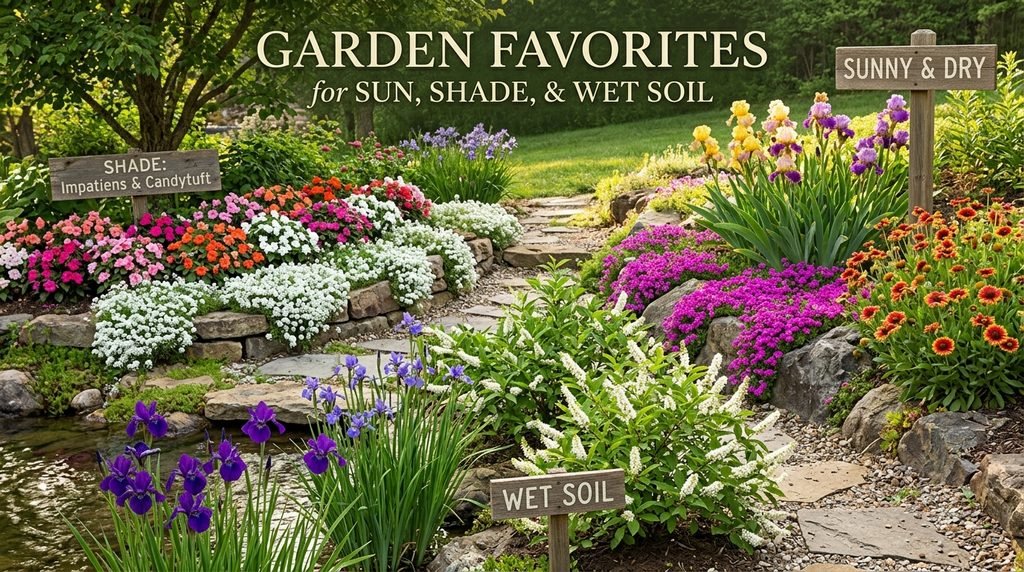
Bearded Iris needs full sun and sharp drainage, and Japanese Iris loves wet feet. Impatiens fills shade with color, and New Guinea types handle more sun. Candytuft spills over walls and borders with white spring flowers. Ice Plant and Indian Blanket suit hot, dry beds, while Virginia Sweetspire adds fragrant white spikes and red fall leaves.
Explore More Flower Guides: 80+ Beautiful Flowers That Start With C (With Pictures, Names & Meanings)
Best Indoor Plants and Houseplants
Few plants live well indoors, but a few do. Ixora is the top pick for a bright, warm room. It produces round clusters of red, orange, or yellow flowers and likes humid air. Ivy Geranium trails from hanging baskets and blooms heavily in strong light. Impatiens grows on a sunny windowsill and roots easily from cuttings. Ismene, the Peruvian Daffodil, sends up fragrant white flowers from a potted bulb. Netted Iris can be forced in small pots in winter, which brings early spring color indoors.
Cut Flowers That Florists Love
Dutch Iris is a florist staple because its slim, elegant blooms open fast in a vase. Iceland Poppy adds silky, tissue-like petals in soft pastels. Sealing the cut stem ends helps them last longer.
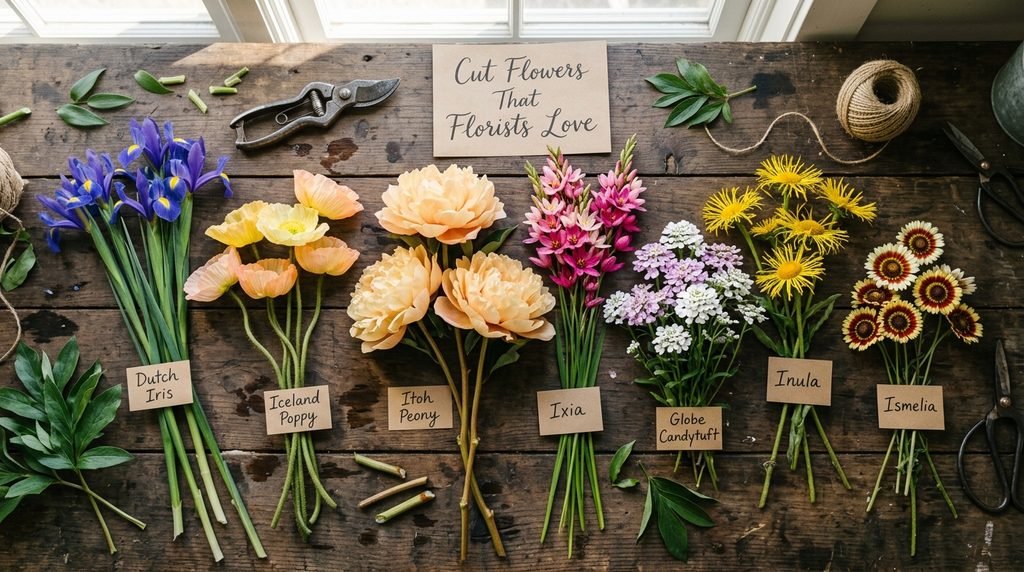
Itoh Peony brings huge, ruffled blooms on sturdy stems. Ixia, or Corn Lily, offers tall, colorful spikes, and Globe Candytuft adds a light, airy filler. Inula and Ismelia bring daisy-like shapes to casual, garden-style bouquets. Each one suits a different mood, from formal to relaxed.
Rare and Unusual Finds
Some flowers are hard to find, and each has its own story. Indian Pipe, or Monotropa uniflora, has no green color at all. It lives off underground fungi and cannot be moved from the wild.
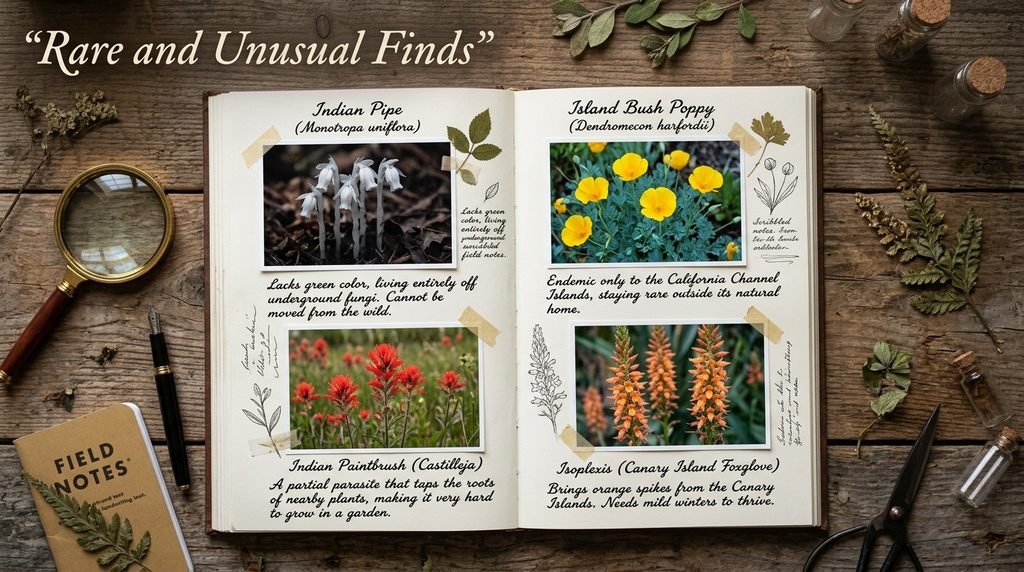
Indian Paintbrush is a partial parasite that taps the roots of nearby plants, which makes it very hard to grow in a garden. Island Bush Poppy grows only on the California Channel Islands, so it stays rare outside its home. Isoplexis, the Canary Island Foxglove, brings orange spikes from the Canary Islands but needs mild winters. Specialty nurseries and native plant societies are the best places to look.
You May Also Like: 65+ Beautiful Flowers That Start With G (With Pictures & Names)
Toxic Flowers and Safety Notes
Several I plants can cause real harm. Indian Pipe, or Veratrum viride, contains strong alkaloids that can be deadly. Isoplexis is a close relative of Foxglove and affects the heart in a similar way. Indian Tobacco contains lobeline, which causes vomiting and worse in large doses. Imperial Crown bulbs contain steroidal alkaloids, and the whole plant has a strong, skunky smell.
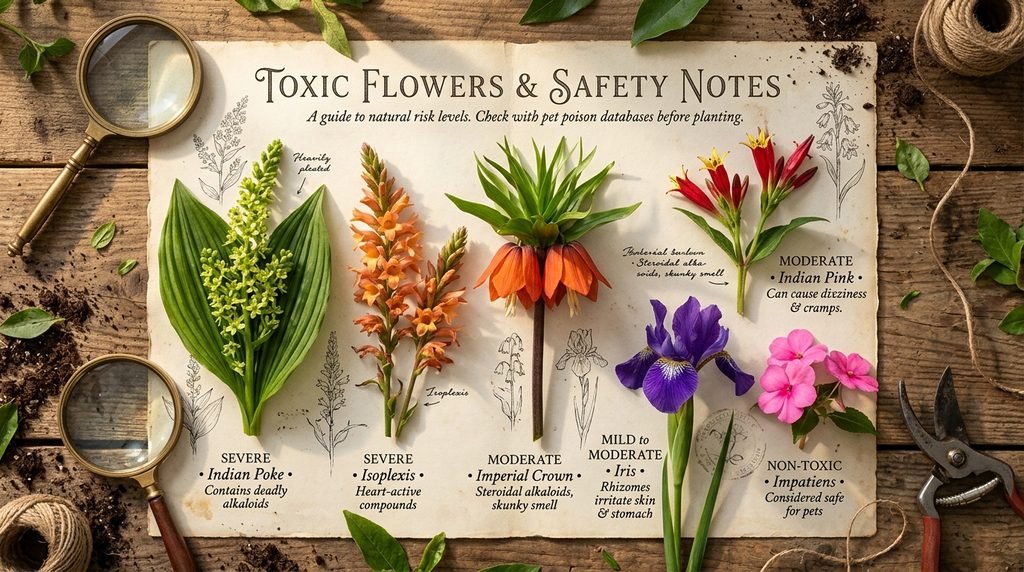
The table below ranks the main risks on this list. Levels reflect the effect of eating a meaningful amount, not a light touch. Check any plant against a pet poison database before planting it near animals.
| Flower | Toxicity Level | Main Concern |
| Indian Poke (Veratrum viride) | Severe | Strong alkaloids; can be deadly |
| Isoplexis | Severe | Heart-active compounds, like Foxglove |
| Indian Tobacco (Lobelia inflata) | Moderate to severe | Lobeline causes vomiting and weakness |
| Imperial Crown | Moderate | Steroidal alkaloids can affect the heart |
| Indian Pink | Moderate | Spigeline can cause dizziness and cramps |
| Iochroma | Moderate | Tropane-type alkaloids, like other nightshades |
| Ivy-Leaved Cyclamen | Moderate | Tubers contain saponins; harmful if dug up and chewed |
| Heavenly Blue Morning Glory | Moderate | Seeds contain mind-altering compounds |
| Indian Coral Tree | Moderate | Seeds contain toxic alkaloids |
| Iris | Mild to moderate | Rhizomes upset the stomach and can irritate skin |
| Indigofera | Mild | Some species harm grazing animals |
| Impatiens | Non-toxic | Considered safe for pets |
Indian Poke and Ixora deserve the most care. Both are rare in home gardens, but they appear in wild areas and specialty plantings. Impatiens and Ixora sit at the opposite end, which is why they suit homes with pets.
Color Groups: Blue, Pink, White, Yellow, and Unusual
Color often drives the choice of flowers that start with I. This section groups the plants by shade and shows where each group works best.
Blue and purple shades have rich options. Iris leads the way in every shade of violet. Italian Bugloss, Ipheion, Heavenly Blue Morning Glory, Ironweed, and Iochroma add more depth. Pair them with yellow blooms for strong contrast. Pink and red shades come from Impatiens, Indian Pink, Illawarra Flame Tree, Ixora, and Incarvillea. They suit warm, bold borders and containers.
White flowers glow in low light. Candytuft, Virginia Sweetspire, Indian Plum, Ismene, and Diamond Flower all fit here. They work well in shaded corners and wedding designs. Yellow and orange flowers bring sunny energy. Inula, Woad, Indian Blanket, Imperial Crown, and Island Bush Poppy thrive in full sun and keep borders bright. Unusual shapes round out the list. Indian Pipe looks like a ghostly candle, and Indian Poke has tall green flowers that blend into a woodland.
Life Cycle Guide: Annuals, Perennials, Bulbs, and Shrubs
Life cycle tells a gardener how much work a plant needs. Annuals bloom for one season and end. Perennials return each year. Bulbs and tubers store energy underground, while shrubs form a lasting frame. Matching the life cycle to your plan saves money, time, and replanting.
| Flower | Life Cycle | What to Expect |
| Garden Balsam | Annual | One season; self-seeds easily |
| Busy Lizzie | Annual or tender perennial | Blooms until frost |
| Diamond Flower | Annual | Tiny blooms; cool weather |
| Globe Candytuft | Annual | Spring to early summer |
| Indian Blanket | Annual or short-lived perennial | Self-seeds in sunny spots |
| Iceland Poppy | Short-lived perennial | Often grown as a biennial |
| Evergreen Candytuft | Perennial | Long-lived; trim after bloom |
| Siberian Iris | Perennial | Long-lived; divide every few years |
| Bearded Iris | Perennial rhizome | Divide every three to four years |
| Dutch Iris | Bulb | Best in the first year |
| Netted Iris | Bulb | Very early spring bloom |
| Imperial Crown | Bulb | Slow to settle; needs drainage |
| Spring Starflower | Bulb | Naturalizes into large drifts |
| Ivy-Leaved Cyclamen | Tuber | Blooms in fall; long-lived |
| Itoh Peony | Perennial | Strong stems; long-lived |
| Virginia Sweetspire | Shrub | Spreads slowly into a thicket |
Annuals give the fastest color but need replanting. Perennials, bulbs, and shrubs cost more at first and pay off over time. Iceland Poppy offers a middle path, since each plant lives only a few years but reseeds so the display keeps going.
Botanical Name Crosswalk
Botanical names matter when you buy plants or search online. Common names change by region and can point to several plants. Morning Glory, for example, covers many Ipomoea species with different habits. A botanical name gives one clear answer, which prevents mix-ups at the nursery.
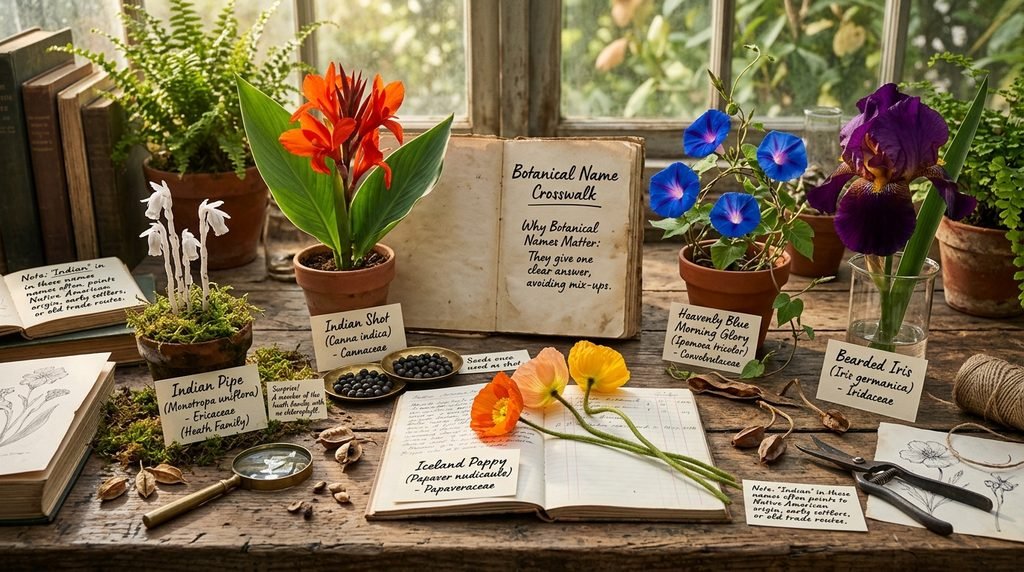
| Common Name | Botanical Name | Family |
| Evergreen Candytuft | Iberis sempervirens | Brassicaceae |
| Iceland Poppy | Papaver nudicaule | Papaveraceae |
| Busy Lizzie | Impatiens walleriana | Balsaminaceae |
| Imperial Crown | Fritillaria imperialis | Liliaceae |
| Indian Blanket | Gaillardia pulchella | Asteraceae |
| Indian Paintbrush | Castilleja spp. | Orobanchaceae |
| Indian Pipe | Monotropa uniflora | Ericaceae |
| Indian Shot | Canna indica | Cannaceae |
| Indian Tobacco | Lobelia inflata | Campanulaceae |
| Indian Poke | Veratrum viride | Melanthiaceae |
| Spring Starflower | Ipheion uniflorum | Amaryllidaceae |
| Heavenly Blue Morning Glory | Ipomoea tricolor | Convolvulaceae |
| Bearded Iris | Iris germanica | Iridaceae |
| Virginia Sweetspire | Itea virginica | Iteaceae |
| Jungle Geranium | Ixora coccinea | Rubiaceae |
| Ivy Geranium | Pelargonium peltatum | Geraniaceae |
Two surprises show up here. Indian Pipe belongs to the heath family, the same family as Blueberry and Rhododendron, despite having no green color. Indian Shot is a Canna, and the name comes from its hard seeds, which people once used as shot. The word Indian in many of these names has little to do with India. It often points to Native American plants, early settlers, or old trade routes.
Meanings and Symbolism
Flowers that start with I carry deep stories, and many have shaped how people give and read flowers. Iris takes its name from the Greek goddess of the rainbow. She carried messages between gods and people. Because of that, Iris has long stood for faith, hope, and wisdom. Many people also link its shape to the French fleur-de-lis.
Impatiens has a playful story. Its ripe seed pods burst when touched, so it earned the nickname touch-me-not. The Latin name means impatient. In the language of flowers, it stood for ardent love or a lack of patience. Indian Lotus is the national flower of India. It rises clean from muddy water, so it stands for purity and spiritual growth in Hindu and Buddhist traditions.
Imperial Crown has a famous legend. Folk tales say it once held its head high, then bowed in shame, and now each bell holds a tear. Iceland Poppy brings a cheerful message, and its silky petals suggest comfort and sleep. Indian Blanket is the state wildflower of Oklahoma, and its red-and-gold pattern is said to resemble woven blankets. Ixora is used in Hindu worship, where its bright red clusters stand for devotion.
Decision Guide: Match the Flower to Your Space
Use the table below to narrow your choices fast. Start with the row that matches your main need, such as shade, wet soil, or pet safety. Then compare the suggested plants and pick the one that suits your climate. Anyone sorting flowers that start with I will find this the quickest route from a long list to a final choice.
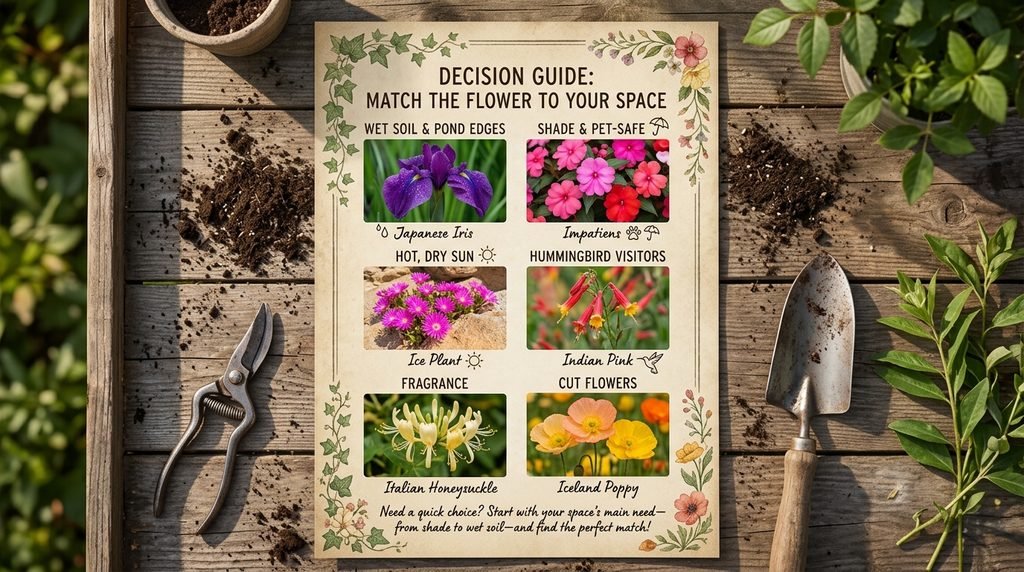
| If You Need | Try These |
| Wet soil or a pond edge | Japanese Iris, Siberian Iris, Blue Flag Iris |
| Shade and steady color | Impatiens, Indian Pink |
| Hot, dry sun | Ice Plant, Indian Blanket |
| Early spring bulbs | Netted Iris, Spring Starflower |
| Cut flowers | Dutch Iris, Iceland Poppy |
| Pet-safe options | Impatiens, Ixora |
| Hummingbird visitors | Indian Pink, Ipomopsis, Iochroma |
| Fragrance | Itea, Italian Honeysuckle, Italian Jasmine |
| Edging and rock gardens | Candytuft, Ice Plant |
| Tropical color | Ixora, Illawarra Flame Tree |
No single plant fits every need. Impatiens and Ixora work for homes with curious pets, while Japanese Iris handles soggy ground that kills most flowers. If safety is a concern, skip the severely toxic plants from the earlier table and choose from the pet-safe row first.
Conclusion
Flowers that start with I offer something for nearly every garden, windowsill, and vase. They range from easy beginners such as Siberian Iris and Impatiens to rare treasures such as Indian Pipe. A few, like Indian Pipe and Isoplexis, call for real caution. Use the tables and guides above to match each plant to your light, space, and household. With so many choices, there is room to experiment.
Frequently Asked Questions
Siberian Iris, Impatiens, Candytuft, and Indian Blanket are all beginner-friendly. They tolerate average soil and need little fuss. Most return or reseed with minimal care.
Indian Poke, Isoplexis, and Indian Tobacco are the most dangerous. Imperial Crown, Indian Pink, and Ivy-Leaved Cyclamen are also toxic if eaten. Keep all of them away from children and pets.
Impatiens is considered non-toxic to cats and dogs. This makes it a popular pick for pet owners. It still needs shade or part shade and steady moisture.
Japanese Iris, Blue Flag Iris, and Yellow Flag Iris all enjoy wet ground. Siberian Iris tolerates damp soil too. Bearded Iris needs sharp drainage, so it does poorly in wet beds.
Downy mildew is a common cause for Busy Lizzie. New Guinea Impatiens resists it better. Water the soil, not the leaves, and give plants good airflow.
Indian Pipe is a true flowering plant. It has no chlorophyll and gets its food from underground fungi. It is best enjoyed in the wild, since it cannot be transplanted.
It is a partial parasite and draws water and nutrients from the roots of nearby plants. Without a suitable host, it struggles. Native plant specialists sometimes succeed by seeding it with grasses.
Plant Bearded Iris rhizomes in late summer. Plant Dutch and Netted Iris bulbs in fall. Siberian Iris can go in during spring or fall.

2 thoughts on “60+ Beautiful Flowers That Start With I (With Pictures & Names)”