
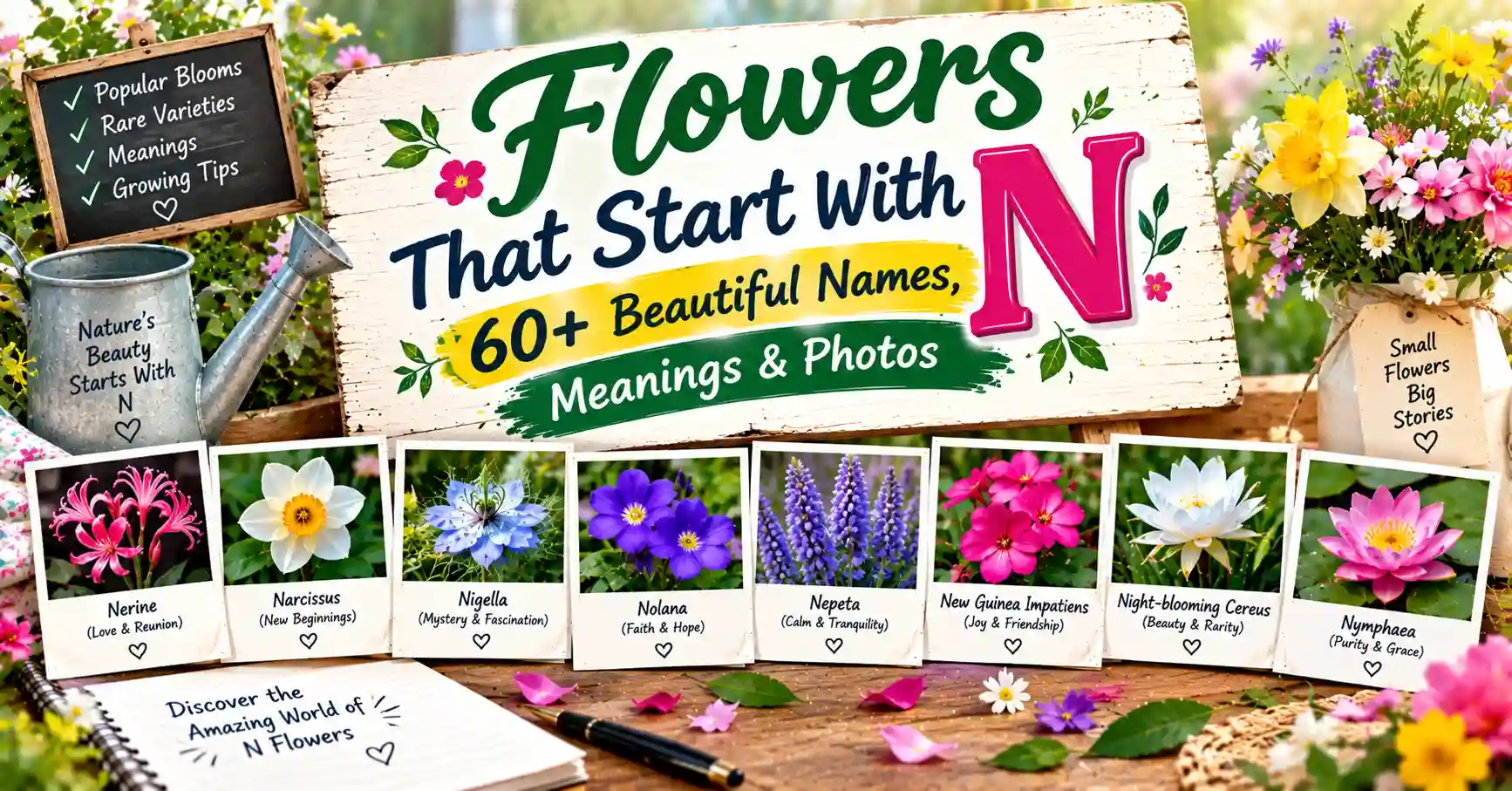
Flowers that start with N are full of night-time magic and spring cheer. Narcissus, nasturtium, nigella, and nepeta are the names most gardeners know. But the letter N also hides a cactus that flowers for a single night, a jasmine that perfumes the dark, and a rare shrub with fluffy white stamens. This guide gathers 62 of them in one place.
Every plant below is real and has a verified botanical name. You will find border favorites, night-scented flowers, houseplants, florist picks, wildflowers, and a few rarities. Three entries are grown mainly for berries, shade, or safety awareness, and each one is clearly marked as an exception.
A long list only helps if you can use it. So this guide sorts the plants by color, life cycle, and use. A bloom’s beauty means little if it dies in your climate. It means even less if it harms a child or a pet. Each table is explained in plain words first, so you never face a bare spreadsheet.
Quick Answer: Ten Standout N Flowers
Narcissus is the spring classic, with golden trumpets that arrive when the garden is still bare. Nasturtium is the easy, edible annual that blooms in poor soil and tastes peppery in salads. Nepeta, also called catmint, gives lavender-blue spikes for months and attracts bees and cats alike. Nigella adds blue stars and striped seed pods, and New England aster lights up autumn for monarch butterflies.
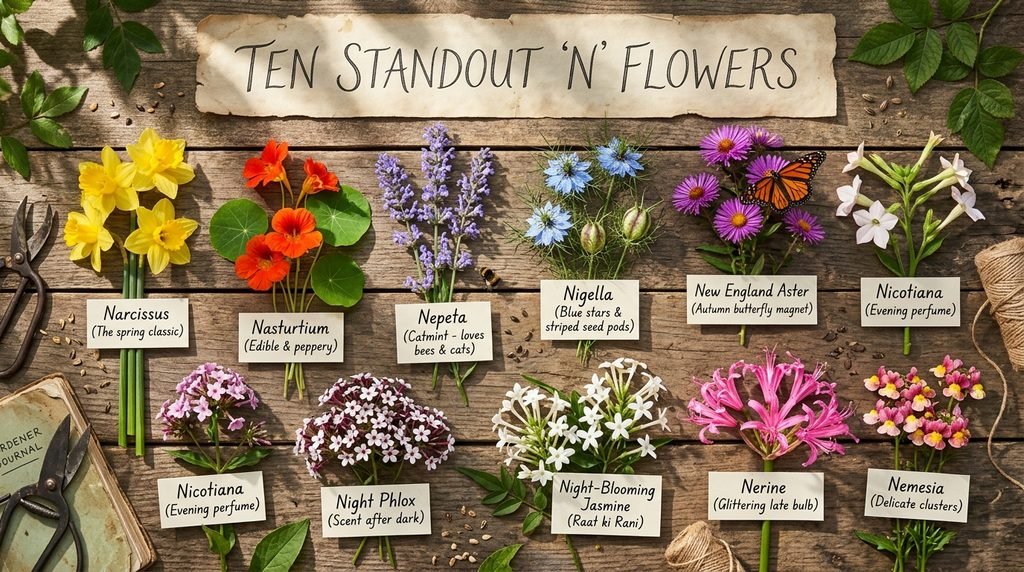
Nicotiana and night phlox are the evening perfume plants, while night-blooming jasmine, known in Urdu as raat ki rani, fills a whole yard with scent after dark. Nerine closes the list as the glittering pink bulb that blooms when most flowers are finished.
Read More: Flowers That Start With P: Beautiful Names, Meanings & Photos
Master Alphabetical List of Flowers That Start With N
This list names 62 flowers. Most entries use a common name that gardeners already know. A few are better known by their botanical name, so they appear under the name nurseries print on plant tags. Each row has a short note, so you can see at a glance what the plant looks like and where it grows best. Three entries are marked as exceptions because the flower is not the main reason people grow them.
| Flower | Botanical Name | Note |
| Nagkesar | Mesua ferrea | Fragrant white flowers on a sacred South Asian tree |
| Naked Lady | Amaryllis belladonna | Pink trumpets on bare stems, toxic bulbs |
| Nandina (exception) | Nandina domestica | White spring panicles, grown for berries, toxic |
| Nanking Cherry | Prunus tomentosa | Pink-white early blossom, edible fruit |
| Naples Garlic | Allium neapolitanum | White star clusters in spring |
| Narcissus | Narcissus pseudonarcissus | Yellow spring trumpets, toxic bulbs |
| Narcissus (Paperwhite) | Narcissus papyraceus | Fragrant white clusters, easy to force indoors |
| Narcissus (Poet’s) | Narcissus poeticus | White petals with a red-rimmed cup |
| Narrowleaf Coneflower | Echinacea angustifolia | Pale pink drooping petals on a prairie native |
| Narrowleaf Milkweed | Asclepias fascicularis | Pale pink clusters, monarch host, toxic |
| Narrowleaf Zinnia | Zinnia angustifolia | Orange daisies, heat and drought tough |
| Nasturtium | Tropaeolum majus | Edible orange and red blooms |
| Natal Lily | Clivia miniata | Orange trumpets for shady rooms |
| Natal Plum | Carissa macrocarpa | White star flowers, fragrant at night |
| Navelwort | Omphalodes verna | Blue forget-me-not-like blooms for shade |
| Nectaroscordum | Nectaroscordum siculum | Nodding bells striped green and maroon |
| Neem (exception) | Azadirachta indica | Tiny honey-scented white flowers on a shade tree |
| Nelumbo (American Lotus) | Nelumbo lutea | Pale yellow lotus for large ponds |
| Nemesia | Nemesia strumosa | Cool-season blooms in bright colors |
| Nemophila | Nemophila menziesii | Sky-blue cups with white centers |
| Neomarica | Neomarica gracilis | Blue-white iris-like blooms on a walking plant |
| Nepal Cinquefoil | Potentilla nepalensis | Pink or orange-red strawberry-like flowers |
| Nepeta (Catmint) | Nepeta × faassenii | Lavender-blue spikes, long bloom |
| Nerine | Nerine bowdenii | Glittering pink spider-like autumn blooms |
| Nerium (Oleander) | Nerium oleander | Pink or white clusters, highly toxic |
| Nettle-Leaved Bellflower | Campanula trachelium | Purple bells on tall stems |
| Neviusia (Alabama Snow-Wreath) | Neviusia alabamensis | Rare shrub with fluffy white stamens |
| New England Aster | Symphyotrichum novae-angliae | Purple fall daisies, monarch magnet |
| New Jersey Tea | Ceanothus americanus | White clustered blooms on a native shrub |
| New Mexico Locust | Robinia neomexicana | Pink pea-flower clusters on a tough shrub |
| New Zealand Christmas Tree | Metrosideros excelsa | Crimson brush flowers at Christmas time in New Zealand |
| Nicandra (Apple of Peru) | Nicandra physalodes | Blue bells, lantern-like pods, toxic |
| Nicotiana | Nicotiana alata | Evening-fragrant tubular blooms, toxic |
| Nierembergia | Nierembergia scoparia | Cupped lavender flowers for baskets |
| Nigella | Nigella damascena | Blue blooms and striped seed pods |
| Night Phlox | Zaluzianskya capensis | White blooms with a honey-almond scent after dusk |
| Night-Blooming Cereus | Selenicereus grandiflorus | Huge white flower that opens for one night |
| Night-Blooming Jasmine | Cestrum nocturnum | Greenish-white blooms that perfume the night |
| Night-Scented Stock | Matthiola longipetala | Plain lilac blooms, strongly fragrant at dusk |
| Nightshade (exception) | Solanum nigrum | White star flowers on a toxic weed, listed for safety |
| Nikko Blue Hydrangea | Hydrangea macrophylla ‘Nikko Blue’ | Big blue mophead blooms |
| Nippon Daisy | Nipponanthemum nipponicum | White fall daisies, tough coastal plant |
| Noble Dendrobium | Dendrobium nobile | Cane orchid with pink-white blooms |
| Nodding Catchfly | Silene nutans | Nodding white flowers, scented at night |
| Nodding Lady’s Tresses | Spiranthes cernua | White spiral orchid spikes in fall |
| Nodding Onion | Allium cernuum | Pink nodding globes, native |
| Nodding Pogonia | Triphora trianthophora | Rare tiny white-pink orchid, blooms for a day |
| Nodding Trillium | Trillium cernuum | White flower hidden under the leaves |
| Noisette Rose | Rosa × noisettiana | Fragrant, repeat-blooming old climbing rose |
| Nolana | Nolana paradoxa | Blue trumpet blooms for baskets |
| Nomocharis | Nomocharis pardanthina | Rare Himalayan lily relative with spotted blooms |
| Nootka Lupine | Lupinus nootkatensis | Blue-purple spikes on a Pacific coast wildflower |
| Nootka Rose | Rosa nutkana | Pink wild rose, tough and fragrant |
| Norfolk Island Hibiscus | Lagunaria patersonia | Pink hibiscus-like blooms on a coastal tree |
| Northern Beardtongue | Penstemon procerus | Small blue-purple tubular blooms |
| Northern Blue Flag | Iris versicolor | Wetland iris in blue-violet |
| Northern Bog Violet | Viola nephrophylla | Violet blooms for wet meadows |
| Northern Wild Monkshood | Aconitum noveboracense | Rare, blue-violet hooded spikes, highly toxic |
| Nun’s Orchid | Phaius tankervilleae | Tall spikes of brown-white orchid flowers |
| Nuttall’s Violet | Viola nuttallii | Yellow prairie violet |
| Nymphaea (Water Lily) | Nymphaea alba | Classic floating pond bloom |
| Nymphoides (Floating Heart) | Nymphoides peltata | Yellow-fringed blooms on pond water |
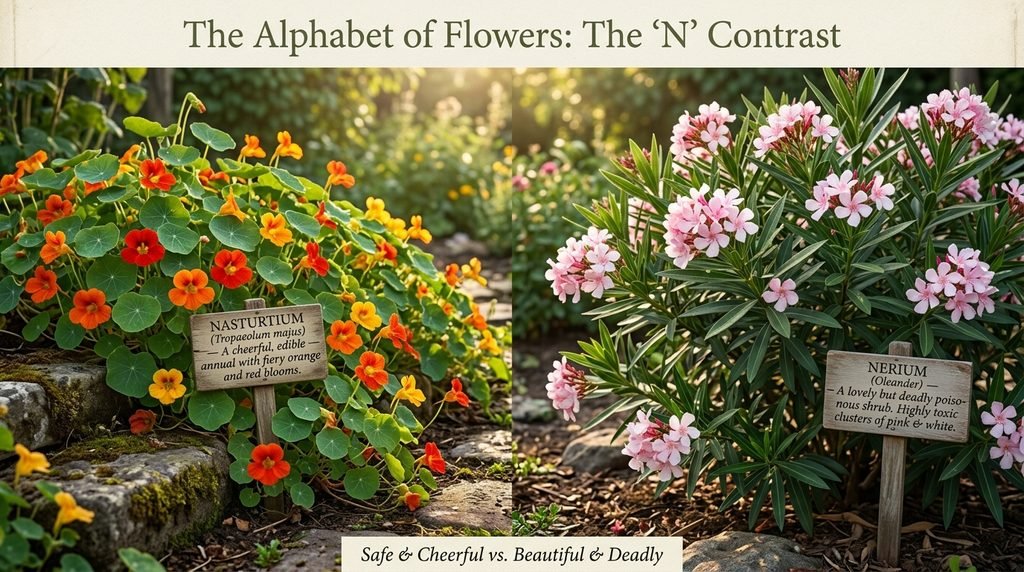
That table names 62 distinct flowers that start with N. Nasturtium and Nerium sit at opposite ends of the story. One is a cheerful, edible annual. The other is a lovely shrub that is deadly poisonous. Both show how wide this single letter reaches.
Explore More Flower Guides: 80+ Beautiful Flowers That Start With L (With Pictures & Names)
Full Comparison Table: Sun, Water, and Bloom Time
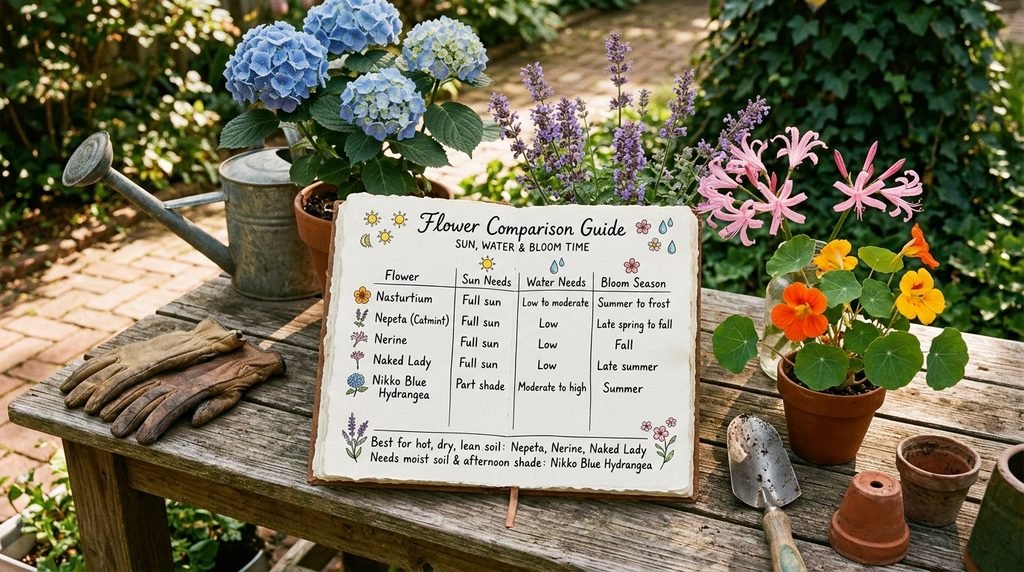
When two plants seem equally good, sun and water needs usually pick the winner. The table below compares the main N flowers from this guide. Read the sun column first. Then check the water column and the bloom season to see if the plant fits your space and your calendar.
| Flower | Sun Needs | Water Needs | Bloom Season |
| Nasturtium | Full sun | Low to moderate | Summer to frost |
| Nemesia | Full sun | Moderate | Spring to summer in cool weather |
| Nemophila | Full sun to part shade | Moderate | Spring |
| Nepeta (Catmint) | Full sun | Low | Late spring to fall |
| Nerine | Full sun | Low | Fall |
| Nicotiana | Full sun to part shade | Moderate | Summer to fall (scented at dusk) |
| Nigella | Full sun | Low to moderate | Late spring to summer |
| Night Phlox | Full sun | Moderate | Summer (scented at dusk) |
| New England Aster | Full sun | Moderate | Fall |
| Narcissus | Full sun to part shade | Moderate | Early to mid-spring |
| Naked Lady | Full sun | Low | Late summer |
| Nodding Onion | Full sun to part shade | Low to moderate | Summer |
| Nikko Blue Hydrangea | Part shade | Moderate to high | Summer |
| Night-Blooming Cereus | Bright indirect light | Low | Summer nights |
| Natal Lily | Bright indirect light to shade | Low to moderate | Late winter to spring |
| Nymphaea (Water Lily) | Full sun | Aquatic | Summer |
| Nanking Cherry | Full sun | Moderate | Early spring |
| Nierembergia | Full sun to part shade | Moderate | Summer |
Nepeta, nerine, and naked lady are the best picks for hot, dry, lean soil. All three bloom better when they are not overwatered. Nikko Blue hydrangea sits at the other end. It wants moist soil and some afternoon shade.
Garden Favorites Among N Flowers
A handful of N flowers earn a place in almost every garden. Nepeta blooms for months and needs almost no care. Nasturtium sprawls over beds and walls with bright edible flowers. Nigella fills gaps with blue stars and later with striped pods. Narcissus returns every spring with no fuss at all.
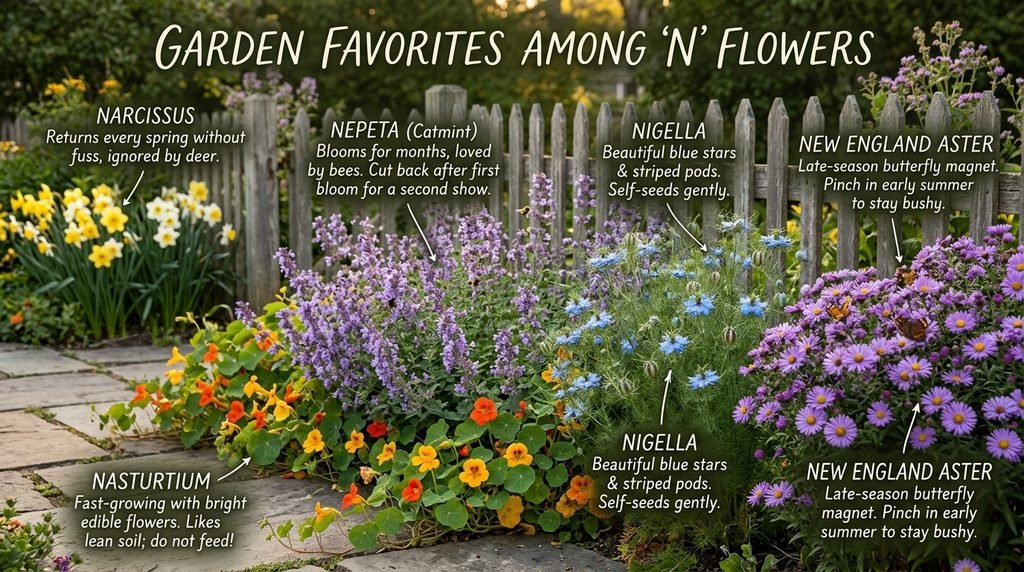
- Nepeta thrives in full sun and poor soil, and bees swarm to it.
- Nasturtium grows fast from large seeds and likes lean soil.
- Nigella self-seeds gently and gives pods for dried arrangements.
- Narcissus multiplies on its own and is ignored by deer.
- New England Aster feeds late-season butterflies and bees.
Nepeta and New England aster make a strong pair. One carries the early summer, and the other carries the fall. Together they keep a sunny border alive for months.
A few care habits keep these plants happy. Do not feed nasturtium, or you will get leaves and few flowers. Cut nepeta back by half after its first flush for a second bloom. Pinch New England aster in early summer so it stays bushy. Let narcissus leaves die back naturally after blooming, since they feed the bulb for next year.
Indoor and Container Picks Among N Flowers
Only a few N plants thrive indoors, but they are worth knowing. Natal lily, also called clivia, blooms in shade with orange trumpets in late winter. Paperwhite narcissus can be forced in a bowl of pebbles and water for scented winter blooms. Noble dendrobium and nun’s orchid bring orchid beauty to bright windowsills. Night-blooming cereus is a trailing cactus that can flower indoors if it gets enough light.
- Natal Lily likes bright shade and blooms best when slightly root-bound.
- Narcissus (Paperwhite) blooms in about four to six weeks from bulbs in water.
- Noble Dendrobium needs a cool, dry rest in winter to set buds.
- Night-Blooming Cereus needs bright light and a long wait for its one-night bloom.
Natal lily is the pick for beginners. It forgives missed waterings. Paperwhites are the fastest reward, but the bulbs are poisonous, so keep them out of reach of children and pets.
Light matters more than anything else for indoor N plants. A bright east window suits natal lily and orchids. Avoid cold drafts and soggy saucers. Most of these plants fail from too much water, not too little.
Florist Favorites Among N Flowers
Florists use N flowers for scent, texture, and early color. Narcissus brings golden spring cheer to bouquets, though its sap harms other flowers if not handled well. Nerine gives sparkly pink stems that last for two weeks in a vase. Nigella adds blue stars and striped pods for texture. Nasturtium flowers appear on cakes and plates as an edible garnish.
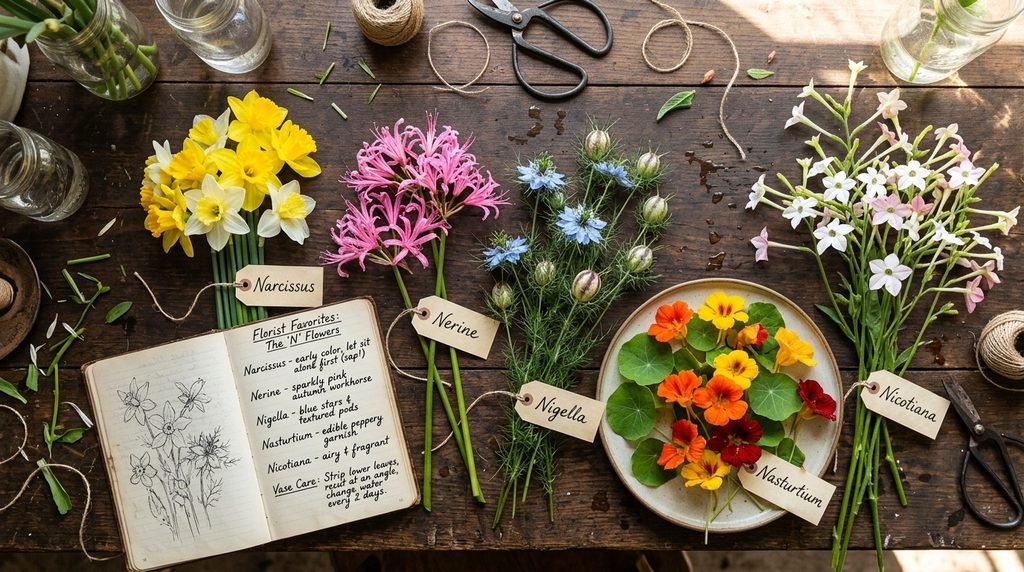
- Narcissus brings early color and strong scent to spring arrangements.
- Nerine lasts a long time and adds sparkle to autumn bouquets.
- Nigella gives blue blooms and pods that dry well.
- Nasturtium is a peppery, edible garnish for salads and cakes.
- Nicotiana adds airy, fragrant stems to cottage-style arrangements.
Nerine and nigella are the quiet workhorses. They hold up well in the vase and add shape that softer blooms lack. A florist’s bouquet in autumn would feel empty without nerine.
Good vase care doubles the life of any cut flower. Strip the leaves below the water line. Recut the stems at an angle. Change the water every two days. For narcissus, let the stems sit alone in water for an hour first, since their sap can harm other cut flowers.
Rare and Unusual N Flowers
Some N plants are hard to find or hard to grow. Night-blooming cereus is the most famous. Its huge white flower opens after dark and closes by dawn, so many gardeners wait years for one night of bloom. Neviusia, the Alabama snow-wreath, is a rare shrub from the southeastern United States with fluffy white stamens instead of petals. Northern wild monkshood is a threatened native with blue-violet hooded flowers, found only in a few cool, damp places. Nodding pogonia is a tiny wild orchid that blooms for just a day or two in late summer.
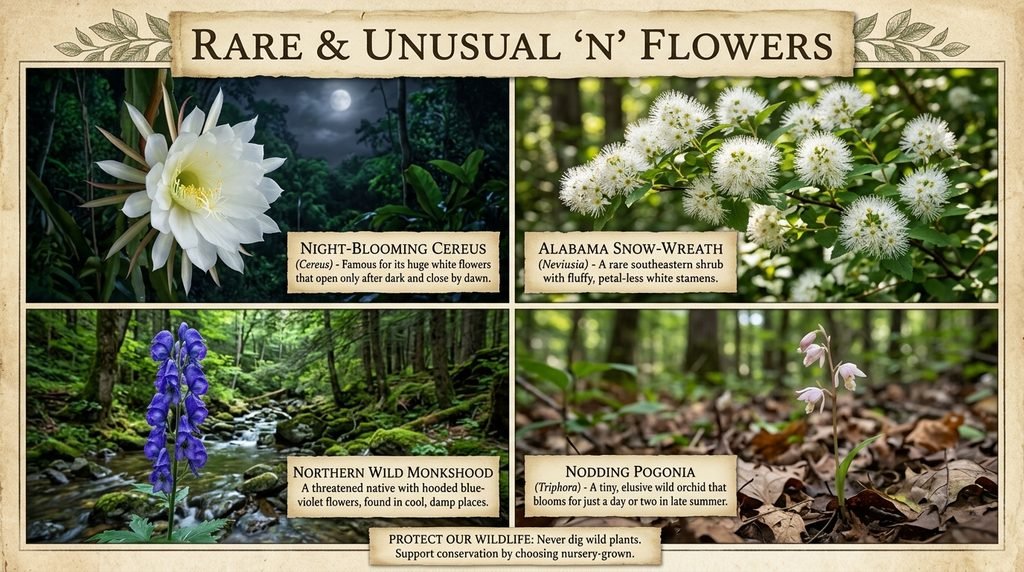
These four plants share one trait. Each wants a very specific home. That is why they stay special. If you want to grow one, buy nursery-grown plants only. Never dig wild plants, since many rare N species are protected by law.
You May Also Like: 80+ Beautiful Flowers That Start With L (With Pictures & Names)
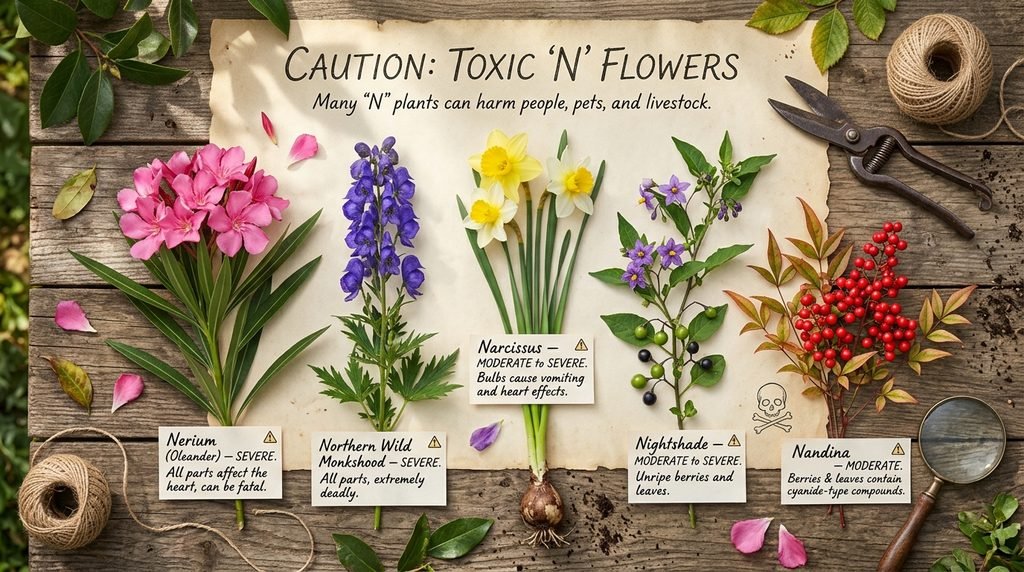
Caution: Toxic N Flowers
Several N plants can harm pets, livestock, or people. Nerium, also called oleander, is the most dangerous. Every part of the plant is poisonous, and even a small amount can affect the heart. Northern wild monkshood is just as deadly. Narcissus bulbs, naked lady bulbs, and Nicotiana leaves can all cause serious illness if eaten. Nightshade and nicandra carry toxic berries and pods.
| Flower | Toxic To | Severity |
| Nerium (Oleander) | Humans, dogs, cats, horses, livestock | Severe — all parts affect the heart, can be fatal |
| Northern Wild Monkshood | Humans, dogs, cats, horses, livestock | Severe — all parts, can be fatal |
| Naked Lady | Dogs, cats, horses | Moderate to severe — bulbs are the riskiest part |
| Narcissus | Dogs, cats, horses | Moderate to severe — bulbs cause vomiting and heart effects |
| Nicotiana | Humans, dogs, cats, livestock | Moderate to severe — nicotine-type alkaloids |
| Nightshade | Humans, dogs, cats, livestock | Moderate to severe — unripe berries and leaves |
| Narrowleaf Milkweed | Dogs, cats, horses, livestock | Moderate to severe — cardiac glycosides |
| Nicandra (Apple of Peru) | Humans, dogs, cats, livestock | Moderate — leaves and pods |
| Night-Blooming Jasmine | Dogs, cats, humans | Moderate — berries and leaves upset the stomach |
| Nandina | Dogs, cats, horses, livestock | Moderate — berries and leaves contain cyanide-type compounds |
| Nerine | Dogs, cats | Mild to moderate — bulbs upset the stomach |
Nerium and northern wild monkshood deserve the loudest warning. Keep both away from children, pets, and livestock. Nerine and nandina are milder, but a chewing dog can still get sick. Nasturtium and catmint, by contrast, are not on this list. If a pet or child eats any plant on this list, call a vet or poison control right away.
N Flowers Grouped by Color
White and cream flowers lead the N list, and many of them glow at night. Night-blooming cereus, night phlox, night-blooming jasmine, narcissus (paperwhite), and Nicotiana all open or smell strongest after dark. Neem and natal plum add white to warm gardens in South Asia and Africa. White suits evening patios, moon gardens, and doorways.
Blue and purple are the cool side of N. Nepeta, nigella, nemophila, nolana, nierembergia, and New England aster; all bring blue, violet, or lilac tones. Nepeta and nigella suit sunny borders. Nemophila and nolana suit baskets and spring beds. New England aster carries purple into fall.
Pink and rose tones run through naked lady, nerine, nanking cherry, noisette rose, and nootka rose. Nanking cherry blooms first, in very early spring. Nerine and naked lady bloom last, in late summer and fall. Nootka rose and noisette rose bring fragrance and old-fashioned charm.
Yellow, gold, and orange bring warmth. Narcissus, nasturtium, natal lily, narrowleaf zinnia, and nuttall’s violet glow in sun or light shade. Narcissus arrives first. Nasturtium and zinnia carry orange through summer. Natal lily brings orange indoors in winter.
Red accents come from the New Zealand Christmas tree, red nasturtium, and nerium. The New Zealand Christmas tree, called pōhutukawa, covers coastal trees in crimson brushes at Christmas time in the southern hemisphere. Nerium draws the eye in hot, dry places, but it is deadly.
Life-Cycle Groupings for N Flowers
A plant’s life cycle tells you how much work to expect. Annuals live one season, so you replant each year. Perennials return on their own. Bulbs need the right winter, cold or warm, to come back. Trees and shrubs take longer to bloom but last for decades. Zones below are approximate and vary by variety, so check your own plant tag.
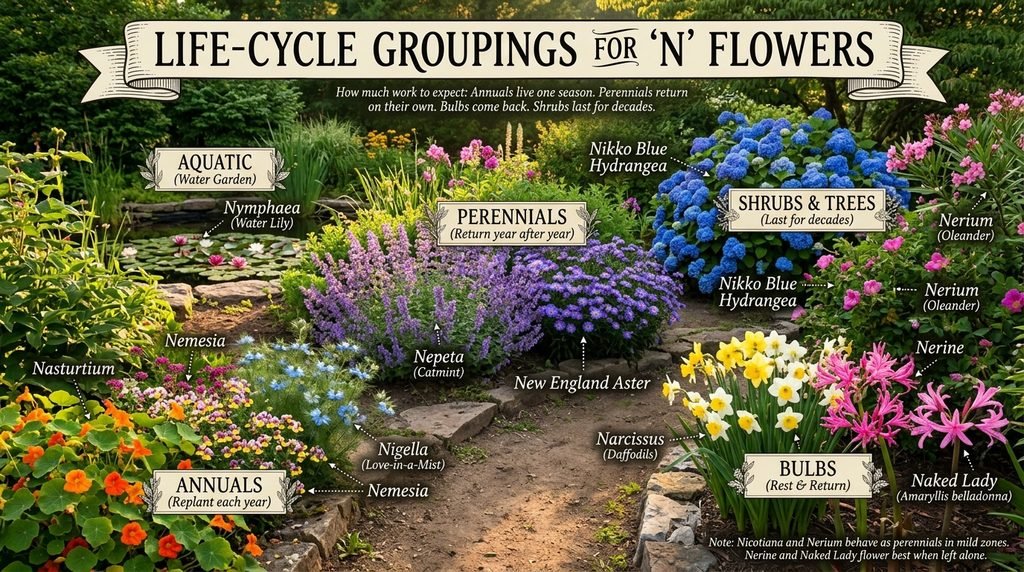
| Flower | Life Cycle | Typical Zones |
| Nasturtium | Annual | All zones (seasonal) |
| Nemesia | Annual | All zones (seasonal) |
| Nemophila | Annual | All zones (seasonal) |
| Nicotiana | Annual (tender perennial) | All zones (seasonal) |
| Nigella | Annual | All zones (seasonal) |
| Night-Scented Stock | Annual | All zones (seasonal) |
| Nolana | Annual | All zones (seasonal) |
| Narrowleaf Zinnia | Annual | All zones (seasonal) |
| Nierembergia | Tender perennial, often grown as annual | 7–10 (perennial), elsewhere annual |
| Nepeta (Catmint) | Perennial | 3–8 |
| New England Aster | Perennial | 4–8 |
| Nettle-Leaved Bellflower | Perennial | 3–8 |
| Narcissus | Perennial (bulb) | 3–9 |
| Nodding Onion | Perennial (bulb) | 3–9 |
| Nectaroscordum | Perennial (bulb) | 5–8 |
| Nerine | Perennial (bulb) | 7–9 |
| Naked Lady | Perennial (bulb) | 7–10 |
| New Jersey Tea | Perennial (shrub) | 4–8 |
| Nikko Blue Hydrangea | Perennial (shrub) | 6–9 |
| Nootka Rose | Perennial (shrub) | 3–8 |
| Nanking Cherry | Perennial (shrub) | 2–7 |
| Nerium (Oleander) | Perennial (shrub) | 8–10 |
| Night-Blooming Jasmine | Tender perennial (shrub) | 9–11 |
| Natal Lily | Tender perennial (houseplant) | 9–11 (indoors elsewhere) |
| Nymphaea (Water Lily) | Perennial (aquatic) | 3–11 |
Nicotiana and Nerium are the two to watch. Both are often sold as annuals, but they can behave as short-lived perennials in mild climates. Nerine and naked lady are the opposite. They look delicate, but they flower best when left alone and kept dry in summer.
Botanical Name Crosswalk
Common names change from place to place. Botanical names do not. Nursery tags and seed packets use Latin for this reason. It also helps you search online with confidence. Two different plants can share one common name, so the Latin name protects you from a wrong purchase.
| Common Name | Botanical Name |
| Narcissus | Narcissus pseudonarcissus |
| Nasturtium | Tropaeolum majus |
| Nepeta (Catmint) | Nepeta × faassenii |
| Nigella | Nigella damascena |
| Nicotiana | Nicotiana alata |
| Nemesia | Nemesia strumosa |
| Nemophila | Nemophila menziesii |
| Nerine | Nerine bowdenii |
| Naked Lady | Amaryllis belladonna |
| New England Aster | Symphyotrichum novae-angliae |
| Night-Blooming Cereus | Selenicereus grandiflorus |
| Night-Blooming Jasmine | Cestrum nocturnum |
| Natal Lily | Clivia miniata |
| Nerium (Oleander) | Nerium oleander |
| Neem | Azadirachta indica |
Night-blooming jasmine shows why this matters. Despite the name, Cestrum nocturnum is not a true jasmine. True jasmine, from the genus Jasminum, is generally safe for pets. Cestrum is a different plant, and its berries are toxic. Also, nasturtium (Tropaeolum) is not the same plant as watercress, whose botanical name is Nasturtium officinale. Both taste peppery, which is how the common name arose.
What N Flowers Mean
Flower meanings vary by culture, but a good number of N flowers carry steady symbolism. Narcissus is tied to the Greek myth of a young man who fell in love with his own reflection, so it stands for self-love and vanity. It also stands for new beginnings and hope, since it comes with spring. Paperwhites are a popular gift for the Lunar New Year, when they bring good luck.
Nasturtium, in Victorian flower language, stood for patriotism and conquest. Nigella, called love-in-a-mist, stood for perplexity. Night-blooming cereus stands for fleeting beauty, because its giant bloom lasts only hours. New England aster stands for patience and elegance, and asters are the birth flower for September.
Water lily, or nymphaea, stands for purity and rebirth. Nandina, called heavenly bamboo, is planted by the doors of Japanese homes because its name sounds like a phrase meaning to turn bad luck around. Nerium carries a warning, and in old flower language it meant caution.
In South Asia, neem is a sacred and healing tree. Its tiny white flowers are used in some traditional dishes, and its leaves are used in home remedies. Night-blooming jasmine, raat ki rani in Urdu and Hindi, is loved for its scent after dark. Match the flower to your message, and remember that the same bloom can mean something different in another culture.
Decision Table: Which N Flower Fits Your Situation
You do not have to read the whole list to choose well. Start with your goal in the left column. The right column names the best N flower for it. Then check the toxicity section if you have pets or children.
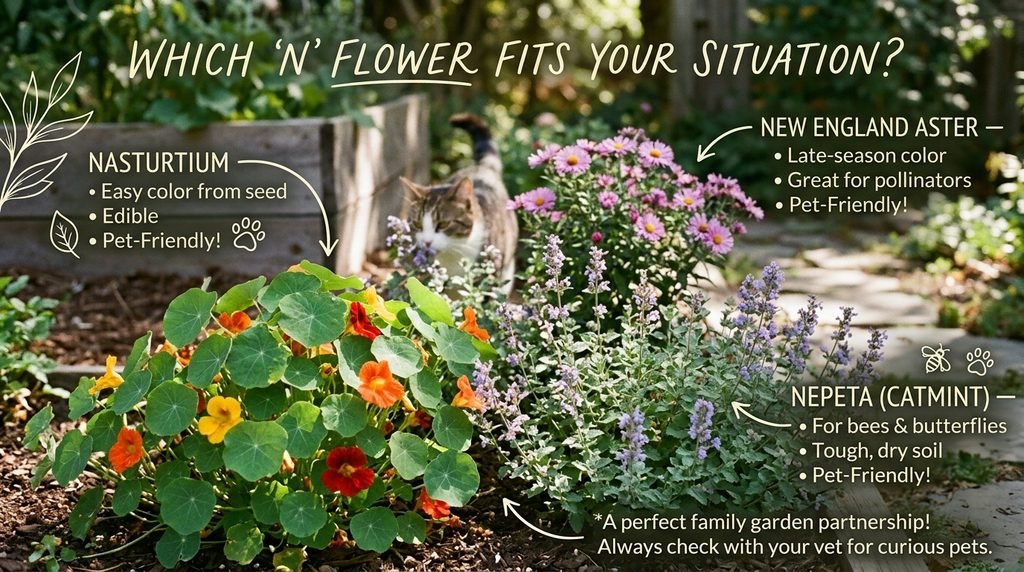
| If You Want… | Choose This N Flower |
| Easy color from seed | Nasturtium, Nigella, or Nemesia |
| Bees and butterflies | Nepeta, New England Aster, or Nodding Onion |
| Evening and night fragrance | Night-blooming Phlox, Nicotiana, or Night-Blooming Jasmine |
| Early spring color | Narcissus, Nemophila, or Nanking Cherry |
| Late-season color | Nerine, New England Aster, or Naked Lady |
| An easy houseplant with blooms | Natal Lily |
| A scented winter bowl of bulbs | Narcissus (Paperwhite) |
| A pond flower | Nymphaea (Water Lily) |
| A tough, dry-soil flower | Nepeta, Nasturtium, or Narrowleaf Zinnia |
| A pet-friendlier garden | Nasturtium, Nepeta, or New England Aster (absent from this guide’s toxic list) |
Nasturtium appears twice because it is easy, edible, and not on the toxic list in this guide. Nepeta is a good partner for it in a family garden, though cats may roll in it. Always double-check any plant with your vet if a pet is likely to chew it.
Conclusion
Flowers that start with N offer a very wide choice, from the cheerful nasturtium to the one-night night-blooming cereus. This guide sorted 62 of them by color, life cycle, and use, so you can pick with confidence. Whether you want a sunny bee border, an evening-scented patio, or an easy shade houseplant, there is an N flower that fits. Use the tables above, read the toxicity notes, and start planting.
Frequently Asked Questions
How many flowers start with N?
More than 60 well-known flowers start with N. This guide lists 62, from common garden plants to rare orchids and night-blooming cacti.
What is the most popular flower that starts with N?
Narcissus, nasturtium, nepeta, and nigella are among the most popular. Night-blooming jasmine and night phlox are favorites for evening gardens.
What are the easiest flowers that start with N to grow?
Nasturtium, nepeta, nigella, narcissus, and narrowleaf zinnia are very easy. Natal lily is the easiest N houseplant.
Which N flowers attract butterflies and hummingbirds?
New England aster, narrowleaf coneflower, and nodding onion draw butterflies and bees. Nasturtium, nepeta, and New Zealand Christmas tree also draw hummingbirds or nectar birds.
Is oleander (Nerium) poisonous?
Yes. Nerium, or oleander, is one of the most poisonous garden plants. Every part can affect the heart, and even dried leaves are dangerous.
Which N flower is the most dangerous?
Nerium (oleander) and northern wild monkshood are the most dangerous for people and pets. Narcissus bulbs and naked lady bulbs are also serious risks.
Are nasturtiums safe to eat?
Yes. Nasturtium leaves and flowers are edible and taste peppery. Use only plants that were grown without sprays, and rinse them well.
What does narcissus symbolize?
Narcissus stands for self-love, new beginnings, and hope. In China, paperwhites are given at the Lunar New Year for good luck.
What is raat ki rani?
Raat ki rani is the Urdu and Hindi name for night-blooming jasmine, Cestrum nocturnum. It is not a true jasmine, and its berries are toxic to pets and people.
Which N flowers bloom at night?
Night-blooming cereus, night phlox, night-blooming jasmine, night-scented stock, and Nicotiana are strongest at night. Nodding catchfly is also scented after dark.
Which N flowers work well in dry, sunny gardens?
Nepeta, nasturtium, narrowleaf zinnia, nerine, and naked lady thrive in dry sun. Nigella and nodding onion also tolerate dry spells.

1 thought on “Flowers That Start With N: 60+ Beautiful Names, Meanings & Photos”