
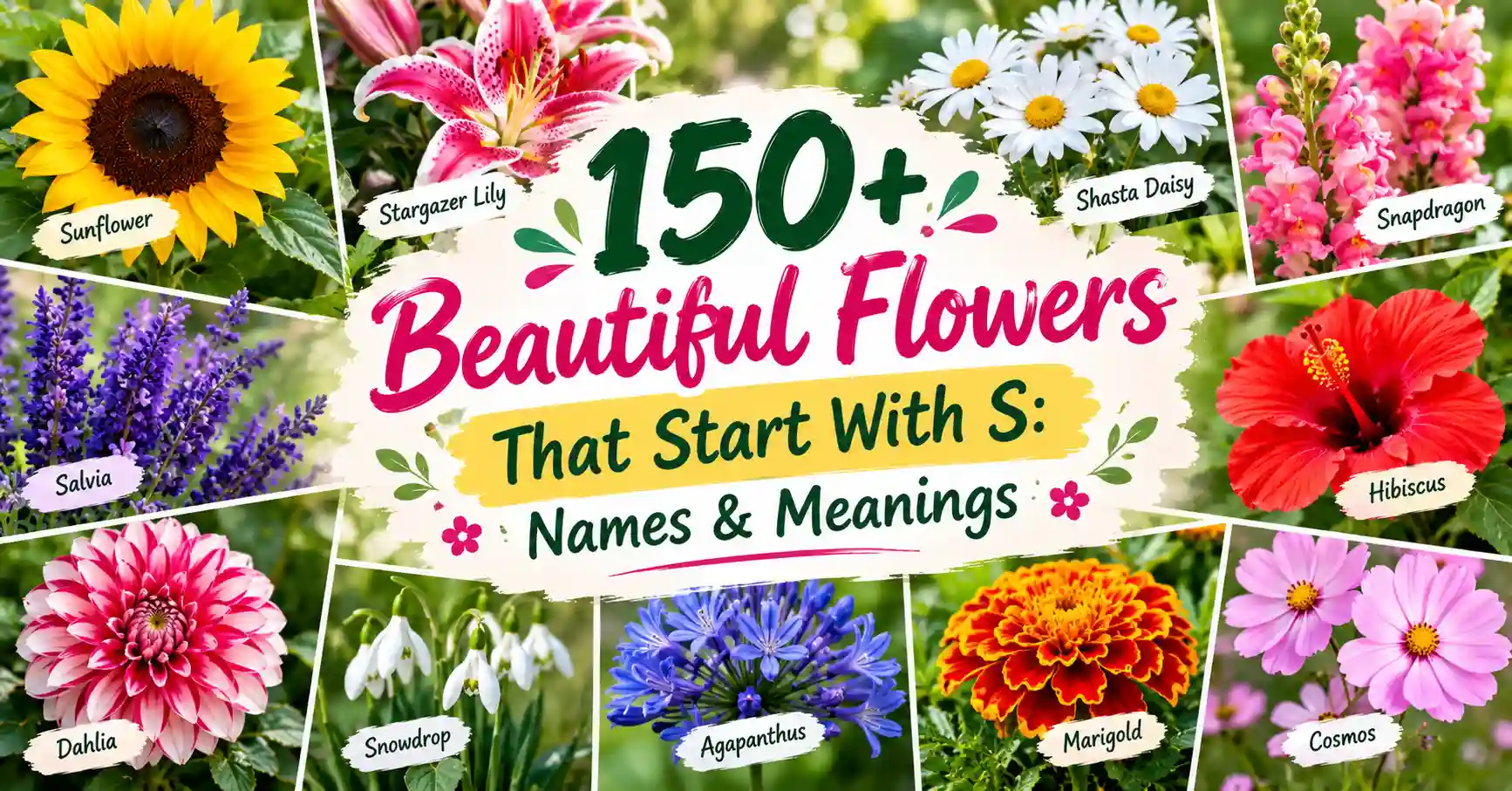
Flowers that start with S fill gardens from late winter to fall. Snowdrop opens first. Sweet Pea, Snapdragon, and Salvia follow. Sunflower towers over summer beds, and Sedum carries color into autumn. This guide brings more than 150 of them together in one place, from easy beginners to rare giants.
Every plant here is real. The flower is the main reason people grow it, with a few exceptions. Trees, shrubs, and cacti such as Southern Magnolia, Syringa, and Saguaro appear because their blooms are famous. Botanical names, native regions, bloom seasons, and toxicity notes were checked against more than one source. Safety facts got extra care, since a wrong guess can hurt a pet or a child.
The guide opens with a quick answer and a full alphabetical list. A comparison table follows. Then come sections on garden plants, houseplants, cut flowers, rare finds, and toxic plants. Color groups, life cycles, botanical names, and meanings come next. A short decision table closes the guide.
Why use a guide like this? Some readers want color for a hot, dry bed. Others need a fragrant vine, a pet-safe houseplant, or a bouquet idea. A clear structure helps each reader find an answer fast, without scrolling through a hundred names.
Quick Answer: Top Flowers That Start With S
Sunflower, Sweet Pea, Snapdragon, Salvia, and Sedum give gardeners the best mix of color and reliability. Sunflower grows fast and tall from seed. Sweet Pea adds scent to a fence, while Snapdragon blooms in cool weather.
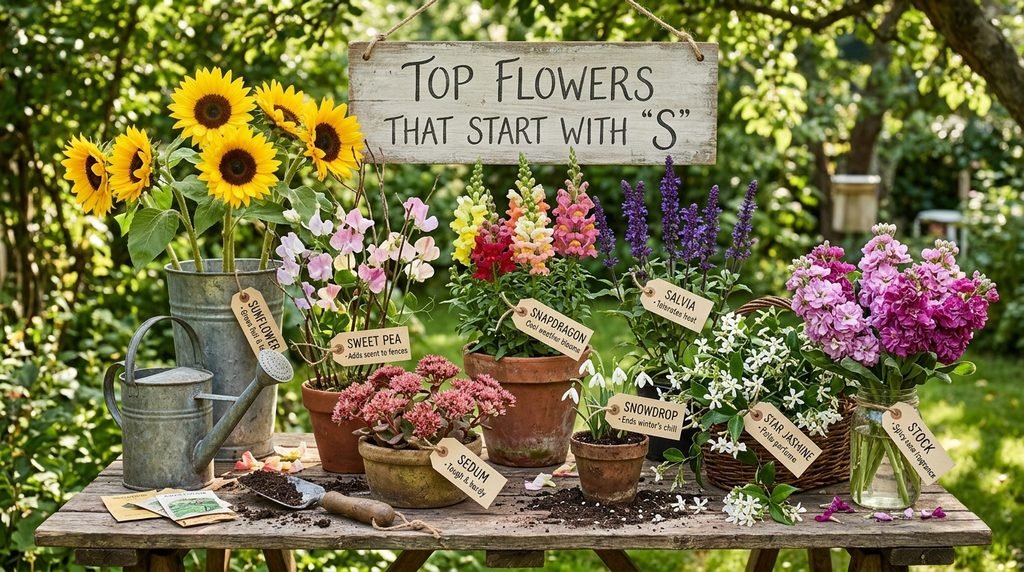
Salvia and Sedum handle heat and poor soil, and both feed pollinators. Snowdrop signals the end of winter, Star Jasmine perfumes a patio, and Stock fills a vase with spicy fragrance, which shows how many needs flowers that start with S can meet.
Simple Read More: 150+ Flowers That Start With T: Popular, Rare & Unique Blooms
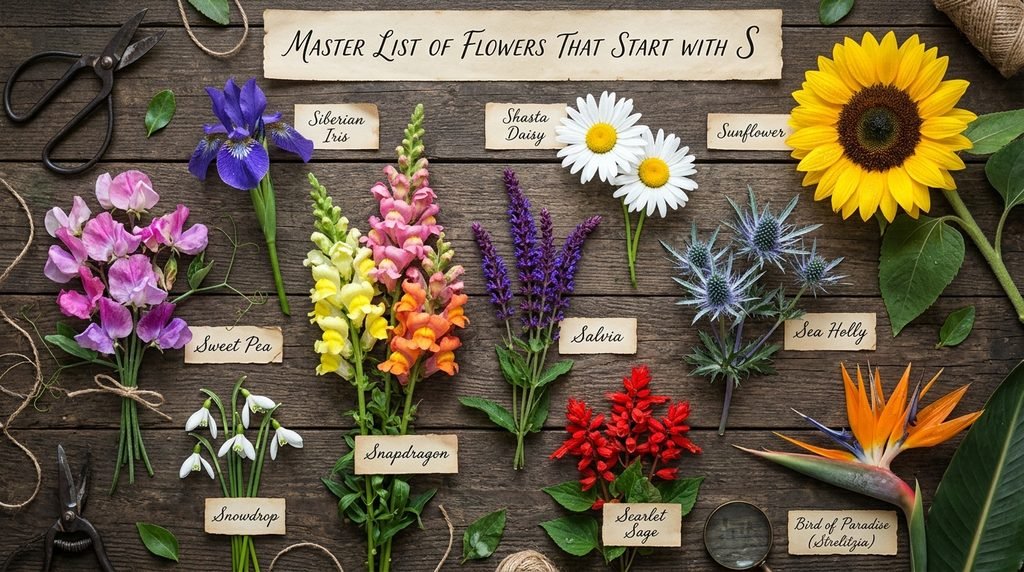
Master List of Flowers That Start With S
The list below mixes common names and botanical names. Where people usually search by common name, that name comes first, such as Sweet Pea or Snowdrop. Where the botanical name is better known, it leads instead, such as Schlumbergera or Sinningia.
- Sacred Lotus
- Safflower
- Saffron Crocus
- Saguaro
- Salpiglossis (Painted Tongue)
- Salvia (Sage)
- Sand Verbena
- Sandersonia (Christmas Bells)
- Sanguinaria (Bloodroot)
- Santolina (Cotton Lavender)
- Sanvitalia (Creeping Zinnia)
- Saponaria (Soapwort)
- Sarcococca (Sweet Box)
- Sarracenia (Pitcher Plant)
- Satin Flower
- Sauromatum (Voodoo Lily)
- Saussurea (Snow Lotus)
- Saxifraga (Saxifrage)
- Scabiosa (Pincushion Flower)
- Scadoxus (Blood Lily)
- Scaevola (Fan Flower)
- Scarlet Flax
- Scarlet Gilia
- Scarlet Monkeyflower
- Scarlet Pimpernel
- Scarlet Sage
- Schizanthus (Butterfly Flower)
- Schlumbergera (Christmas Cactus)
- Scilla (Squill)
- Scotch Broom
- Scotch Thistle
- Scutellaria (Skullcap)
- Sea Daffodil
- Sea Holly
- Sea Lavender
- Sea Thrift
- Sedum
- Selenicereus (Queen of the Night)
- Senna (Candle Bush)
- Serruria (Blushing Bride)
- Serviceberry
- Sesbania (Scarlet Wisteria Tree)
- Shasta Daisy
- Sheep Laurel
- Shell Flower
- Shell Ginger
- Shooting Star
- Shrimp Plant
- Shrubby Cinquefoil
- Siberian Bugloss
- Siberian Iris
- Siberian Squill
- Siberian Wallflower
- Sidalcea (Checkermallow)
- Silene (Catchfly)
- Silk Tree
- Silphium (Cup Plant)
- Silverbell
- Silybum (Milk Thistle)
- Sinningia (Gloxinia)
- Sisyrinchium (Blue-Eyed Grass)
- Skunk Cabbage
- Sky Flower
- Sleepy Daisy
- Slipper Flower
- Slipper Orchid
- Smithiantha (Temple Bells)
- Snake’s Head Fritillary
- Snapdragon
- Sneezeweed
- Snowball Bush
- Snowbell (Styrax)
- Snowdrop
- Snowflake
- Snow-in-Summer
- Society Garlic
- Solandra (Chalice Vine)
- Solanum (Potato Vine)
- Soldanella (Alpine Snowbell)
- Solidago (Goldenrod)
- Solomon’s Seal
- Sourwood
- Southern Magnolia
- Spanish Bluebell
- Spanish Broom
- Spanish Flag
- Spanish Shawl
- Sparaxis (Harlequin Flower)
- Spathiphyllum (Peace Lily)
- Speedwell
- Spider Flower
- Spider Lily
- Spiderwort
- Spigelia (Pinkroot)
- Spilanthes (Toothache Plant)
- Spiraea (Bridal Wreath)
- Spotted Beebalm
- Spotted Geranium
- Sprekelia (Aztec Lily)
- Spring Beauty
- Spring Gentian
- Spring Snowflake
- Spring Starflower
- St Bernard’s Lily
- St John’s Wort
- Stachys (Betony)
- Stapelia (Starfish Flower)
- Star Cluster
- Star Jasmine
- Star Magnolia
- Star of Bethlehem
- Star of Persia
- Star of the Veldt
- Statice
- Stenocarpus (Firewheel Tree)
- Stephanotis (Madagascar Jasmine)
- Sternbergia (Winter Daffodil)
- Stewartia
- Stinking Hellebore
- Stinking Iris
- Stock
- Stokes’ Aster
- Stonecress
- Stonecrop
- Stork’s Bill
- Strawflower
- Strelitzia (Bird of Paradise)
- Streptocarpus (Cape Primrose)
- Streptosolen (Marmalade Bush)
- Striped Squill
- Strobilanthes (Kurinji)
- Sturt’s Desert Pea
- Stylophorum (Wood Poppy)
- Sugarbush
- Sulphur Flower
- Summer Snapdragon
- Summer Snowflake
- Sun Rose
- Sundrops
- Sunflower
- Sunset Hibiscus
- Sutherlandia (Balloon Pea)
- Swamp Azalea
- Swamp Milkweed
- Swan Plant
- Swan River Daisy
- Sweet Alyssum
- Sweet Autumn Clematis
- Sweet Olive
- Sweet Pea
- Sweet Rocket
- Sweet Sultan
- Sweet Violet
- Sweet William
- Sweet Woodruff
- Sweetshrub
- Sweetspire
- Sword Lily
- Symphyotrichum (New England Aster)
- Syringa (Lilac)
Some names cause mix-ups. Sedum and Stonecrop are the same group. Star Jasmine is not a true Jasmine. Spider Lily can mean Hymenocallis or Lycoris, two different bulbs. Squill appears under Scilla, and Striped Squill is a separate plant, Puschkinia.
Comparison Table: Region, Bloom Time, Zones, and Safety
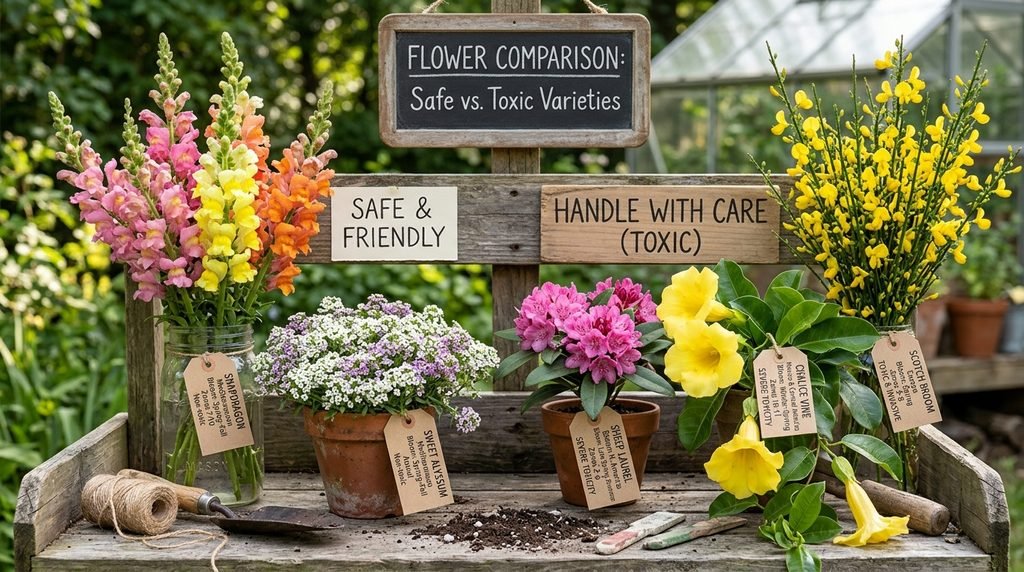
The table below compares 14 popular flowers side by side. Columns cover native region, bloom season, hardiness zones, and toxicity. Hardiness zones show where a plant survives winter outdoors, so check your own zone before buying.
| Flower | Native Region | Bloom Season | Hardiness Zones | Toxicity |
| Sunflower | North America | Summer to fall | Annual | Minimal |
| Sweet Pea | Southern Italy and Sicily | Spring to early summer | Annual | Mild; seeds |
| Salvia | Many regions worldwide | Summer to fall | 3–10, varies by type | Minimal |
| Snapdragon | Mediterranean | Spring to fall | 7–10, annual in cold zones | Non-toxic |
| Sedum | Europe and Asia | Late summer to fall | 3–9 | Minimal |
| Shasta Daisy | Garden hybrid | Summer | 4–9 | Mild |
| Snowdrop | Southeastern Europe | Late winter | 3–8 | Mild to moderate; bulbs |
| Star Jasmine | East Asia | Late spring to summer | 8–10 | Mild; sap irritates skin |
| Siberian Iris | Europe and Russia | Early summer | 3–9 | Mild |
| Bird of Paradise | South Africa | Winter to spring | 10–12 | Mild |
| Sweet Alyssum | Mediterranean | Spring to fall | Annual | Non-toxic |
| Scotch Broom | Europe | Spring | 5–8 | Moderate |
| Sheep Laurel | Eastern North America | Late spring to summer | 2–6 | Severe |
| Chalice Vine | Mexico and Central America | Winter to spring | 10–11 | Severe |
Three rows deserve a second look. Sheep Laurel and Chalice Vine both carry severe toxicity, even though each looks pretty. Scotch Broom is toxic too, and it is invasive in many regions. Snapdragon and Sweet Alyssum sit at the safe end, which makes them good picks for homes with curious pets.
Explore More Flower Guides: 50+ Beautiful Flowers That Start With O (With Pictures & Names)
Garden Favorites for Sun, Shade, and Wet Soil
Gardeners who want easy wins among flowers that start with S should begin with Sunflower, Salvia, and Sedum. Sunflower grows from seed to full height in one season. Salvia blooms for months and shrugs off heat.
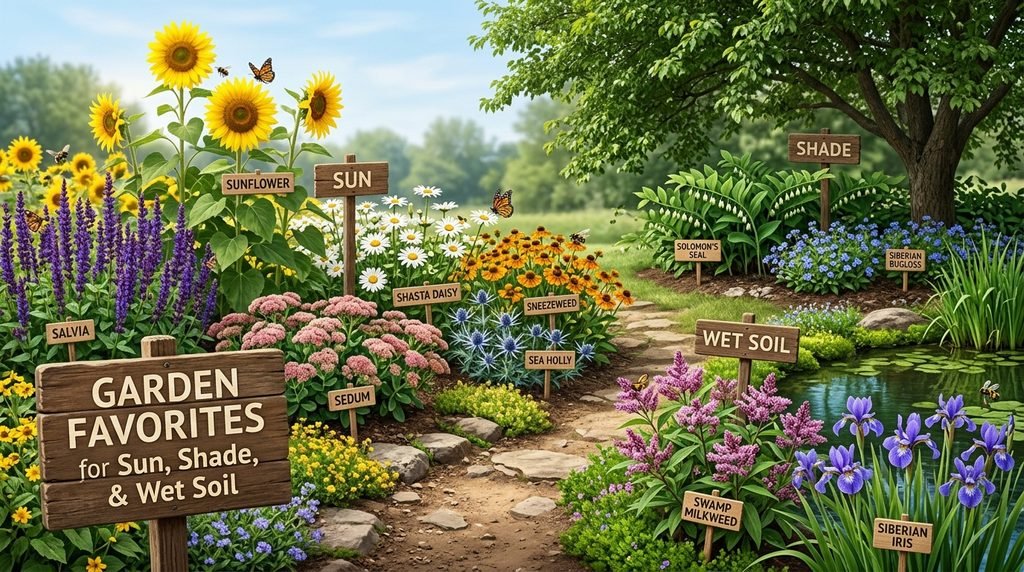
Sedum handles poor soil and feeds late-season pollinators. Shasta Daisy and Siberian Iris return each year with little care, and Sneezeweed brings gold to fall beds. Sea Holly adds spiky blue texture in dry soil. Solomon’s Seal and Siberian Bugloss light up shade, while Swamp Milkweed thrives in wet ground.
Best Indoor Plants and Houseplants
Several S plants live well indoors. Streptocarpus, the Cape Primrose, blooms almost all year in bright, indirect light. Sinningia, or Gloxinia, offers velvety trumpets in deep purple, red, or white. Schlumbergera, the Christmas Cactus, blooms when nights get long and cool.
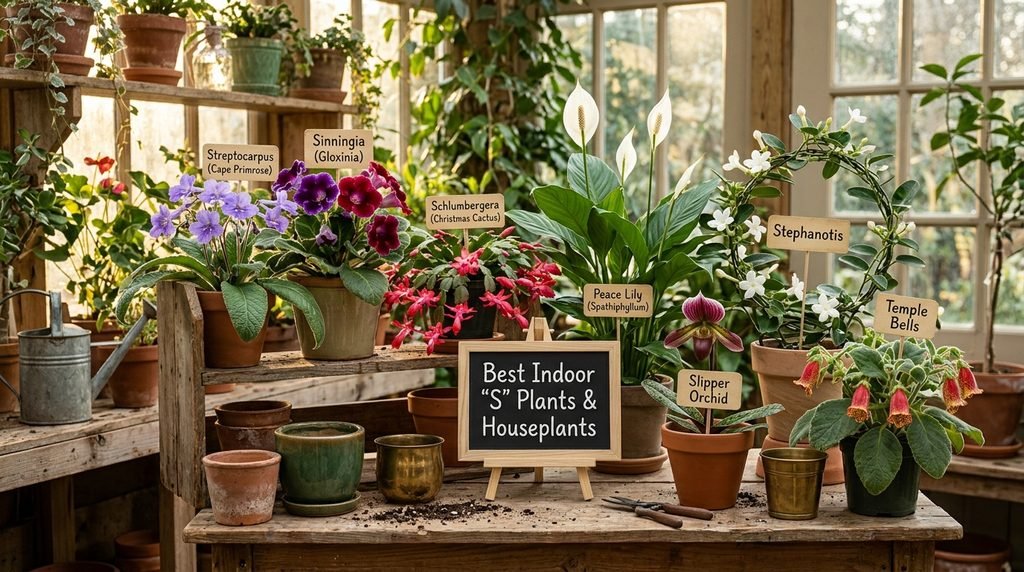
Peace Lily, or Spathiphyllum, handles low light and sends up white spathes. Stephanotis is a twining vine with waxy white flowers and a sweet scent, though it likes warmth and humidity. Orchid fans can try a Slipper Orchid, while Temple Bells adds velvety leaves and bell-shaped blooms.
Cut Flowers That Florists Love
Stock fills a vase with a spicy, clove-like scent. Snapdragon adds tall, colorful spires, and Sweet Pea brings delicate, ruffled blooms with a sweet fragrance. Statice and Strawflower dry well, so they last for months in wreaths.
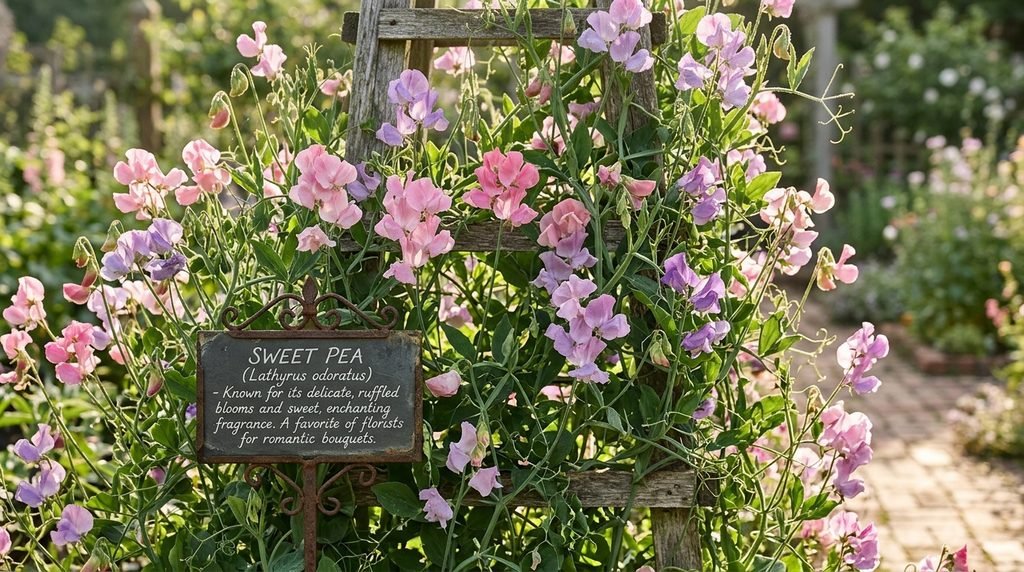
Scabiosa adds airy, pincushion-shaped blooms on slim stems. Sunflower suits big, cheerful bouquets, and Sea Holly adds spiky blue texture. Stephanotis is a bridal favorite, often tucked into wedding bouquets. Each one suits a different style, from formal to relaxed.
You May Also Like: 70+ Flowers That Start With K: Beautiful Names, Meanings & Photos
Rare and Unusual Finds
Some S flowers are hard to find, and each has its own story. Strobilanthes kunthiana, called Kurinji, blooms only once every twelve years. When it does, it turns hillsides in southern India a hazy blue. Sturt’s Desert Pea, from the dry interior of Australia, has bold red flowers with a glossy black center. It is the floral emblem of South Australia, and it is famously hard to grow.
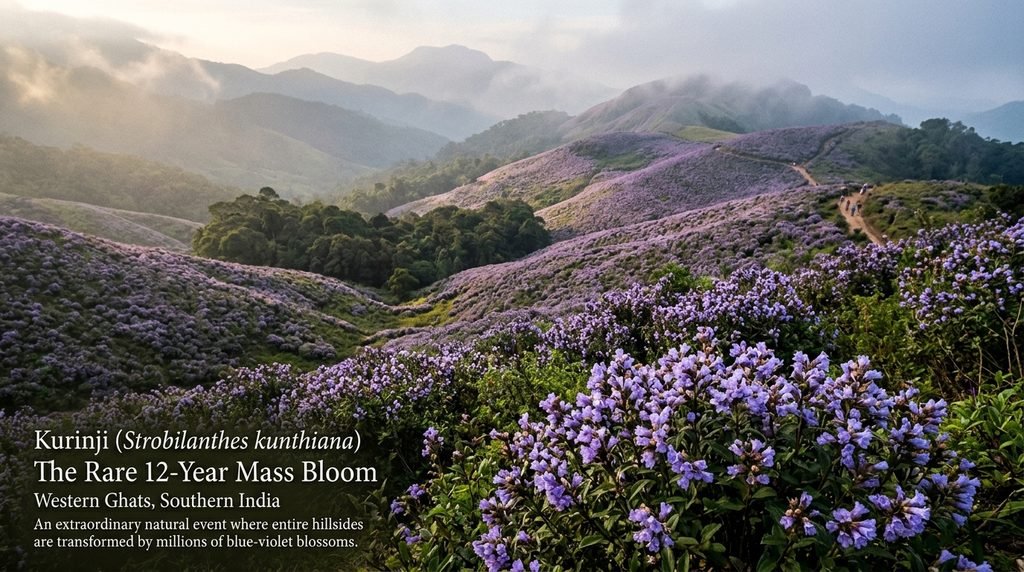
Snow Lotus, or Saussurea, grows high in the Himalayas and Tian Shan mountains and is protected in several regions. Blushing Bride, a Serruria from South Africa, has airy pink-white blooms and needs perfect drainage. Specialty nurseries and botanical gardens are the best places to see them.
Toxic Flowers and Safety Notes
Several S plants can cause real harm. Sheep Laurel contains grayanotoxins that can kill grazing animals, which explains its old nickname, lambkill. Chalice Vine holds tropane alkaloids in every part. Sky Flower produces bright orange berries that attract children but are toxic. Stinking Hellebore irritates the mouth and affects the heart. Swan Plant has milky sap with heart-active compounds.
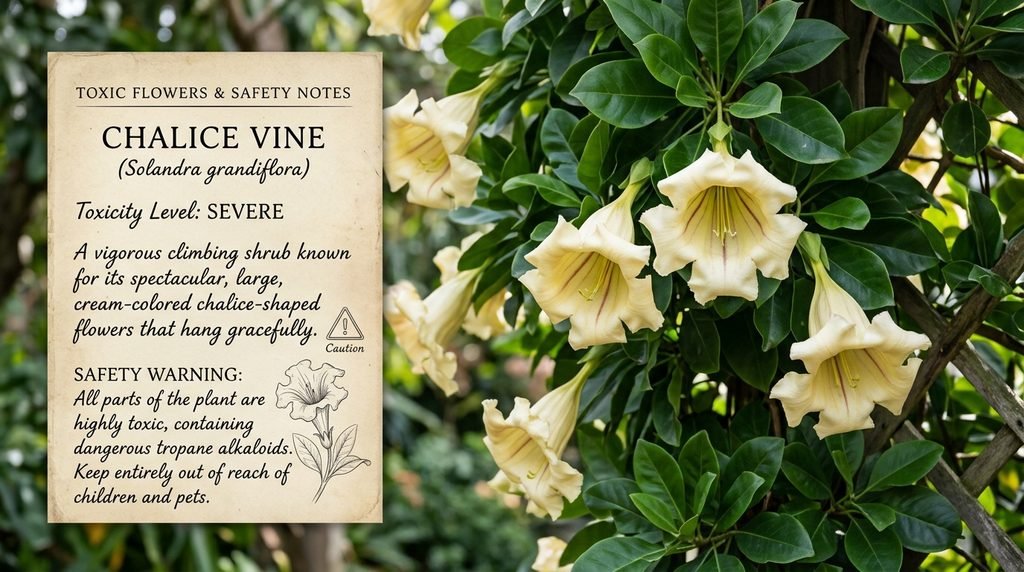
The table below ranks the main risks on this list. Levels reflect the effect of eating a meaningful amount, not a light touch. Check any plant against a pet poison database before planting it near animals.
| Flower | Toxicity Level | Main Concern |
| Sheep Laurel | Severe | Grayanotoxins; can be deadly to livestock |
| Chalice Vine | Severe | Tropane alkaloids in all parts |
| Stinking Hellebore | Moderate to severe | Irritant and heart-active compounds |
| Swan Plant | Moderate | Cardiac glycosides in milky sap |
| Sesbania | Moderate | Seeds are toxic to animals and people |
| Sky Flower | Moderate | Berries are toxic, especially to children |
| Scotch Broom | Moderate | Alkaloids; invasive in many regions |
| Spigelia | Moderate | Can cause dizziness and cramps if eaten |
| Solanum (Potato Vine) | Mild to moderate | Solanine in leaves and berries |
| Snowdrop | Mild to moderate | Bulbs upset the stomach |
| Sweet Pea | Mild | Seeds are mildly toxic |
| Snapdragon | Non-toxic | Considered safe for pets |
Sheep Laurel and Chalice Vine deserve the most care. Sky Flower is the sneakiest, since its berries look like candy. Snapdragon sits at the opposite end and is a safer choice for homes with children and pets.
Large cream-colored chalice vine flowers hanging from a climbing shrub
Color Groups: Blue, Pink, White, Yellow, and Unusual
Color often drives the choice of flowers that start with S. This section groups the plants by shade and shows where each group works best.
Blue and purple shades are well covered. Salvia, Siberian Iris, Scabiosa, Sea Holly, Speedwell, Spiderwort, and Statice all bring rich tones. Pair them with yellow Sunflower or Sundrops for strong contrast. Pink and red shades come from Sweet Pea, Snapdragon, Sweet William, Shrimp Plant, and Spiraea. They suit cottage borders and romantic bouquets.
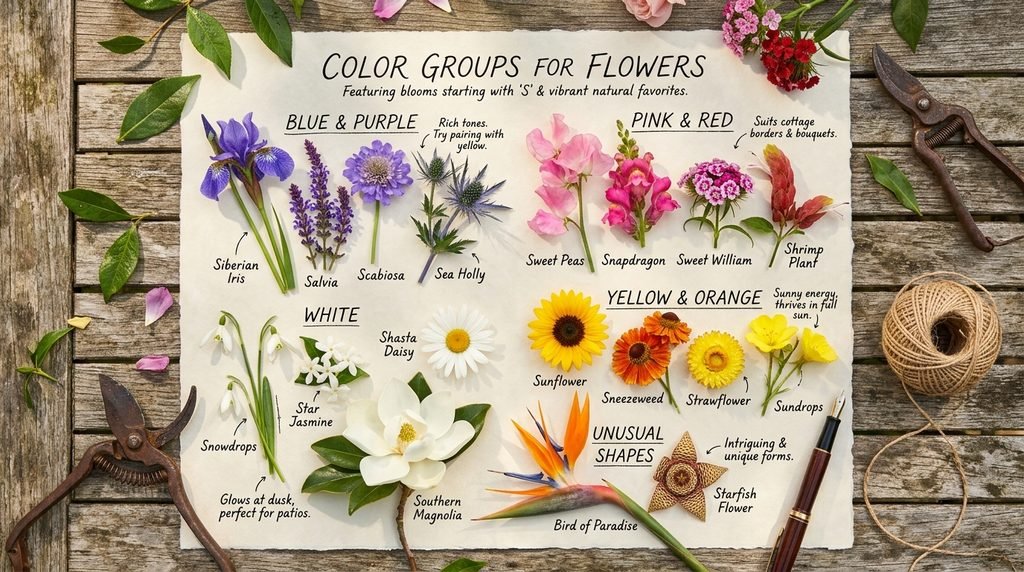
White flowers glow at dusk. Snowdrop, Star Jasmine, Shasta Daisy, Stephanotis, Silverbell, and Southern Magnolia all fit here. They work well beside patios and in wedding designs. Yellow and orange flowers add sunny energy. Sunflower, Sneezeweed, Strawflower, Goldenrod, and Sulphur Flower thrive in full sun and keep borders bright into fall. Unusual shapes round out the list. Bird of Paradise looks like a tropical bird, and Starfish Flower has a star-shaped bloom with a strong carrion smell.
Life Cycle Guide: Annuals, Perennials, Bulbs, and Shrubs
Life cycle tells a gardener how much work a plant needs. Annuals bloom for one season and end. Perennials return each year. Bulbs and corms store energy underground, while shrubs and trees build a lasting frame. Matching the life cycle to your plan saves money, time, and replanting.
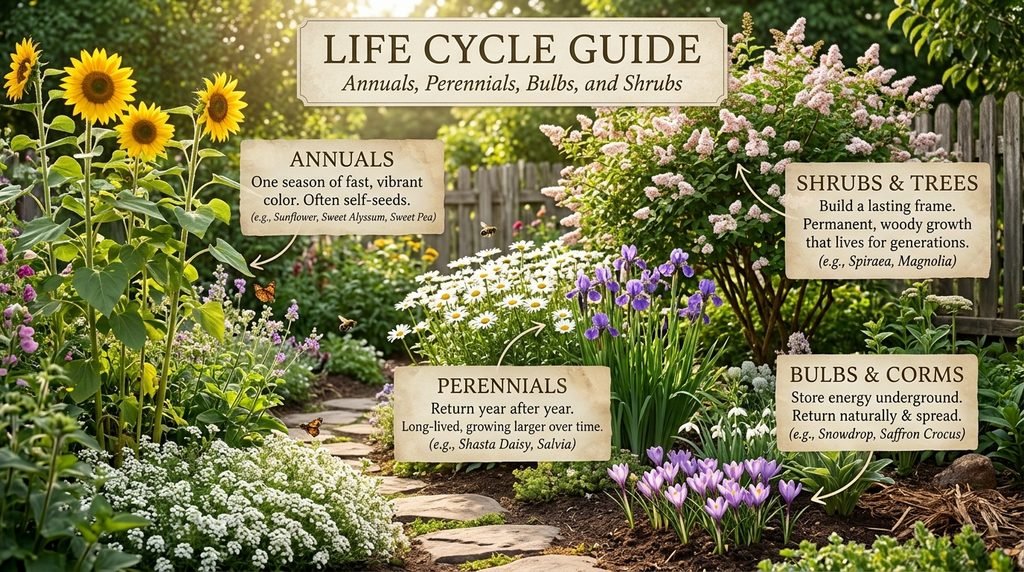
| Flower | Life Cycle | What to Expect |
| Sweet Alyssum | Annual | One season; often self-seeds |
| Sunflower | Annual | Fast growth; seeds feed birds |
| Sweet Pea | Annual | Best in cool weather |
| Spider Flower | Annual | Self-seeds freely |
| Snapdragon | Short-lived perennial | Often grown as an annual |
| Sweet William | Biennial | Blooms in year two, then self-seeds |
| Salvia | Perennial or annual | Depends on type and climate |
| Shasta Daisy | Perennial | Divide every few years |
| Sedum | Perennial | Long-lived; divide in spring |
| Siberian Iris | Perennial | Long-lived; forms large clumps |
| Snowdrop | Bulb | Spreads into drifts |
| Saffron Crocus | Corm | Blooms in fall; spice from stigmas |
| Star Jasmine | Woody vine | Slow at first, then vigorous |
| Spiraea | Shrub | Long-lived; prune after bloom |
| Southern Magnolia | Evergreen tree | Slow; lives for generations |
Annuals give the fastest color but need replanting. Perennials, bulbs, and shrubs cost more at first and pay off over time. Sweet William offers a middle path, since each plant lives two years but reseeds so the bed keeps blooming.
Botanical Name Crosswalk
Botanical names matter when you buy plants or search online. Common names change by region and can point to several plants. Sage, for example, can mean the cooking herb or one of hundreds of ornamental Salvia species. A botanical name gives one clear answer, which prevents mix-ups at the nursery.
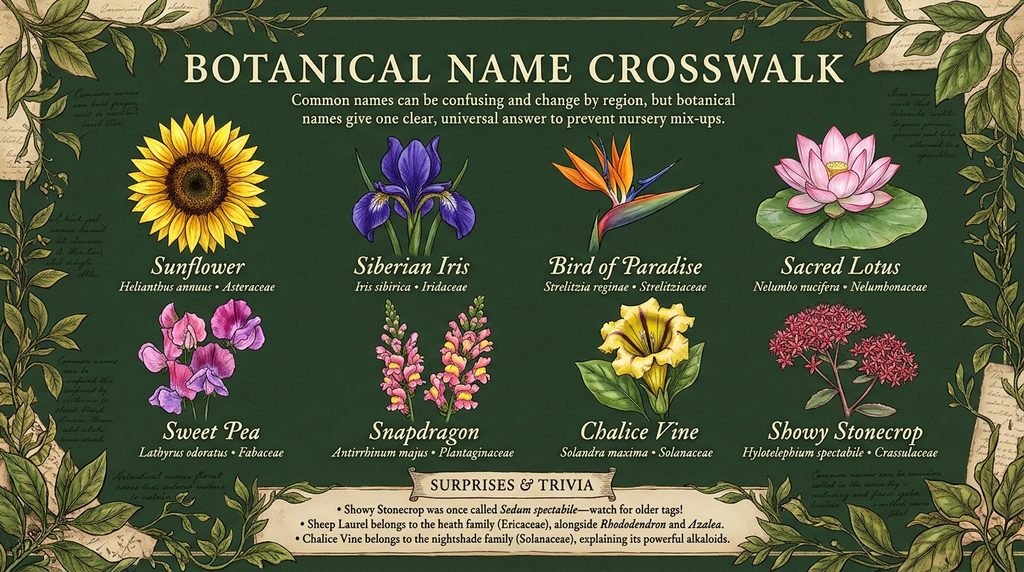
| Common Name | Botanical Name | Family |
| Sunflower | Helianthus annuus | Asteraceae |
| Sweet Pea | Lathyrus odoratus | Fabaceae |
| Salvia | Salvia spp. | Lamiaceae |
| Snapdragon | Antirrhinum majus | Plantaginaceae |
| Showy Stonecrop | Hylotelephium spectabile | Crassulaceae |
| Shasta Daisy | Leucanthemum × superbum | Asteraceae |
| Snowdrop | Galanthus nivalis | Amaryllidaceae |
| Star Jasmine | Trachelospermum jasminoides | Apocynaceae |
| Siberian Iris | Iris sibirica | Iridaceae |
| Bird of Paradise | Strelitzia reginae | Strelitziaceae |
| Cape Primrose | Streptocarpus spp. | Gesneriaceae |
| Christmas Cactus | Schlumbergera × buckleyi | Cactaceae |
| Lilac | Syringa vulgaris | Oleaceae |
| Sheep Laurel | Kalmia angustifolia | Ericaceae |
| Chalice Vine | Solandra maxima | Solanaceae |
| Sacred Lotus | Nelumbo nucifera | Nelumbonaceae |
Two surprises show up here. Showy Stonecrop was once called Sedum spectabile, so older tags may use that name. Sheep Laurel belongs to the heath family, the same family as Rhododendron and Azalea. Chalice Vine belongs to the nightshade family, which explains its powerful alkaloids.
Meanings and Symbolism
Flowers that start with S carry deep stories, and many have shaped how people give and read flowers. Sunflower stands for adoration and loyalty. Young flowers turn to follow the sun, which gave the plant a long link to devotion. The sacred lotus rises clean from muddy water, so it stands for purity and spiritual growth in Hindu and Buddhist traditions.
Snowdrop means hope. Legend says an angel turned falling snowflakes into snowdrops to comfort Eve after she left the garden. Sweet Pea carries a gentler, mixed message. Victorian writers linked it to blissful pleasure, but also to a delicate goodbye. Snapdragon stood for grace under pressure, and sometimes for deception, since its flower seems to snap shut like a mouth.
Statice means remembrance and lasting sympathy, since it holds its color for months. Sweet William suggests gallantry, and Star Jasmine signals love and grace. Syringa, or Lilac, often means first love and youthful innocence. Saffron Crocus stands for luxury, because it takes thousands of flowers to make a single ounce of saffron. Taken together, these meanings give gardeners and gift givers a rich set of choices beyond color and shape.
Decision Guide: Match the Flower to Your Space
Use the table below to narrow your choices fast. Start with the row that matches your main need, such as shade, wet soil, or pet safety. Then compare the suggested plants and pick the one that suits your climate. Anyone sorting flowers that start with S will find this the quickest route from a long list to a final choice.
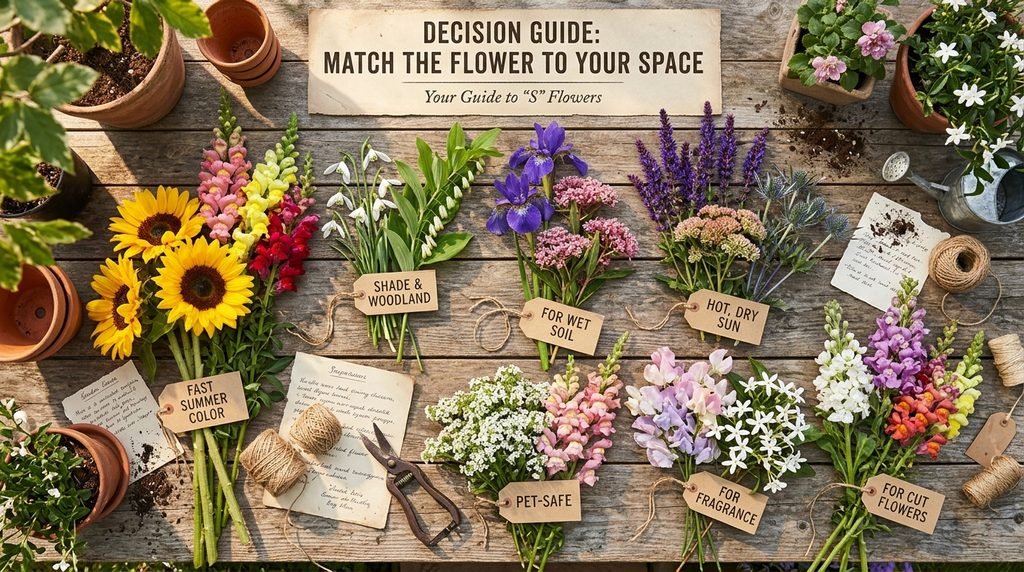
| If You Need | Try These |
| Fast, cheap summer color | Sunflower, Snapdragon |
| Shade and woodland color | Snowdrop, Solomon’s Seal, Siberian Bugloss |
| Wet soil | Siberian Iris, Swamp Milkweed |
| Hot, dry sun | Sedum, Salvia, Sea Holly |
| Pet-safe options | Snapdragon, Sunflower, Sweet Alyssum |
| Cut flowers | Stock, Snapdragon, Sweet Pea |
| Pollinators | Salvia, Swamp Milkweed, Sneezeweed |
| Fragrance | Sweet Pea, Star Jasmine, Sweet Olive |
| Pet-safe houseplants | Christmas Cactus, Cape Primrose |
| Tropical drama | Bird of Paradise, Stephanotis |
No single plant fits every need. Snapdragon and Sweet Alyssum work for homes with curious pets, while Siberian Iris handles soggy ground that kills most flowers. If safety is a concern, skip the severely toxic plants from the earlier table and choose from the pet-safe rows first.
Final Thoughts on Flowers That Start With S
Flowers that start with S offer something for nearly every garden, windowsill, and vase. They range from easy beginners such as Sunflower and Salvia to rare treasures such as Kurinji and Sturt’s Desert Pea. A few, like Sheep Laurel and Chalice Vine, call for real caution around pets and children. Use the tables and guides above to match each plant to your light, space, and household. With so many choices, there is room to experiment.
Frequently Asked Questions
What are the easiest flowers that start with S to grow?
Sunflower, Salvia, Sedum, and Snapdragon are all beginner-friendly. They tolerate average soil and need little fuss. Sunflower and Snapdragon also bloom quickly from seed.
Which S flowers are poisonous?
Sheep Laurel, Chalice Vine, and Stinking Hellebore are the most dangerous. Sky Flower berries and Sesbania seeds are also toxic. Keep all of them away from children and pets.
Is Star Jasmine the same as true Jasmine?
No. Star Jasmine belongs to the Apocynaceae family, while true Jasmine is in the olive family. Star Jasmine has a milky sap that can irritate skin.
When should I plant Sweet Pea?
Sow seeds early, as soon as the soil can be worked. Sweet Pea thrives in cool weather. In mild climates, sow in fall for spring bloom.
Do Sunflowers follow the sun?
Young sunflower buds track the sun across the sky. Mature flowers stop moving and usually face east. This helps warm the flower and attract pollinators.
Is Snapdragon safe for cats and dogs?
Yes, Snapdragon is considered non-toxic to cats and dogs. This makes it a good choice for pet owners. It blooms best in cool weather and full sun.
How long does it take Snowdrop bulbs to spread?
Snowdrops often form noticeable clumps in two to three years. Planting them “in the green,” just after bloom, helps them settle. They spread into larger drifts over time.
Why is Kurinji so special?
Strobilanthes kunthiana blooms only once every twelve years. During a mass bloom, whole hillsides in southern India turn blue. The event draws visitors from around the world.
Does Sedum come back every year?
Yes. Most garden Sedum varieties are hardy perennials in zones 3 to 9. They die back in winter and return in spring. Divide clumps every few years.

5 thoughts on “150+ Beautiful Flowers That Start With S: Names & Meanings”