
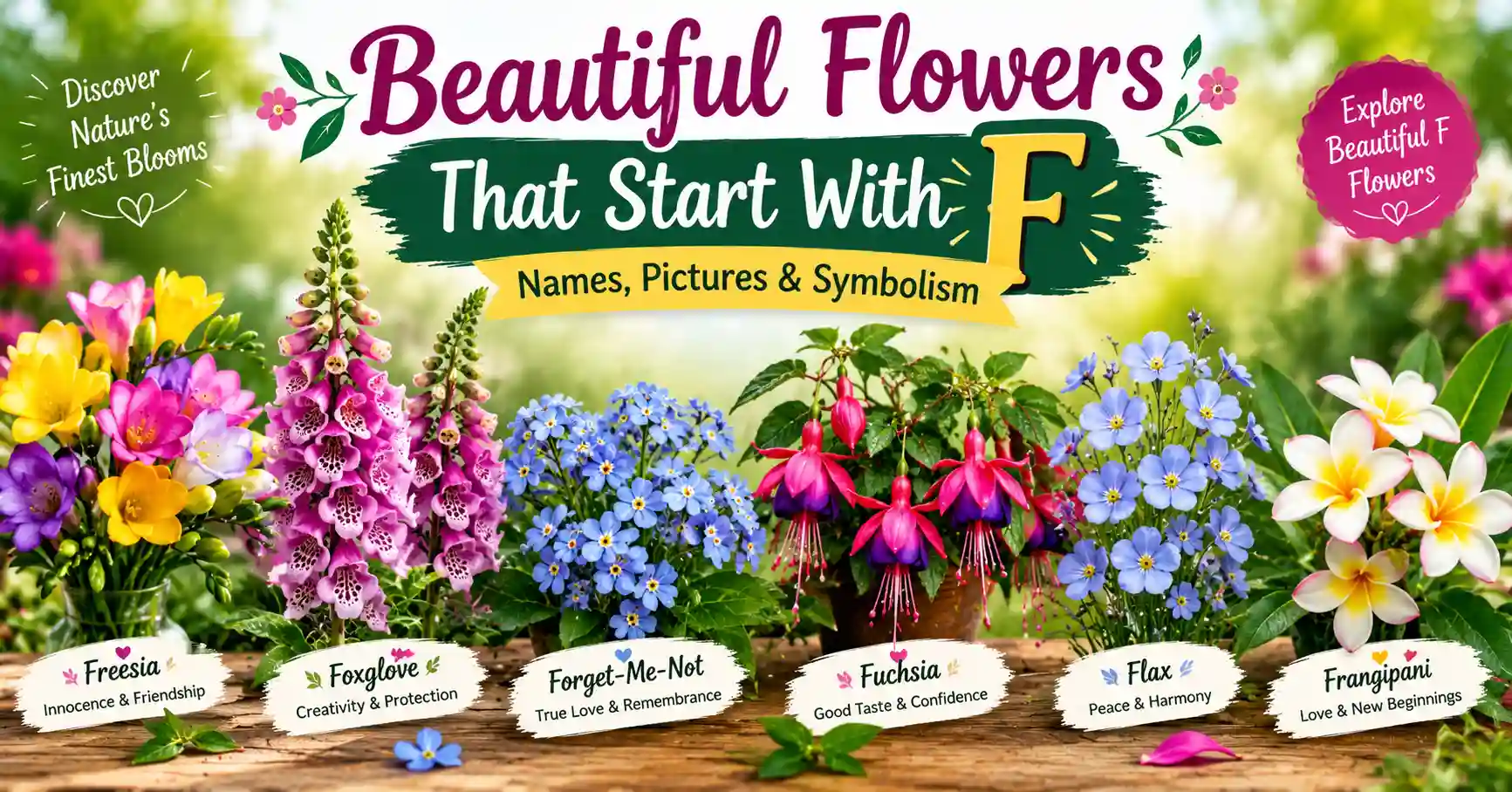
Flowers that start with F range from the humble forget-me-not to the glamorous frangipani. Foxglove, freesia, fuchsia, and forsythia are the names most gardeners reach for first. But the letter F also hides odd and lovely surprises, like flannel flower, firecracker flower, and franklinia. This guide gathers them in one place.
The list below covers more than 60 real plants. Each one has a verified botanical name. You will find garden staples, houseplants, florist picks, wildflowers, and a few rare species that most lists skip. Nothing here is filler.
A long list is only useful if it helps you choose. So this guide sorts flowers that start with F by color, life cycle, and use. A bloom’s beauty means little if it dies in your climate. It means even less if it is dangerous to a child or a pet. Every table is explained in plain words first, so you never hit a bare spreadsheet.
You can read straight through or jump ahead. Need a pet-safe border? Go to the toxicity section. Looking for a name or a meaning? Use the alphabetical list and the symbolism section. Want a fast answer? Try the decision table near the end.
Quick Answer: Ten Standout F Flowers
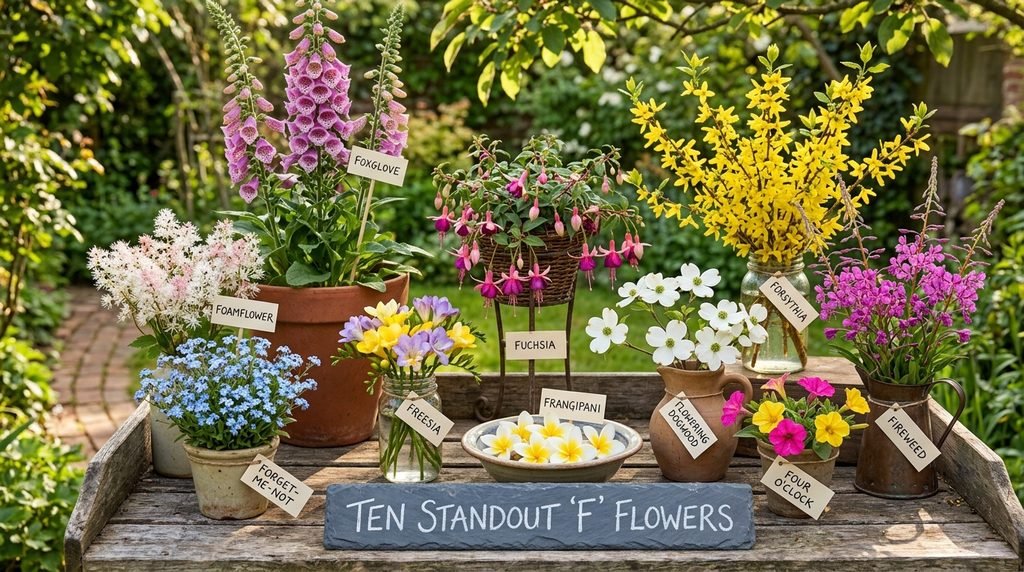
Foxglove is the cottage-garden showstopper, with tall spires that bees love, though every part is toxic. Forget-me-not and foamflower are the shade-garden stars, offering sky-blue and frothy white blooms where little else flowers. Freesia and frangipani are the fragrance leaders, one perfect for bouquets and the other for tropical warmth. Fuchsia dangles jewel-like blooms from baskets, and forsythia lights up late winter with sheets of yellow. Flowering dogwood turns a small tree into a spring cloud, while four o’clock opens each evening and perfumes the dusk. Fireweed rounds out the list as the wild, tough pollinator plant that thrives where little else will.
Master Alphabetical List of Flowers That Start With F
This list names 65 flowers. Most entries use a common name that gardeners already know. A few are better known by a botanical name, so those appear under the name nurseries print on plant tags. Each row has a short note, so you can see at a glance what the plant looks like and where it grows best.
| Flower | Botanical Name | Note |
| Fairy Duster | Calliandra eriophylla | Pink powder-puff blooms, desert shrub |
| Fairy Lily | Zephyranthes candida | White crocus-like blooms after rain |
| Fairy Primrose | Primula malacoides | Dainty pink or lilac tiers for cool rooms |
| False Indigo | Baptisia australis | Tall blue-purple spikes, long-lived native |
| False Rue Anemone | Enemion biternatum | Small white woodland bloom in spring |
| False Spirea | Astilbe × arendsii | Feathery plumes for shade |
| False Sunflower | Heliopsis helianthoides | Golden daisy blooms all summer |
| Fan Columbine | Aquilegia flabellata | Compact blue and white spurred blooms |
| Fan Flower | Scaevola aemula | Fan-shaped purple blooms for baskets |
| Farewell-to-Spring | Clarkia amoena | Silky pink cups in late spring |
| Feather Hyacinth | Muscari comosum ‘Plumosum’ | Wispy purple tassels, bulb |
| Fern Leaf Peony | Paeonia tenuifolia | Fine leaves with early red blooms |
| Feverfew | Tanacetum parthenium | Tiny white daisies, old herb-garden plant |
| Fiddleneck | Amsinckia menziesii | Curled yellow-orange spikes, wild annual |
| Fiesta Flower | Pholiota auritum | Violet bells on a sprawling wildflower |
| Fig Buttercup | Ficaria verna | Glossy yellow stars, very early spring |
| Firebush | Hamelia patens | Orange-red tubes, hummingbird shrub |
| Firecracker Flower | Dichelostemma ida-maia | Red tubes tipped in green and white |
| Firecracker Plant | Russelia equisetiformis | Arching red tubular sprays |
| Fire Pink | Silene virginica | Bright red woodland wildflower |
| Fireweed | Chamaenerion angustifolium | Tall pink-purple spikes, fast colonizer |
| Flag Iris | Iris pseudacorus | Yellow iris for pond edges and wet soil |
| Flame Azalea | Rhododendron calendulaceum | Orange-yellow blooms on a native shrub |
| Flame Flower | Tropaeolum speciosum | Scarlet blooms on a cool-climate vine |
| Flame Lily | Gloriosa superba | Red and yellow wavy climbing lily, toxic |
| Flame Vine | Pyrostegia venusta | Orange trumpets that cover fences |
| Flamingo Flower | Anthurium andraeanum | Glossy red or pink spathe, houseplant |
| Flannel Flower | Actinotus helianthi | Soft, felty white Australian bloom |
| Flax | Linum usitatissimum | Sky-blue blooms, crop and ornamental |
| Flax Lily | Dianella caerulea | Blue star blooms, then purple berries |
| Fleabane | Erigeron karvinskianus | Tiny pink-white daisies on walls |
| Fleeceflower | Persicaria amplexicaulis | Red bottlebrush spikes late in the season |
| Floating Heart | Nymphoides peltata | Yellow fringed blooms on pond water |
| Florentine Iris | Iris germanica ‘Florentina’ | Pale blue-white, fragrant, historic |
| Floss Flower | Ageratum houstonianum | Fluffy blue pom-poms for edging |
| Flower of an Hour | Hibiscus trionum | Creamy cups with dark centers, short-lived |
| Flowering Almond | Prunus triloba | Pink pom-pom blooms before the leaves |
| Flowering Crabapple | Malus spp. | Pink-white spring clouds, bird-friendly fruit |
| Flowering Currant | Ribes sanguineum | Pink tassels that draw early bees |
| Flowering Dogwood | Cornus florida | White or pink bracts on a small tree |
| Flowering Maple | Abutilon × hybridum | Bell-shaped blooms, indoor or outdoor |
| Flowering Quince | Chaenomeles speciosa | Bright coral-red blooms on thorny stems |
| Flowering Rush | Butomus umbellatus | Pink umbels for shallow water |
| Flowering Tobacco | Nicotiana alata | Evening-fragrant white or green blooms |
| Foamflower | Tiarella cordifolia | Frothy white spikes over woodland leaves |
| Forget-Me-Not | Myosotis sylvatica | Tiny sky-blue blooms for shade |
| Forsythia | Forsythia × intermedia | Yellow sheets in late winter |
| Fortnight Lily | Dietes iridioides | White iris-like blooms, tough evergreen |
| Fothergilla | Fothergilla major | White bottlebrush blooms, fiery fall color |
| Four O’Clock | Mirabilis jalapa | Trumpets that open in late afternoon |
| Foxglove | Digitalis purpurea | Tall bell-covered spires, highly toxic |
| Foxtail Lily | Eremurus stenophyllus | Tall golden spikes, dramatic in borders |
| Foxtail Orchid | Rhynchostylis gigantea | Dense, fragrant pink-spotted orchid sprays |
| Frangipani | Plumeria rubra | Waxy, perfumed tropical blooms |
| Franklinia | Franklinia alatamaha | White, camellia-like blooms, extinct in the wild |
| Freesia | Freesia refracta | Sweet, citrusy cut-flower bloom |
| French Lavender | Lavandula dentata | Purple spikes with toothed gray leaves |
| French Marigold | Tagetes patula | Compact orange and gold bedding bloom |
| Fringe Tree | Chionanthus virginicus | White ribbon-like blooms in late spring |
| Fringed Bleeding Heart | Dicentra eximia | Pink hearts on lacy leaves |
| Fritillary | Fritillaria meleagris | Checkered, nodding purple bells |
| Fuchsia | Fuchsia magellanica | Two-toned dangling blooms for baskets |
| Fuji Cherry | Prunus incisa | Small white-pink blooms, very early |
| Fumewort | Corydalis solida | Pink-purple spring bulb, quick to fade |
| Furze (Gorse) | Ulex europaeus | Coconut-scented yellow, spiny shrub |
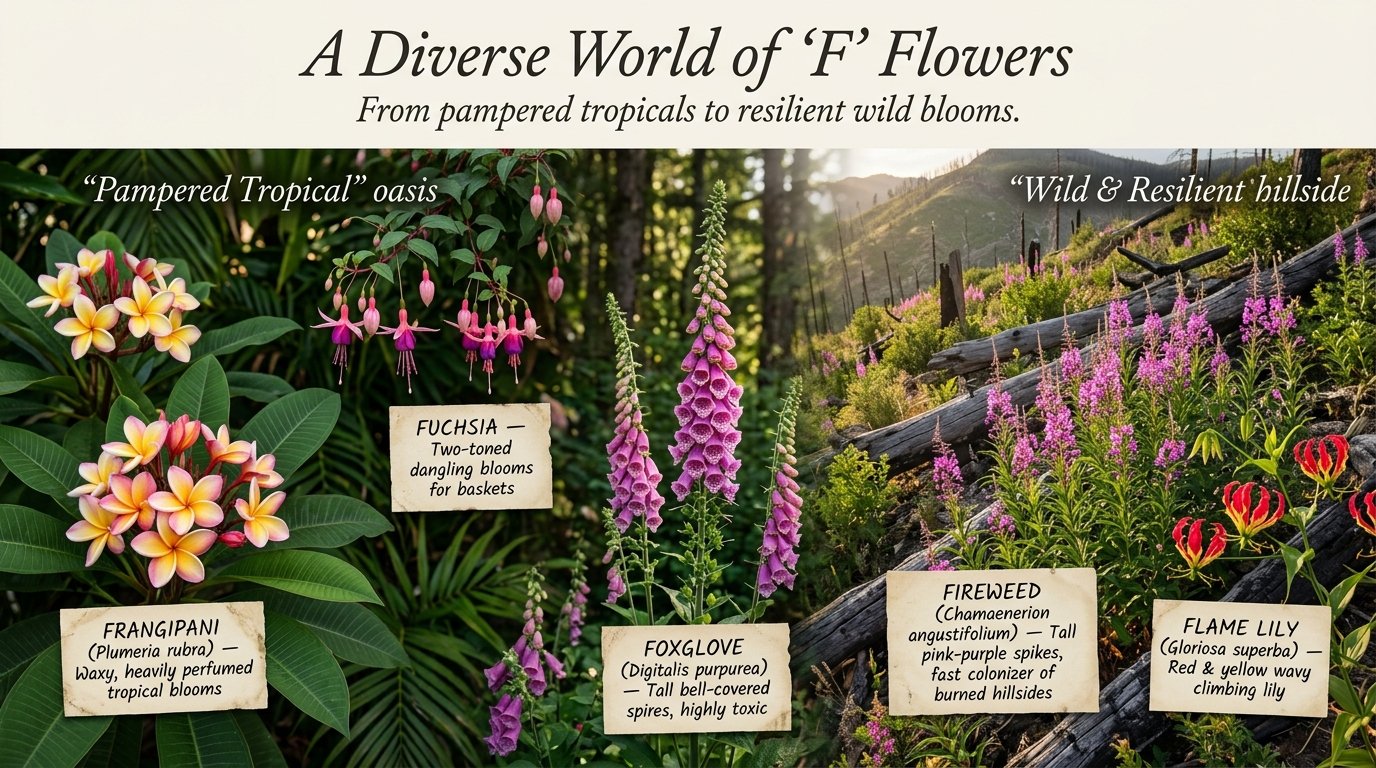
That table names 65 distinct flowers that start with F. Frangipani and fireweed sit at opposite ends of the list. One is a pampered tropical. The other grows on burned hillsides. Both show how wide this single letter reaches.
Full Comparison Table: Sun, Water, and Bloom Time
When two plants seem equally good, sun and water needs usually pick the winner. The table below compares the main F flowers from this guide. Read the sun column first. Then check the water column and the bloom season to see if the plant fits your space and calendar.
| Flower | Sun Needs | Water Needs | Bloom Season |
| Foxglove | Part shade | Moderate | Late spring to early summer |
| Forget-Me-Not | Part to full shade | Moderate | Spring |
| Freesia | Full sun | Moderate | Late winter to spring |
| Fuchsia | Part shade | Moderate to high | Summer to frost |
| Four O’Clock | Full sun | Low to moderate | Summer to frost |
| Flowering Tobacco | Full sun to part shade | Moderate | Summer to fall |
| Feverfew | Full sun | Low to moderate | Summer |
| Foamflower | Part to full shade | Moderate | Spring |
| Forsythia | Full sun | Low to moderate | Late winter to early spring |
| Flowering Dogwood | Part shade | Moderate | Mid-spring |
| Flowering Quince | Full sun | Low to moderate | Late winter to spring |
| Frangipani | Full sun | Low | Spring to fall in warm climates |
| Foxtail Lily | Full sun | Moderate | Early summer |
| Floss Flower | Full sun to part shade | Moderate | Late spring to frost |
| False Indigo | Full sun | Low once established | Late spring |
| Fringed Bleeding Heart | Part shade | Moderate | Spring to fall |
| Fireweed | Full sun | Low to moderate | Midsummer |
| Flamingo Flower | Bright indirect light | Moderate | Nearly year-round indoors |
Frangipani and false indigo suit hot, dry spots. Both prefer to dry out between drinks. Fuchsia and foamflower sit at the other end. They want cool roots, shade, and steady moisture.
Read More: Flowers That Start With E: 85 Beautiful Blooms With Names & Pictures
Garden Favorites Among F Flowers
A handful of F flowers earn a place in almost every garden. Foxglove brings height and drama to a shady border. Forsythia and flowering quince announce spring before almost anything else is awake. False indigo returns every year and needs almost no help. Four o’clock fills sunny beds with color that opens right on schedule each evening.
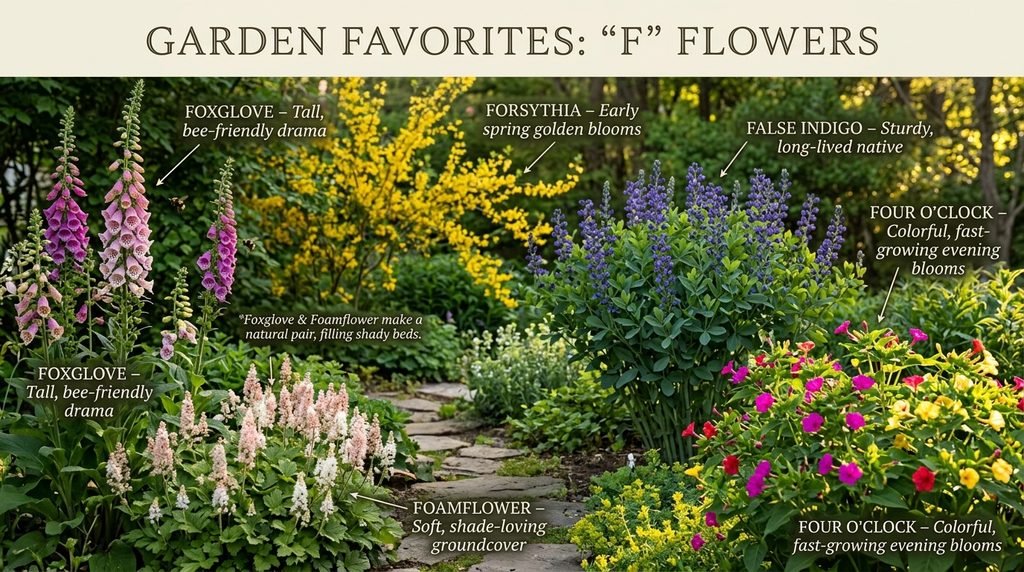
- Foxglove self-seeds gently and gives tall, bee-friendly spires.
- Forsythia blooms on bare stems in late winter and needs only an occasional prune.
- False Indigo is a long-lived native that forms a sturdy, shrubby clump.
- Four O’Clock grows fast from large seeds and blooms until frost.
- Foamflower spreads slowly and brightens deep shade.
Foxglove and foamflower make a natural pair. One gives height, the other gives a soft groundcover. Together they fill a shady bed from spring into summer.
Indoor Plants Among F Flowers
Only a few F flowers thrive indoors, but they are good ones. Flamingo flower blooms nearly year-round in bright, indirect light. Flowering maple, or abutilon, flowers in a sunny window. Fairy primrose brings cool-season color to bright, cooler rooms. Foxtail orchid is a rewarding choice for experienced growers with warm, humid space.
- Flamingo Flower wants warmth, humidity, and bright light without direct sun.
- Flowering Maple blooms best with plenty of light and regular feeding.
- Fairy Primrose prefers cool rooms and short-lived color.
- Fuchsia can bloom indoors in a bright, cool spot over winter.
Flamingo flower is the easiest of the group for beginners. Its glossy spathes last for weeks. Just keep it away from pets, since it contains irritating crystals.
Florist Favorites Among F Flowers
Florists rely on F flowers for fragrance and form. Freesia is a top choice for scent, with sweet, citrusy blooms along arching stems. Foxglove brings height to large arrangements. Flowering quince and forsythia branches are classic for spring displays. Foxtail lily adds drama to big, modern bouquets.
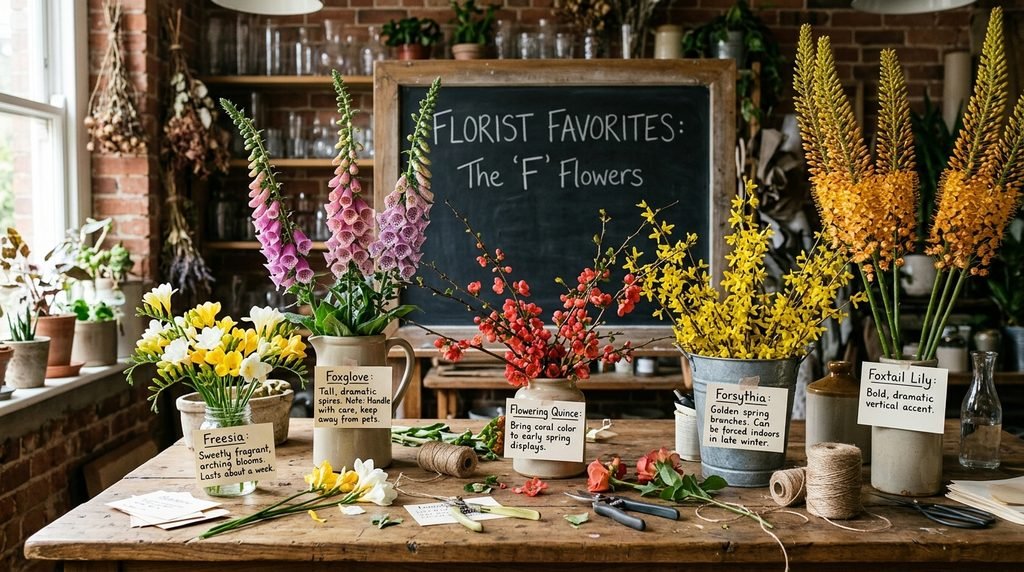
- Freesia is fragrant and lasts about a week in a vase.
- Foxglove adds tall spires, but handle it with care and keep it away from food and pets.
- Forsythia branches can be forced indoors in late winter.
- Flowering Quince brings coral color to early arrangements.
- Foxtail Lily gives a bold, vertical accent.
Freesia and forsythia are the quiet workhorses. They rarely steal the show. But many spring arrangements would feel flat without them.
Rare Flowers That Start With F
A few F plants are hard to find or hard to grow. Franklinia is the most famous. It was found in Georgia in the 1700s and has not been seen in the wild since the early 1800s, so every living tree descends from cultivated stock. Flannel flower is a soft, felted Australian wildflower that struggles outside its home climate. Fire pink is a bright red woodland native that needs shade and good drainage. Flame flower is a Chilean climber that sulks in hot summers and prefers cool, damp air.
These four plants share one trait. Each wants a very specific home. That is why they remain special.
Explore More Ideas: 65+ Beautiful Flowers That Start With G (With Pictures & Names)
Caution: Toxic Flowers That Start With F
Several F flowers can harm pets, livestock, or people. Foxglove and flame lily are the most dangerous. Foxglove affects the heart, and flame lily contains colchicine. Flowering tobacco contains nicotine-related alkaloids. Fig buttercup and flag iris irritate the mouth and skin, and flamingo flower contains oxalate crystals.
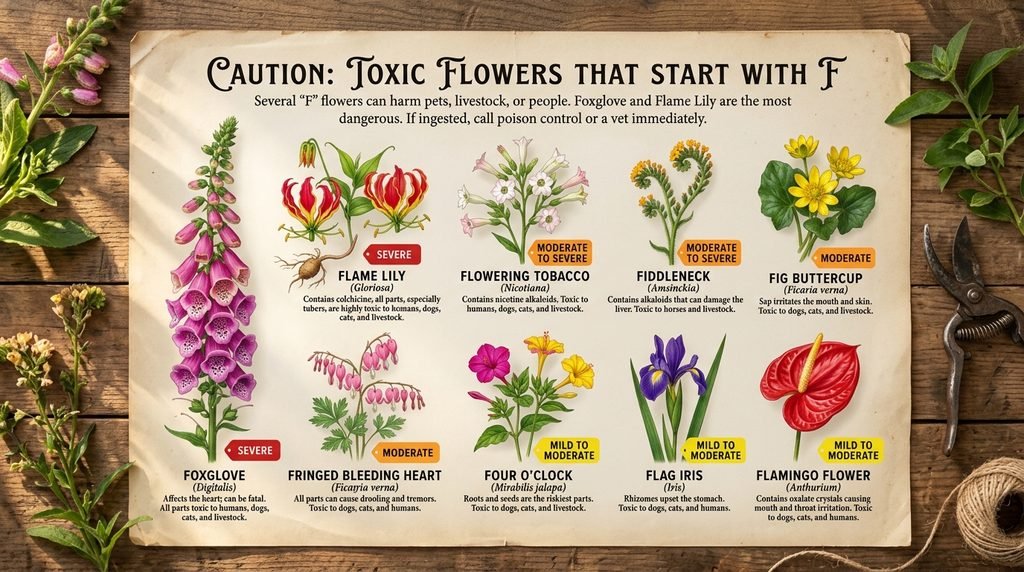
| Flower | Toxic To | Severity |
| Foxglove | Humans, dogs, cats, horses, livestock | Severe — all parts affect the heart, can be fatal |
| Flame Lily | Humans, dogs, cats, livestock | Severe — tubers and all parts, colchicine |
| Flowering Tobacco | Humans, dogs, cats, livestock | Moderate to severe — nicotine-type alkaloids |
| Fiddleneck | Horses, livestock | Moderate to severe — can damage the liver |
| Fringed Bleeding Heart | Dogs, cats, humans | Moderate — all parts can cause drooling and tremors |
| Fig Buttercup | Dogs, cats, livestock | Moderate — sap irritates mouth and skin |
| Four O’Clock | Dogs, cats, livestock | Mild to moderate — roots and seeds are the riskiest parts |
| Flag Iris | Dogs, cats, humans | Mild to moderate — rhizomes upset the stomach |
| Flamingo Flower | Dogs, cats, humans | Mild to moderate — oral and throat irritation |
Foxglove and flame lily deserve the loudest warning. Keep both away from children and pets. Four o’clock and flag iris are milder, but a chewing dog can still get sick. If a pet or child eats any plant on this list, call a vet or poison control right away.
F Flowers Grouped by Color
Pink and rose tones run through fuchsia, freesia, flowering quince, flowering almond, and fireweed. Flowering almond and flowering dogwood give the biggest show, since they bloom on whole shrubs and trees. Fuchsia suits baskets and shady patios. Fireweed suits wild, sunny meadows.
Yellow and orange bring warmth. Forsythia, false sunflower, French marigold, and fig buttercup glow in sun. Forsythia lights up the end of winter. French marigold fills summer beds and borders. False sunflower gives months of golden color with almost no care.
Blue and purple are the cool side of F. Forget-me-not, floss flower, false indigo, and flax add calm, true blues. Use them to soften hot-colored beds. Forget-me-not carpets shade. Floss flower edges sunny beds. False indigo anchors a border.
White and cream flowers include foamflower, fringe tree, flannel flower, and flowering dogwood. White brightens shade and glows at dusk. Foamflower and fringe tree are the best choices for woodland-style gardens.
Red-hot accents come from firecracker plant, firebush, fire pink, and flame vine. All four draw hummingbirds. Plant them where you can watch from a window.
Life-Cycle Groupings for F Flowers
A plant’s life cycle tells you how much work to expect. Annuals live one season, so you replant each year. Biennials flower in their second year. Perennials return on their own. Tender plants need warmth or winter protection. Zones below are approximate and vary by variety, so check your own tag.
| Flower | Life Cycle | Typical Zones |
| Flowering Tobacco | Annual | All zones (seasonal) |
| Floss Flower | Annual | All zones (seasonal) |
| French Marigold | Annual | All zones (seasonal) |
| Foxglove | Biennial | 4–9 |
| Forget-Me-Not | Biennial or short-lived perennial | 3–9 |
| Feverfew | Short-lived perennial | 5–9 |
| Foamflower | Perennial | 3–9 |
| False Indigo | Perennial | 3–9 |
| Fringed Bleeding Heart | Perennial | 3–9 |
| Foxtail Lily | Perennial | 5–8 |
| Fireweed | Perennial | 2–7 |
| Fuchsia (hardy types) | Perennial (shrub) | 6–9 |
| Four O’Clock | Tender perennial | 7–10 (annual in colder zones) |
| Freesia | Tender perennial (corm) | 9–10 |
| Forsythia | Perennial (shrub) | 5–8 |
| Flowering Quince | Perennial (shrub) | 4–9 |
| Flowering Dogwood | Perennial (small tree) | 5–9 |
| Frangipani | Tender perennial (tree) | 10–12 |
| Flamingo Flower | Tender perennial (houseplant) | 11–12 (indoors elsewhere) |
Foxglove and forget-me-not are the two to watch. Many people treat them as permanent perennials. In truth, they flower in year two and then depend on self-seeding. Let a few seed heads ripen, and the patch will keep going.
Botanical Name Crosswalk
Common names change from place to place. Botanical names do not. Nursery tags and seed packets use Latin for this reason. It also helps you search online with confidence. Two different plants can share one common name, so the Latin name protects you from a wrong purchase.
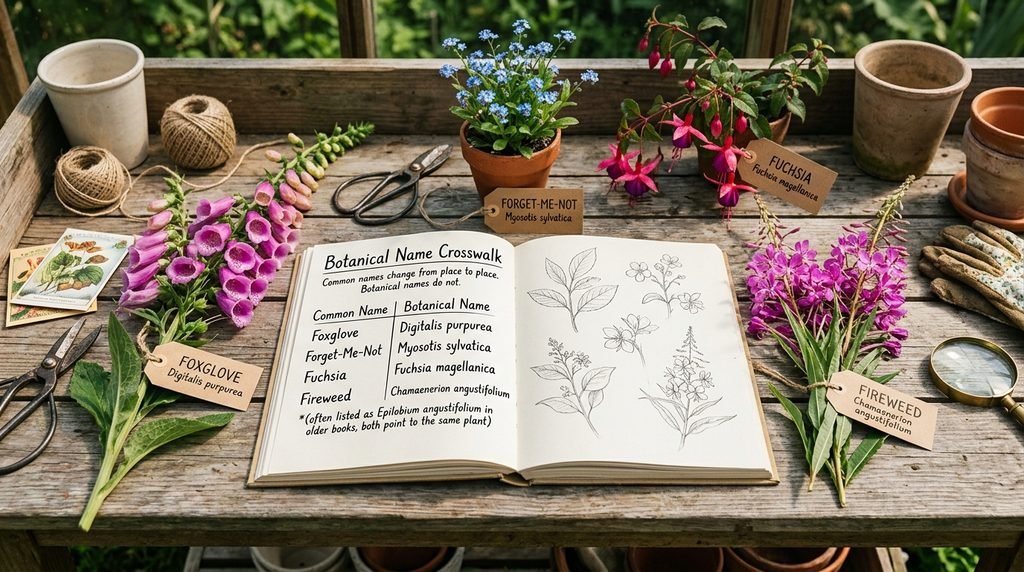
| Common Name | Botanical Name |
| Foxglove | Digitalis purpurea |
| Forget-Me-Not | Myosotis sylvatica |
| Freesia | Freesia refracta |
| Fuchsia | Fuchsia magellanica |
| Forsythia | Forsythia × intermedia |
| Four O’Clock | Mirabilis jalapa |
| Frangipani | Plumeria rubra |
| Foamflower | Tiarella cordifolia |
| Flowering Dogwood | Cornus florida |
| Flowering Quince | Chaenomeles speciosa |
| Flowering Tobacco | Nicotiana alata |
| Foxtail Lily | Eremurus stenophyllus |
| Fireweed | Chamaenerion angustifolium |
| Flame Lily | Gloriosa superba |
| Feverfew | Tanacetum parthenium |
Fireweed shows why this matters. Older books list it as Epilobium angustifolium. Newer references use Chamaenerion angustifolium. Both names point to the same plant, so check both when you shop.
Read Growing Tips: 80+ Beautiful Flowers That Start With H (With Pictures & Names)
What F Flowers Mean
Flower meanings vary by culture, but a good number of F flowers carry steady symbolism. Forget-me-not is the classic flower of remembrance. A German legend tells of a knight who tossed the bloom to his love as he fell into a river, calling out for her not to forget him. It still appears on memorial gardens and sympathy cards. Freesia stands for trust, friendship, and thoughtfulness, which is why it is often given as a gentle thank-you.
Foxglove has a darker, more mysterious reputation. Folklore tied the bells to fairies, and in Victorian flower language the plant meant insincerity. Fuchsia, with its hanging, two-toned blooms, spoke of humble love and good taste. Forsythia stands for anticipation, since it is one of the first blooms to announce spring.
Frangipani carries deep meaning across the tropics. In Hawaii, it is strung into leis. In parts of Asia, it is planted at temples and linked to devotion and new beginnings. Flowering dogwood stands for durability and rebirth, and it is the state flower of Virginia and North Carolina. Fireweed is a symbol of resilience. It is among the first plants to return after a fire, and it is the territorial flower of the Yukon.
Flame lily is the national flower of Zimbabwe and stands for glory and pride. Four o’clock, also called the marvel of Peru, has been tied to timidity, since it hides its blooms until late in the day. The flamingo flower stands for hospitality. Match the flower to your message, and know that the same bloom can carry a different meaning in another culture.
Decision Table: Which F Flower Fits Your Situation
You do not have to read the whole list to choose well. Start with your goal in the left column. The right column names the best F flower for it. Then check the toxicity section if you have pets or children.
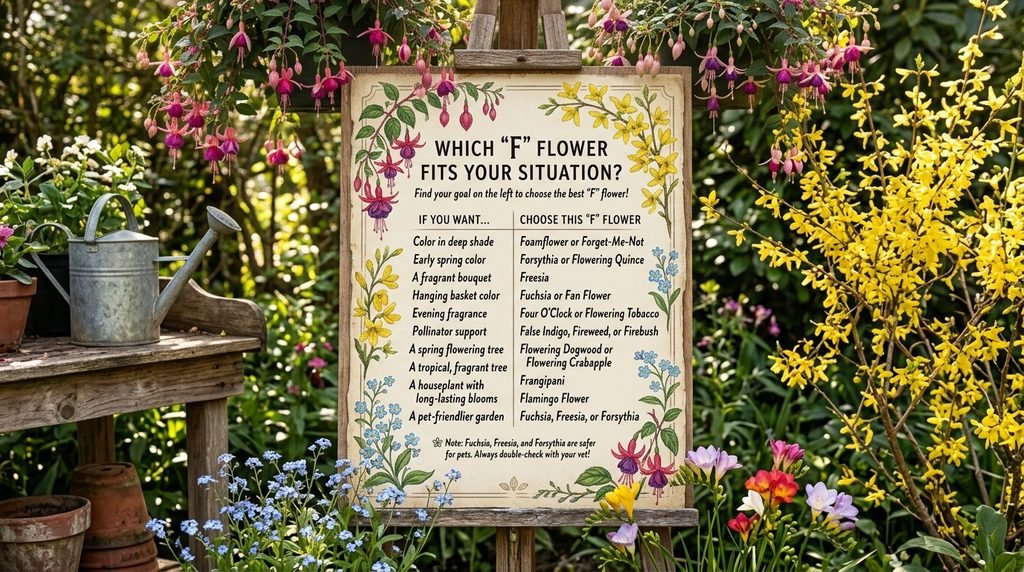
| If You Want… | Choose This F Flower |
| Color in deep shade | Foamflower or Forget-Me-Not |
| Early spring color | Forsythia or Flowering Quince |
| A fragrant bouquet flower | Freesia |
| Hanging basket color | Fuchsia or Fan Flower |
| Evening fragrance | Four O’Clock or Flowering Tobacco |
| Pollinator support | False Indigo, Fireweed, or Firebush |
| A spring flowering tree | Flowering Dogwood or Flowering Crabapple |
| A tropical, fragrant tree | Frangipani |
| A houseplant with long-lasting blooms | Flamingo Flower |
| A pet-friendlier garden | Fuchsia, Freesia, or Forsythia |
Fuchsia appears twice because it is showy, easy in shade, and generally listed as non-toxic to pets. Freesia is a good partner for it. Always double-check any plant with your vet if a pet is likely to chew it.
Conclusion
Flowers that start with F offer a very wide choice, from the quiet forget-me-not to the bold foxtail lily. This guide sorted more than 60 of them by color, life cycle, and use, so you can pick with confidence. Whether you want a shady border, a fragrant bouquet, or an early spring shrub, there is an F flower that fits. Use the tables above, read the toxicity notes, and start planting.
Frequently Asked Questions
How many flowers start with F?
More than 60 well-known flowers start with F. This guide lists 65, from common garden plants to rare wildflowers.
What is the most popular flower that starts with F?
Foxglove, forget-me-not, freesia, and fuchsia are among the most popular. Forsythia and flowering dogwood are the best-known spring shrubs and trees.
Which flowers that start with F grow best in shade?
Foamflower, forget-me-not, fuchsia, foxglove, and fringed bleeding heart all do well in shade. Fairy primrose suits cool, bright rooms indoors.
Which F flowers attract butterflies and hummingbirds?
Firebush, firecracker plant, fuchsia, and fireweed are top picks. False indigo and flowering currant also draw pollinators.
Is foxglove poisonous?
Yes. Every part of foxglove affects the heart and can be fatal if eaten. Wear gloves when handling it and keep it away from children and pets.
Which F flower is the most dangerous?
Foxglove and flame lily are the most dangerous. Both can cause severe poisoning in people, pets, and livestock.
Are fuchsias safe for pets?
Fuchsia is generally listed as non-toxic to dogs and cats. It is still wise to confirm with your vet if a pet tends to chew plants.
What does forget-me-not symbolize? Forget-me-not stands for remembrance and lasting love. It is common in memorial gardens and on sympathy cards.
Which F flowers bloom in late winter?
Forsythia, flowering quince, fig buttercup, and Fuji cherry bloom in late winter or very early spring.
Do foxgloves come back every year?
Foxglove is usually a biennial. It flowers in its second year, then returns by self-seeding if you let some seed heads ripen.
What is the best F flower for fragrance?
Freesia and frangipani are top picks for scent. Four o’clock and flowering tobacco are fragrant in the evening.

4 thoughts on “Beautiful Flowers That Start With F: Names, Pictures & Symbolism”